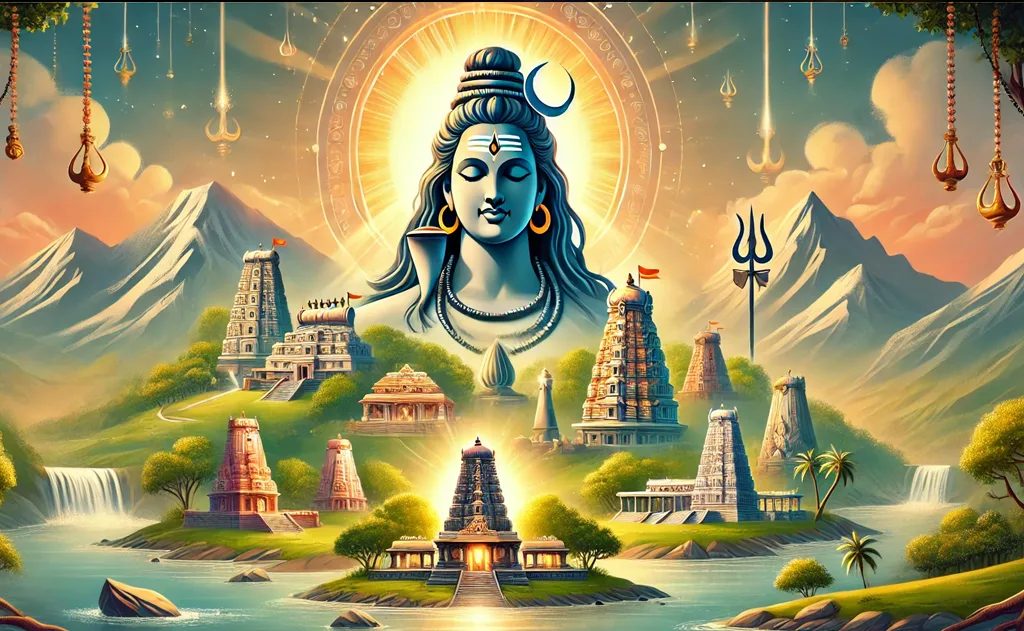
Amarnath: Divine Mysteries & Soul-Stirring Miracles of the Ice Linga Cave in Kashmir
Where Lord Shiva narrated the secret of immortality to Parvati — discover the Amarnath cave at 12,756 feet, home of the self-forming ice linga that waxes and wanes with the moon. Cosmic origin, the brutal yatra path, the Sangam confluence, miracles, and why pilgrims risk everything to reach it.

Where Lord Shiva narrated the secret of immortality to Parvati — discover the Amarnath cave at 12,756 feet, home of the self-forming ice linga that waxes and wanes with the moon. Cosmic origin, the brutal yatra path, the Sangam confluence, miracles, and why pilgrims risk everything to reach it.
Twelve thousand seven hundred and fifty-six feet above sea level, in a cave hidden in the Lidder valley of Kashmir, a Shiva linga forms itself every year out of dripping water that freezes into ice. The linga waxes through the months of Shravan (July–August), reaches its peak height of 18 feet around the full moon, and then slowly melts away. No human hand sculpts it. No priest installs it. The cave does its work in the dark, and one of the most extraordinary pilgrimages in the Hindu world walks itself up the mountain to witness it.
This HinduTone guide opens the Amarnath cave: the Treta Yuga story of Shiva narrating the Amar Katha to Parvati, the geographic mystery of the self-forming ice linga, the punishing yatra path that takes pilgrims through the upper Himalayas, the daily rituals during the yatra months, the miracles documented across centuries, and why thousands risk altitude sickness, weather, and danger every monsoon to stand for a moment before a piece of ice.
The Cosmic Story: When Shiva Whispered the Secret of Immortality
The Bhrigu Samhita and the local Kashmiri pandit chronicles preserve the story. Goddess Parvati, ever Shiva's companion, repeatedly asked her husband about the secret of immortality — how is it that Shiva never dies, why does he wear a garland of skulls, what is the source of his deathlessness? Shiva refused for centuries; the knowledge, he said, was not meant for the mortal world.
Finally, after Parvati's persistent devotion, Shiva agreed to teach her the Amar Katha — the Story of Immortality. But the knowledge was so secret that no living being could overhear it. Shiva traveled deep into the Himalayas, leaving behind every part of himself that could be witnessed: at Pahalgam he left Nandi the bull; at Chandanwari he left the moon from his hair; at Sheshnag lake he left the snake from his neck; at Mahagunas Top he abandoned the five elements; at Panjtarni he left the five Pandavas of his consciousness; and at the Amarnath cave he sat with Parvati alone.
To make absolutely certain no other ear caught the secret, Shiva spread a deer skin and lit a fire of all the sins and karmas of the world to clear the cave. He began the Amar Katha. Parvati, exhausted from the climb, fell asleep. But two doves nesting in the cave roof remained awake and heard every word. They were transformed into Amar Pakshi — the immortal doves — and devotees still report sighting them on the cave's upper ridge to this day. The cave itself, sanctified by the Amar Katha, became the eternal seat of Shiva's deathlessness.
The Living Cave: A Linga That Forms Itself
The Amarnath cave is a natural limestone formation at 12,756 feet, accessible only during the brief window when the Himalayan passes are clear of snow — typically July to August. The cave is roughly 130 feet wide and 60 feet deep. The miracle is the Shiva linga at the centre.
- The linga is composed entirely of ice, formed each year by water dripping from a fissure in the cave roof. The drops freeze on contact with the cold floor, building up the linga centimetre by centimetre.
- The linga peaks in size around Shravan Purnima (the full moon of the lunar month of Shravan) — typically 12 to 18 feet tall — and then begins to melt as the warmer months arrive.
- No other naturally-occurring ice linga of comparable size has been documented anywhere else in the world. The geology is replicated nowhere.
- Beside the main Shiva linga are two smaller ice formations identified as Parvati and Ganesha — also self-forming, also waxing and waning with the seasons.
- The water source above the cave is fed by Himalayan snow-melt at a temperature consistent enough to produce slow accretion, not just a frozen puddle. The result is a vertical sculpture that mimics the human-carved linga forms in every other Shiva temple.
The Yatra: One of the Hardest Pilgrimages in the World
The Amarnath Yatra is not a casual visit. It is one of the most physically demanding pilgrimages in Hinduism. The Indian government and the Shri Amarnathji Shrine Board open the route for roughly 45 days every monsoon, and over half a million pilgrims attempt the journey each year. Hundreds die — from altitude sickness, hypothermia, exhaustion, or accident.
There are two main routes:
- Pahalgam Route (traditional): 48 km, takes 4-5 days. Passes Chandanwari, Pissu Top (climb of 11,000 feet in one day), Sheshnag lake, Mahagunas Top (14,000 feet), Panjtarni, then final ascent to the cave. The route Shiva himself walked.
- Baltal Route (shorter, harder): 14 km but with a brutal vertical gain. Takes 1-2 days but the altitude shock is severe. Helicopter service available from Baltal for those who cannot walk.
- Medical certificate is mandatory; the Shrine Board screens pilgrims for cardiac, respiratory, and altitude-tolerance fitness.
- Military protection along the entire route — Amarnath has been targeted by terror groups in the past; security is now extensive.
- Langar stalls run by sevaks line both routes; free food is available at every kilometre during the yatra.
Daily Rituals During the Yatra
The cave shrine has no permanent priest. During the yatra window, priests from the Shrine Board perform daily aartis at the cave; outside the yatra months, the cave is empty, the linga melts away, and the mountain reclaims its silence.
- Mangal Aarti (4:30 am): the first aarti at dawn, when the linga is most visible in the cold light. Pilgrims who reach the cave at this hour describe a presence that altitude cannot account for.
- Madhyana Aarti (12:00 noon): the noon aarti, with full abhishekam of the linga with water from the cave's own dripping spring.
- Sandhya Aarti (7:00 pm): the evening aarti as light fades. By this hour most pilgrims have descended; the cave belongs to the priests and the linga.
- Shravan Purnima Aarti: the all-night vigil on Guru Purnima (the full moon of Shravan). The linga is at its peak height. Tens of thousands of pilgrims pack the cave through the night.
- Raksha Bandhan / Chhari Mubarak: the Shri Chhari Mubarak — the sacred mace of Shiva — is carried from Srinagar by the Mahant in procession, reaching the cave on Raksha Bandhan day. This is the official closing ceremony of the yatra.
Soul-Stirring Miracles: Ice, Doves, and the Sangam Light
The Self-Forming Linga: The annual reformation of the linga is the central miracle. Despite efforts by ISRO and various geological surveys to model the phenomenon, the precise mechanism by which the water consistently produces a structure of the same shape, in the same place, year after year, has not been fully explained. The melt-and-reform cycle has been documented continuously for at least 5,000 years.
The Amar Pakshi Doves: Throughout the yatra, pilgrims who reach the cave's outer ridge consistently report sighting two white doves resting near the entrance. The Shrine Board's register has recorded such sightings every year for over a century. Biologists explain that these are rock doves; devotees say they are the original immortal doves who overheard the Amar Katha and were granted endless life.
The Sangam Confluence: At Panjtarni, just below the cave, five rivers meet — Pancha-tarni, the five streams. The confluence is mathematically improbable: five glacial streams from five different valleys converging within a small geographic area. The pilgrim bathes here before the final climb; ritual immersion at the confluence is considered the spiritual equivalent of all five rivers in one act.
Survival Miracles: Every year, pilgrims at the limits of their physical capacity report being assisted — sometimes literally — to complete the climb. Local villagers and Shrine Board sevaks have documented hundreds of cases where exhausted pilgrims were helped by strangers who then disappeared, by unseen guides who appeared during whiteout conditions, by sudden physical strength that came from nowhere. The Lord, the local saying goes, brings his devotees to him.
The Path of Devotion: How to Approach the Cave
Amarnath is not a temple to visit casually. It must be earned. The pilgrim should begin physical preparation months in advance — daily cardio, altitude conditioning if possible, weight-bearing hikes. Spiritual preparation matters too: many pilgrims observe a clean diet, meditation routine, and Shiva mantra recitation for 41 days before departure.
- Register through the official Shri Amarnathji Shrine Board (SASB) website — registration is mandatory and limited.
- Get the medical certificate from an approved doctor — without it you will be turned away at Baltal or Pahalgam.
- Carry warm clothing, rain protection, water, energy snacks. Temperature drops sharply above 12,000 feet even in July.
- Walk slowly. Altitude sickness kills more pilgrims than anything else.
- Stop at Sheshnag lake to honour the snake. Bathe at Panjtarni to honour the five elements. The route is the prayer.
- Reach the cave at dawn if possible — Mangal Aarti has the deepest darshan.
- Do not push past your limits. The Lord recognises the attempt as much as the arrival.
Why Amarnath is the Pinnacle of Shiva Devotion
There are simpler ways to see Shiva. There are temples accessible by road, deities in marble and gold, gurus to interpret the path. Amarnath is something else. It is the temple that demands the pilgrim climb a mountain to a cave to stand for a moment before a piece of ice — and that piece of ice, year after year, is recognised by millions as one of the most powerful Shiva darshans in existence.
The lessons of Amarnath are uncomfortable ones. That the divine is not always made comfortable for human access. That the journey itself is the worship. That immortality is a secret, but the path to it is open to anyone willing to climb. That a linga of ice, melting away each year and reforming the next, is a more honest sculpture of impermanence and renewal than any stone.
Bam Bam Bhole. Har Har Mahadev.
Frequently asked questions
When is the Amarnath ice linga at its tallest?
The linga peaks around Shravan Purnima, the full moon of the lunar month of Shravan, at roughly 12 to 18 feet. After that it begins to melt as the warmer months arrive.
How high is the Amarnath cave and when can pilgrims reach it?
The cave stands at 12,756 feet in the Lidder valley of Kashmir. It is accessible only when the Himalayan passes are clear of snow, typically July to August, and the route opens for roughly 45 days.
What are the two routes to the Amarnath cave?
The traditional Pahalgam route is 48 km and takes 4-5 days. The Baltal route is shorter at 14 km and takes 1-2 days, but the climb is steeper; helicopter service is available from Baltal.
What do pilgrims need before starting the Amarnath Yatra?
Registration through the Shri Amarnathji Shrine Board website and a medical certificate are mandatory. Pilgrims should also carry warm clothing, rain protection, water and snacks, and walk slowly to avoid altitude sickness.
What are the daily aarti timings at the Amarnath cave?
During the yatra, Mangal Aarti is at 4:30 am, Madhyana Aarti at 12:00 noon and Sandhya Aarti at 7:00 pm. Reaching the cave at dawn for Mangal Aarti is said to give the deepest darshan.
Why is the Amarnath cave sacred to Shiva devotees?
As commonly told, Shiva narrated the Amar Katha, the story of immortality, to Parvati here. Two doves overheard it and became the immortal Amar Pakshi, and the cave became the seat of Shiva's deathlessness.
You might also like

Somnath: Divine Mysteries & Soul-Stirring Miracles of the First Jyotirlinga

Mahakaleshwar: Divine Mysteries & Soul-Stirring Miracles of the Lord of Time at Ujjain
Lingaraja: Divine Mysteries & Soul-Stirring Miracles of the Eleventh-Century Shiva-Vishnu Temple at Bhubaneswar