Sree Padmanabhaswamy Temple Mysteries: Divine Legend, Hidden Treasure & Anantha Shayana Story
The Divine Legend of Sree Padmanabhaswamy Temple: Eternal Treasure, Anantha Shayana Idol Story & World's Richest Hindu Shrine Mysteries Revealed The viral…
The Divine Legend of Sree Padmanabhaswamy Temple: Eternal Treasure, Anantha Shayana Idol Story & World's Richest Hindu Shrine Mysteries Revealed The viral…
The Divine Legend of Sree Padmanabhaswamy Temple: Eternal Treasure, Anantha Shayana Idol Story & World's Richest Hindu Shrine Mysteries Revealed
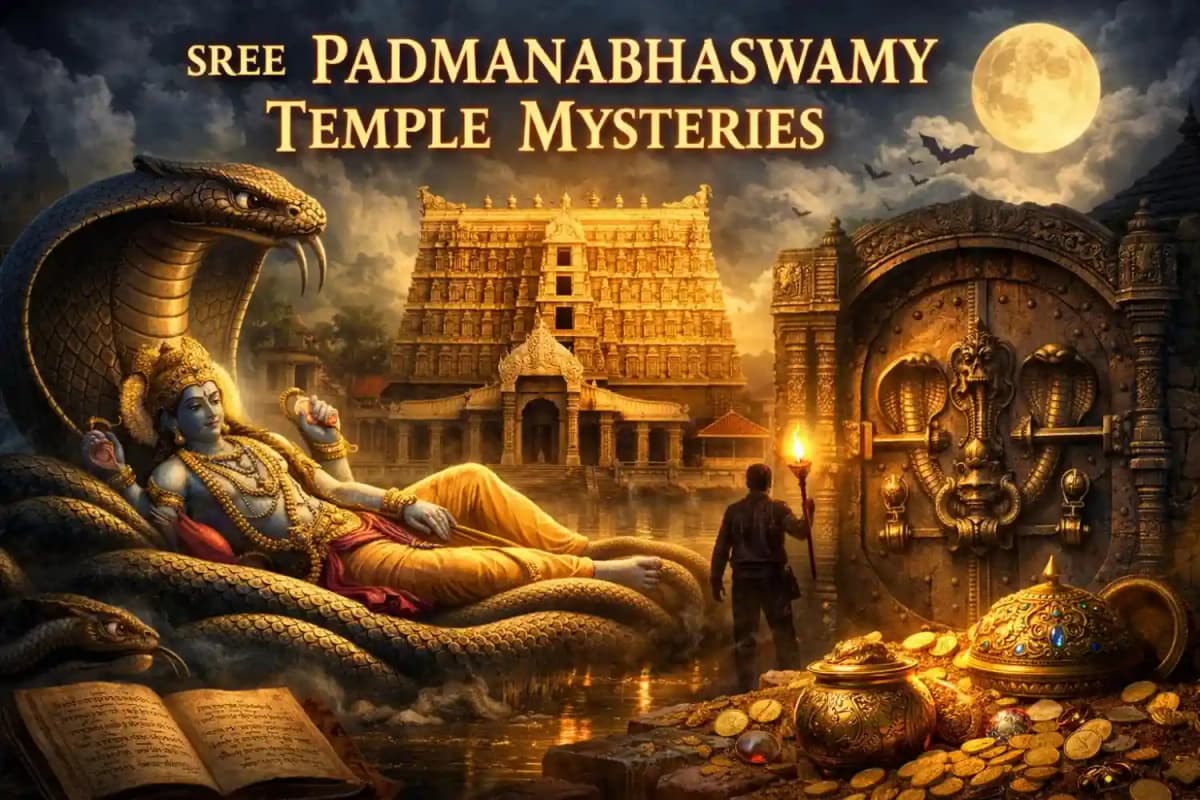
The viral claims about a 3000-year-old **Anantha Padmanabhaswamy statue** made of 7800 kg of pure gold, 780,000 diamonds, and 780 carats of diamonds refer to a modern replica or artistic creation, not the ancient deity idol. Fact-checks confirm this is a 2023 masterpiece crafted by Hyderabad-based Shiv Narayan Jewellers, weighing about 2.8 kg of gold and adorned with around 75,000 diamonds (totaling roughly 500 carats). It was inspired by the iconic deity at **Sree Padmanabhaswamy Temple** in Thiruvananthapuram, Kerala, but is not the temple's ancient idol. The temple's principal deity is a sacred wooden image of Lord Vishnu in Anantha Shayana (reclining on the serpent Anantha), covered in sacred soot and precious offerings over centuries—not a massive solid-gold statue.
The **Sree Padmanabhaswamy Temple** is one of Hinduism's holiest sites—one of the 108 Divya Desams—and renowned as the world's richest temple due to its vast treasures accumulated over millennia.
Devotional Story and Sacred Legend of Sree Padmanabhaswamy
The temple's origins blend profound mythology, divine visions, and ancient history. According to legends from texts like the Brahmanda Purana, Padma Purana, and local traditions:
A Nambudiri Brahmin sage named Vilwamangalam Swamiyar (or Divakara Muni in some accounts) was deeply devoted to Lord Vishnu. One day, while meditating, a playful child appeared and disturbed his worship by playfully swallowing a sacred shaligram stone. Angered, the sage scolded the child, who then vanished, revealing himself as Lord Vishnu. The divine voice instructed the sage to seek Him at Ananthankadu (a dense forest, now the temple site).
Journeying there, the sage beheld a colossal vision of Lord Vishnu reclining eternally on the cosmic serpent Adi Shesha (Anantha), with the five hoods forming a canopy. From the Lord's navel emerged a lotus bearing Brahma, the creator. Lakshmi (Sridevi) and Bhudevi attended Him, and His right hand rested gently over a Shiva Lingam, symbolizing harmony between Vaishnavism and Shaivism.
Overwhelmed by the grandeur, the sage prayed for the Lord to condense into a form visible to devotees. Lord Vishnu obliged, shrinking to the magnificent Anantha Shayana posture seen today—18 feet long, reclining on Shesha, with Brahma on the lotus, sages like Bhrigu and Markandeya, and consorts nearby. The sage offered a mango in a coconut shell as naivedyam, a tradition that continues.
Another legend speaks of a woman finding an abandoned crying infant in the forest, who grew miraculously and revealed His divine form. These stories emphasize the Lord's eternal rest (Yoga Nidra) and protective grace.
The temple finds mentions in Sangam literature (as the "Golden Temple" due to its ancient wealth), Silappatikaram (circa 100-300 AD), and works of Alvars (Vaishnava saints). Balarama (Krishna's brother) is said to have visited and bathed in the Padmatheertham tank.
Historically, the temple dates back at least to the 8th-9th century CE (with some scholars suggesting origins over 5,000 years ago in Kali Yuga). It was renovated by Travancore kings, notably Anizham Thirunal Marthanda Varma in 1731, who dedicated his kingdom to the Lord (Thripadidanam), ruling as His servant. The Travancore royal family remains trustees.
The temple's vaults (opened partially in 2011 by Supreme Court order) revealed unimaginable treasures—gold idols (including small ones of 32 kg), crowns, coins from ancient empires (Roman, Greek, Chera, Pandya), gem-studded ornaments, diamond necklaces, and artifacts worth billions (estimates around $22 billion or more for opened vaults). Vault B remains sealed due to tradition, mantras, and reverence—believed guarded by divine serpents and curses.
Devotees experience profound peace and blessings here, viewing the Lord through three doors: face and Lingam (first), lotus and consorts (second), feet (third). It is a site of eternal devotion, where material wealth serves divine purpose.
For More Devotional Journey, Follow
- Temples
/temples/ - Tirumala Updates
/tirumala/ - Sabarimala Yatra
/category/sabarimala-yatra/ - Pooja, Slokas & Mantras
/pooja-slokas-and-mantras/ - Hindu Gods
/hindu-gods/
How to Reach — Travel Guide — Sree Padmanabhaswamy Temple, Thiruvananthapuram
✈️ By Flight
Trivandrum International Airport (TRV, ~6 km from the temple) — one of India's closest airports to a major temple, ~20 minutes by taxi. Direct flights from Delhi, Mumbai, Bengaluru, Chennai, Hyderabad, Kolkata and many Gulf/SE Asia destinations.
🚂 By Train
Thiruvananthapuram Central (TVC, ~1 km) and Trivandrum Pettah (Pet, ~2 km) — both serve the temple. Excellent connectivity: Kerala Express (Delhi), Trivandrum Rajdhani, Netravati Express (Mumbai), Mangala Express, multiple south-Indian state expresses.
🚌 By Bus
Thampanoor KSRTC Bus Stand is just 1 km from the temple — major terminus with services from Bengaluru (16 hrs Volvo), Chennai, Coimbatore, Mangalore, Kanyakumari (1.5 hrs), and across Kerala (Kochi 220 km, Kollam 70 km).
🚗 By Road / Car
On NH-66 (coastal) and NH-744. From Kanyakumari (90 km), Kollam (70 km), Kochi (220 km), Madurai (240 km), Bengaluru (700 km). The temple is in East Fort, central Trivandrum; park outside East Fort and walk in.
Best Places to Visit Near Sree Padmanabhaswamy Temple, Thiruvananthapuram
Combine your darshan at Sree Padmanabhaswamy Temple, Thiruvananthapuram with these well-known nearby attractions for a complete pilgrimage and travel experience:
Napier Museum & Sri Chitra Art Gallery (2 km) — Indo-Saracenic 19th-century museum with bronzes and Raja Ravi Varma originals.
AdvertisementKuthiramalika Palace Museum (200 m, adjacent to temple) — wooden palace of Travancore royals; 122 carved horse brackets.
Kovalam Beach (16 km) — the iconic crescent-shaped Lighthouse Beach; sunset point.
Veli Tourist Village (10 km) — backwaters meet the sea; pedal boats, sculpture park, kids' play area.
Shankhumukham Beach (5 km) — long sandy beach near the airport; sunset and the Jalakanyaka mermaid statue.
Kanakakunnu Palace & Museum Compound (2 km) — royal palace turned cultural centre; weekend music events.
Padmanabhapuram Palace (55 km, Tamil Nadu side) — original Travancore royal palace, finest wooden architecture in South India.
All distances are approximate; please verify on Google Maps and check current road, weather and local conditions before travelling. For latest darshan timings and special pilgrim arrangements, refer to the temple's official authority website.
Frequently Asked Questions
Where is Sree Padmanabhaswamy Temple Mysteries located?
The Divine Legend of Sree Padmanabhaswamy Temple: Eternal Treasure, Anantha Shayana Idol Story & World's Richest Hindu Shrine Mysteries Revealed The viral claims about a 3000-year-old **Anantha Padmanabhaswamy statue** made of 7800 kg of pure gold, 780,000 diamonds, and 780 carats of diamonds refer to a modern replica or artistic creation, not the ancient de
Who is the presiding deity of Sree Padmanabhaswamy Temple Mysteries?
The temple's presiding deity and its significance are described in the guide above.
What are the timings and how do I reach Sree Padmanabhaswamy Temple Mysteries?
Temples typically open early morning and evening; confirm current darshan timings before visiting. The nearest airport, railway station and road routes are covered in the guide above.
What is the best time to visit Sree Padmanabhaswamy Temple Mysteries?
Major festival days and the cooler months are popular, though weekday mornings offer a calmer darshan. Plan around the temple's key festivals for the most vibrant experience.
You might also like
Janmashtami 2026 in India: Date, Rituals & Top Temples to Visit
Sree Padmanabhaswamy: Divine Mysteries & Soul-Stirring Miracles of Lord Ananta Padmanabha
Prambanan: Divine Mysteries & Soul-Stirring Miracles of the Trimurti in Indonesia