Dhanurmasam 2026 in Australia: Margazhi Start and End Times City by City, First Dawn Thursday 17 December and a Summer Tiruppavai Routine
Dhanurmasam and Tamil Margazhi 2026 in Australia: the Sun enters Dhanu on the afternoon of Wednesday 16 December (local times for Sydney, Melbourne, Brisbane, Perth, Adelaide and Canberra), so the first dawn is Thursday 17 December and the last is Thursday 14 January 2027. Makar Sankranti arrives in the early hours of Friday 15 January in the eastern states.
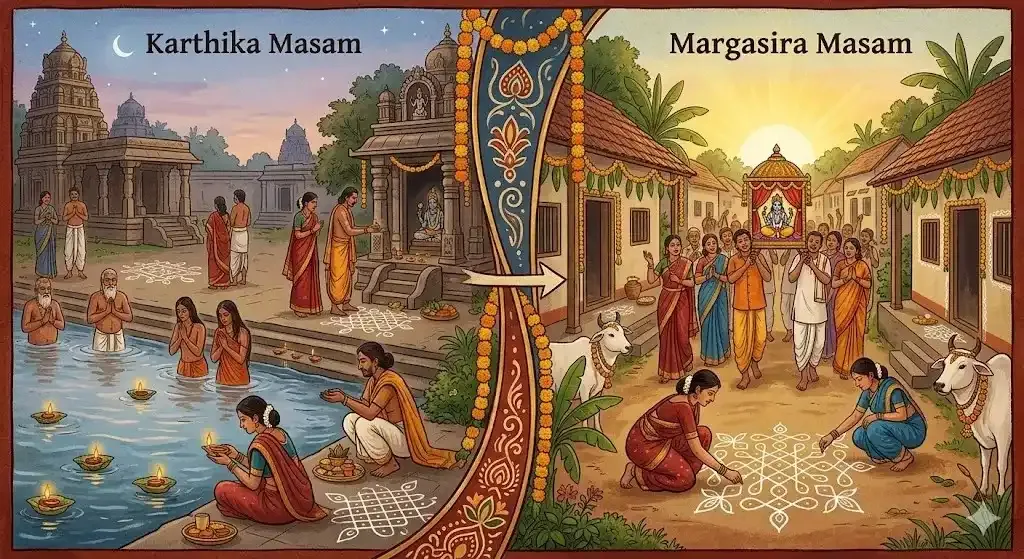
Dhanurmasam and Tamil Margazhi 2026 in Australia: the Sun enters Dhanu on the afternoon of Wednesday 16 December (local times for Sydney, Melbourne, Brisbane, Perth, Adelaide and Canberra), so the first dawn is Thursday 17 December and the last is Thursday 14 January 2027. Makar Sankranti arrives in the early hours of Friday 15 January in the eastern states.
Quick answer: Dhanurmasam 2026 in Australia (Tamil Margazhi) begins when the Sun enters Dhanu on the afternoon of Wednesday 16 December 2026: 3:41 PM in Sydney, Melbourne and Canberra, 3:11 PM in Adelaide, 2:41 PM in Brisbane and 12:41 PM in Perth. The first Dhanurmasam dawn is Thursday 17 December and the last is Thursday 14 January 2027. The month closes with Makar Sankranti in the early hours of Friday 15 January in the eastern states.
Inside the month, Vaikuntha Ekadashi and Gita Jayanti fall on Sunday 20 December and Margashirsha Purnima (Datta Jayanti) on Wednesday 23 December, the same dates as in India. Summer actually makes the dawn worship of this month easier in Australia than anywhere in the northern hemisphere.
About these dates: the Australian dates and times are computed with HinduTone's sunrise-tithi calculator (Drik Panchang method, validated against Drik Panchang to within 1–2 minutes). Please confirm on Drik Panchang for your city and follow your temple's calendar.
Dhanurmasam 2026 Australia: start and end by city
All times are local clock time in each city, including daylight saving where it applies.
| City | Dhanu Sankranti (month begins) | First Dhanurmasam dawn | Last Dhanurmasam dawn | Makar Sankranti (month ends) |
|---|---|---|---|---|
| Sydney | Wed 16 Dec 2026, 3:41 PM | Thu 17 Dec 2026 | Thu 14 Jan 2027 | Fri 15 Jan 2027, 2:26 AM |
| Melbourne | Wed 16 Dec 2026, 3:41 PM | Thu 17 Dec 2026 | Thu 14 Jan 2027 | Fri 15 Jan 2027, 2:26 AM |
| Brisbane | Wed 16 Dec 2026, 2:41 PM | Thu 17 Dec 2026 | Thu 14 Jan 2027 | Fri 15 Jan 2027, 1:26 AM |
| Perth | Wed 16 Dec 2026, 12:41 PM | Thu 17 Dec 2026 | Thu 14 Jan 2027 | Thu 14 Jan 2027, 11:26 PM |
| Adelaide | Wed 16 Dec 2026, 3:11 PM | Thu 17 Dec 2026 | Thu 14 Jan 2027 | Fri 15 Jan 2027, 1:56 AM |
| Canberra | Wed 16 Dec 2026, 3:41 PM | Thu 17 Dec 2026 | Thu 14 Jan 2027 | Fri 15 Jan 2027, 2:26 AM |
Hobart and Darwin are not in our table. Hobart shares Sydney's time zone; Darwin has its own half-hour offset and no daylight saving. Please check Drik Panchang for those cities.
What the times mean, in plain words
One moment, different clocks. The Sun's entry into Dhanu is one astronomical moment for the whole world. Sydney, Melbourne and Canberra read it as 3:41 PM because they are on daylight saving time. Brisbane reads 2:41 PM because Queensland does not use daylight saving. Adelaide's half-hour time zone gives 3:11 PM, and Perth, on Western Australian time, reads 12:41 PM.
Why the first dawn is Thursday 17 December. Dhanurmasam worship happens at dawn. On Wednesday 16 December the sun has already risen everywhere in Australia long before the Sankranti moment in the afternoon, so Wednesday's dawn still belongs to the previous month. The first sunrise after the Sun has entered Dhanu is Thursday 17 December, in every city.
Why the end falls in the early hours of Friday 15 January. The Sun enters Makara at 2:26 AM on Friday 15 January in Sydney, Melbourne and Canberra, 1:26 AM in Brisbane and 1:56 AM in Adelaide: in the middle of the night, before Friday's sunrise. Perth's clocks are behind, so there the same moment is 11:26 PM on Thursday 14 January. Either way, the last dawn of Dhanurmasam is Thursday 14 January 2027 in all six cities.
Day one is counted differently. Regional calendars do not all agree on whether the Sankranti day itself is day one of the month. Tamil calendars, for example, have their own rule for when Margazhi 1 falls. If your temple begins the dawn Tiruppavai on a different morning, follow your temple. Our table gives the first and last dawns after and before the Sun's actual entry and exit.
How this compares with India. In India the Sun enters Dhanu on the morning of Wednesday 16 December and Makara on the evening of Thursday 14 January, with Makar Sankranti and Thai Pongal usually observed on Friday 15 January. Australian Pongal dates can differ by city, especially in Perth, so check your temple's calendar for Pongal.
Festivals inside Dhanurmasam 2026 in Australia
| Festival | Sydney, Melbourne, Brisbane, Adelaide, Canberra | Perth |
|---|---|---|
| Dhanu Sankranti (month begins) | Wed 16 Dec 2026 (afternoon) | Wed 16 Dec 2026 (12:41 PM) |
| First Tiruppavai dawn | Thu 17 Dec 2026 | Thu 17 Dec 2026 |
| Vaikuntha (Mukkoti) Ekadashi and Gita Jayanti | Sun 20 Dec 2026 | Sun 20 Dec 2026 |
| Margashirsha Purnima / Datta Jayanti | Wed 23 Dec 2026 | Wed 23 Dec 2026 |
| Saphala Ekadashi | Sun 3 Jan 2027 | Sun 3 Jan 2027 |
| Last Dhanurmasam dawn | Thu 14 Jan 2027 | Thu 14 Jan 2027 |
- Vaikuntha Ekadashi (Sun 20 Dec): the high point of the month for Vishnu devotees, when the northern gate of Vishnu temples is opened. Smarta and Vaishnava families keep the same Sunday in all six cities. See Vaikuntha Ekadashi 2026 in Australia and Gita Jayanti 2026 in Australia.
- Dhanurmasa Pournami (Wed 23 Dec): the full moon inside Dhanurmasam is Margashirsha Purnima, also Datta Jayanti and Annapurna Jayanti. See Dhanurmasa Pournami and Datta Jayanti 2026 in Australia.
- Arudra Darshan (Thiruvathirai): Shiva's cosmic dance is celebrated on the Thiruvathirai (Ardra) star in Margazhi. Its local date depends on the nakshatra at your location, and we have not calculated it for Australian cities, so please follow your temple's calendar. See Dhanurmasa Arudra for the background.
- Saphala Ekadashi (Sun 3 Jan 2027): the last Ekadashi of the month, on the first Sunday of the new year.
Why Dhanurmasam is special
Dhanurmasam, called Margazhi in Tamil and Dhanurmasa in Telugu and Kannada, is the solar month when the Sun travels through Dhanu. It is counted as the dawn of the gods' day, so the hour before sunrise (Brahma muhurta) in this month is held to be especially sacred for Vishnu worship.
At the heart of the month is the Tiruppavai of Andal, the woman poet-saint of Srivilliputhur. As commonly told, she kept the Margazhi vow (paavai nonbu) as a young girl, singing one verse each dawn to wake her friends and go together to worship Krishna. Her 30 pasurams are sung one a day across the month in homes and temples, and the month traditionally ends with the celebration of her marriage to Ranganatha. For the full month in India, see Dhanurmasam 2026 dates and Tiruppavai schedule and Margazhi 2026: Tamil month festivals.
A dawn routine for the Australian summer
In much of the world Dhanurmasam means getting up in the dark and cold. In Australia it means warm, light mornings. Sunrise in mid-December is around 5 to 6 AM in most cities, and earlier in Brisbane, so the dawn puja can be done before school-holiday plans or work.
- Rise before sunrise: bathe, put on fresh clothes and light the lamp indoors. Even 15 minutes before leaving for work keeps the month's practice.
- One pasuram a day: sing or recite one Tiruppavai pasuram each morning, starting with "Margazhi thingal" on your first dawn. Our Tiruppavai 30 pasurams guide gives each verse with its meaning.
- Kolam or rangoli: a small kolam at the front door is the classic Margazhi sign. On a balcony or tiled entry, chalk or rice flour works well; rice flour also feeds ants and birds, which is the tradition's intent.
- Vishnu puja: offer tulasi, flowers and a lamp to Vishnu, Krishna or Venkateswara, and recite a few names or the Vishnu Sahasranama if time allows.
- Pongal naivedyam: ven pongal or sakkarai pongal is the traditional dawn offering. In the heat, make it fresh and share it soon after the puja rather than leaving it out.
- Involve children: the long summer holidays are the ideal time for children to learn a pasuram a week. See Dhanurmasam daily rituals for families.
Bushfire season, holidays and travel
- Lamp and camphor safety: December and January are bushfire season across much of Australia. Keep diyas indoors on a metal plate, away from curtains, and never leave them unattended. On Total Fire Ban days, do not light lamps, camphor or havan fires outdoors, including in backyards, parks and camping grounds.
- Heat: temple visits for Vaikuntha Ekadashi may involve waiting outside. Carry water, wear a hat and sunscreen, and bring elders early.
- Christmas and New Year away: if you are at the beach or camping, a small portable altar, an LED lamp and the Tiruppavai on your phone keep the daily practice going.
- Temples: many Australian Vishnu, Venkateswara and Murugan temples observe the month. Check your temple's website for its own Dhanurmasam arrangements; we do not list programmes or times.
For every December date in one place, see December 2026 Hindu festivals in Australia, and for the lunar month that overlaps Dhanurmasam, Margashirsha Masam 2026 in Australia.
Frequently asked questions
When does Dhanurmasam 2026 start in Sydney?
The Sun enters Dhanu (Sagittarius) at 3:41 PM on Wednesday 16 December 2026, Sydney time. Because that is in the afternoon, the first Dhanurmasam dawn in Sydney is Thursday 17 December. Some calendars count the Sankranti day itself as day one, so follow your temple's calendar.
When does Margazhi 2026 start in Melbourne, Brisbane and Perth?
Dhanu Sankranti is Wednesday 16 December 2026 at 3:41 PM in Melbourne, 2:41 PM in Brisbane and 12:41 PM in Perth, local time. In all three cities the first Margazhi dawn is Thursday 17 December.
When does Dhanurmasam 2026 end in Australia?
The last Dhanurmasam dawn is Thursday 14 January 2027 in every Australian city we checked. The Sun then enters Makara at 2:26 AM on Friday 15 January in Sydney, Melbourne and Canberra, 1:26 AM in Brisbane and 1:56 AM in Adelaide, and at 11:26 PM on Thursday 14 January in Perth.
When is Vaikuntha Ekadashi 2026 in Australia?
Sunday 20 December 2026 in Sydney, Melbourne, Brisbane, Perth, Adelaide and Canberra, the same day as Gita Jayanti. It is the most important day of Dhanurmasam for Vishnu devotees.
Why is Brisbane's Sankranti time an hour earlier than Sydney's?
Queensland does not use daylight saving, so in December Brisbane's clocks are an hour behind Sydney's. The Sankranti is a single moment for the whole world; only the local clock reading changes.
Can I do the Dhanurmasam dawn puja in the Australian summer?
Yes, and summer helps: sunrise is early and the first hour is usually the coolest of the day. Keep lamps indoors and never light anything outdoors on a Total Fire Ban day.
Editor's note
Editor's note (6 October 2026): This guide has been restored at its original address after the earlier version was lost. The Australian dates and Sankranti times are computed with HinduTone's sunrise-tithi calculator (Drik Panchang method, validated to 1–2 minutes). Please confirm on Drik Panchang for your city and follow your temple's calendar, especially for day one of Margazhi, Arudra Darshan and Pongal. We do not list temple events, programmes or darshan times.
Related guides
You might also like
Margazhi and Dhanurmasam 2026 in Singapore: Start Time, First and Last Dawn, Thiruppavai and Kolam
Dhanurmasam 2026 in Europe: Dates, Dhanu Sankranti Time and Tiruppavai Routine City by City
Hindu Festivals November–December 2026 in Brazil: Diwali, Chhath, Ekadashis, Gita Jayanti and Dhanurmasam by City