Ayodhya Deepotsav and Diwali 2026 in Uttar Pradesh: Rama's Return, the Saryu Ghats, Varanasi and Braj
How Uttar Pradesh celebrates Diwali 2026: Ayodhya's Deepotsav lamp festival on the Saryu ghats, the story of Rama's return as traditionally told, Diwali in Varanasi and Mathura-Vrindavan, Govardhan Puja in Braj, and calculated Lakshmi Puja muhurat for Lucknow and Varanasi.
How Uttar Pradesh celebrates Diwali 2026: Ayodhya's Deepotsav lamp festival on the Saryu ghats, the story of Rama's return as traditionally told, Diwali in Varanasi and Mathura-Vrindavan, Govardhan Puja in Braj, and calculated Lakshmi Puja muhurat for Lucknow and Varanasi.
Quick answer: Diwali 2026 in Uttar Pradesh falls on Sunday 8 November (Drik Panchang). In Ayodhya, the state-organised Deepotsav lights the ghats of the Saryu with lamps around Diwali to remember Rama's return home; its 2026 date and programme are announced by the UP government. Across the state, families perform Lakshmi-Ganesh puja on Amavasya evening. Calculated Lakshmi Puja muhurat: Lucknow 5:43 PM to 7:40 PM and Varanasi 5:38 PM to 7:35 PM.
Diwali 2026 dates in Uttar Pradesh
| Day | Date (India) | What happens in UP homes |
|---|---|---|
| Dhanteras | Fri 6 Nov | Buying metal utensils, coins or a new broom; a lamp for Yama at the door |
| Naraka Chaturdashi (Choti Diwali) | Sun 8 Nov (morning) | Early bath; in many homes a small lamp for Yama |
| Diwali / Lakshmi Puja | Sun 8 Nov (evening) | Lakshmi-Ganesh puja, diyas, sweets |
| Govardhan Puja / Annakut | Tue 10 Nov | Govardhan worship, Annakut offerings, especially in Braj |
| Bhai Dooj | Wed 11 Nov | Sisters apply tilak to brothers; Chitragupta Puja in Kayastha families |
Source: Drik Panchang (India). In 2026, Naraka Chaturdashi and Lakshmi Puja fall on the same Sunday, so the morning bath and the evening puja are on one day. Monday 9 November is the second day of Amavasya, which is why Govardhan Puja moves to Tuesday.
Ayodhya Deepotsav: lamps on the Saryu
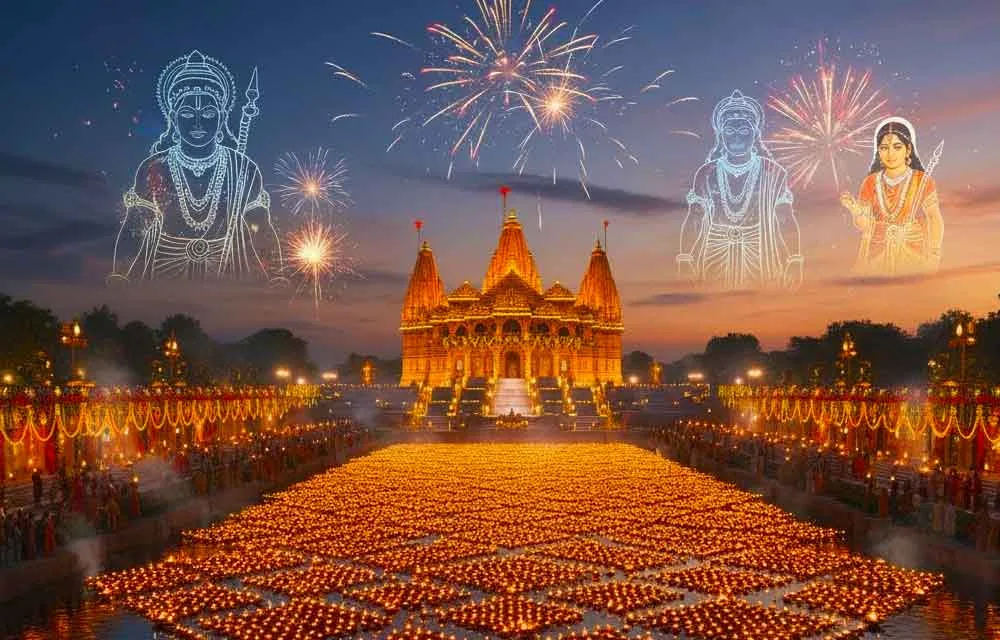
Deepotsav is a lamp festival organised by the Uttar Pradesh government in Ayodhya around Diwali, held every year since 2017. Its centre is the riverfront along the Saryu, especially the series of ghats known as Ram ki Paidi, where volunteers arrange and light very large numbers of clay lamps at dusk. The evening has typically included an aarti on the river, cultural programmes, and tableaux or performances based on the Ramayana, with the arrival of Rama, Sita and Lakshmana re-enacted for the crowd.
We do not repeat lamp-count or record figures here: those change every year and are announced officially. The 2026 date, schedule and visitor arrangements are published by the UP government and the Ayodhya district administration, usually a few weeks before Diwali. If you plan to travel, check those announcements, expect heavy crowds and traffic controls around the riverfront, and book stays early.
- Arrive early for the evening and follow police directions; some areas near the ghats may be restricted for lighting work.
- Many visitors combine Deepotsav with darshan at the Ram temple and at long-established shrines such as Hanuman Garhi; check each temple's official website for current timings.
- Carry little, keep children close, and keep phones charged; networks are often congested on big festival evenings.
Rama's return to Ayodhya, as traditionally told
In the Ramayana tradition, Rama completed fourteen years of exile, defeated Ravana in Lanka and returned to Ayodhya with Sita, Lakshmana and Hanuman. The people of Ayodhya, overjoyed, lit rows of lamps along streets and rooftops to welcome their king. This homecoming is the main story behind North Indian Diwali, and Ayodhya, as Rama's own city, holds a special place in the festival.
The same night is also Kartik Amavasya, when Lakshmi is worshipped for prosperity, and many families tell both stories together. For Lakshmi's own legends, see the story of Goddess Lakshmi's birth during Diwali.
Diwali in a typical UP home
Customs differ between Awadh, Purvanchal, Rohilkhand, Bundelkhand and the western districts, but several are widely shared:
- Cleaning and whitewashing the house in the weeks before, and drawing rangoli or chowk at the entrance.
- Buying a new Lakshmi-Ganesh murti (often clay) for the year's puja, along with kheel-batashe (puffed rice and sugar drops), a staple offering in North Indian Lakshmi puja.
- Lighting clay diyas with mustard oil or ghee along the doorway, windows, terraces and near the water source after the puja.
- Gujiya, laddoos and mathri made at home or bought from local sweet shops, and exchanged with neighbours.
- In many homes, a lamp is kept burning through the night, and some families play a few rounds of cards or dice, a custom often linked with the day after Diwali.
For step-by-step worship, see Lakshmi-Ganesh puja vidhi and samagri 2026 and recipes in North Indian Diwali sweets: gujiya, mathri and coconut ladoo.
Lakshmi Puja muhurat 2026 for Uttar Pradesh cities
| City | Lakshmi Puja, Sun 8 Nov 2026 (IST) | Dhanteras puja, Fri 6 Nov 2026 (IST) | Source |
|---|---|---|---|
| Lucknow | 5:43 PM to 7:40 PM | 5:51 PM to 7:47 PM | Calculated (HinduTone, Drik method) |
| Varanasi | 5:38 PM to 7:35 PM | 5:45 PM to 7:43 PM | Calculated (HinduTone, Drik method) |
These windows follow the Drik method (Pradosh Kaal with a fixed Vrishabha lagna). They are calculated, not copied from a printed panchang; confirm with your family pandit or on Drik Panchang for your exact town. For other cities, see Lakshmi Puja muhurat 2026 India city-wise and Diwali 2026 date and Lakshmi Puja muhurat.
Varanasi: Diwali, Annakut and Dev Deepawali
Kashi celebrates Diwali with lamps on homes, temples and ghats, and the Annakut tradition on the day after Diwali, when temples offer large arrangements of cooked food to the deity. Temples associated with Annapurna, the goddess of food, are especially linked with this custom in Kashi. For darshan at Kashi Vishwanath, check the temple's official website for current timings.
The city's most famous lamp festival comes a fortnight later: Dev Deepawali on Kartik Purnima, Tuesday 24 November 2026 (Drik Panchang), when the ghats along the Ganga are lined with lamps, traditionally described as the gods themselves celebrating. Read Varanasi Diwali 2026: Dev Deepawali on 24 November.
Mathura and Vrindavan: Govardhan and Annakut
In Braj, the land of Krishna, the day after Diwali is often as important as Diwali itself. Govardhan Puja recalls Krishna lifting Govardhan hill to shelter the people of Braj from Indra's storms, as told in the Bhagavata Purana. Families make a small Govardhan of cow dung or clay in the courtyard and worship it, and temples prepare Annakut, a 'mountain of food' with many dishes offered to Krishna. Many devotees walk the parikrama around Govardhan hill during this season. In 2026, Govardhan Puja falls on Tuesday 10 November in India. See Govardhan Puja and Annakut 2026.
Bhai Dooj and Chitragupta Puja
On Wednesday 11 November, sisters perform tilak and aarti for their brothers and pray for their long life, remembering Yamuna welcoming her brother Yama. Many Kayastha families in Uttar Pradesh also observe Chitragupta Puja on this day, worshipping pen, ink and account books in honour of Chitragupta, the keeper of records. See Bhai Dooj 2026: date, story and tika vidhi.
Air quality and fireworks
Diwali falls in early winter, when air quality in many UP cities is already poor. Fireworks rules, permitted hours and types of crackers are set by courts, the state and district administrations, and can change at short notice. Follow the current local orders, keep pets and elderly relatives in mind, and consider a lamp-focused celebration; ideas in eco-friendly, cracker-free Diwali 2026.
For UP families abroad
- Use your own city's muhurat; never convert Lucknow or Varanasi times to your local time.
- Dates can shift abroad: in the USA, Canada and the UK, Govardhan Puja is Monday 9 November and Bhai Dooj Tuesday 10 November (Drik Panchang). See Diwali 2026 in the USA city by city.
- Many temples abroad hold a Ramayana-themed evening or Annakut darshan on the nearest weekend; check their own announcements.
Frequently asked questions
When is Diwali 2026 in Uttar Pradesh?
Diwali (Lakshmi Puja) is on Sunday 8 November 2026 in India, per Drik Panchang. Dhanteras is Friday 6 November, Govardhan Puja is Tuesday 10 November and Bhai Dooj is Wednesday 11 November.
When is Ayodhya Deepotsav 2026?
Deepotsav is organised by the Uttar Pradesh government around Diwali, usually on or just before the main Diwali evening. The 2026 date and programme are announced by the state government and the Ayodhya district administration, so check their official announcements closer to the festival.
What is the Lakshmi Puja muhurat in Lucknow and Varanasi?
The HinduTone calculator (Drik method) gives 5:43 PM to 7:40 PM for Lucknow and 5:38 PM to 7:35 PM for Varanasi on Sunday 8 November 2026. These are calculated times; confirm them with your family pandit or on Drik Panchang.
Why is Diwali linked with Ayodhya?
As traditionally told in the Ramayana tradition, Rama returned to Ayodhya with Sita and Lakshmana after defeating Ravana, and the people lit rows of lamps to welcome him. North Indian Diwali remembers this homecoming, alongside the worship of Lakshmi on Kartik Amavasya.
Is Dev Deepawali in Varanasi the same as Diwali?
No. Dev Deepawali is celebrated on Kartik Purnima, about fifteen days after Diwali. In 2026 it falls on Tuesday 24 November (Drik Panchang), when the ghats of Varanasi are lit with lamps.
Can I burst crackers in Ayodhya or Lucknow?
Rules on fireworks change from year to year and city to city, especially around air quality. Follow the current orders of the district administration and police, and prefer lamps and quieter celebrations.
Editor's note (9 October 2026)
Festival dates follow Drik Panchang for India. Muhurat times for Lucknow and Varanasi are calculated with the HinduTone calculator (Drik method) and should be confirmed locally. We have deliberately not given a Deepotsav date, schedule or lamp count for 2026, because these are set and announced by the Uttar Pradesh government each year. Stories are given as traditionally told, and household customs vary by region and family.
Related guides
You might also like
Diwali 2026 in Punjab: Hindu Diwali Traditions and Bandi Chhor Divas in Amritsar
Diwali 2026 State by State in India: How Every Region Celebrates, with Lakshmi Puja Muhurat by City
Diwali 2026 in Bihar and Jharkhand: Lakshmi-Ganesh Puja, Kali Puja, Sohrai, Chitragupta Puja and the Road to Chhath