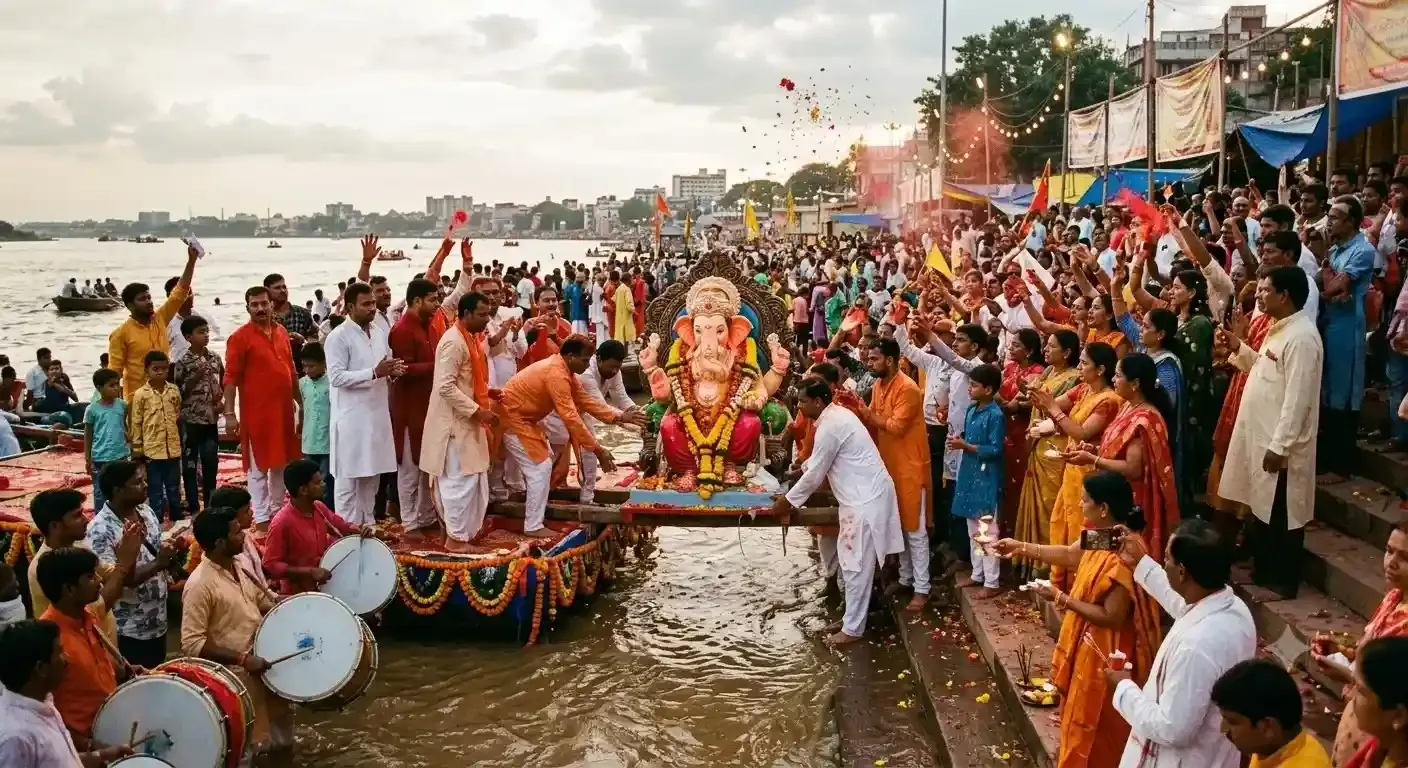
Ganesh Chaturthi in Bangkok 2026: Mandapam, Permits, Immersion
Ganesh Chaturthi in Bangkok 2026 falls on Monday 14 September. Bangkok is one of the easiest cities outside India to celebrate: Phra Phikanet is a mainstream Thai deity, Hinduism is officially recognised, and religious rites are exempt from the public assembly law. The real obstacle is the rain. A practical guide to mandapams, permits and immersion.
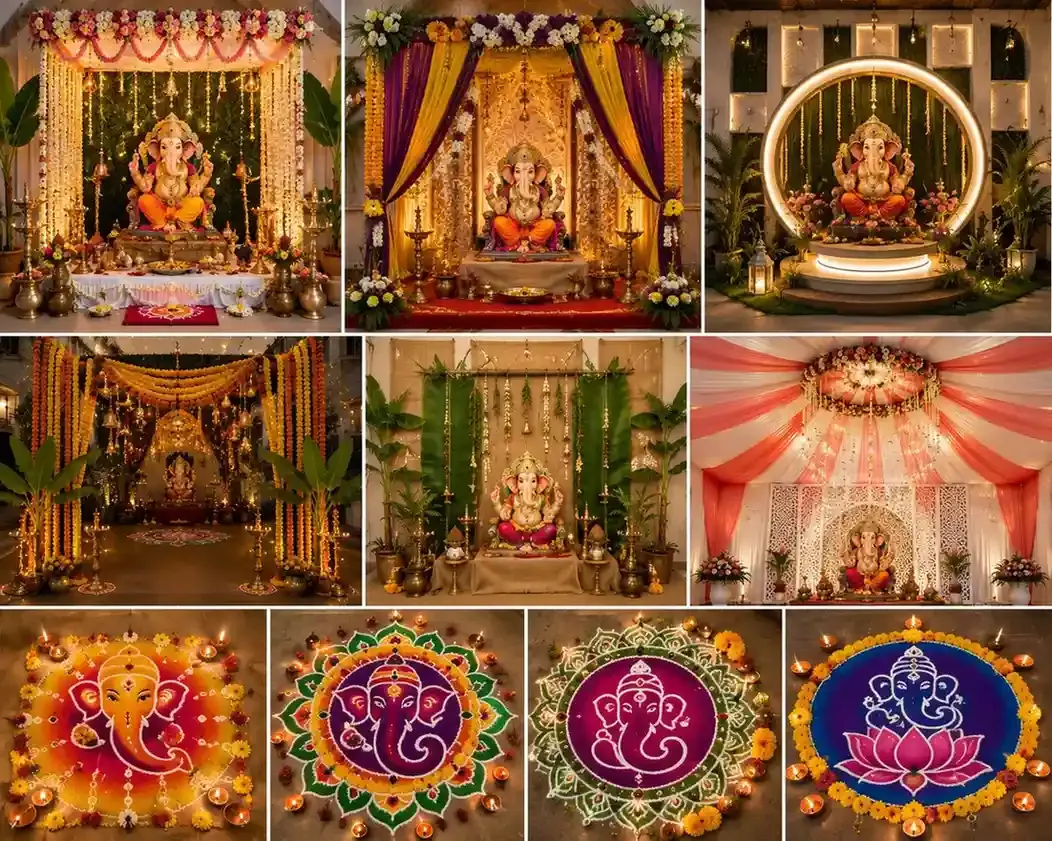
Ganesh Chaturthi in Bangkok 2026 falls on Monday 14 September. Bangkok is one of the easiest cities outside India to celebrate: Phra Phikanet is a mainstream Thai deity, Hinduism is officially recognised, and religious rites are exempt from the public assembly law.
Quick answer: In Bangkok a home Ganesh Chaturthi puja needs no permit; public religious ceremonies are exempt from Thailand's Public Assembly Act (Section 3), though you still notify police and get district-office/BMA approvals for structures, space, sound and food; celebrate via Sri Mahamariamman Temple on Silom, source flowers at Pak Khlong Talat, plan an indoor mandapam for the rainy season, and immerse via a temple group, an artificial tank, or home — never plaster of Paris; the Chao Phraya is dangerous, so immerse only from a boat/pier with a group.
Ganesh Chaturthi 2026 falls on Monday 14 September, with Anant Chaturdashi immersion on Friday 25 September. It is a normal working day in Thailand, so community celebrations cluster on the weekends of 12-13 and 19-20 September. Bangkok is in several ways the easiest major city outside India in which to celebrate Ganesh Chaturthi: Hinduism is an officially recognised religion, religious ceremonies are expressly exempt from the country's public assembly law, the deity is already beloved by the majority population, flowers are cheap and excellent, and floating biodegradable ritual objects on the Chao Phraya is a mainstream Thai tradition. The one serious obstacle is not legal — it is the rain.
Part 1 — Why Bangkok Is Different
Phra Phikanet Is a Thai Deity
Ganesha (Phra Phikanet) is worshipped widely by Thai Buddhists. Shrines with no connection to the Indian community include the Huai Khwang Ganesha Shrine on Ratchadaphisek (busy around the clock), a prominent shrine at CentralWorld, and the Hindu deity shrines around the Erawan area. In Chachoengsao province (about 90 minutes away) sit two of the largest Ganesha images in the world — the reclining pink Ganesha at Wat Saman Rattanaram and the standing bronze Ganesha at Khlong Khuean Ganesh International Park. Because Phra Phikanet is familiar, landlords, condo management, neighbours and officials all recognise the deity, removing much of the friction seen elsewhere.
Hinduism Is Officially Recognised
Thailand's Department of Religious Affairs recognises five religious groups, and Brahmin-Hindu is among them. Thailand maintains Devasathan, the royal Brahmin temple near the Giant Swing (Sao Ching Cha), established 1784, where court Brahmins conduct royal ceremonies.
The Community and Its Temples
| Place | Details |
|---|---|
| Sri Mahamariamman Temple (Wat Khaek, Silom) | Silom Road, founded 1879 by Tamil settlers, the principal Hindu temple in Bangkok and the centre of Ganesh Chaturthi observance |
| Devasathan (Brahmin Temple) | Near Sao Ching Cha, royal Brahmin institution established 1784 |
| Vishnu Temple (Wat Witsanu) | Yannawa, associated with the Hindu Samaj community |
| Phahurat | Bangkok's Little India adjacent to Yaowarat/Chinatown, commercial and cultural heart of the Indian community, also home to the Sikh Gurdwara Siri Guru Singh Sabha |
| Huai Khwang Ganesha Shrine | Ratchadaphisek, hugely popular Thai devotional site |
| Wat Saman Rattanaram | Chachoengsao, the giant pink reclining Ganesha |
Part 2 — The Rain, Your Real Design Constraint
September and October are the peak of Thailand's rainy season; Bangkok gets its heaviest monthly rainfall then — intense afternoon and evening downpours, humidity above 80%, and localised street flooding that can appear within twenty minutes.
What the Rain Rules Out
- Outdoor mandapams without engineered rain protection
- Paper, cardboard, untreated MDF (they sag, warp, delaminate)
- Decorative canopies that pool water and collapse
- Unprotected outdoor electrics (a genuine safety hazard)
- Fixed outdoor procession timing with no wet-weather alternative
What the Rain Favours
- Fully indoor mandapams (the default and correct choice)
- Fresh flowers (last far better here)
- Banana trunk and plantain leaf
- Sealed or treated timber, PVC, aluminium
- Pitched, guttered, properly drained covers if outdoors
- RCD-protected, weatherproof outdoor electrics
Practical Wet-Season Planning
- Build a rain contingency into the schedule — fix a primary and alternate time for any outdoor element and communicate both.
- Morning is drier than afternoon — schedule outdoor processions and immersion trips for the morning.
- Check flood-prone routes — know your route's history before a procession or river convoy.
- Dry everything before storage — mould forms within days.
- Have covered waiting space for elders and children.
Part 3 — Mandapam Design for Bangkok
Home Mandapam
- Console or shelf mandapam (practical default for a condo).
- Removable adhesive hook backdrop (condo tenancy penalises wall damage).
- Tension-rod arch (no fixings, stores flat).
- Pak Khlong Talat garlands (Bangkok's single greatest advantage).
- Banana trunk pillars (any fresh market, biodegradable).
- Mango leaf thoranam (humidity keeps them fresh).
- Brass lamps and kuthuvilakku.
- Three-point lighting (warm key front-left, soft fill front-right, cool backlight).
- Turn off the overhead fluorescent during aarti.
- LED diyas in condominiums (sensitive high-rise fire detection).
Community and Temple Scale
- Modular aluminium truss from Bangkok event suppliers (documented, weathers humidity).
- Printed tension backdrop on flame-retardant fabric (specify FR at quotation).
- Engineered rain cover, pitched and guttered.
- Elevated flooring or matting (ground water is a real September problem).
- Accessible darshan path.
- Trilingual QR storytelling placards (Thai, English, Tamil or Hindi) — the Thai version genuinely gets read.
- Live-stream to India (Bangkok is 1.5 hours ahead of IST; a 9pm Bangkok aarti is 7:30pm IST).
Sourcing in Bangkok
| Item | Where |
|---|---|
| Flowers and garlands | Pak Khlong Talat, the 24-hour flower market near Memorial Bridge (marigold, jasmine, rose, lotus, cheap; go before dawn) |
| Murtis, puja samagri, Indian goods | Phahurat (Little India) and shops around Sri Mahamariamman on Silom |
| Fabric, silk, brocade, trim | Phahurat |
| Decorations, lights, craft supplies | Sampeng Lane (Soi Wanit 1), Chinatown, wholesale and cheap |
| Banana trunks, plantain leaves, fruit | Any fresh market; Pak Khlong Talat |
| Truss, staging, AV hire | Bangkok event suppliers |
| Printing, signage, FR fabric | Commercial printing districts (ask for FR explicitly) |
A mandapam in Bangkok can be dressed in fresh marigold and jasmine daily for all ten days at very low cost.
Part 4 — Permissions
Note: this is a general framework, not legal advice; confirm current requirements with your district office (khet), the Metropolitan Police Bureau, and your temple before finalising plans.
4.1 At Home: Nothing Required
A puja in your own home or condominium with family and invited guests requires no permit; religious freedom is constitutionally protected and Hinduism is officially recognised. Practical only: condominium juristic person rules on common-area use and amplified sound; use LED diyas in high-rise units; keep amplification moderate and finish at a reasonable hour; a private religious observance by foreign residents is entirely ordinary.
4.2 The Public Assembly Act Exempts Religious Ceremonies
Thailand's Public Assembly Act B.E. 2558 (2015) requires organisers of a public assembly to notify the local police station chief at least 24 hours in advance; however Section 3 lists categories to which the Act does not apply, and among them is assembly in the course of religious rituals, traditional activity, or local culture (royal and state ceremonies are similarly excluded). A Ganesh Chaturthi procession or temple festival is a religious ritual and sits outside the Public Assembly Act's notification regime.
What you should still do anyway: notify your local police station and district office (khet) well in advance and request traffic and crowd assistance. One point to note: for assemblies that are covered by the Act, processions moving between 6:00 PM and 6:00 AM require police permission; religious ceremonies are exempt, but an evening or night procession is exactly where you want police coordination anyway — arrange it in advance and in writing.
4.3 What You Do Need Approvals For
| Activity | Authority |
|---|---|
| Use of public space / street | District office (khet) + Bangkok Metropolitan Administration (BMA) |
| Temporary structure, stage, large tent | District office under the Building Control Act B.E. 2522 |
| Road closure, traffic management | Metropolitan Police Bureau + BMA |
| Food service at scale | BMA Health Department under the Public Health Act |
| Amplified sound in public | District office, BMA noise regulations |
| Fire safety | Bangkok Fire and Rescue Department |
| Temporary electrical supply | Licensed contractor, MEA coordination for significant loads |
| Banners and signage | District office, BMA signage rules |
Lead time: 4-8 weeks.
4.4 A Note for Foreign Organisers
Constitutional assembly provisions are framed around Thai nationals; foreign residents celebrate freely in homes and at temples; if you are a foreign national organising a large public event, the easier route is through Sri Mahamariamman Temple, the Hindu Samaj, or another established registered Thai organisation.
4.5 Thai Cultural Observances
- Royal imagery — lese-majeste provisions are serious and strictly enforced; never incorporate royal portraits or symbols into decoration, and if in doubt leave it out.
- Buddhist imagery — do not mix Buddha images into a decorative mandapam; Thailand has strict norms and export restrictions around Buddha images.
- Feet — never point your feet toward the murti and never step over offerings.
Part 5 — Immersion in Bangkok
5.1 The Loy Krathong Advantage
At Loy Krathong millions of Thais float krathongs on the Chao Phraya and waterways; over two decades there has been a strong shift toward banana-trunk, banana-leaf and bread-based krathongs and away from styrofoam, with the BMA collecting and counting them and reporting the biodegradable percentage. This means placing a biodegradable ritual object in the Chao Phraya is culturally normal, Thai environmental expectations are well established, and the argument for clay over plaster of Paris needs no explanation. Use the parallel to explain, not to appropriate.
5.2 The Regulatory Framework
| Authority | Remit |
|---|---|
| Marine Department (Krom Chao Tha) | The Chao Phraya and navigable waterways |
| Pollution Control Department | Water quality (Ministry of Natural Resources and Environment) |
| Bangkok Metropolitan Administration | Piers, riverbanks, public space, waste collection |
| District office (khet) | Local gatherings, riverside space |
| Metropolitan Police | Crowd safety |
5.3 The Four Options, Ranked
- Temple-Organised Immersion (Best) — Sri Mahamariamman Temple and community organisations coordinate arrangements; contact the temple in early September as transport fills.
- Artificial Immersion Tank — temporary tank on temple grounds or a community venue; full ritual integrity, zero river impact, no drowning risk, dissolved clay returns to the garden; suited to Bangkok's rainy September.
- Home Immersion — a large tub or drum at home; complete uttar puja, immerse, let the clay dissolve over 24-48 hours, use the water and sediment for plants.
- Chao Phraya or Coastal Immersion — traditional and practised; go with an organised group, use a licensed boat operator where possible, read the safety section.
Coastal alternative: the Gulf of Thailand coast at Bang Saen or Pattaya in Chonburi province is roughly 90 minutes to two hours away; confirm local municipal rules.
5.4 Materials
Acceptable: natural clay with natural pigments; banana trunk and plant-fibre construction; paper mache with natural binders; fresh flowers and organic offerings in reasonable quantity.
Never: plaster of Paris; chemical or synthetic paints; thermocol, polystyrene, fibreglass; plastic-threaded garlands; glitter, foil, plastic ornaments; any electrical or battery component. Strip the murti completely before immersion, bag the removed items and take them home.
5.5 Chao Phraya Safety
The Chao Phraya is a working commercial river and genuinely dangerous: heavy barge and ferry traffic, strong variable currents, poor visibility, steep slippery banks, and in September the flow is at its seasonal strongest. Non-negotiable rules:
- Do not wade into the Chao Phraya — the bank drops away sharply and the current is stronger than it appears.
- Immerse from a pier or a boat with a licensed and experienced operator, never from an improvised riverbank position.
- Life jackets on the boat, every person, every time.
- Children stay ashore.
- Assign designated spotters not participating in the ritual.
- No alcohol.
- Daylight only.
- Check conditions after heavy rain — postpone if the river is high or fast.
- Never immerse near an operating ferry pier or in a navigation channel.
Artificial tanks and home immersion eliminate this risk entirely; for families with children, elderly members or non-swimmers that is the correct decision, and the uttar puja and sankalpa are complete either way.
Part 6 — Planning Timeline
| When | Action |
|---|---|
| Early August | Order/buy clay murti in Phahurat, contact Sri Mahamariamman about programme and immersion |
| Mid-August | If organising a public event, file district office and BMA applications, request police coordination |
| Late August | Order FR fabric and printing, confirm rain contingency, test-build the mandapam |
| Early September | Confirm approvals in writing, confirm immersion booking, buy non-perishables |
| 12-13 September | Likely community celebration weekend |
| Monday 14 September | Ganesh Chaturthi, sthapana in the madhyahna muhurat, Pak Khlong Talat flower run at dawn |
| 19-20 September | Second community weekend |
| Friday 25 September | Anant Chaturdashi immersion, morning, daylight, organised group |
This article is general information, not legal advice. Requirements vary and change. Confirm current rules with your district office (khet), the Bangkok Metropolitan Administration, the Metropolitan Police Bureau, and your temple before finalising plans.
Frequently Asked Questions
Do I need a permit to celebrate Ganesh Chaturthi in Bangkok?
Not for a home celebration — a puja in your own home or condominium requires no permit. For public events, religious ceremonies are exempt from Thailand's Public Assembly Act under Section 3, so the 24-hour notification requirement does not apply. However, separate approvals from your district office and the BMA are needed for temporary structures, use of public space, road closures, amplified sound, and food service.
Is Ganesha worshipped in Thailand?
Yes, extensively. Ganesha is known as Phra Phikanet and is widely revered by Thai Buddhists as the deity of success, obstacle-removal, arts and learning. He is the emblem of Thailand's Fine Arts Department, and major shrines including Huai Khwang and CentralWorld draw large numbers of Thai devotees. Two of the world's largest Ganesha images are in nearby Chachoengsao province.
Where is Ganesh Chaturthi celebrated in Bangkok?
The principal centre is Sri Mahamariamman Temple, also known as Wat Khaek, on Silom Road — founded in 1879 and the heart of Bangkok's Tamil Hindu community. Phahurat, Bangkok's Little India, is the associated commercial and cultural district.
Where can I buy a clay Ganesha idol in Bangkok?
Phahurat (Little India) near Chinatown is the main source, along with shops around Sri Mahamariamman Temple on Silom Road. Buy in early August — good clay murtis with natural colours sell out ahead of the festival.
Where can I immerse the Ganesha idol in Bangkok?
The best options are a temple-organised immersion through Sri Mahamariamman, an artificial immersion tank, or home immersion in a large tub for smaller murtis. The Chao Phraya is used but is a working commercial river with strong September currents — immerse only from a boat or pier with an organised group, never by wading. Some groups travel to the Chonburi coast at Bang Saen or Pattaya.
What is the weather like in Bangkok during Ganesh Chaturthi?
September is the peak of Bangkok's rainy season, with heavy afternoon and evening downpours, humidity above 80%, and possible street flooding. Plan an indoor mandapam, schedule outdoor activities for the morning, and build a wet-weather contingency into your programme.
Where do I buy flowers for the mandapam in Bangkok?
Pak Khlong Talat, the 24-hour flower market near Memorial Bridge, is one of Asia's finest and inexpensive. Marigold, jasmine, rose and lotus are readily available. Go before dawn for the best selection, and you can refresh garlands daily for the full ten days at very low cost.
Is Ganesh Chaturthi a public holiday in Thailand?
No. It is a normal working day. In 2026 it falls on Monday 14 September, so community celebrations are typically held on the surrounding weekends.
You might also like
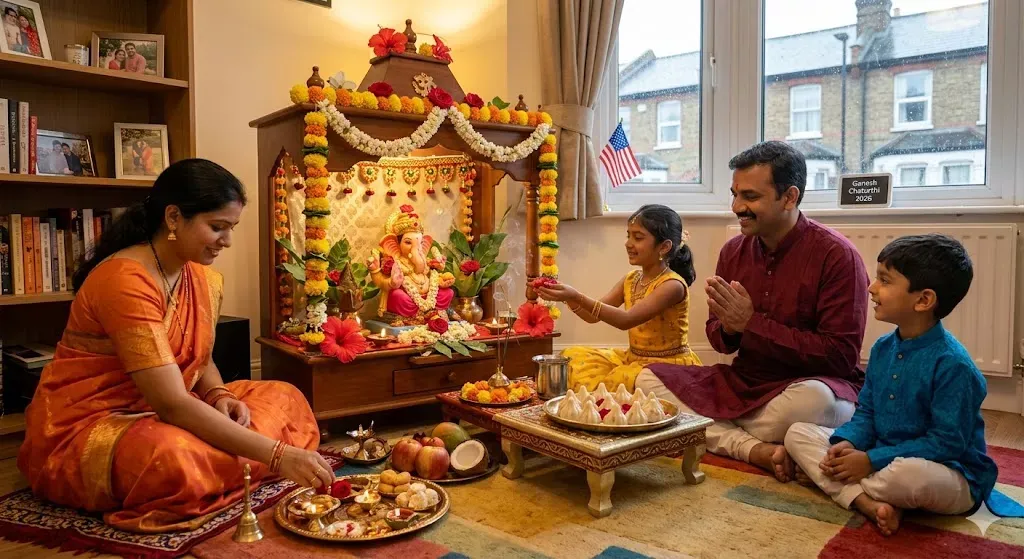
Ganesh Chaturthi 2026 in Fahaheel: Mandapam Ideas, Where to Buy & Visarjan
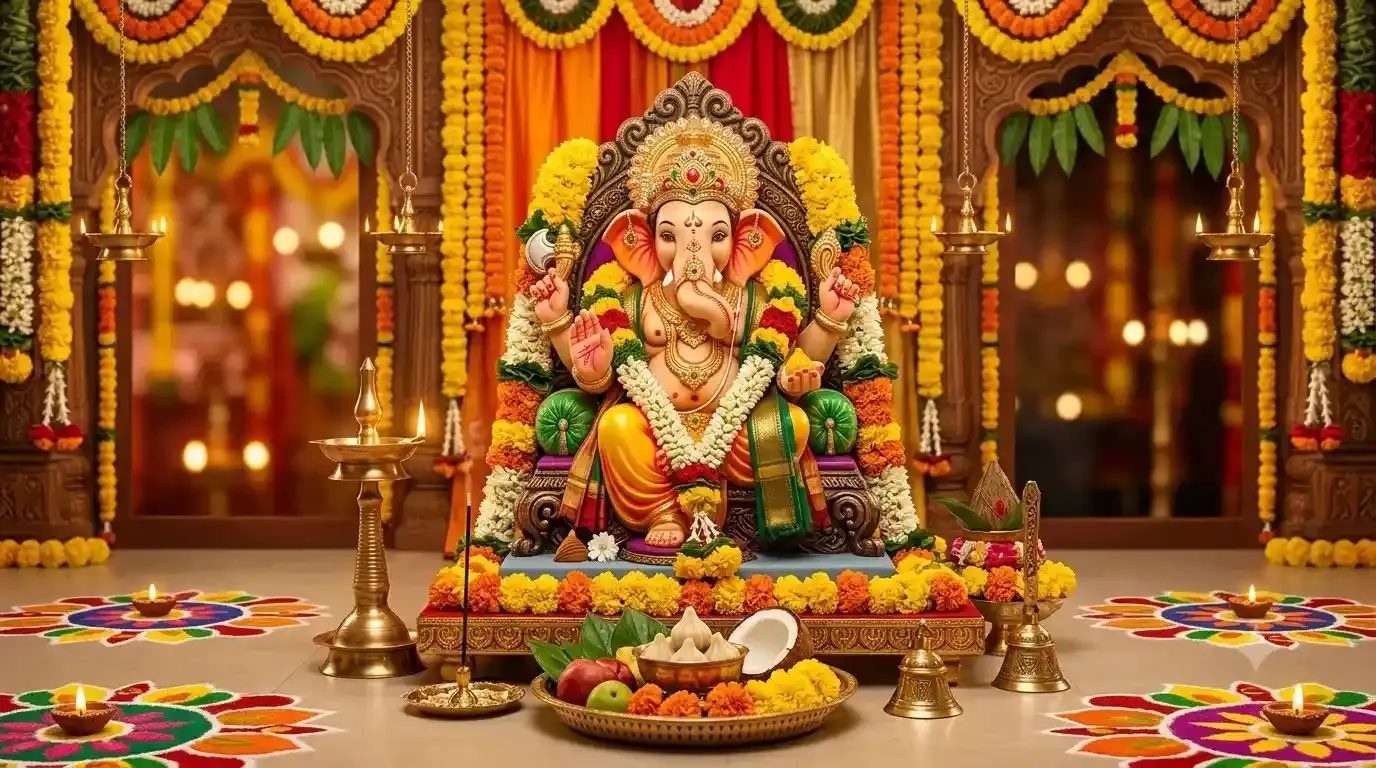
Ganesh Chaturthi 2026 in Salmiya: Mandapam Ideas, Where to Buy & Visarjan
Ganesh Chaturthi 2026 in Doha: Mandapam Ideas, Where to Buy & Visarjan