Ganesh Chaturthi in Indonesia 2026: Mandapam, Permits & Immersion Guide
Ganesh Chaturthi 2026 in Indonesia is centred on Medan's Tamil community, with expatriate celebrations in Jakarta, Surabaya and Bali. It is not a traditional Balinese festival. Here is a practical, respectful guide to dates, permits, mandapam design and safe immersion.
Ganesh Chaturthi 2026 in Indonesia is centred on Medan's Tamil community, with expatriate celebrations in Jakarta, Surabaya and Bali. It is not a traditional Balinese festival.
Quick answer: Ganesh Chaturthi in Indonesia is centred on Medan's Tamil community (Kampung Madras, Shri Mariamman Temple), with expatriate celebrations in Jakarta, Surabaya and Bali; it is NOT a traditional Balinese festival. Home puja needs no permit but inform your RT; public events need an izin keramaian via PHDI or a temple, and in Bali you must go through the desa adat; immerse via a temple/PHDI group, an artificial tank, or at home with a clay idol — never plaster of Paris.
Ganesh Chaturthi 2026 falls on Monday 14 September, with Anant Chaturdashi on Friday 25 September. It is not a public holiday in Indonesia, so community celebrations fall on the weekends of 12–13 and 19–20 September. Indonesia is the world's largest Muslim-majority country, and also one where Hinduism is one of six officially recognised state religions, where an entire province (Bali) is Hindu-majority, and where the national Hindu council sits in formal relationship with the Ministry of Religious Affairs.
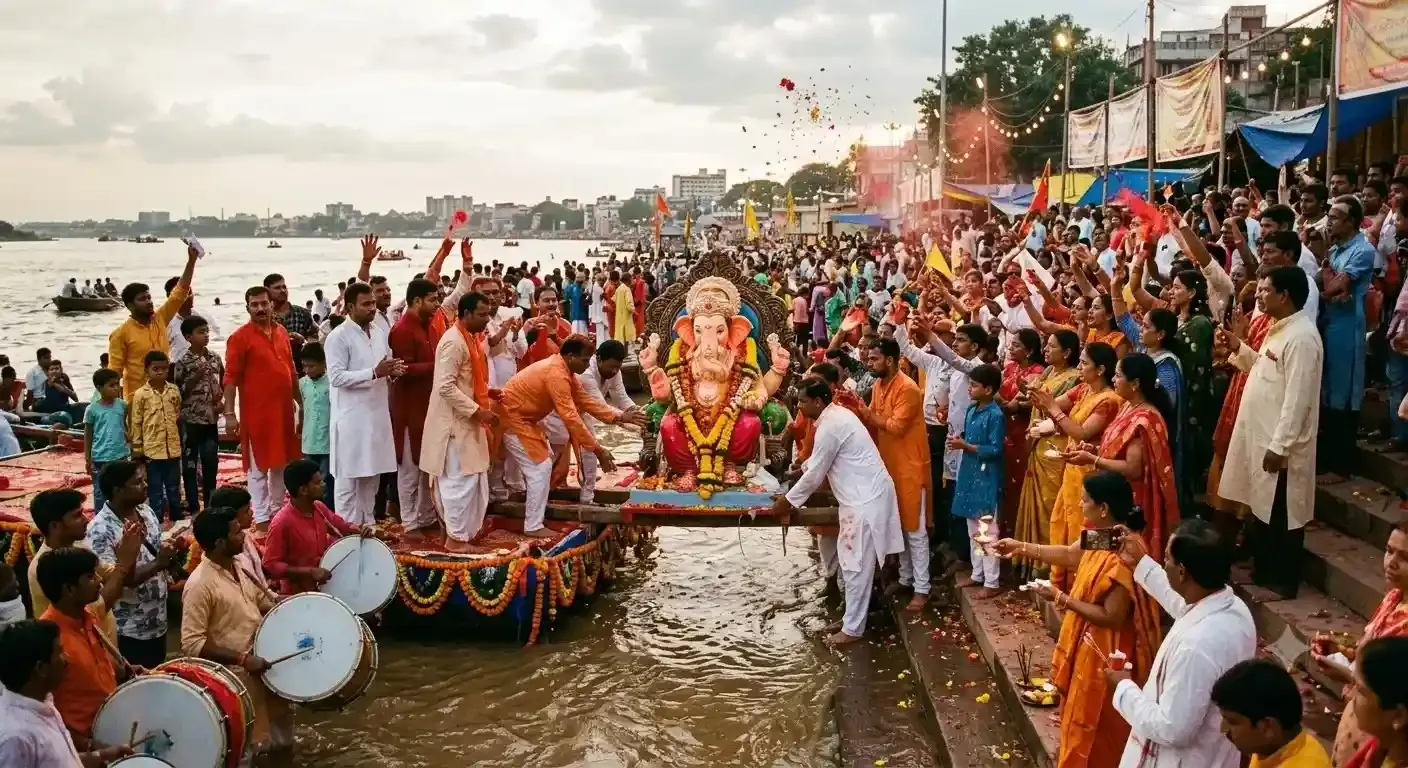
For Ganesh Chaturthi specifically, the heart of the celebration is not Bali — it is Medan, in North Sumatra, where a Tamil community established in the nineteenth century celebrates each year in the thousands, and where the city government has publicly welcomed the festival as a reflection of Medan's plural character.
Three distinct communities — the critical editorial context
Before anything else, understand that three very different communities relate to this festival in three very different ways. Lead with Medan, not Bali; never imply Balinese Hindus should observe Ganesh Chaturthi; and be honest that Bali's celebration is expatriate and recent.
| Community | Approx. Size | Relationship to Ganesh Chaturthi |
|---|---|---|
| Balinese Hindus (Agama Hindu Dharma) | ~4 million | Ganesh Chaturthi is not a traditional Balinese festival; Balinese Hinduism has its own calendar — Galungan, Kuningan, Nyepi, Saraswati, Pagerwesi, Odalan; Ganesha is deeply present as a guardian figure, but the Bhadrapada Chaturthi observance is not indigenous practice. |
| Tamil Indonesians | Concentrated in Medan, North Sumatra | Celebrate in the Tamil temple tradition; Medan is the true centre of Ganesh Chaturthi in Indonesia. |
| Indian expatriate community (Sindhi, Punjabi, North Indian) | Jakarta, Surabaya, Bali, Batam | Celebrate in the Indian manner; in Bali the festival was introduced relatively recently — largely from 2006 onward through the Indian Cultural Centre and the expatriate community — rather than being long-established. |
Part 1 — The Indonesian context
Hinduism is a recognised state religion
Indonesia's Pancasila framework recognises six religions, and Hinduism has been among them since 1959; this shapes Hindu religious education in state schools, recognised religious holidays, and formal institutional representation.
PHDI — the institution that matters
Parisada Hindu Dharma Indonesia (PHDI), founded 1959 and headquartered in Denpasar, is the national body representing Hinduism to the government; it determines Hindu religious holidays, handles legal affairs, and standardises Hindu religious education. For any organised public celebration, PHDI is your route — a local branch (including PHDI Medan, active in the city's Ganesh Chaturthi celebrations) carries standing that an informal group does not.
One nuance: PHDI has historically been Balinese-dominated, and there has been an ongoing push to make the framework more inclusive of non-Balinese Hindu traditions, which is why Tamil and Indian community organisations in Medan and Jakarta matter alongside PHDI.
Where the communities are
| City | Community | Key Places |
|---|---|---|
| Medan, North Sumatra | Largest Tamil Indonesian community; the centre of Ganesh Chaturthi in Indonesia | Kampung Madras (Little India, formerly Kampung Keling); Shri Mariamman Temple, founded 1884, the oldest Hindu temple in Medan; Balinese Hindu temples including Raksa Buana. |
| Jakarta | Sindhi and North Indian business community; Balinese Hindu diaspora | Pura Aditya Jaya, Rawamangun; Indian community organisations; Pasar Baru area historically. |
| Bali | Balinese Hindu majority; growing Indian expatriate community | Indian Cultural Centre; expatriate observance in the Denpasar–Sanur–Ubud–Canggu corridor. |
| Surabaya | Established Indian community | Community organisations and temples. |
| Batam | Smaller community, strong Singapore linkage | — |
Ganesha in Indonesian culture
Ganesha is everywhere in Indonesia — as a stone guardian at Balinese temple gates, in Javanese archaeological heritage, in the monuments of Prambanan — a familiar and respected figure; but familiarity with Ganesha is not the same as observance of Ganesh Chaturthi.
Part 2 — The weather (good news)
Unlike Bangkok, September works in your favour across most of Indonesia.
- Bali and Java: September is the end of the dry season — typically sunny, low rainfall, comfortable humidity; outdoor mandapams are genuinely viable.
- Jakarta: dry season, though air quality can be poor.
- Medan and Sumatra: more equatorial, rainfall spread across the year — expect afternoon showers and plan a rain contingency, but nothing like Bangkok's monsoon.
Practical implication: Bali and Jakarta organisers can plan outdoor or semi-outdoor mandapams and evening cultural programmes with reasonable confidence; Medan organisers should build a covered contingency.
Part 3 — Mandapam design
Home mandapam
- Console or altar-table mandapam.
- Removable adhesive hooks for backdrops (rented apartments in Jakarta and Bali).
- Tension-rod arch.
- Fresh flowers in abundance (marigold, jasmine, frangipani/kamboja, heliconia, orchids).
- Banana trunk (batang pisang) pillars from any pasar.
- Janur (young coconut leaf) work — the distinctly Indonesian design element; Balinese and Javanese janur weaving (penjor, sampian, decorative fronds) is a genuine local art form.
- Brass lamps and dipa.
- Three-point lighting (warm key front-left, soft fill front-right, cool backlight).
- Turn off the overhead fluorescent during aarti.
- LED diyas in apartments (sensitive Jakarta high-rise fire detection).
Community scale
- Outdoor or semi-outdoor pandal in Bali and Jakarta (the dry season permits it).
- Bamboo structural work — Indonesia has world-class bamboo construction craft; a bamboo mandapam frame by a Balinese or Javanese artisan is structurally excellent and biodegradable.
- Penjor-style entrance markers (tall curved bamboo poles used in Balinese ceremony) — used respectfully and with local guidance.
- Modular truss and printed backdrops (Jakarta, Denpasar, Medan).
- Elevated flooring or matting for outdoor setups.
- Trilingual QR storytelling (Bahasa Indonesia, English, Tamil or Hindi).
- Live-stream to India (Jakarta and Medan are 1.5 hours ahead of IST; Bali 2.5 hours; a 9pm Jakarta aarti is 7:30pm IST).
Sourcing
| What | Where |
|---|---|
| Murtis, puja samagri, Indian goods | Kampung Madras, Medan (the best source in the country); Pasar Baru, Jakarta; Indian grocers in Denpasar and Seminyak. |
| Fresh flowers and garlands | Any pasar bunga (flower market); Rawa Belong in Jakarta; Bali has excellent daily supply. |
| Banana trunk, plantain leaf, janur | Any traditional market. |
| Bamboo, janur craft, penjor work | Bali and Java, commission from local artisans. |
| Fabric, textiles | Kampung Madras (Medan); Tanah Abang (Jakarta), one of Southeast Asia's largest textile markets. |
| Truss, staging, AV, printing | Jakarta, Denpasar, Medan suppliers. |
A note on Bali: because Balinese Hindu ritual consumes enormous daily quantities of flowers, palm leaf and offering materials, the supply chain for exactly the things a mandapam needs is the best in the world.
Part 4 — Permissions
Note: general framework, not legal advice; requirements vary by province and city and change; confirm with your local PHDI branch, RT/RW, kelurahan, and police.
4.1 At home: nothing formal required
A puja in your own home with family and invited guests requires no permit; Hinduism is a recognised religion and private worship is entirely ordinary. But there is one uniquely Indonesian step you should take.
4.2 Inform your RT and RW — the key local custom
Indonesia's neighbourhood administration runs through RT (Rukun Tetangga) and RW (Rukun Warga), the smallest civic units headed by an elected neighbour. If you are hosting more than a handful of guests, inform your Pak RT in advance — not a legal permit but the social and administrative norm.
A brief courteous visit explaining the occasion, dates, expected numbers, parking and finishing time prevents complaints, signals respect, means your RT can vouch for you, and in a Muslim-majority neighbourhood demonstrates kerukunan (harmony). Skipping this is the most common mistake foreign residents make. Practical points to raise: guest parking, amplified sound volume and end time, prayer-time consideration if there is a mosque nearby.
4.3 Public and community events
| Requirement | Authority |
|---|---|
| Izin keramaian (public gathering permit) | Polri — Polsek for smaller events, Polres for larger; the core permit for any public event. |
| Institutional backing | PHDI local branch, or an established temple or registered community organisation. |
| Local administrative approval | Kelurahan and Kecamatan. |
| Religious affairs coordination | Kementerian Agama (Kemenag) regional office; FKUB (Forum Kerukunan Umat Beragama) where relevant. |
| Road closure and traffic | Dinas Perhubungan (Dishub) + Polri. |
| Fire safety | Dinas Pemadam Kebakaran (Damkar). |
| Public space use, permits enforcement | Satpol PP; local government (Pemkot/Pemkab). |
| Food service at scale | Local health office (Dinas Kesehatan). |
Sequence matters: secure PHDI or temple backing first, then the kelurahan, then the izin keramaian. Lead time 4–8 weeks.
4.4 In Bali: the desa adat governs
Bali operates a dual governance system; alongside formal government sits the desa adat (customary village), which holds genuine authority over ritual matters, ceremonial use of land and beaches, and community events; Pecalang (traditional village security) manage ceremonies and crowds. If organising anything in Bali — a community pandal, a beach immersion, a procession — approach the desa adat first through the bendesa adat (customary village head); no formal permitting substitutes for this. For foreign residents this is not optional.
4.5 A note for foreign residents
Private home observance is normal; for organising public events, foreign nationals should work through an Indonesian institution — PHDI, a registered temple, or a registered yayasan or perkumpulan.
4.6 Cultural considerations
- Prayer times — in Muslim-majority neighbourhoods, pause or lower amplified sound during the five daily prayer times and especially Friday prayers.
- Kerukunan — Indonesia's civic framework places real weight on inter-religious harmony; frame your celebration as open and neighbourly and invite neighbours.
- Modesty and scale — restraint reads better than spectacle outside Bali.
Part 5 — Immersion
5.1 The Melasti parallel
Melasti is the Balinese purification ceremony in which temple pratima and sacred objects are carried in procession to the sea or a water source, cleansed and returned; it happens annually before Nyepi in enormous processions at designated beaches; Balinese tradition also includes nganyut (ceremonial release of ritual remains into water). The cultural logic of taking a sacred object to the sea is fully established in Indonesia.
But do not conflate the two — Melasti is a specific Balinese ceremony with its own meaning and designated sites; your Ganesh Chaturthi immersion is not Melasti and should not be described as such or conducted at a beach during a Melasti observance. Use the parallel to explain, not to appropriate.
5.2 The regulatory picture
| Authority | Role |
|---|---|
| Local government (Pemkot/Pemkab) | Beach and public space access. |
| Desa adat (Bali) | Customary authority over ceremonial beach use — decisive in Bali. |
| Dinas Lingkungan Hidup (DLH) | Environmental / water quality at local level. |
| Ministry of Environment and Forestry (KLHK) | National environmental framework. |
| Polri | Crowd safety, izin keramaian. |
| Basarnas / local lifeguards | Water safety. |
5.3 The four options, ranked
- Temple or PHDI-organised collective immersion (best) — correct site, group safety, proper coordination; contact your temple or local PHDI branch in early September.
- Artificial immersion tank — on temple grounds or a community venue; full ritual integrity, no environmental impact, no drowning risk, dissolved clay returns to the garden.
- Home immersion — a large tub or drum for a household murti; complete uttar puja, immerse, let the clay dissolve over 24–48 hours, use the water and sediment for plants; the right answer for apartment families in Jakarta.
- Sea immersion at an appropriate site — traditional and viable, but with group organisation, correct permissions, and the safety discipline below.
5.4 By city
| City | Immersion Notes |
|---|---|
| Medan | Coastal access via the Belawan direction; local rivers used historically; confirm the current site with Shri Mariamman Temple or PHDI Medan, who organise this. |
| Jakarta | The Ancol coastal area is accessible, but Jakarta Bay water quality is poor — be honest; for most Jakarta families home immersion or a temple tank is better and cleaner. |
| Bali | The east and south coasts have long-established ceremonial beach access; go through your desa adat; never simply arrive at a Balinese beach with a murti and a crowd. |
| Surabaya | East Java coastal access; coordinate through community organisations. |
Confirm every site for the current year.
5.5 Water safety
Indonesian coastal waters carry serious hazards; Bali's southern beaches (Kuta, Legian, Canggu, Seminyak) have strong rip currents and heavy surf and see drownings every year including of strong swimmers; Java's south coast is more dangerous; September can bring significant swell.
Non-negotiable rules:
- Never immerse in surf — if waves are breaking, that beach is wrong; use a calm-water site (Bali's east coast is generally calmer than the south-west) or a tank.
- Waist-deep maximum, and only in genuinely calm water.
- Children stay ashore, always.
- Designated spotters not participating — strong swimmers, sober, watching the water only.
- Nobody who cannot swim enters the water.
- No alcohol.
- Daylight only.
- Check surf and current conditions on the day and ask local lifeguards or the desa adat.
- Postpone rather than proceed in poor conditions.
Artificial tanks and home immersion remove this risk entirely.
5.6 Materials
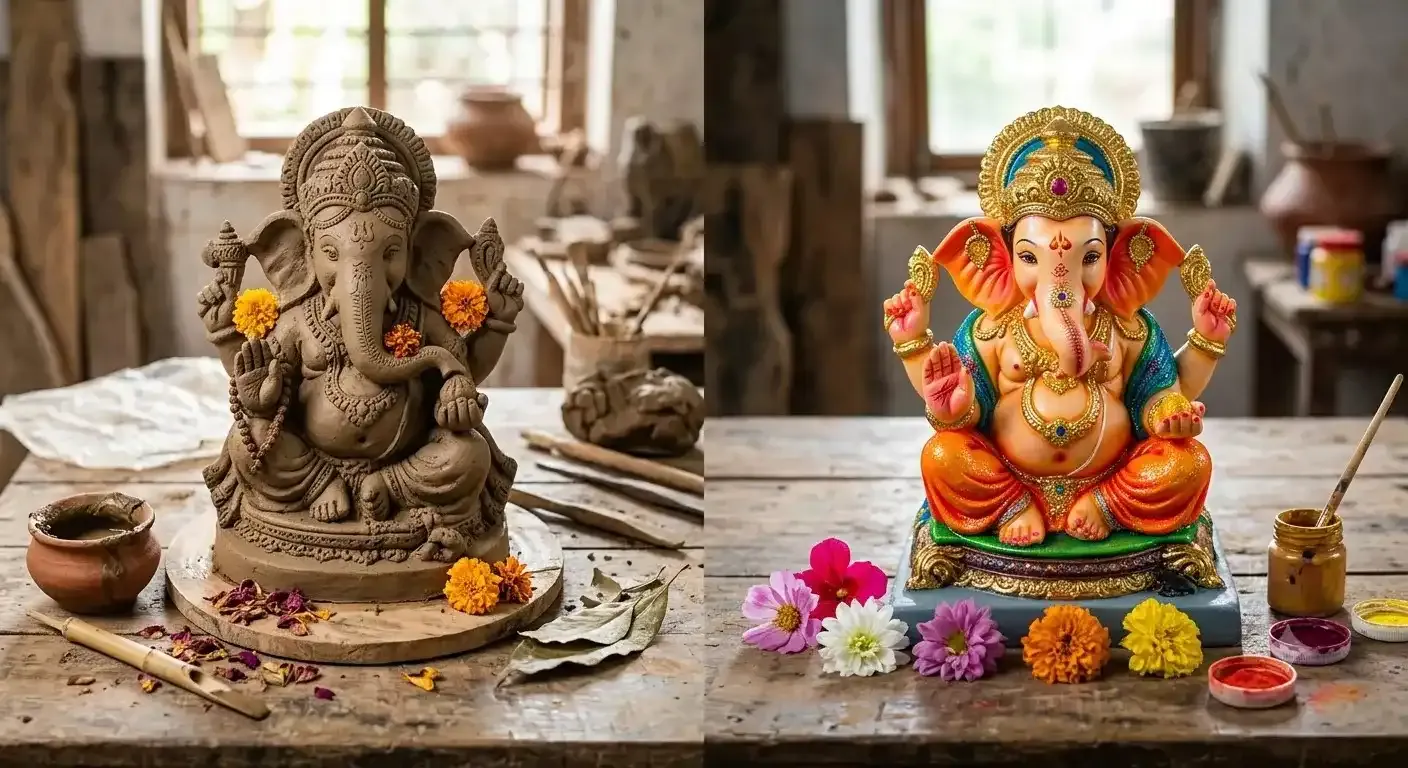
Acceptable: natural clay with natural pigments; banana trunk and plant-fibre construction; paper mâché with natural binders; fresh flowers and organic offerings.
Never: plaster of Paris; chemical or synthetic paints; thermocol, polystyrene, fibreglass; plastic-threaded garlands; glitter, foil, plastic ornaments; batteries or electrical components. Strip the murti completely before immersion; Indonesia has a serious marine plastic problem and the Hindu community should be visibly part of the solution.
Part 6 — City briefs
Medan (the flagship)
The true home of Ganesh Chaturthi in Indonesia; Kampung Madras is the Little India district and Shri Mariamman Temple (founded 1884) is the oldest Hindu temple in the city and the centre of the festival; thousands attend; the Medan city government has publicly welcomed the celebration.
Jakarta
Sindhi and North Indian business community plus Balinese Hindu diaspora at Pura Aditya Jaya in Rawamangun; apartment-scale mandapams, Pasar Baru sourcing, home immersion; note Jakarta Bay water quality honestly.
Bali
The Indian expatriate community celebrates, primarily in the Denpasar–Sanur–Ubud–Canggu corridor, and the festival was introduced relatively recently rather than being long-established Balinese practice; the design and sourcing advantages are unmatched (flowers, janur, bamboo, ritual artisans); the desa adat governs everything ceremonial.
Surabaya and Batam
Surabaya: established Indian community, East Java, smaller-scale but genuine. Batam: small community with strong Singapore ties.
This article is general information, not legal advice. Requirements vary by province and city and change over time. Confirm current requirements with your local PHDI branch, RT/RW, kelurahan, and police before finalising plans.
Frequently Asked Questions
Is Ganesh Chaturthi celebrated in Indonesia?
Yes. It is celebrated mainly by Indian Hindu communities, most prominently in Medan where thousands attend, and also in Jakarta, Surabaya and Bali. It is not a national public holiday. Ganesh Chaturthi is not a traditional Balinese Hindu festival — Balinese Hinduism follows its own calendar including Galungan, Kuningan, Nyepi and Saraswati.
Do I need a permit to celebrate Ganesh Chaturthi in Indonesia?
Not for a home celebration. For public or community events you need an izin keramaian from the police plus local kelurahan approval, and applications are far easier with backing from PHDI, an established temple, or a registered community organisation. In Bali you must also go through the desa adat, the customary village.
What is the RT and why should I inform them?
The RT (Rukun Tetangga) is Indonesia's smallest neighbourhood administrative unit, headed by an elected neighbour. Informing your Pak RT before hosting a gathering is not a legal permit but an important social norm. It prevents complaints, demonstrates respect for the neighbourhood, and means someone locally can vouch for your event. Skipping it is the most common mistake foreign residents make.
Where is Ganesh Chaturthi celebrated in Medan?
The centre is Kampung Madras, Medan's Little India district, and Shri Mariamman Temple, founded in 1884 and the oldest Hindu temple in the city. The celebration draws thousands and has been publicly welcomed by the Medan city government.
Where can I buy a Ganesha idol in Indonesia?
Kampung Madras in Medan is the best source in the country. In Jakarta, the Pasar Baru area and Indian grocers stock puja items. In Bali, Indian community shops in the Denpasar and Seminyak areas. Buy in early August for good clay murtis with natural colours.
Where can I immerse the Ganesha idol in Indonesia?
The best options are a temple or PHDI-organised collective immersion, an artificial immersion tank, or home immersion in a large tub. For sea immersion, coordinate through your temple, and in Bali through the desa adat. Jakarta Bay water quality is poor, and Bali's southern beaches have dangerous rip currents.
What is the weather like in Indonesia during Ganesh Chaturthi?
September is the end of the dry season in Bali and Java, typically sunny with low rainfall, making outdoor mandapams viable. Medan and Sumatra see rainfall through the year, so plan a covered contingency there.
Can foreigners celebrate Ganesh Chaturthi in Indonesia?
Yes, freely, in private homes and at temples. For organising public events, foreign nationals should work through an Indonesian institution such as PHDI, a registered temple, or a registered yayasan or perkumpulan.
You might also like
Ganesh Chaturthi 2026 in Fahaheel: Mandapam Ideas, Where to Buy & Visarjan
Ganesh Chaturthi 2026 in Salmiya: Mandapam Ideas, Where to Buy & Visarjan
Ganesh Chaturthi 2026 in Doha: Mandapam Ideas, Where to Buy & Visarjan