Ganesh Chaturthi in Nepal 2026: Chatha & the Char Binayak
In Nepal, Ganesh Chaturthi is the Newar Chatha, a one-day evening household puja built around the prohibition against looking at the moon, alongside the Char Binayak temple pilgrimage. Learn the date, the moon legend, Chaurchan in the Terai, and why immersion is not the Nepali way.
In Nepal, Ganesh Chaturthi is the Newar Chatha, a one-day evening household puja built around the prohibition against looking at the moon, alongside the Char Binayak temple pilgrimage. Learn the date, the moon legend, Chaurchan in the Terai, and why immersion is not the Nepali way.
Quick answer: In Nepal, Ganesh Chaturthi is a one-day observance — the Newar Chatha, an evening household puja centred on NOT looking at the moon (the Mithya Dosha legend), not the ten-day pandal-and-immersion of Maharashtra. Devotees visit the Char Binayak temples of the Kathmandu Valley (Jal, Surya, Ashok and Chandra Binayak). In the Mithila Terai, Chaurchan does the opposite and worships the moon. Verify the date via Hamro Patro / Nepal Panchanga Nirnayak Samiti, as it can differ from the Indian panchang. Immersion is not traditional and September rivers are dangerous — immerse a clay murti at home or keep a permanent brass image.
Nepal is not a diaspora market and it is not an Indian-model festival. Nepal is a Hindu-majority country of around 30 million where Ganesha (Binayak or Ganedyah) receives agra puja, the first worship, before every ritual undertaking; every Newar locality has its own Ganesh shrine as protector, and Ganesha is worshipped by both Hindus and Newar Buddhists. But the festival looks almost nothing like Mumbai.
| Aspect | India (Maharashtra model) | Nepal |
|---|---|---|
| Duration | 10 days | One day |
| Form | Household and public pandal installation | Evening household puja and temple pilgrimage |
| Central observance | Sthapana, daily aarti, visarjan | Not looking at the moon |
| Immersion | Central | Not a traditional Nepali practice |
| Newar name | (none) | Chatha (Cho:tha) |
| Sits alongside | (none) | Haritalika Teej and Rishi Panchami |
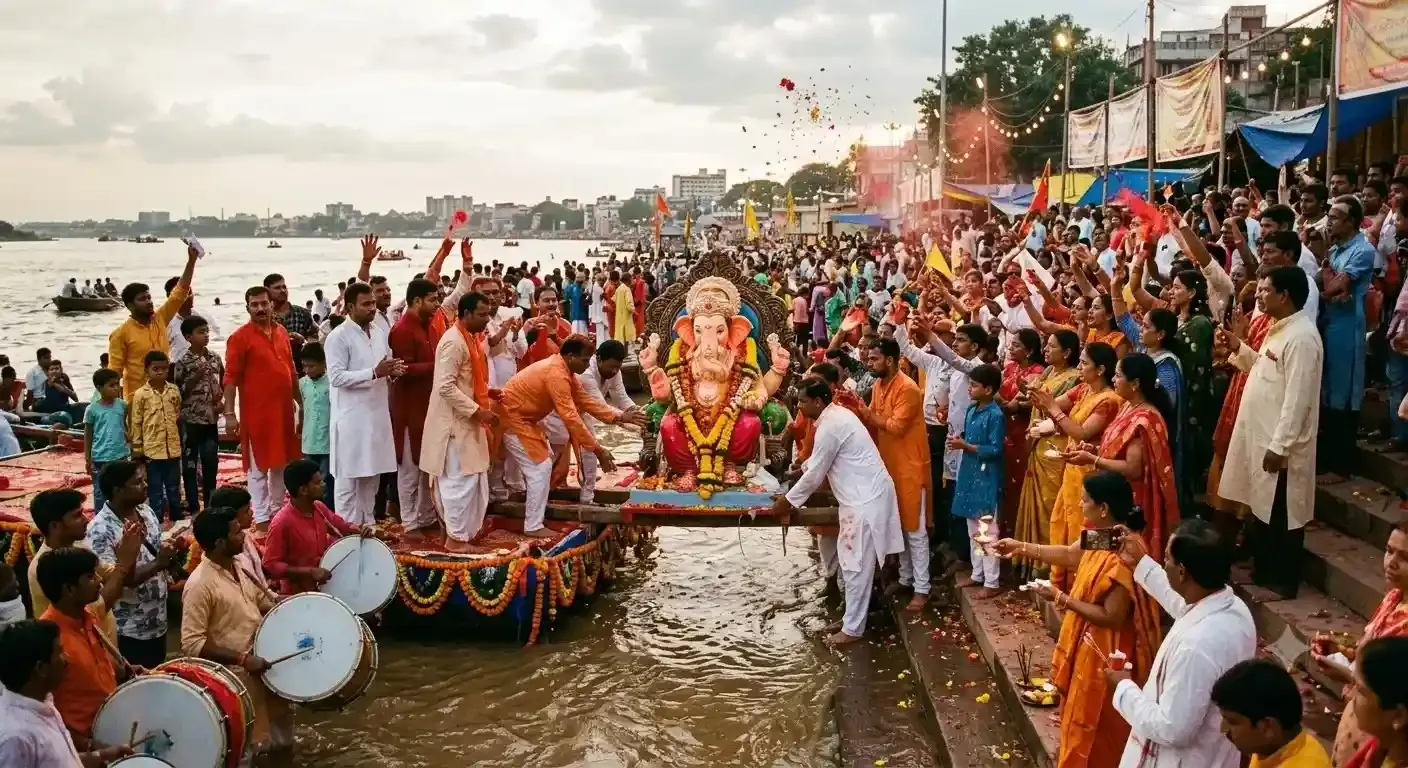
In Mumbai, Ganesh Chaturthi ends with a million people carrying murtis to the sea under a bright night sky. In Kathmandu, parents tell their children not to look up. Ganesh Chaturthi in Nepal — known to the Newar community as Chatha — is a one-day observance built around an evening household puja and a prohibition: do not look at the moon. There are no ten-day pandals in the Nepali tradition, and no visarjan.
The date and a Nepali complication
Internationally, Ganesh Chaturthi 2026 falls on Monday 14 September. In Nepal, verify the date locally before you plan. This is the Nepali festival calendar for Bhadra 2083 BS.
| Nepali Date | Gregorian | Observance |
|---|---|---|
| Bhadra 28 | Sunday 13 September | Dar Khane Din (Teej feasting day) |
| Bhadra 29 | Monday 14 September | Haritalika Teej — principal day, a public holiday particularly observed by women |
| Bhadra 29–30 | 14–15 September | Ganesh Chaturthi / Chatha |
| Bhadra 31 | Wednesday 16 September | Rishi Panchami |
Ganesh Chaturthi sits inside the Teej sequence, immediately after Haritalika Teej and before Rishi Panchami.
The complication: because Tritiya, Chaturthi and Panchami tithis can overlap or compress across sunrise, the Nepali observance date sometimes differs by a day from the Indian panchang, and Teej and Chaturthi can even fall on the same day; in some years the Nepal Panchanga Nirnayak Samiti has ruled that Chaturthi and Panchami fall together.
Practical advice: check Hamro Patro or the Nepal Panchanga Nirnayak Samiti's determination for Bhadra 2083 before finalising your vrata or travel; do not simply assume the Indian date.
Is it a public holiday? Haritalika Teej is widely observed as a holiday, particularly for women; Ganesh Chaturthi itself is not separately a national public holiday, but because it falls within the Teej window much of the country is already in festival mode.
The moon
The prohibition
On Bhadra Shukla Chaturthi you must not look at the moon. The legend: after a large feast, Ganesha was riding his mouse when the moon (Chandra) saw his round belly and mocked him; Ganesha, insulted, cursed the moon that its glow would be diminished and anyone who gazed upon it on this night would suffer Mithya Dosha — false accusation, blame, and dishonour in society. Krishna himself is said to have been afflicted, falsely accused over the Syamantaka jewel, and to have observed the Chaturthi vrata on Narada's advice to be released from it.
In Nepal this is not a footnote — it is the observance; Nepali parents genuinely keep children from looking at the sky that night.
The remedy
If someone sights the moon by accident, the traditional remedy is to recite the Syamantaka verse.
सिंहः प्रसेनमवधीत्सिंहो जाम्बवता हतः। सुकुमारक मारोदीस्तव ह्येष स्यमन्तकः॥
Siṃhaḥ prasenam avadhīt siṃho jāmbavatā hataḥ / Sukumāraka mā rodīs tava hyeṣa syamantakaḥ.
Note: depending on how the tithi falls, the moon-sighting prohibition may extend across two consecutive evenings.
The extraordinary contrast — Chaurchan in the Terai
On the very same day (Bhadra Shukla Chaturthi), the Mithila region of the Terai observes Chaurchan (also Chauth Chandra), and the practice is the exact opposite — in Mithilanchal people worship the moon. The reasoning: the Maithil tradition accepts that the moon of this night carries a flaw, and precisely for that reason one should not look at it empty-handed; instead offerings are made — kheer, puri, fruits, sweets and yoghurt are presented to the lunar deity so that its flaw does not tarnish the devotee; households fast, and women draw aripan (auspicious rice-flour designs) on the ground, placing banana leaves upon them. So on one night in one country: the hills hide from the moon, and the Terai feeds it.
Chatha, the Newar observance
Among the Newar community of the Kathmandu Valley the festival is Chatha or Cho:tha. Its distinguishing feature: unlike most pujas, Chatha is performed in the evening, not the morning; it is a household ritual conducted at home, within the presence of the moon one is nevertheless not to look at.
Other Newar elements include Chushyamusya, a customary gift given to children on this day; Ganedyah as locality protector — every Newar tole has its own Ganesh shrine and residents worship their own local Ganesh first; and both Hindu and Buddhist observance, as Newar Buddhists venerate Ganesha too.
The Ganesh Rath Yatra: since roughly 2065 BS (2008–09 CE) a Ganesh Rath Yatra (chariot procession) has been organised in Kathmandu and other major cities on this day; this is a modern development rather than an ancient Newar tradition, reflecting growing Indian-style public celebration in urban Nepal alongside the older household observance.
The Char Binayak — Nepal's Ganesha pilgrimage
The Kathmandu Valley has four principal Ganesh shrines, the Char Binayak, with two or three further temples of major importance; on Chatha devotees throng all of them.
| Temple | Location | Notes |
|---|---|---|
| Jal Binayak | Chobhar, Kathmandu | Described as the most important Ganesh shrine of central Kathmandu; originally built in 723 Nepal Sambat by Malla king Shiva Singh Malla; the gajur added 83 years later in 789 NS by Sri Nivas Malla of Patan; the present pagoda structure rebuilt in 871 NS by King Rajya Prakash Malla; sits beside the Bagmati at the Chobhar gorge. |
| Surya Binayak | Bhaktapur | Positioned to catch the first sun; associated with knowledge, wisdom and enlightenment; a destination for students and those beginning study. |
| Ashok Binayak | Maru Tole, Kathmandu Durbar Square | Also called Maru Ganesh; small, ancient, and among the most visited shrines in the city. |
| Chandra Binayak | Chabahil, Kathmandu | Completes the classical four. |
| Karya Binayak | Bungamati, Lalitpur | Dedicated in Nepal Sambat 781 (1661 CE) under local leader Purna Singh; worship began at a naturally formed Ganesha-shaped stone, now a silver-clad image; devotees come before beginning any undertaking; priests are largely of the Tuladhar surname, organised as the Nine Priests Association; busiest on Tuesdays and Saturdays. |
| Kamal Binayak | Bhaktapur | Also widely visited on this day. |
| Kamaladi Ganesh | Kathmandu | One of the busiest Ganesh temples in the city. |
A proper Char Binayak Yatra route guide — the four or six temples in a sensible order, with travel times, best hours, and what each Binayak is petitioned for — would serve devotees and visitors.
Practical observance
At home
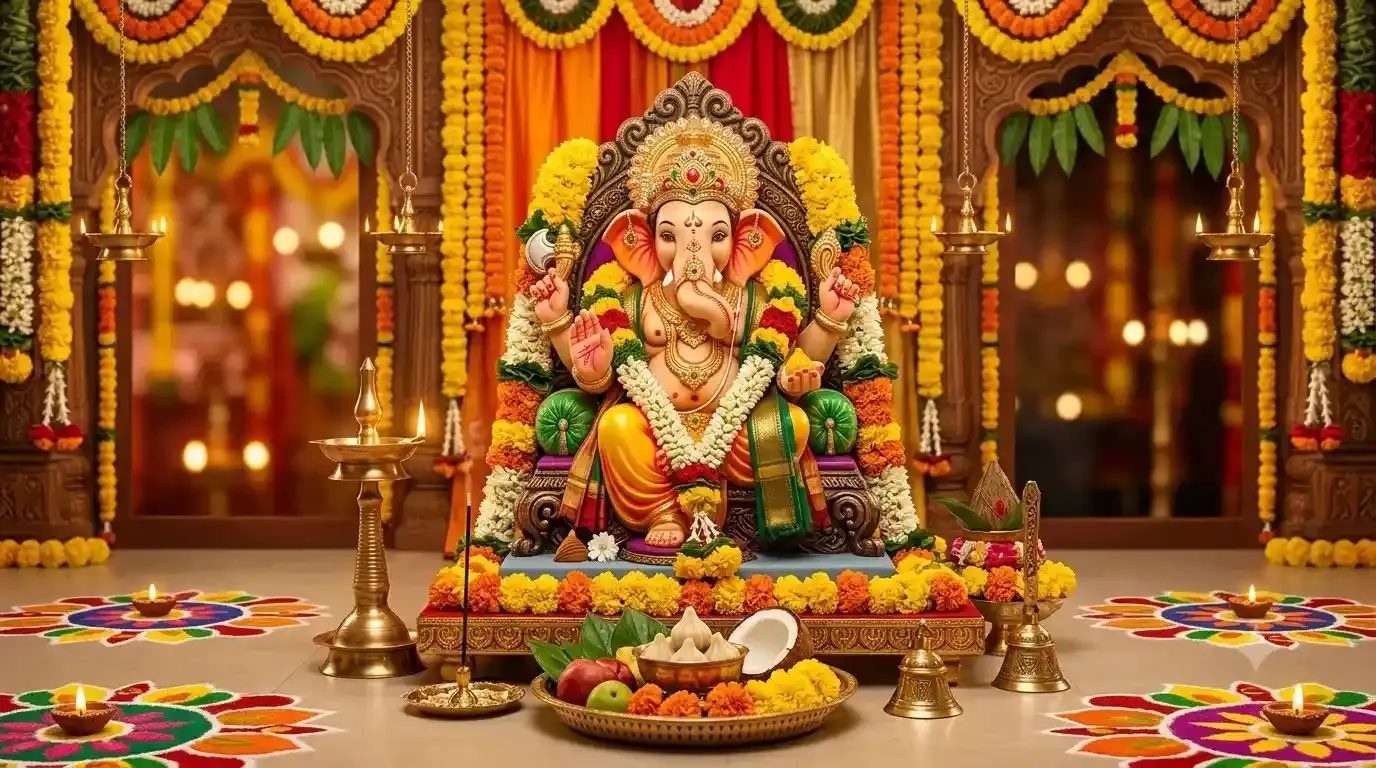
The Nepali household observance is modest and does not require a large mandapam.
- A clean puja space (the family altar or a dedicated corner, washed and prepared).
- A Ganesh image or small murti (many families use a permanent brass or stone image rather than a clay murti for immersion).
- Fresh flowers, durva grass, and red abir/sindoor.
- Ghee lamp (diyo) and incense.
- Naivedya — laddu, modak, sweets, seasonal fruit, kheer.
- Evening timing — Chatha is an evening puja, not a morning one.
- Curtained or shaded windows if the household is strict about the moon.
- Arghya — where families combine the Teej fast with Ganesha worship, arghya is offered in the afternoon after completing the morning Teej observance.
If you are doing an Indian-style installation
Nepal's Marwari and Indian-origin business communities (significant in Kathmandu, Birgunj and Biratnagar) do observe the fuller Maharashtrian and Gujarati form, with a murti installed for several days and a concluding immersion; frame it accurately as one community's practice rather than the national norm. For that audience: clay murti with natural colours ordered early (Nepal's supply is limited); modest indoor mandapam (a console or altar table with a fabric backdrop); fresh flowers from Kalimati or your local market; load-shedding-proof lighting (traditional lamps plus battery LEDs).
Permissions
This is a general framework, not legal advice; confirm with your ward office, the District Administration Office, and Nepal Police before organising any public event.
At home: nothing required — household puja requires no permission; Nepal's Constitution guarantees religious freedom, and this is the overwhelmingly normal form of observance.
For public events, Rath Yatra and processions, these are the authorities involved.
| Requirement | Authority |
|---|---|
| Permission for public processions and gatherings | District Administration Office (DAO) — the Chief District Officer (CDO) is the key authority |
| Security and traffic coordination | Nepal Police; Traffic Police for road management |
| Use of public space, roads, local approvals | Ward office, then the metropolitan or municipal authority — Kathmandu Metropolitan City (KMC), Lalitpur, Bhaktapur, Birgunj, Biratnagar etc., under the Local Government Operation Act 2074 |
| Heritage sites | Department of Archaeology — Kathmandu, Patan and Bhaktapur Durbar Squares are UNESCO World Heritage; any structure, stage or large event at or near a heritage monument requires clearance; Ashok Binayak sits inside Kathmandu Durbar Square |
| Traditional festival management | Guthi Sansthan and local guthi organisations |
| Fire safety | Municipal fire service |
The two pieces of advice that matter most: go through your guthi or temple committee (the Valley's festivals have been organised through guthi structures for centuries); and never erect a structure at a heritage site without Department of Archaeology clearance. Allow a lead time of 4–6 weeks.
Immersion — and why it is mostly not the question in Nepal
Be clear: visarjan is not a traditional part of Nepal's Ganesh Chaturthi; most Nepali households worship a permanent image and there is nothing to immerse; readers asking where to immerse are usually from the Marwari, Madhesi or Indian-origin community or influenced by Indian media.
Mid-September is the worst possible time for Nepali rivers: it falls at the tail end of the monsoon; Nepal's rivers are at or near peak annual flow — fast, cold, silt-heavy, opaque, with unstable and undercut banks; September is peak landslide and flash-flood season, and river levels can rise without warning from rainfall upstream.
Important: Do not immerse in a Nepali river in September — not the Bagmati, not the Bishnumati, not the Manohara, not the Narayani or the Koshi; the current does not need to be deep to take an adult off their feet.
The sensible options:
- Home immersion in a tub or bucket (best) — full uttar puja, immerse a clay murti at home, let it dissolve over 24–48 hours, use the water and clay for plants.
- A temple-arranged artificial tank where provided.
- A permanent image — worship a brass or stone Ganesha kept year after year, which is what most Nepali households already do and is fully traditional.
The Bagmati point: the Bagmati is sacred and also severely polluted, with a long-running public cleanup campaign of real national concern; ritual materials and idol immersion are a recognised contributor; immersing plaster of Paris, synthetic paints, plastic garlands and thermocol into the Bagmati is not devotion; a clay murti dissolved at home, its clay returned to a plant, honours both Ganesha and the river.
Materials, if immersing at all: natural clay with natural pigments only; never plaster of Paris, chemical paint, thermocol, plastic-threaded garlands, glitter or foil; strip the murti completely before immersion.
Where to go on the day
| Place | Why |
|---|---|
| Ashok Binayak, Kathmandu Durbar Square | Central, ancient, busy from early morning |
| Kamaladi Ganesh, Kathmandu | Among the city's most-visited Ganesh temples |
| Chandra Binayak, Chabahil | One of the classical four |
| Jal Binayak, Chobhar | The most significant, beside the Bagmati gorge; go early |
| Surya Binayak, Bhaktapur | For students and those beginning new study |
| Kamal Binayak, Bhaktapur | Popular Valley shrine |
| Karya Binayak, Bungamati | Petitioned before beginning any undertaking |
Practical advice: go early morning (queues at Ashok Binayak and Kamaladi build fast); mid-September can bring rain, carry cover; if attempting the full Char Binayak circuit in a day, start at Bhaktapur and work west.
This article is general information. Festival dates in Nepal are determined by the Nepal Panchanga Nirnayak Samiti and may differ from the Indian panchang — verify locally. For public events, confirm requirements with your ward office, the District Administration Office, and the Department of Archaeology where heritage sites are involved.
Frequently Asked Questions
When is Ganesh Chaturthi 2026 in Nepal?
Internationally Ganesh Chaturthi 2026 falls on Monday 14 September, within the Teej sequence in Bhadra 2083 BS. However, because Tritiya, Chaturthi and Panchami tithis can overlap, the Nepali observance date sometimes differs by a day from the Indian panchang. Check Hamro Patro or the Nepal Panchanga Nirnayak Samiti determination before finalising your vrata.
Why should you not look at the moon on Ganesh Chaturthi?
According to the legend, the moon mocked Ganesha's appearance after a feast, and Ganesha cursed it so that anyone who gazed at it on Bhadra Shukla Chaturthi would suffer Mithya Dosha — false accusation and dishonour. In Nepal this prohibition is the central observance of the day. If someone sights the moon accidentally, the traditional remedy is to recite the Syamantaka verse beginning "Simhah prasenam avadhit".
What is Chatha?
Chatha, or Cho:tha, is the Newar name for Ganesh Chaturthi. Unlike most pujas it is performed in the evening rather than the morning, as a household ritual. In the Newar community it is also customary to give children a gift called Chushyamusya on this day.
What are the Char Binayak of Kathmandu Valley?
The four principal Ganesh shrines are Jal Binayak at Chobhar, Surya Binayak in Bhaktapur, Ashok Binayak at Kathmandu Durbar Square, and Chandra Binayak at Chabahil. Karya Binayak in Bungamati, Kamal Binayak in Bhaktapur, and Kamaladi Ganesh in Kathmandu are also major destinations on this day.
Is Ganesh Chaturthi celebrated the same way in Nepal as in India?
No. Nepal's observance is a one-day evening household puja and temple pilgrimage, centred on the prohibition against looking at the moon. The ten-day pandal installation and immersion associated with Maharashtra are not part of the traditional Nepali observance, though Marwari and Indian-origin communities in Kathmandu, Birgunj and Biratnagar do observe that fuller form.
What is Chaurchan?
Chaurchan, or Chauth Chandra, is the Mithila observance in Nepal's Terai on the same day. Remarkably, it involves worshipping the moon rather than avoiding it — offerings of kheer, puri, fruit, sweets and yoghurt are made so that the moon's flaw does not tarnish the devotee, and aripan designs are drawn in rice flour.
Where can I immerse a Ganesha idol in Nepal?
Immersion is not a traditional Nepali practice, and mid-September is the tail of the monsoon when rivers are at peak flow and genuinely dangerous. Do not immerse in the Bagmati or any Nepali river at this time. Immerse a clay murti at home in a tub, use a temple-arranged tank, or keep a permanent brass or stone image as most Nepali households do.
Is Ganesh Chaturthi a public holiday in Nepal?
Haritalika Teej, which falls in the same window, is widely observed as a holiday particularly for women. Ganesh Chaturthi itself is not separately a national public holiday, though much of the country is already in festival mode across the Teej to Rishi Panchami sequence.
You might also like
Ganesh Chaturthi 2026 in Fahaheel: Mandapam Ideas, Where to Buy & Visarjan
Ganesh Chaturthi 2026 in Salmiya: Mandapam Ideas, Where to Buy & Visarjan
Ganesh Chaturthi 2026 in Doha: Mandapam Ideas, Where to Buy & Visarjan