
Ganesha Stories: 10 Puranic Legends Every Family Should Know
From his birth in the Shiva Purana to the broken tusk, Kubera's feast, the curse on the moon, the Atmalinga at Gokarna and the eight avatars of the Mudgala Purana, here are the essential Ganesha legends with their sources and meaning.
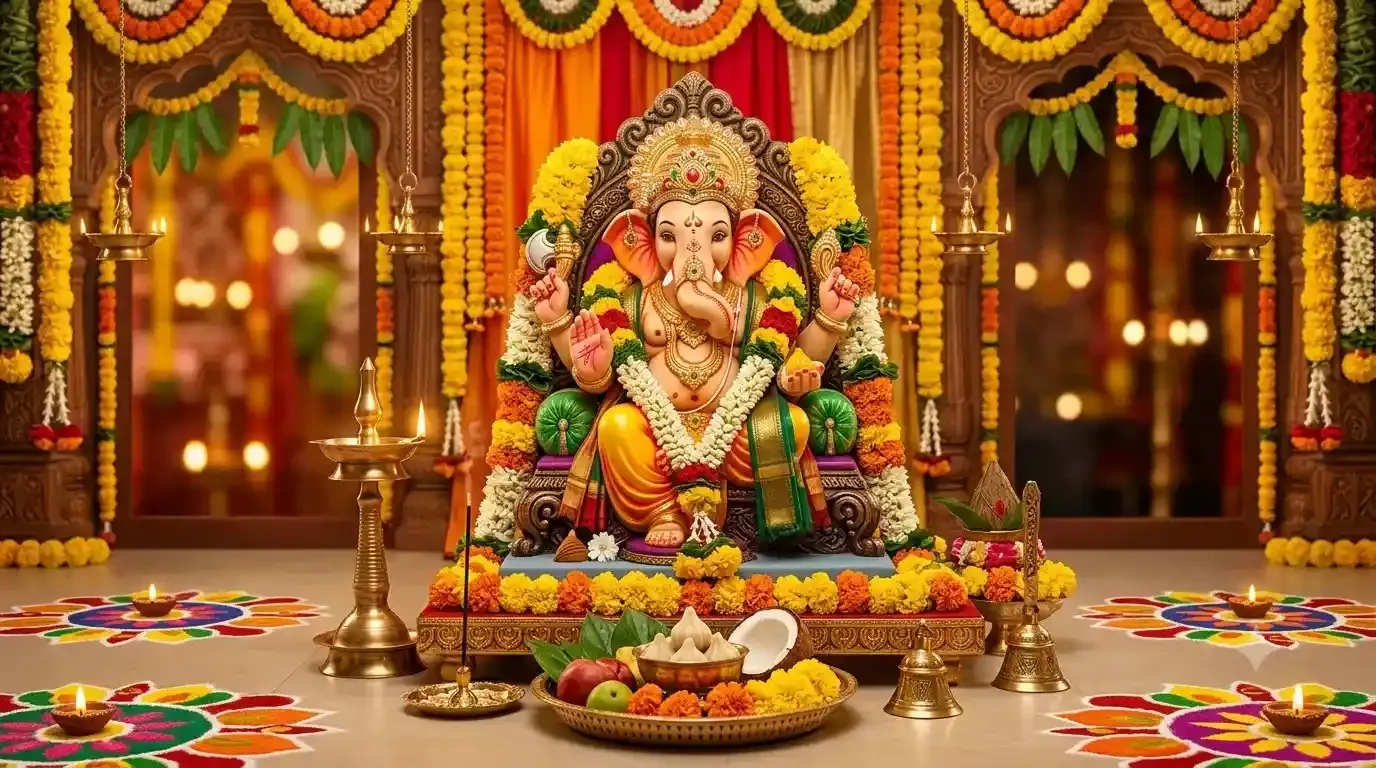
From his birth in the Shiva Purana to the broken tusk, Kubera's feast, the curse on the moon, the Atmalinga at Gokarna and the eight avatars of the Mudgala Purana, here are the essential Ganesha legends with their sources and meaning.
Quick answer: The best-known Ganesha stories are his birth from Parvati and restoration with an elephant's head (Shiva Purana); the contest with Kartikeya in which he circles his parents; the broken tusk (Ekadanta); the curse on the moon; Kubera's feast; the Atmalinga of Gokarna; and the avatars described in the Ganesha and Mudgala Puranas. Each teaches a clear lesson: devotion over pride, wisdom over strength and humility over display. Versions vary between texts and regions, and the notes below say where each comes from.
This collection, restored at its original hindutone.com address, is written for parents and grandparents who want to tell these stories well, and for anyone curious about where they come from.
1. The birth of Ganesha
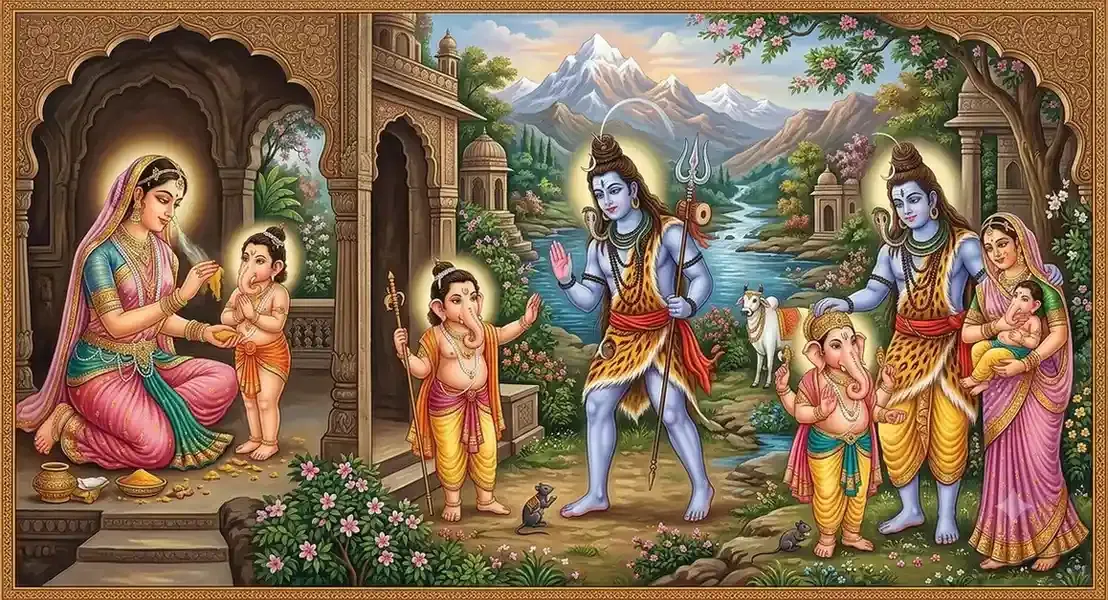
In the Shiva Purana, Parvati wishes for an attendant entirely her own. While bathing, she forms a boy from the fragrant paste on her body, breathes life into him and asks him to guard her door. When Shiva returns home, the boy refuses to let him in. Shiva's ganas fight him and fail; finally Shiva himself beheads the boy.
Parvati's grief is so great that creation trembles. Shiva sends his ganas northward to bring the head of the first creature they meet. They return with an elephant's head, which Shiva places on the boy's body, bringing him back to life. Shiva makes him leader of the ganas, Ganapati, and decrees that he will be worshipped first.
Lesson: Duty and loyalty are sacred, and even mistakes can be transformed into blessings.
Another version: The Brahmavaivarta Purana says that Shani, whose gaze was cursed, looked at the infant Ganesha at Parvati's insistence, and the child's head was severed; Vishnu then brought an elephant's head to restore him.
2. The race around the world
Shiva and Parvati challenge their sons to circle the world. Kartikeya speeds off on his peacock; Ganesha walks around his parents, explaining that they are his whole world. He is declared the winner. In Tamil tradition, the prize was a divine fruit (often said to be a mango brought by the sage Narada), and the disappointed Kartikeya went away to the hill of Palani. In the Shiva Purana, the prize is the right to marry first, and Ganesha marries Siddhi and Buddhi.
Lesson: Wisdom and love for one's parents outweigh speed and strength.
3. Ekadanta: the broken tusk
Ganesha is shown with one broken tusk, and there are several stories about it. In one, Parashurama, a great devotee of Shiva, comes to Kailasa to see him; Ganesha stops him, and Parashurama strikes him with the axe Shiva had given him. Out of respect for his father's weapon, Ganesha accepts the blow on his tusk instead of deflecting it. This version is told in the Brahmanda Purana.
The most popular story says the sage Vyasa needed a scribe for the Mahabharata. Ganesha agreed on condition that Vyasa never pause; Vyasa agreed on condition that Ganesha understand every verse before writing. When Ganesha's pen broke, he snapped off his tusk and kept writing. This episode appears in some recensions of the Mahabharata and is considered a later addition by scholars.
Lesson: Commitment to a task may call for personal sacrifice.
4. The curse on the moon
After a feast of sweets, Ganesha falls from his mouse and his belly bursts; he ties it up with a snake. Chandra, the moon, laughs. Ganesha curses him so that whoever sees the moon will be falsely accused. When the gods plead, he limits the curse to one night: Bhadrapada Shukla Chaturthi, Ganesh Chaturthi. This is why the moon is avoided that night. Read the full story and the remedy in our guide to Ganesh Chaturthi and the moon.
Lesson: Never mock others; pride in appearance invites a fall.
5. Kubera's feast
Kubera, the god of wealth, invites Shiva to a grand feast to display his riches. Shiva sends the young Ganesha in his place. Ganesha eats everything served, then the stores, then the furniture, and is still hungry. The panicked Kubera runs to Shiva, who gives Ganesha a handful of roasted rice offered with love, and his hunger is satisfied at once. This is a popular devotional tale told in many regional forms.
Lesson: God is satisfied by love, not by lavish display.
6. Ravana and the Atmalinga of Gokarna
Ravana, after fierce penance, receives Shiva's Atmalinga, on the condition that it must not be set down before he reaches Lanka, or it will stay forever where it is placed. The gods, worried about Ravana's growing power, ask Ganesha for help. As Ravana stops for his evening prayers at the seashore, a young cowherd boy, Ganesha in disguise, offers to hold the linga. The boy calls Ravana three times and then sets the linga on the ground, where it remains. Ravana, furious, strikes the boy on the head.
This is the founding legend of the Mahabaleshwar temple at Gokarna in Karnataka. The Ganesha temple there shows him with a dent on his head, in memory of Ravana's blow.
Lesson: Cleverness used for the good of the world defeats brute power.
7. Agastya, the crow and the Kaveri
In a legend of South India, the sage Agastya carries the waters of the future river Kaveri in his water pot (kamandalu). Ganesha, taking the form of a crow, tips the pot over, and the river flows out to bless the land. The story is closely associated with Talakaveri in Kodagu and is told across Karnataka and Tamil Nadu.
Lesson: The divine works for the welfare of all, sometimes in unexpected ways.
8. Gajamukhasura and the mouse
Tamil tradition tells of the demon Gajamukhasura, who could not be killed by any weapon. Ganesha broke off his own tusk and hurled it at the demon. Overcome, the demon took the form of a mouse, and Ganesha made him his vehicle. A different story in the Ganesha Purana tells of a celestial musician, Krauncha, cursed to become a giant mouse, who was tamed by Ganesha.
Lesson: Even the restless and destructive can be transformed when brought under wisdom.
9. The four yuga avatars (Ganesha Purana)
| Yuga | Avatar | Vehicle |
|---|---|---|
| Krita (Satya) Yuga | Mahotkata Vinayaka | Lion |
| Treta Yuga | Mayureshvara | Peacock |
| Dvapara Yuga | Gajanana | Mouse |
| Kali Yuga | Dhumraketu | Horse |
The Ganesha Purana says Ganesha takes a form in each age to restore dharma. Dhumraketu is described as the avatar yet to come at the end of Kali Yuga.
10. The eight avatars (Mudgala Purana)
The Mudgala Purana describes eight forms of Ganesha, each defeating a demon who personifies a human weakness:
| Avatar | Demon defeated | Weakness represented |
|---|---|---|
| Vakratunda | Matsarasura | Envy |
| Ekadanta | Madasura | Arrogance |
| Mahodara | Mohasura | Delusion |
| Gajanana | Lobhasura | Greed |
| Lambodara | Krodhasura | Anger |
| Vikata | Kamasura | Desire |
| Vighnaraja | Mamasura | Possessiveness |
| Dhumravarna | Abhimanasura | Pride |
These avatars turn the stories inward: the real demons are within us, and Ganesha's grace helps overcome them.
How to tell these stories to children abroad
- Tell one story a day during the Ganesh Chaturthi festival, ending with the lesson.
- Let children draw the scene, or act it out with friends at the temple.
- Link each story to an image: the broken tusk, the mouse, the snake around the belly. Children love finding these details on idols.
- Explain that different families and books tell stories differently; that is part of the richness of the tradition.
Frequently asked questions
Which Purana tells the story of Ganesha's birth?
The most familiar version, in which Parvati creates Ganesha and Shiva later gives him an elephant's head, is in the Rudra Samhita of the Shiva Purana. The Brahmavaivarta Purana gives a different account, in which Ganesha's head is lost because of the glance of Shani.
Are there Puranas dedicated to Ganesha?
Yes. The Ganesha Purana and the Mudgala Purana are the two principal texts of the Ganapatya tradition, which worships Ganesha as the supreme deity. They describe his avatars and many of his battles against demons.
Did Ganesha really write the Mahabharata?
Popular tradition says Vyasa dictated the Mahabharata and Ganesha wrote it down, breaking off his tusk to use as a pen. This episode is found in some versions of the epic's opening chapter but not in the critical edition, so scholars regard it as a later addition. It remains a much-loved story.
Why do the stories differ from one book or region to another?
Hindu sacred stories were transmitted through many texts and oral traditions over centuries. Different Puranas and regional retellings preserve different versions. Families usually tell the version their own tradition has handed down; none needs to be treated as the only true one.
Which Ganesha stories are best for young children?
The race around the parents, Kubera's feast and the curse on the moon are short, vivid and carry clear lessons about respect, humility and kindness. The birth story can be told gently for younger children.
Editor's note
Editor's note (5 October 2026): This collection has been restored at its original address after the earlier version was lost. We have named the source of each story where a well-known text tells it, and marked regional or devotional tellings as such. Some details, such as the prize in the race or the origin of the mouse, differ between texts; we have presented the variations rather than choosing one.
Related guides
You might also like
Why Is Ganesha Worshipped First? The Stories, Scriptures and Meaning
Parthiva Ganapati: The Significance of Worshipping a Clay Ganesha, and How to Make One at Home
Ganesh Chaturthi 2026 in Mumbai: Lalbaugcha Raja, Siddhivinayak, Famous Mandals, Visarjan and Planning for 2027