Hanuman Jayanti 2026 in UAE: Indian Community in Dubai, Abu Dhabi & Sharjah Celebrates Bajrangbali with Immense Devotion
April 3, 2026 – The large Indian and Hindu diaspora in the United Arab Emirates (UAE) celebrated Hanuman Jayanti 2026 with great faith, spiritual fervour, and…
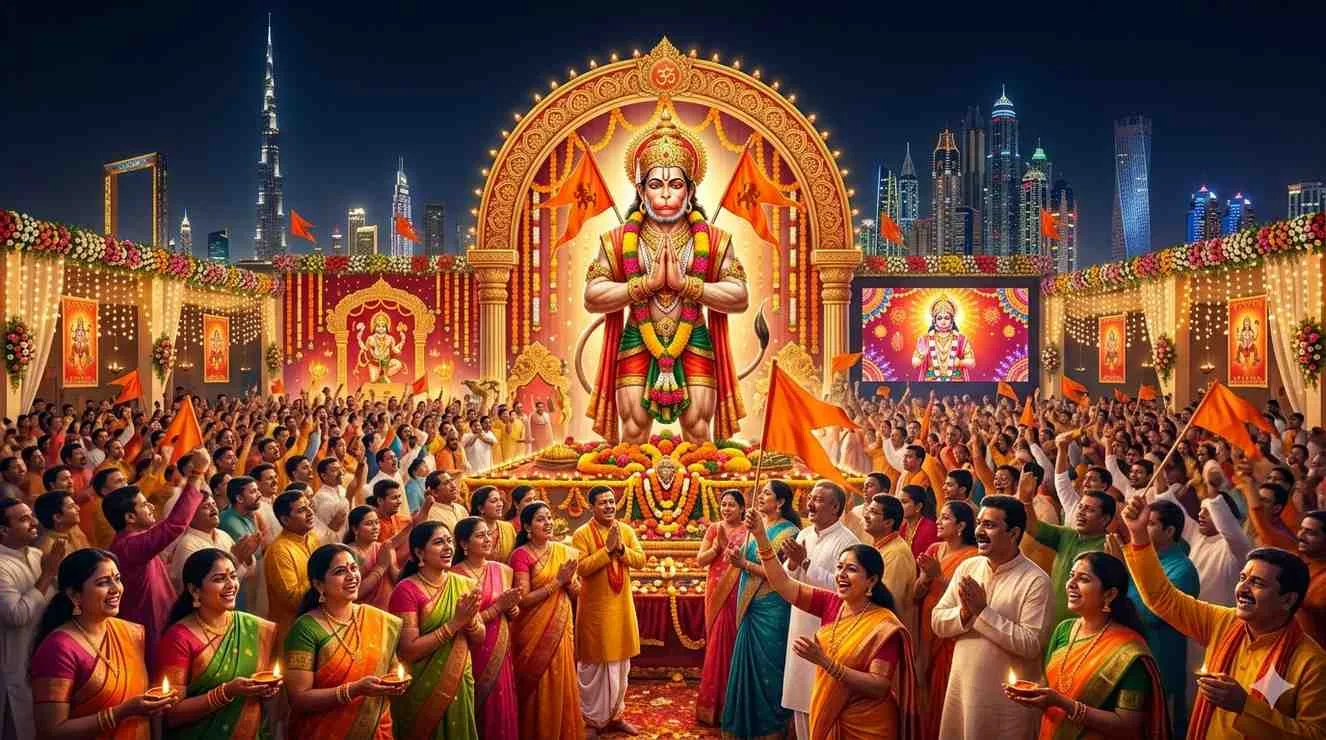
April 3, 2026 – The large Indian and Hindu diaspora in the United Arab Emirates (UAE) celebrated Hanuman Jayanti 2026 with great faith, spiritual fervour, and…
April 3, 2026 – The large Indian and Hindu diaspora in the United Arab Emirates (UAE) celebrated Hanuman Jayanti 2026 with great faith, spiritual fervour, and community unity on Thursday, April 2, 2026. The festival, marking the birth of Lord Hanuman — the embodiment of strength, courage, unwavering devotion to Lord Ram, and selfless service — saw temples and community halls filled with devotees from early morning.
Falling on Chaitra Purnima, Hanuman Jayanti 2026 was observed with special pujas, collective chanting, and cultural events across major cities including Dubai, Abu Dhabi, Sharjah, and other emirates.
Highlights of Hanuman Jayanti Celebrations in the UAE
Dubai
- Hindu Temple Dubai celebrated Shree Hanuman Jayanti on Thursday, April 2, with special poojas and events. The temple remained open throughout the day for darshan. Devotees participated in Hanuman Chalisa recitations, aartis, and bhajans.
- Shree Radheshyam Mandir organised morning aarti at 7:00 AM followed by evening satsang, Hanuman Chalisa chanting, and community programmes.
- Many community groups arranged special abhishekam, Sundar Kand Path, and devotional gatherings.
Abu Dhabi
- Triveni Adhyatmik Samitee invited devotees for Hanuman Mahajanmotsav celebrations, creating an evening filled with devotion, bhakti, and blessings.
- Other Hindu organisations hosted special prayers and community events to mark the auspicious occasion.
Sharjah & Other Emirates Temples and Indian associations in Sharjah, Ajman, and Ras Al Khaimah organised similar programmes including group aartis, bhajans, and community bhandaras (free prasad meals). Families gathered at home and temples to seek Lord Hanuman’s blessings for strength, protection, and success.
Common Rituals Observed by the Indian Diaspora in UAE
- Early morning holy bath and special puja with sindoor, jasmine oil, red flowers, bananas, laddoos, and red cloth.
- Recitation of Hanuman Chalisa (11, 21, 108 times or more), Sundar Kand Path, and powerful Hanuman mantras.
- Temple visits for darshan, collective aartis, and bhajans.
- Community langar/bhandara and acts of seva, reflecting Hanuman ji’s spirit of selfless service.
- Many devotees observed a fast (vrat) and broke it only after evening prayers.
Spiritual Significance for the UAE Indian Community
For the Indian expatriate community in the UAE — one of the largest in the Gulf — Hanuman Jayanti serves as a powerful anchor of faith and culture. Lord Hanuman’s message of fearlessness, loyalty, and inner strength resonates deeply with professionals, families, and students living far from home, helping them face life’s challenges with courage and positivity.
This year’s celebrations highlighted the vibrant Hindu traditions thriving in the UAE, where temples act as important spiritual and social hubs for the diaspora.
Jai Shri Ram! Jai Bajrangbali!
hindutone extends warm greetings to the entire Indian and Hindu community in the United Arab Emirates on this auspicious occasion. May Lord Hanuman bless you with good health, success in all endeavours, protection from obstacles, and boundless inner strength.
Stay tuned to Hindutone for more stories on global Hindu festivals, traditions, and the rich spiritual life of the Indian diaspora worldwide.
Why Is Hanuman Jayanti Celebrated on Chaitra Purnima — and What Do the Scriptures Say About His Birth?
According to the Valmiki Ramayana and the Ananda Ramayana, Lord Hanuman was born on the full moon day (Purnima) of the lunar month of Chaitra, in the Moola Nakshatra, at sunrise. His mother Anjana, a celestial apsara who had taken birth as a vanara due to a sage's curse, performed intense tapasya to receive a divine son. The wind-god Vayu (Pavanadeva) carried the sacred prasad of the yagna performed by King Dasharatha and delivered it to Anjana, making Hanuman the spiritual son of Vayu — hence his widely revered name Pavanputra.
The Shiva Mahapurana offers a complementary account, describing Hanuman as an amsha (partial manifestation) of Lord Shiva himself, born to serve the mission of Lord Vishnu's avatar Sri Rama. This dual theological identity — devotee of Vishnu and manifestation of Shiva — gives Hanuman a uniquely revered place across all major sampradayas of Sanatana Dharma. In the UAE, both Shaiva and Vaishnava devotees gather without distinction to celebrate this day, reflecting his universally beloved nature.
The Spiritual Significance of Sundar Kand Path — the Central Practice of Hanuman Jayanti
Among all the rituals observed during Hanuman Jayanti, the collective recitation of Sundar Kand holds special importance. Sundar Kand is the fifth chapter of Valmiki's Ramayana and the only kanda named after a place — Lanka — whose beauty (sundara) Hanuman himself perceived through the eyes of devotion. It narrates Hanuman's heroic journey across the ocean, his search for Mata Sita in Ashoka Vatika, his meeting with her, and his fearless demonstration of strength before Ravana's court. Reciting Sundar Kand is considered equivalent to performing a complete parikrama of the Ramayana.
The Ramcharitmanas of Goswami Tulsidas, composed in Awadhi in the 16th century, presents the Sundar Kand in its most popularly chanted form across North Indian and diaspora communities. Groups in Dubai and Sharjah typically undertake the Sundar Kand Path in continuous sessions of two to three hours, often beginning before sunrise. It is believed that sincere recitation removes obstacles (vighnas), dispels fear, and brings the grace of both Sri Rama and Hanuman into the household — a belief rooted in the Tulasidas-composed doha: 'Sankat kate mite sab peera, jo sumirai Hanumat balbira.'
Abhishekam with Sindoor and Oil — the Sacred Ritual Science Behind Hanuman's Distinctive Worship
The offering of sindoor (vermilion) to Hanuman is one of his most distinctive forms of worship and is grounded in a narrative from the Ramcharitmanas. Seeing Sita apply sindoor to her forehead as a mark of her devotion to and long life for Lord Rama, Hanuman covered his entire body with sindoor, declaring that if a pinch of sindoor could invoke Sri Rama's grace, his whole body smeared in it would bring the Lord's grace in full measure. Sri Rama, moved by this act, blessed Hanuman saying that whoever worships him with sindoor shall have all their sorrows removed.
Jasmine oil (chameli ka tel) is applied to Hanuman's idol because the Hanuman Puja Paddhati, derived from the Agama traditions, associates this fragrant oil with strength and vitality. Devotees in the UAE typically offer red flowers (particularly red hibiscus), freshly fried boondi laddoos, and bananas — each item carrying symbolic meaning: red flowers denote valor, laddoos represent the sweetness of bhakti, and bananas are associated with Hanuman's well-known fondness documented in folk traditions. Temples in Dubai's Bur Dubai area and Abu Dhabi's Hindu mandirs guide devotees through these specific ritual steps during the Jayanti puja.
Hanuman in the UAE — How the Hindu Diaspora Has Built Temples and Kept Devotion Alive Far From India
The UAE is home to one of the largest Indian diasporas in the world, with an estimated 3.5 million Indians residing across the seven emirates, many of whom are Hindu. The Bur Dubai Hindu Temple — formally known as the Shrinath Ji Temple — is among the oldest Hindu places of worship in the Gulf region, tracing its origins to a small prayer room permitted by the ruling family of Dubai decades ago. Over the years, community organisations such as the Dubai Hindu Temple Trust and various regional associations from Gujarat, Rajasthan, Maharashtra, and Andhra Pradesh have structured regular puja schedules, festival observances, and dharmic education programmes.
Festivals like Hanuman Jayanti serve a dual function in the diaspora context: they are acts of sincere worship and also vital occasions for cultural cohesion. Community bhandaras — the free distribution of prasad meals — bring together devotees irrespective of their state or language background, with Hanuman's inclusive appeal transcending regional divisions. Abu Dhabi's Triveni Adhyatmik Samitee and Sharjah's Indian associations have consistently organised multi-lingual programmes that include bhajans in Hindi, Telugu, Marathi, and Gujarati, ensuring that every segment of the Hindu community feels represented and spiritually nourished.
The Eight Names and Ashta Siddhis of Hanuman — What Devotees Invoke During Jayanti Prayers
The Hanuman Chalisa, composed by Goswami Tulsidas, describes Hanuman as the master of ashta siddhis (eight supernatural powers) and nava nidhis (nine divine treasures), which he can bestow upon his devotees. The ashta siddhis include Anima (the ability to become infinitesimally small), Mahima (the ability to expand infinitely), Garima (acquiring immense weight), Laghima (becoming weightless), Prapti (reaching anywhere), Prakamya (fulfilling all desires), Ishitva (lordship over all creation), and Vashitva (control over all beings). Devotees who recite the Chalisa on Jayanti day specifically meditate on these qualities as divine blessings they seek for themselves and their families.
Hanuman is also worshipped through his Ashtanama — the eight sacred names: Hanuman, Anjanisutha, Vayuputra, Mahābala, Rāmeshtha, Phalguna Sakha, Pingāksha, and Amitavikrama. These names are chanted as part of the morning puja ritual, with each name corresponding to a distinct aspect of his character: his birth (Anjanisutha), his strength (Mahābala), his friendship with Arjuna in the Mahabharata era (Phalguna Sakha), and his limitless valour (Amitavikrama). In the UAE celebrations, community leaders and priests guide participants through these name-chants before the main aarti, deepening the collective understanding of who Hanuman truly is beyond popular imagery.
Hanuman Jayanti Across Different States — Why Some Indian Communities in the UAE Celebrate It Twice a Year
A noteworthy feature of Hanuman Jayanti celebrations within the UAE's diverse Indian community is that different regional groups observe the festival on different dates, based on their home-state traditions. While the majority of North Indian Hindus observe Hanuman Jayanti on Chaitra Purnima (as was the case on April 2, 2026), communities from Andhra Pradesh, Telangana, Karnataka, and Tamil Nadu traditionally celebrate Hanuman Jayanti on the Karthika Bahula Chaturdashi — a date in the month of Karthika (October–November). This regional variation is rooted in different Puranic and regional agamic traditions that each community holds sacred.
In cities like Dubai and Sharjah, where Telugu, Tamil, Kannada, and Malayali Hindu communities are strongly present alongside Hindi-speaking groups, both dates are observed with full devotion. This effectively means that the broader UAE Hindu community comes together to celebrate Hanuman not once but twice a year, reflecting the richness of Sanatana Dharma's regional diversity. Far from creating division, the two celebrations have become an occasion for inter-regional exchange, with North Indian communities attending South Indian-style Hanuman Jayantis and vice versa — a unique characteristic of Hindu diaspora life in the Gulf that strengthens community bonds.
Frequently Asked Questions
When is Hanuman Jayanti in UAE 2026?
Hanuman Jayanti in UAE 2026 falls on April 3, 2026.
What is the significance of Hanuman Jayanti in UAE?
April 3, 2026 – The large Indian and Hindu diaspora in the United Arab Emirates (UAE) celebrated Hanuman Jayanti 2026 with great faith, spiritual fervour, and community unity on Thursday, April 2, 2026. The festival, marking the birth of Lord Hanuman — the embodiment of strength, courage, unwavering devotion to Lord Ram, and selfless service — saw temples an
How is Hanuman Jayanti in UAE celebrated?
Devotees observe it with puja, fasting or special offerings, visiting temples, chanting mantras, and gathering with family. Customs vary by region and tradition.
What should devotees do on Hanuman Jayanti in UAE?
Worship Lord Hanuman, perform the day's puja and offerings, observe the fast where prescribed, and chant the associated mantras with devotion.
You might also like
Hanuman Jayanti 2026: How India Celebrated the Birth of Bajrangbali with Massive Devotion and Festive Spirit
Hanuman Jayanti 2026 in New Zealand: Date, Timings, Complete Birth Story, Puja Vidhi & Major Hanuman Temples Across NZ Cities

Gita Jayanti 2026 Prasad Recipes — Tulsi-Honoring Sweets, Krishna's Favourites & December 10 Bhog Plate