Karthika Pournami 2025 Celebrations and Events in Tirumala-Tirupati
Date: November 5, 2025 (Tripurari Pournami) Purnima Tithi: Begins 10:36 PM Nov 4, Ends 6:48 PM Nov 5 Moonrise: ~6:15 PM IST Auspicious Muhurta: Brahma Muhurta…
Date: November 5, 2025 (Tripurari Pournami) Purnima Tithi: Begins 10:36 PM Nov 4, Ends 6:48 PM Nov 5 Moonrise: ~6:15 PM IST Auspicious Muhurta: Brahma Muhurta…
Date: November 5, 2025 (Tripurari Pournami) Purnima Tithi: Begins 10:36 PM Nov 4, Ends 6:48 PM Nov 5 Moonrise: ~6:15 PM IST Auspicious Muhurta: Brahma Muhurta (4:30–5:15 AM) for Suprabhatam; Pradosha (6–8 PM) for Garuda Seva.
Key Temple Events
- Pilgrim Tips: TTD manages crowds; free laddu prasadam. Book sevas online.
- Virtual: Live-stream on TTD app/YouTube.
- Eco-Note: Cotton wicks, biodegradable plates.
Common Celebration Elements Across Tirumala-Tirupati Temples
- Garuda Seva: Processional highlight on full moon days.
- Abhishekam: Ghee, milk, sandalwood in kalashas.
- Annadanam: Tirupati laddu, curd rice for millions.
- Cultural Fusion: Carnatic music, Bharatanatyam, Telugu bhajans.
- Eco-Friendly: Clay diyas, herbal lamps.
How to Participate in Tirumala-Tirupati
Transportation:
- Flights: Tirupati Airport (TIR)
- Trains: Tirupati Junction (TPTY)
- Buses: APSRTC to Tirumala Hills
Tips:
- Book darshan tokens via TTD app (free SSD for 300 Rs donation).
- Wear veshti/saree for temple entry.
- Carry tulsi leaves, ghee, camphor for offerings.
- Join annadanam – volunteer at Govinda Sadanam.
- Trek Alipiri steps (3,550) for lamp-lit ascent.
Regional Variations in Tirumala-Tirupati Celebrations
Karthika Pournami & Tirumala-Tirupati Multiculturalism
- Interfaith Harmony: Muslims light lamps; Christians attend mela.
- Tourism Boost: AP Tourism promotes Tirumala Deepotsavam.
- Sadhu Culture: Annadanam unites castes; sadhus fed first.
- Eco-Spirituality: Swami Pushkarini cleaning drives.
Conclusion
Karthika Pournami in Tirumala-Tirupati is not just a festival — it is Balaji's cosmic grace in light. From the golden glow of Garuda Seva to the fiery Deeparadhana, from the serene Tulsi Vivah at Padmavathi to the thundering mada veedhi procession, this sacred night transforms the seven hills into a city of a million lamps.
On November 5, 2025, join the light. Take a dip in Swami Pushkarini. Light a diya for Balaji. Chant Govinda Govinda. And become part of Tirumala's eternal spiritual legacy.
Karthigai Deepam: Where the hills bow to the divine light.
For exact timings, virtual queue booking, and annadanam details, check tirumala.org or TTD app. Most events are free and open to all.
Why is Karthika Pournami called Tripurari Pournami and what is its Puranic significance?
Karthika Pournami is celebrated as Tripurari Pournami because, according to the Shiva Purana, Lord Shiva destroyed the three demon-cities known as Tripura on this full-moon night, earning the epithet Tripurari — the enemy of Tripura. The Matsya Purana further describes how Brahma, Vishnu, and all the devas assembled their combined divine energy into a single cosmic arrow, which Shiva released from Mount Meru as his bow, annihilating the asuras Tarakaksha, Vidyunmali, and Kamalaksha.
At Tirumala, this narrative is woven into the Vaishnava devotional framework: Lord Venkateswara is venerated as the Supreme who empowered even Shiva's victory, reflecting the Vishishtadvaita theology of Sri Ramanujacharya that sees all divine acts as expressions of Narayana's will. The Karthika Pournami Deepotsavam at Tirumala therefore carries a dual scriptural resonance — celebrating both Shiva's cosmic triumph and Vishnu's all-pervading luminosity, making the lighting of lamps an act of honouring the singular divine principle behind all forms.
What is the spiritual significance of Swami Pushkarini on Karthika Pournami?
Swami Pushkarini, the sacred tank adjacent to the Sri Venkateswara temple atop Tirumala, is considered one of the most sanctified tirtha-kshetras in South India. The Varaha Purana, which narrates the origin story of Tirumala, describes Swami Pushkarini as a tirtha that descended from Vaikuntha itself, brought by Garuda to purify the earth. A bath in its waters on Karthika Pournami is believed to confer the merit of bathing in all the seven sacred rivers — Ganga, Yamuna, Godavari, Saraswati, Narmada, Sindhu, and Kaveri — simultaneously.
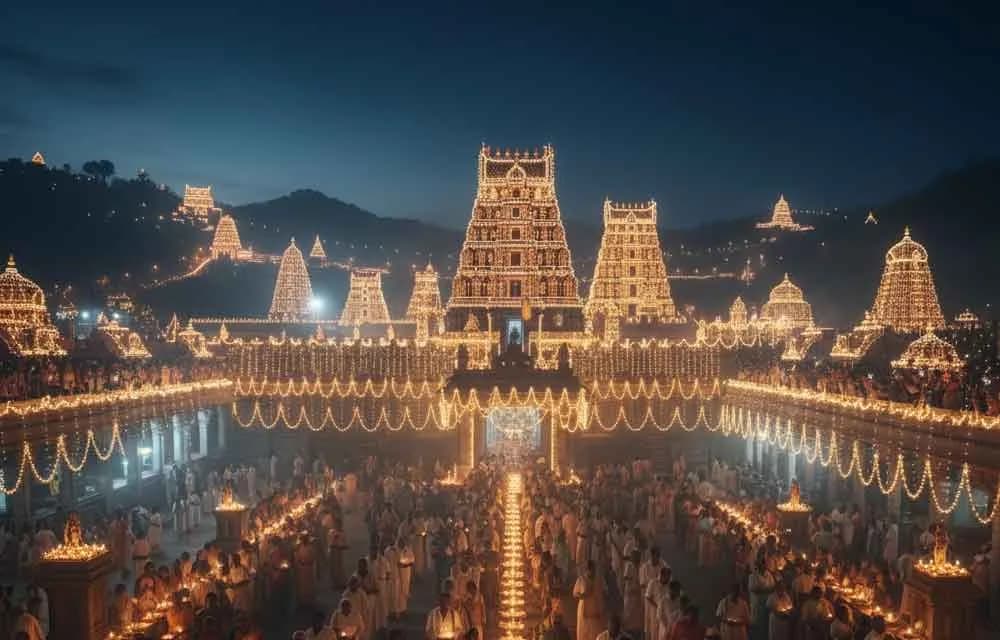
On the night of Karthika Pournami, TTD (Tirumala Tirupati Devasthanams) organises a special Pushkarini Deepotsavam, where thousands of earthen diyas are set afloat on the tank's surface, mirroring the stars above and creating the visual of a liquid sky. Pilgrims who take the early-morning snana (bath) during Brahma Muhurta between 4:30 and 5:15 AM receive a special darshan queue priority. The Pushkarini cleaning drives conducted in partnership with eco-volunteers ensure the tank remains pristine for this sacred ritual each year.
How does the Garuda Seva during Karthika Pournami differ from routine Garuda Seva processions?
Garuda Seva is conducted on several auspicious occasions throughout the Tirumala calendar, but the Karthika Pournami Garuda Seva holds special distinction because it takes place under the full moon of Kartika, a month the Padma Purana describes as the most beloved of Lord Vishnu. During this night procession, the utsava murthy of Lord Venkateswara — accompanied by Sridevi and Bhudevi — is seated on the golden Garuda Vahana and carried along the four mada veedhis (temple streets) of Tirumala to the continuous chanting of the Venkatesa Suprabhatam, Prabandhams from the Nalayira Divya Prabandham, and Vedic hymns.
What distinguishes the Karthika Pournami Garuda Seva is the Pradosha timing — the procession begins precisely at the Pradosha kalam between 6:00 PM and 8:00 PM, coinciding with the moonrise at approximately 6:15 PM IST. Devotees who witness the Lord on Garuda Vahana under the rising full moon are said to receive the combined blessings of Surya darshan and Chandra darshan in a single moment, a rarity called Tri-Kala Darshan in local temple tradition. The streets are lined with rows of camphor lamps and cotton-wick diyas, and Carnatic nadaswaram players accompany the procession, filling the cool November air of the Seven Hills with devotional resonance.
What is the importance of Tulsi Vivah at Padmavathi Temple during this period?
Tulsi Vivah — the ceremonial marriage of the Tulsi plant (Vrinda Devi) to Lord Vishnu in the form of the Shaligrama or an image of Venkateswara — marks the formal end of the Chaturmas period and the opening of the auspicious Vivaha season in the Hindu calendar. At Sri Padmavathi Ammavari Temple in Tiruchanur, approximately 5 kilometres from Tirupati city, this ceremony is performed with full Vedic honours during the Karthika Pournami period, as Padmavathi is revered as an earthly manifestation of Lakshmi Devi, making her temple a fitting site for the divine marriage rite.
The Skanda Purana's Kartika Mahatmya states that one who witnesses Tulsi Vivah during Kartika Purnima earns the merit of performing Kanyadan — the gift of a daughter in marriage — a highly regarded act of dharma. Devotees at Tiruchanur present new silk vastrams, bangles, and floral garlands to the Tulsi plant. Many families from Andhra Pradesh and Telangana bring their own Tulsi pots, which are formally consecrated by temple priests during this festival, taking home sanctified plants as a form of living prasadam to place in their domestic puja rooms.
What Vedic and Agamic rituals mark the Deeparadhana at Sri Venkateswara Temple on this night?
The Deeparadhana — the waving of lamps before the deity — at Sri Venkateswara Temple on Karthika Pournami follows the Vaikhanasa Agama, the ancient ritual scripture that governs all worship at Tirumala. Unlike the daily Ekantha Seva, the Karthika Pournami Deeparadhana employs a specially constructed Maha Deepa consisting of 108 wicks soaked in pure cow ghee, arranged in a concentric lotus pattern. The number 108 corresponds to the 108 Divya Desams — sacred Vaishnava shrines celebrated in the Nalayira Divya Prabandham — and each wick is lit while reciting one name from the Ashtottara Shatanamavali of Lord Venkateswara.
The Vaikhanasa Agama prescribes that during Kartika Purnima, the Deeparadhana must be performed at three distinct moments: at Sayam Sandhya (dusk), at the exact moment of Purnima tithi peak, and at Nishita Kala (midnight). TTD priests follow this trikala Deeparadhana schedule meticulously. The camphor flame used in this ritual, called Karpura Harati, is considered uniquely purifying in Agamic tradition because camphor leaves no residue when it burns — symbolising the dissolution of ego in the divine light of Venkateswara.
What preparations should a first-time pilgrim make to experience Karthika Pournami fully at Tirumala?
First-time pilgrims should ideally arrive in Tirupati on November 4, 2025, a day before the main Pournami, to avoid the peak rush on the festival day itself. TTD provides accommodation at its guest houses such as Srinivasam, Bhimas, and Vishnu Nivasam — all bookable through the official TTD website. Arriving early also allows pilgrims to visit Sri Govindarajaswami Temple and Sri Kodandaramaswami Temple within Tirupati city, both of which conduct their own Karthika lamp festivals on the evening of November 5.
For the Tirumala ascent, the Alipiri footpath offers a spiritually rewarding trek of 3,550 steps, and on Karthika Pournami night this path is illuminated with rows of diyas placed by volunteers, creating a corridor of light that many devotees describe as walking through a living Deepotsavam. Pilgrims are advised to carry cotton wicks, a small ghee container, and a clay diya from the stalls at the foothpath base to participate in this living tradition. For those unable to trek, TTD buses from Alipiri or RTC buses from Tirupati city provide regular service to Tirumala throughout the night, with special frequency scheduled on festival days.
Frequently Asked Questions
What is Karthika Pournami Celebrations and Events?
Date: November 5, 2025 (Tripurari Pournami) Purnima Tithi: Begins 10:36 PM Nov 4, Ends 6:48 PM Nov 5 Moonrise: ~6:15 PM IST Auspicious Muhurta: Brahma Muhurta (4:30–5:15 AM) for Suprabhatam; Pradosha (6–8 PM) for Garuda Seva. Key Temple Events Pilgrim Tips: TTD manages crowds; free laddu prasadam.
What are the key points about Karthika Pournami Celebrations and Events?
Virtual: Live-stream on TTD app/YouTube. Eco-Note: Cotton wicks, biodegradable plates.
Why does Karthika Pournami Celebrations and Events matter in Hinduism?
It reflects core values of Sanatana Dharma and offers practical and spiritual guidance that remains relevant across generations.
How can devotees apply Karthika Pournami Celebrations and Events in daily life?
By reflecting on its teaching, incorporating the related practices or observances into daily routine, and approaching it with sincere devotion and understanding.
You might also like
Anant Ambani Donates 25 Electric Buses to Tirumala TTD | ₹27.5 Crore Mahā Kānuka

Tirumala Tirupati TTD — Complete Guide for NRIs (Darshan, Seva, Accommodation)
The Hindu Festival Calendar Abroad: How NRI Households Choose Which to Commit To