The Story of Lord Shiva and Devi Parvati in Karthika Masam
Karthika Masam (the month of Kartik in the Hindu calendar) holds profound significance in the story of Lord Shiva and Devi Parvati, particularly celebrating…
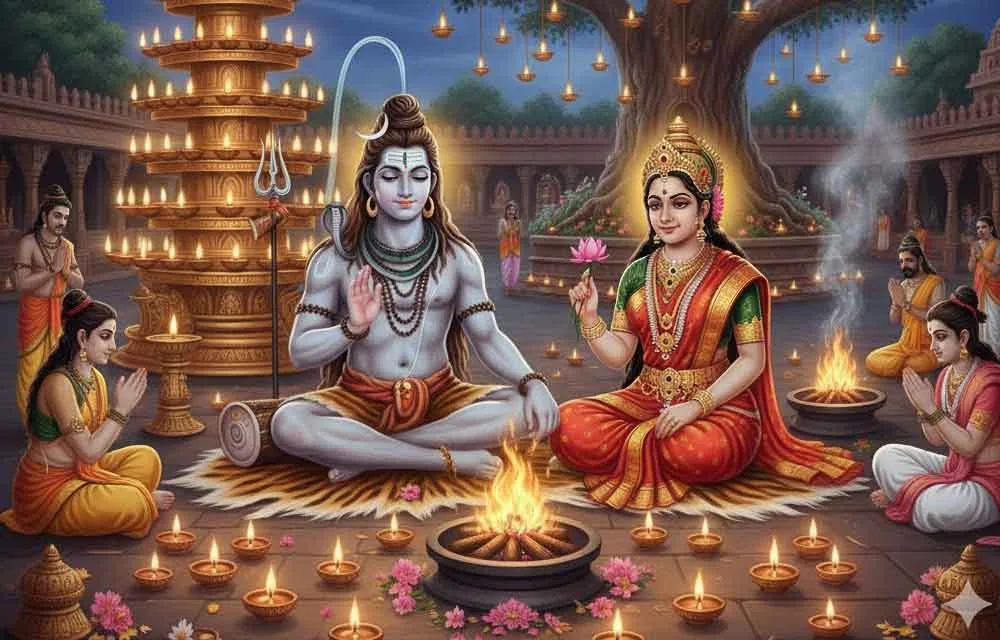
Karthika Masam (the month of Kartik in the Hindu calendar) holds profound significance in the story of Lord Shiva and Devi Parvati, particularly celebrating their divine union and the birth of their son, Lord Kartikeya (also known as Skanda or Murugan).
The Sacred Marriage
According to Hindu mythology, Karthika Masam is especially auspicious because it marks the period when Parvati performed intense penance to win Shiva's heart. After Sati's self-immolation, Shiva retreated into deep meditation, renouncing the world. Sati was reborn as Parvati, daughter of the Himalayas (Himavan), and was destined to reunite with Shiva.
Parvati's Devotion
Parvati undertook severe austerities during this sacred month, meditating without food or water, standing on one leg, and enduring harsh conditions. Her unwavering devotion and penance finally moved Shiva, who tested her resolve in various forms before accepting her as his consort. Their marriage symbolizes the union of Purusha (consciousness) and Prakriti (nature/energy).
The Birth of Kartikeya
During Karthika Masam, the divine couple's son Kartikeya was born. He was created to defeat the demon Tarakasura, who could only be killed by Shiva's son. The six Krittikas (Pleiades constellation stars) nursed the infant Kartikeya, which is why this month is named after them.
Significance in Karthika Masam
During this holy month, devotees:
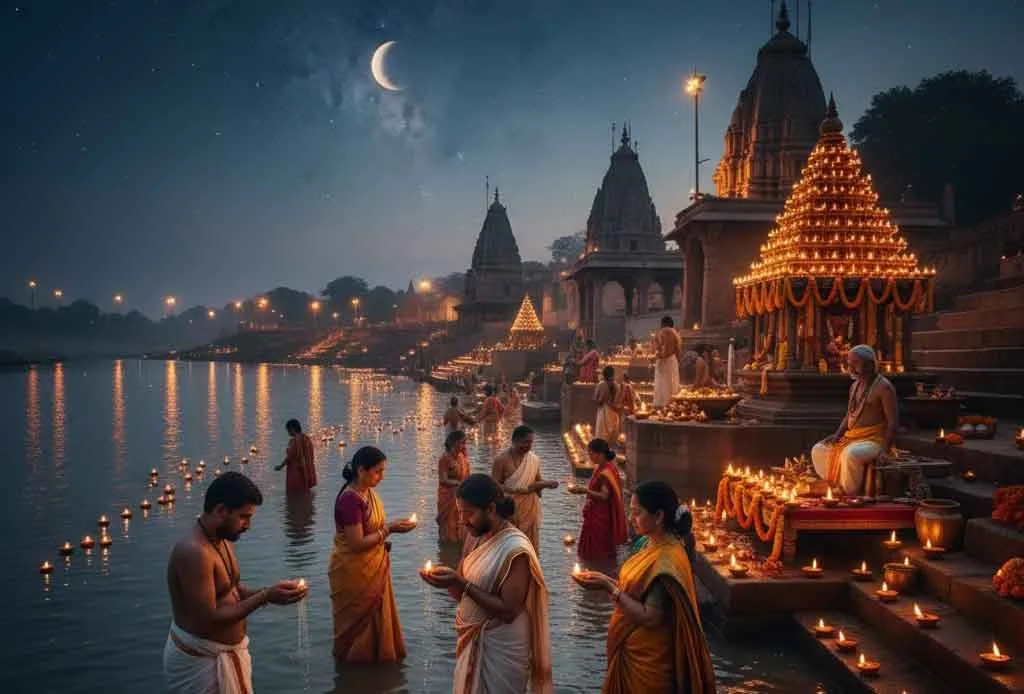
- Light lamps (deepams) to dispel darkness, symbolizing the divine light of Shiva and Parvati
- Observe the Karthika Somavaram (Mondays in Karthika) as particularly auspicious for worshipping the divine couple
- Celebrate their eternal love and the power of devotion
- Seek blessings for marital harmony and spiritual growth
The story reminds devotees that sincere devotion and unwavering faith can move even the ascetic Shiva, and that the divine union of Shiva-Parvati represents the perfect balance of cosmic forces.
What does the Shiva Purana reveal about Parvati's penance in Karthika Masam?
The Shiva Purana, particularly in its Uma Samhita and Rudra Samhita sections, describes Parvati's tapas in vivid detail. She is said to have practiced the harshest form of austerity known as 'Panchagni tapas' — sitting surrounded by four blazing fires in the four cardinal directions while the fifth fire, the sun, blazed overhead. During the cold months coinciding with Karthika, she also stood immersed in icy Himalayan waters, earning her the name 'Aparna' — she who does not even eat a leaf.
Shiva, determined to test her sincerity, sent the Saptarishis (the seven celestial sages) to dissuade her, arguing that an ascetic god was an unsuitable husband. Parvati firmly refused their counsel, stating that her devotion was born of cosmic destiny, not mere desire. Shiva then appeared himself in the disguise of a wandering brahmin and criticized his own character, only to be met with Parvati's unwavering rebuke. This episode underscores that true bhakti cannot be shaken by external argument or adversity.
How does the Skanda Purana connect Kartikeya's birth to the Krittikas and the constellation of Karthika?
The Skanda Purana provides the most expansive account of Kartikeya's birth. Shiva's potent seed (tejas), released during his union with Parvati, was so intense that even the fire god Agni could not fully contain it. Agni, at the instruction of the gods, deposited it in the river Ganga, and she in turn placed it among the reeds of the Sharavana forest in the Himalayas. From those reeds, six infants emerged simultaneously — one for each of the six Krittika stars of the Pleiades cluster.
The six Krittikas nursed the six infants, who then miraculously merged into a single divine child with six faces — 'Shanmukha.' This is why the presiding deity of Karthika Masam is simultaneously Kartikeya (son of the Krittikas) and a direct manifestation of Shiva's divine energy. Temples such as the Palani Dhandayuthapani Swamy Temple in Tamil Nadu and the Tiruttani Murugan Temple celebrate this cosmic birth throughout Karthika with special abhishekas and deep-night lamp rituals.
Why are Mondays (Karthika Somavaram) especially sacred during this month?
In Vedic tradition, Monday is governed by Soma — the moon — and Shiva himself bears the moon as a crown ornament, earning him the epithet 'Someshwara' (lord of the moon). The convergence of Shiva's day (Monday) within Shiva's month (Karthika) creates a doubly auspicious window. Devotees perform Rudrabhisheka — ritual bathing of the Shivalinga with milk, honey, curd, ghee, and sacred water — specifically on these Mondays, chanting the Sri Rudram from the Krishna Yajurveda.
A popular Karthika Somavaram vow observed widely in Andhra Pradesh and Telangana involves women fasting from sunrise to sunset, visiting a Shiva temple before breaking the fast, and lighting a deepam (oil lamp) near a Tulasi plant at dusk. This practice draws from the belief that Parvati herself maintained such devotional discipline to draw Shiva's attention. The vow is considered especially beneficial for unmarried women seeking virtuous husbands and for married couples seeking harmony, mirroring Parvati's own intention.
What is the cosmic symbolism behind the Shiva-Parvati union in Shaiva philosophy?
In Kashmir Shaivism and Shakta Tantra, the union of Shiva and Parvati is not merely a mythological event but the foundational metaphysical principle of existence. Shiva represents pure, unchanging consciousness (Chit), while Parvati as Shakti represents the dynamic creative power (Spanda) that causes manifestation. Without Shakti, Shiva is described in the Soundarya Lahari of Adi Shankaracharya as 'Shava' (a corpse) — inert and unable to act.
The Ardhanareeshvara form — half Shiva, half Parvati in a single body — is the iconic visual expression of this philosophy. This form, celebrated at temples such as the Tiruchengode Ardhanareeswarar Temple in Tamil Nadu, teaches that masculine and feminine principles are inseparable aspects of the same ultimate reality. Karthika Masam, by commemorating their union, effectively becomes a month-long meditation on this non-dual cosmic truth.
The Linga, worshipped during Karthika deepa rituals, itself encodes this symbolism: the Linga (Shiva) rests within the Yoni-pitha (Shakti), representing the interpenetration of consciousness and energy that sustains all creation. Lighting the Karthika deepam before a Shivalinga is therefore understood as honouring the entire cosmos in its generative wholeness.
Which major temples and pilgrimage observances are linked to Shiva-Parvati during Karthika Masam?
Kashi Vishwanath Temple in Varanasi (Kashi) holds the most exalted status during Karthika. It is believed that Lord Vishnu himself lights a lamp at the Vishwanatha Linga on Karthika Purnima, and the Ganga Aarti at Dashashwamedha Ghat on that night draws lakhs of pilgrims annually. The Karthika Purnima festival here is called 'Tripuri Purnima,' commemorating the moment Shiva destroyed the three demon cities (Tripurasura vadha) with a single arrow, a victory made possible by the combined power of all gods.
In South India, the Thiruvannamalai Annamalaiyar Temple in Tamil Nadu observes the Karthikai Deepam festival, where a massive beacon fire is lit atop the Arunachala hill, visible for miles. This represents the column of fire (Jyotirlinga) that Shiva manifested to settle a dispute between Brahma and Vishnu, and the entire event symbolizes the self-revealing light of consciousness — Prakasha. Devotees circumambulate the hill (Girivalam) on the full moon night, a practice believed to equal the merit of a thousand regular pilgrimages.
In Andhra Pradesh and Telangana, the Srikalahasti Temple near Tirupati is a focal point of Karthika worship. The unique 'Vayu Linga' at Srikalahasti, representing the air element among the Pancha Bhuta Lingas, is worshipped with special Shivaratri observances within Karthika month. The fluttering of the temple flame in the sealed inner sanctum — with no visible source of wind — is considered direct evidence of Shiva's living presence.
How should a devotee ideally observe Karthika Masam with reference to Shiva-Parvati bhakti?
Classical texts like the Skanda Purana's Karthika Mahatmya prescribe a month-long sadhana beginning on the first day of Karthika (the day after Ashtami of Ashwayuja). The core daily practice involves waking before sunrise (Brahma Muhurta), taking a bath — ideally in a river or, symbolically, in water mixed with ganga jal — and then lighting a ghee or sesame-oil lamp before a Shivalinga or a Tulasi plant. Reciting the Panchakshara mantra 'Om Namah Shivaya' 108 times is the simplest and most universally recommended practice.
Fasting on Pradosham (the twilight period on the 13th lunar day of each fortnight) during Karthika is considered supremely meritorious, since Pradosham is already Shiva's most sacred time and its power is amplified within Karthika. During Pradosham worship, the Nandikeshvara stotra and the Shiva Tandava Stotram are traditionally chanted. Offering white flowers such as Dhatura and Erukku (Calotropis), bael leaves (Bilva patra), and raw milk to the Linga reflects the specific preferences attributed to Shiva in the Shiva Purana.
Devotees are also encouraged to read or listen to the Karthika Puranam — the Telugu-language rendering of Karthika Mahatmya — in the evenings throughout the month. This communal recitation, held in homes and temples, reinforces the narratives of Parvati's penance, Kartikeya's birth, and the significance of lamp-lighting, turning scriptural knowledge into lived, monthly devotion.
Frequently Asked Questions
Why is Karthika Masam linked to Shiva and Parvati?
As commonly told, Parvati performed intense penance during this month to win Shiva's heart after Sati's self-immolation. The month also marks the birth of their son Kartikeya, who was created to defeat the demon Tarakasura.
Why is the month named Karthika?
The six Krittikas, the stars of the Pleiades, nursed the infant Kartikeya, and the month takes its name from them. Kartikeya is also known as Skanda or Murugan.
Why are Mondays (Karthika Somavaram) especially sacred?
Monday is governed by Soma, the moon, which Shiva wears as a crown ornament, so a Monday in Shiva's month is doubly auspicious. Devotees perform Rudrabhisheka with milk, honey, curd, ghee and sacred water while chanting the Sri Rudram.
How is the Karthika Somavaram vow observed in Andhra Pradesh and Telangana?
Women fast from sunrise to sunset, visit a Shiva temple before breaking the fast, and light a deepam near a Tulasi plant at dusk. It is considered beneficial for unmarried women seeking virtuous husbands and for married couples seeking harmony.
How can a devotee observe Karthika Masam daily?
Wake before sunrise in Brahma Muhurta, bathe, and light a ghee or sesame-oil lamp before a Shivalinga or Tulasi plant. Chanting Om Namah Shivaya 108 times is the simplest recommended practice, and fasting on Pradosham is considered especially meritorious.
Which temples are important for Shiva-Parvati worship in Karthika?
Kashi Vishwanath in Varanasi, famed for Karthika Purnima (Tripuri Purnima), and the Annamalaiyar Temple at Thiruvannamalai, known for the Karthikai Deepam beacon, are key sites. In Andhra Pradesh, the Srikalahasti Temple near Tirupati is a focal point of Karthika worship.
Share this with family and friends
Send it on WhatsApp, post it, or copy the link.
More from Karthika Masam 2025
- Kartika Amavasya: Significance, Importance & Must-Perform Rituals for Spiritual Blessings
- Karthika Masam Monday Rituals: Complete Guide for Hindus in USA, Canada, UK & Australia
- Karthika Masam Sunday Rituals: Sacred Sun Worship Traditions and Mantras
- How Cambodia Celebrated Karthika Pournami 2025: A Comprehensive City-Wise and Temple-Wise Exploration
- Celebrating Kartika Vana Bhojanalu: A Sacred Journey of Devotion Among Hindus in the USA
You might also like
Karthika Masam Monday Rituals: Complete State-wise Guide for India
Must-Visit Temples During Karthika Masam: A Complete Guide to Sacred Destinations
Karthika Amavasya: Complete Guide to Rituals, Significance, and Puja Vidhi