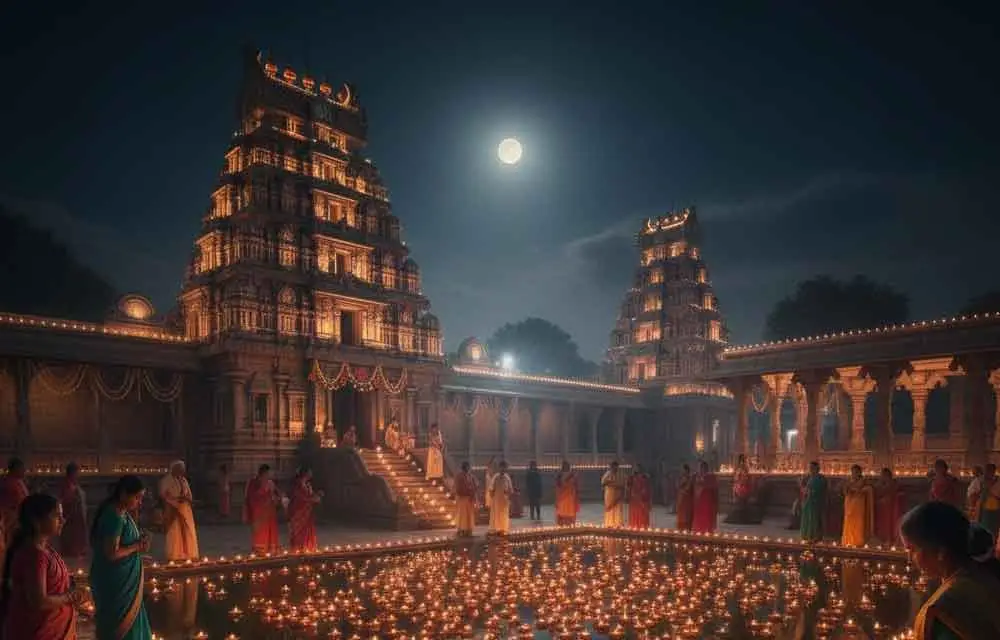
Karthika Masam 2026 Celebrations and Events in Australia
Karthika Masam 2026 begins on 10 November and ends on 9 December. Here are the Australian dates for Karthika Somavaram, Prabodhini Ekadashi, Tulsi Vivah and Karthika Pournami, with rituals and community traditions.

Karthika Masam 2026 begins on 10 November and ends on 9 December. Here are the Australian dates for Karthika Somavaram, Prabodhini Ekadashi, Tulsi Vivah and Karthika Pournami, with rituals and community traditions.
Quick answer: Karthika Masam 2026 (amanta) runs from Tuesday 10 November to Wednesday 9 December 2026. In Australia, Diwali is on Sunday 8 November, Govardhan Puja on Tuesday 10 November and Bhai Dooj on Wednesday 11 November. The Karthika Somavaram Mondays are 16, 23, 30 November and 7 December, Tulsi Vivah is on Sunday 22 November and Karthika Pournami is on Tuesday 24 November 2026. Because 2026 has an extra lunar month, the season falls about three weeks later than last year.
Karthika Masam 2026 by country
In Australian time zones Karthika Masam 2026 runs from Tuesday 10 November to Wednesday 9 December, with four Somavarams (16, 23, 30 November and 7 December) and Karthika Pournami on Tuesday 24 November.
- Karthika Masam 2026 USA — dates, Somavarams and Pournami city by city
- Karthika Masam 2026 UK — dates, Somavarams and Pournami city by city
- Karthika Masam 2026 Canada — dates, Somavarams and Pournami city by city
- Karthika Masam 2026 Australia — dates, Somavarams and Pournami city by city
- Karthika Masam 2026 Dubai & UAE — dates, Somavarams and Pournami city by city
Overview
Karthika Masam is one of the holiest periods in the Hindu calendar, dedicated to Lord Shiva, Lord Vishnu and Lord Kartikeya. For Telugu, Kannada, Tamil, Marathi and Gujarati families across Australia, it is a month of early baths, evening lamps, Monday fasts and community deepotsavams, coming straight after the Diwali week and stretching into early summer.
Key dates and phases
- Shukla Paksha (bright fortnight): 10 November to Karthika Pournami on 24 November 2026
- Krishna Paksha (dark fortnight): 25 November to Karthika Amavasya on Wednesday 9 December 2026
North Indian families who follow the purnimanta calendar count Kartik from about 26 October to 24 November 2026; both calendars share the same Kartika Purnima.
Major festivals during Karthika Masam 2026 (Australian dates)
| Festival | Date in Australia |
|---|---|
| Dhanteras | Friday 6 November 2026 |
| Naraka Chaturdashi and Diwali / Lakshmi Puja | Sunday 8 November 2026 |
| Bali Pratipada / Govardhan Puja (Karthika Masam begins) | Tuesday 10 November 2026 |
| Bhai Dooj | Wednesday 11 November 2026 |
| Chhath Puja | 13 to 16 November 2026 |
| 1st Karthika Somavaram | Monday 16 November 2026 |
| Prabodhini (Devuthani) Ekadashi | Saturday 21 November 2026 |
| Tulsi Vivah | Sunday 22 November 2026 |
| 2nd Karthika Somavaram | Monday 23 November 2026 |
| Karthika Pournami / Kartika Purnima | Tuesday 24 November 2026 |
| 3rd Karthika Somavaram | Monday 30 November 2026 |
| 4th Karthika Somavaram | Monday 7 December 2026 |
| Karthika Amavasya (month ends) | Wednesday 9 December 2026 |
Lakshmi Puja on Diwali is performed in the Pradosh Kaal that begins at local sunset. On 8 November 2026 sunset is about 7:29 pm in Sydney, 8:01 pm in Melbourne, 6:11 pm in Brisbane and 6:47 pm in Perth. Confirm the exact muhurat for your city on Drik Panchang.
Spiritual practices and rituals
Devotees light oil or ghee lamps at dawn and dusk, especially near the Tulasi plant and at the front door, take Karthika Snanam (a holy bath before sunrise), and follow fasts such as Ekabhuktam (one meal a day) or Naktha Vratam (eating only after sunset).
Important observances
- Karthika Somavara Vratham: Monday vows to Lord Shiva with abhishekam and fasting.
- Deepa Daanam: donating ghee or oil lamps to temples, or placing lamps around the home.
- Tulasi Puja: daily worship of the sacred basil plant.
- Damodara Puja: offering lamps and singing the Damodarashtakam to baby Krishna.
- Other vratams: Kartika Deepadaana Vratham, Lakshavarthi Nomu (offering one lakh wicks) and Akashadeepa (a lamp raised high at dusk).
Why Karthika Masam is the holiest month
Karthika Masam is sanctified by the grace of both Lord Shiva and Lord Vishnu, so it is celebrated across Shaiva, Vaishnava and Smarta traditions alike. The Skanda Purana declares that there is no month equal to Karthika. It is the month in which Lord Vishnu wakes from His yogic sleep (Yoga Nidra) on Prabodhini Ekadashi, and in which Lord Shiva is especially accessible to devotees who offer lamps.
The month also carries the energy of Lord Kartikeya (Skanda, Murugan), the divine commander who destroyed the demon Tarakasura. The Padma Purana praises a single lamp lit in Karthika as bringing immense merit, which is why Deepa Daanam is the central act of devotion throughout the month.
Karthika Snanam: the pre-dawn sacred bath
The Karthika Puranam prescribes a bath before sunrise every day of the month, ideally in a river or sacred tank during the Brahma Muhurta, about an hour and a half before sunrise. In India, huge crowds gather on the banks of the Godavari at Rajamahendravaram, the Krishna at Vijayawada and the Ganga at Varanasi.
In Australia, the spirit of the practice is kept by bathing early at home, offering water and prayers to the rising sun, and lighting a lamp before the Tulasi plant. Early sunrise in November means a very early start, so many families take Snanam on weekends and Mondays and a simpler bath on other days. Some Telugu and Kannada community groups have organised collective early-morning gatherings at halls or beaches; check with your local association whether anything is planned for 2026.
Tulasi Vivah and Prabodhini Ekadashi
Prabodhini Ekadashi marks the moment Lord Vishnu awakens from the four-month Chaturmas that began on Devshayani Ekadashi. During Chaturmas, weddings and sacred-thread ceremonies are traditionally postponed; with Prabodhini Ekadashi the auspicious season resumes. In Australia it falls on Saturday 21 November 2026, and Tulsi Vivah, the sacred marriage of Lord Vishnu (as the Shaligrama) to Tulasi Devi, follows on Sunday 22 November.
The Tulasi plant is revered as a form of Mahalakshmi, and the Puranas describe a home with a Tulasi plant as sacred as a place of pilgrimage. In Australian homes, a Shaligrama or small Vishnu idol is ceremonially married to a decorated Tulasi plant with sugarcane, amla, flowers and lamps. Tulasi grows well outdoors in much of Australia in late spring, so this is a lovely ritual to share with children.
Karthika Pournami 2026: Tripuri Purnima and lamps on the water
Karthika Pournami on Tuesday 24 November 2026 is one of the most significant full-moon nights of the year. It is called Tripuri Purnima because, according to the Shiva Purana, Lord Shiva destroyed the three demon cities (Tripura) on this night and became known as Tripurantaka. The devas celebrated by lighting lamps across the heavens, and devotees re-enact this by floating earthen diyas on rivers, lakes and ponds.
In South India, temples light tall lamp pillars (deepa stambha) and Murugan temples hold grand lamp festivals. In Australia, some temples hold evening abhishekam and deepotsavam, and families light 365 wicks at home, one for each day of the year. If you float lamps outdoors, follow local fire rules, which can be strict in late spring.
Damodara month: the Vaishnava dimension
In the Vaishnava tradition, Kartika is Damodara Masam, named after the pastime in which Mother Yashoda bound the infant Krishna with a rope (dama) around His belly (udara), told in the Srimad Bhagavatam. The Hari Bhakti Vilasa prescribes singing the eight verses of the Damodarashtakam every evening while offering a lamp to baby Damodara.
ISKCON temples worldwide, including Hare Krishna Melbourne and other Australian centres, observe the month with daily lamp offerings and collective chanting of the Damodarashtakam, usually following the purnimanta reckoning that ends on Kartika Purnima. Contact your nearest centre for its 2026 schedule.
How Australian communities adapt Karthika traditions
Australian Hindu communities calculate Snanam, Ekadashi and Purnima timings by local sunrise and moonrise rather than India time. Temple committees in Sydney, Melbourne, Brisbane, Adelaide and Perth typically publish monthly panchang calendars adapted to Australian time zones, and bodies such as the Australian Council of Hindu Clergy have worked on unified panchangs for Australian Eastern time. Note that a few Ekadashi and Tulsi Vivah dates fall a day later in Australia than in India in 2026.
Community organisations such as the Telugu Association of Melbourne, the Hindu Council of Australia, and the Balaji and Venkateswara temples in Australian cities have long organised Karthika Deepotsavam evenings combining Vedic puja, discourses and collective Tulasi puja. These gatherings keep devotional continuity for first-generation migrants and introduce Australian-born children to festivals beyond Diwali. For 2026 programmes, check with your local temple or association.
Frequently asked questions
When is Karthika Masam 2026 in Australia?
In the Telugu and Kannada (amanta) calendar, Karthika Masam 2026 begins on Tuesday 10 November, the day of Bali Pratipada and Govardhan Puja in Australia, and ends on Karthika Amavasya, Wednesday 9 December 2026 in Australian time zones.
Why is Karthika Masam so much later in 2026?
2026 contains an extra lunar month (Adhika Masa). As a result Diwali, Karthika Masam and the festivals around them fall roughly three weeks later than in the previous year.
When is Karthika Pournami 2026 in Australia?
Karthika Pournami (Kartika Purnima, Tripuri Purnima) falls on Tuesday 24 November 2026 in Australia.
When is Tulsi Vivah 2026 in Australia?
Because of the time difference with India, Prabodhini (Devuthani) Ekadashi falls on Saturday 21 November and Tulsi Vivah on Sunday 22 November 2026 in Australia, one day later than in India.
What are the Karthika Somavaram dates in 2026?
The Mondays of Karthika Masam 2026 are 16, 23 and 30 November and 7 December. Devotees fast and perform Shiva abhishekam on these days.
Where can I find exact puja timings for my Australian city?
Use Drik Panchang with your city selected, or the panchang published by your local temple. Times differ between Sydney, Melbourne, Brisbane, Adelaide and Perth, so avoid using India times.
Editor's note (4 October 2026)
This article has been updated for 2026 using Drik Panchang dates for Australia. Specific events, venues and timings from earlier editions have been removed because they do not carry over to 2026. Check your local temple or association for this year's programmes.
Related guides
You might also like
Gita Jayanti 2026 Prasad Recipes — Tulsi-Honoring Sweets, Krishna's Favourites & December 20 Bhog Plate
Shani Deva Temples Worldwide & Must-Performed Rituals — Complete Devotee's Guide
Maha Shivratri 2026 Vrat Recipes — Sabudana Khichdi, Singhada Halwa, Phalahara Foods Complete Fasting Guide