
Margashirsha Guruvar Vrat 2026: Mahalakshmi Thursday Dates, Margasira Lakshmivara Vratam, Puja Vidhi, Katha and Udyapan
The Margashirsha Guruvar Mahalakshmi vrat of Maharashtra and the Telugu Margasira Lakshmivara vratam are kept on the Thursdays of the amanta month of Margashirsha. In 2026 the month runs from Wednesday 9 December to Thursday 7 January 2027, giving five Thursdays: 10, 17, 24 and 31 December and 7 January. Here are the dates in India and abroad, ghata sthapana, the vrat katha in our own words, naivedya, the udyapan and a health note.
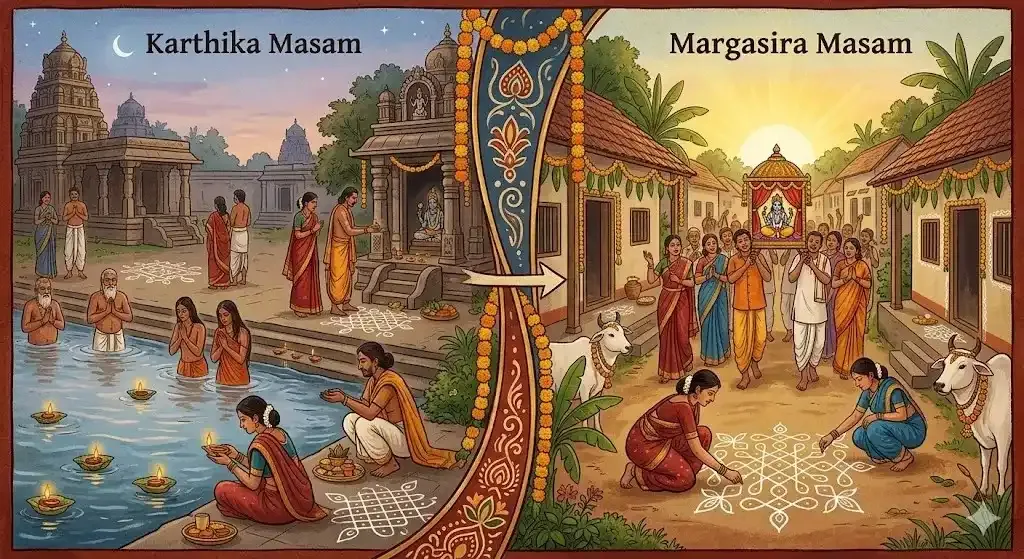
Quick answer: Margashirsha Guruvar 2026 (the Mahalakshmi Thursday vrat of Maharashtra) and the Telugu Margasira Lakshmivara vratam fall on five Thursdays: 10, 17, 24 and 31 December 2026 and 7 January 2027. The amanta month of Margashirsha runs from Wednesday 9 December 2026 to Thursday 7 January 2027. The udyapan is traditionally on the last Thursday, 7 January 2027. The Thursdays are the same in India, the USA, Canada, the UK, the Gulf, Singapore and Australia.
Last updated: 21 October 2026. We have brought the Telugu Margasira Lakshmivara vratam onto this page, added the Amavasya times from Drik Panchang that fix the start of the month, checked the Thursdays for cities abroad, and added the first verse of the Mahalakshmi Ashtakam from a verified source.
Margashirsha Guruvar 2026 dates (Margashirsha Guruvar vrat kab hai)
| Thursday | Date | What else falls nearby |
|---|---|---|
| 1st Guruvar / 1st Lakshmivaram | Thursday 10 December 2026 | First Thursday of the month; Chandra Darshana |
| 2nd Guruvar / 2nd Lakshmivaram | Thursday 17 December 2026 | Day after Dhanu Sankranti (16 December), the start of Dhanurmasam |
| 3rd Guruvar / 3rd Lakshmivaram | Thursday 24 December 2026 | Margashirsha Purnima; day after Datta Jayanti (23 December) |
| 4th Guruvar / 4th Lakshmivaram | Thursday 31 December 2026 | Last Thursday of 2026 |
| 5th Guruvar / 5th Lakshmivaram | Thursday 7 January 2027 | Amavasya, last day of Margashirsha; usual udyapan day |
How the month is fixed: Drik Panchang shows the Kartika Amavasya ending at 6:21 AM IST on Wednesday 9 December 2026, so Margashirsha begins that day. Our calculator places the next Amavasya's end at about 1:55 AM IST on Friday 8 January 2027, so Thursday 7 January is still in Margashirsha. Pausha begins on 8 January.
Other important days this month: Vivah Panchami (Monday 14 December), Subrahmanya Shashti and Champa Shashti (Tuesday 15 December), Gita Jayanti and Mokshada Ekadashi (Sunday 20 December) and Datta Jayanti (Wednesday 23 December).
Also read in this Margashirsha series: Sabarimala Yatra 2026-27: season dates and deeksha rules, Utpanna Ekadashi 2026, Kalabhairav Jayanti 2026, Vivah Panchami 2026, Subrahmanya Shashti 2026, Gita Jayanti and Mokshada Ekadashi 2026, Datta Jayanti 2026.
Margashirsha Thursdays abroad
The amanta month starts after the local new moon, so in principle the dates could shift abroad. This year they do not. Our calculator, which matches Drik to within one or two minutes, gives the same five Thursdays in every city we checked:
| Region | Cities checked | Margashirsha Thursdays |
|---|---|---|
| India | Delhi, Mumbai, Pune, Hyderabad, Vijayawada, Bengaluru, Chennai | 10, 17, 24, 31 Dec 2026; 7 Jan 2027 |
| USA | New York, Chicago, Houston, Los Angeles, San Jose, Seattle | 10, 17, 24, 31 Dec 2026; 7 Jan 2027 |
| Canada | Toronto, Montreal, Winnipeg, Calgary, Vancouver | 10, 17, 24, 31 Dec 2026; 7 Jan 2027 |
| UK and Gulf | London, Dubai | 10, 17, 24, 31 Dec 2026; 7 Jan 2027 |
| Asia-Pacific | Singapore, Kuala Lumpur, Sydney, Melbourne, Brisbane, Perth | 10, 17, 24, 31 Dec 2026; 7 Jan 2027 |
For city-by-city details see the USA, the UK, Canada and Australia.
What is the Margashirsha Guruvar vrat?
The Margashirsha Guruvar vrat, also called the Mahalakshmi vrat, is a Thursday worship of Goddess Mahalakshmi kept through the month of Margashirsha. It is especially popular in Maharashtra and among Marathi families abroad. Women pray for the health, harmony and wellbeing of their families. In Krishna's words in the Bhagavad Gita (10.35), 'among months I am Margashirsha', so the month is held sacred, and worshipping Lakshmi, Vishnu's consort, in it is seen as especially auspicious.
Margasira Lakshmivara vratam: the Telugu tradition
In Andhra Pradesh and Telangana, Margasira Masam is known for its Thursday Lakshmi puja, the Margasira Lakshmivara vratam (also called Margasira Guruvara vratam or Margasira Lakshmi puja). Women set up a kalasam for Lakshmi Devi, perform puja with turmeric, kumkum and flowers, read the vrata katha and offer naivedyam. Some families offer a different naivedyam on each Thursday, as given in their vrata book, and complete the vratam with a vayanam (offering to married women) on the last Thursday. The Margasira month also has Dhanurmasam, with Tiruppavai recitation in Vishnu temples from 16 December. For the full Telugu month, see Margasira Masam 2026 and Margasira Lakshmi vratam rituals.
Odisha: Odia families keep a similar Thursday Lakshmi worship, Manabasa Gurubar, in their own Margashira month. Their Thursdays follow the Odia panjika and can differ from the dates above.
Ghata sthapana and puja vidhi
Families follow their own vrat book, but a common Thursday setup is:
- Clean the puja area and draw a rangoli. Place a chaurang (low stool) and cover it with a clean red or yellow cloth.
- Spread a small heap of rice or wheat on the cloth and place a kalash on it.
- Fill the kalash with water and add a coin, a betel nut and a little haldi-kunku. Arrange mango leaves (or leaves of five trees, if that is your custom) at the mouth.
- Place a coconut on top, and set a picture or idol of Mahalakshmi, or a Shri Yantra, beside the kalash.
- Offer haldi, kunku, flowers, durva and a ghee lamp. Light incense.
- Read the vrat katha, sing the Mahalakshmi aarti and offer naivedya. Many families repeat the aarti in the evening.
The next morning the kalash water is commonly poured at the foot of a tulsi plant, and the rice is used in cooking. A short Lakshmi mantra many families chant, from our verified list:
ॐ श्रीं महालक्ष्म्यै नमः॥
oṃ śrīṃ mahālakṣmyai namaḥ||
Meaning: Salutations to Mahalakshmi. Shreem is the seed syllable traditionally associated with Lakshmi.
Mahalakshmi Ashtakam: the first verse
Many women recite the Mahalakshmi Ashtakam on each Thursday. Its first verse, from the text published by sanskritdocuments.org:
नमस्तेऽस्तु महामाये श्रीपीठे सुरपूजिते ।
शङ्खचक्रगदाहस्ते महालक्ष्मि नमोऽस्तु ते ॥ १॥
namaste'stu mahāmāye śrīpīṭhe surapūjite |
śaṅkhacakragadāhaste mahālakṣmi namo'stu te || 1||
Meaning: Salutations to you, Mahamaya, who dwells in Shri Pitha and is worshipped by the gods. You hold the conch, discus and mace in your hands; O Mahalakshmi, salutations to you. Read the full Mahalakshmi Ashtakam with meaning.
Mahalakshmi vrat katha, as commonly told
This is our own outline of the story found in Marathi vrat booklets; versions differ between families and between the Marathi and Telugu traditions.
Goddess Mahalakshmi once visited a kingdom in the form of a poor old woman. A proud queen turned her away, but a humble woman welcomed her and learned from her the Thursday vrat of Margashirsha. By keeping the vrat faithfully, with a clean home and a kind heart, the humble woman and her family lived in harmony and plenty.
The queen's household then fell on hard times. When she too learned the vrat, kept it with humility and understood her mistake, her fortune returned. The lesson is that Lakshmi stays where there is respect for others, humility and a devoted, orderly home, not merely where there is money. Read the full katha from your family's vrat book on each Thursday.
Naivedya ideas
- Sheera (rava halwa), kheer or puran poli in Marathi homes
- Pongali, pulihora or payasam in Telugu homes
- Fresh fruit, especially bananas, and dry fruits
- Milk with sugar, or panchamrut
There is no single required menu. Choose by family custom and what you can prepare well.
Udyapan on the last Thursday
The udyapan closes the vrat. In 2026-27 the last Thursday is 7 January 2027. After the usual puja, women commonly:
- Invite married women (suvasinis) for haldi-kunku; many families invite five, seven or more by custom.
- Offer each guest fruit, a small gift and often a copy of the vrat katha booklet, so the vrat spreads.
- Share the naivedya as prasad with guests and family.
- Pray to Mahalakshmi to forgive any mistakes made during the vrat.
Because 7 January is also Amavasya, some families prefer to hold the udyapan on 31 December, on the advice of their elders or priest. The spirit of the udyapan is sharing and gratitude.
Tips for families abroad
- Keep the vrat on Thursday in your own time zone; nothing needs converting from India.
- A small kalash from any Indian store works. If mango leaves are not available, use betel leaves or whatever your family considers suitable.
- If Thursday is a work day, do a short morning puja with a lamp and the katha, and a fuller aarti in the evening.
- The 24 and 31 December Thursdays fall in the holiday season in many countries, which makes a family haldi-kunku easier to arrange.
- For the udyapan, invite friends from your local Marathi mandal or Telugu association.
A note on health
Fasting is optional in this vrat. If you are pregnant, diabetic, unwell or on regular medication, consult your doctor and keep a lighter observance, such as a normal sattvic meal with the puja. Tradition does not ask anyone to put their health at risk, and the vrat does not promise any particular result; it is an offering of devotion and gratitude.
Margashirsha Guruvar 2026: frequently asked questions
What are the Margashirsha Guruvar dates in 2026?
Thursday 10 December, Thursday 17 December, Thursday 24 December and Thursday 31 December 2026, and Thursday 7 January 2027. They fall in the amanta month of Margashirsha, which begins on Wednesday 9 December 2026, after the Amavasya that ends at 6:21 AM IST that morning (Drik Panchang), and ends with the Amavasya of 7 January 2027.
When is the Margashirsha Guruvar udyapan in 2026?
The udyapan is traditionally done on the last Thursday of the month. In 2026-27 that is Thursday 7 January 2027, which is also Amavasya and the last day of Margashirsha. Some families prefer the fourth Thursday, 31 December, so ask your elders.
Are the Telugu Margasira Lakshmivara vratam dates the same?
Yes. Telugu and Kannada families also follow the amanta calendar, so the Margasira Thursdays are the same five days: 10, 17, 24 and 31 December 2026 and 7 January 2027.
Why does the vrat start in December when North India's Margashirsha starts in November?
North India uses the purnimanta calendar, in which Margashirsha began on 25 November and ends with the full moon of 24 December. Maharashtra, Andhra Pradesh, Telangana and Karnataka use the amanta calendar, in which Margashirsha begins after the new moon, on 9 December. The Guruvar vrat follows the amanta month.
Are the Thursdays different in the USA, UK or Australia?
No. We checked New York, Chicago, Los Angeles, Toronto, Vancouver, London, Dubai, Singapore, Sydney and Perth with our calculator, and the five Thursdays are the same everywhere. Keep the puja on Thursday in your own time zone.
Do I have to fast?
No. Many women eat one meal or eat after the evening puja; others do the puja without fasting. Pregnant women, elders and anyone with diabetes or another health condition should keep a lighter observance and ask their doctor before fasting.
Editor's note
Editor's note (21 October 2026): We have updated this page in place. The start of Margashirsha (Amavasya ending 6:21 AM IST on 9 December) and the nearby festival dates come from Drik Panchang; the end of the month and the Thursdays abroad come from our ephemeris calculator, which matches Drik to within one or two minutes. The Sanskrit verse is reproduced from sanskritdocuments.org. The katha is our own outline of a traditional story; versions differ between families and regions. Please follow your family tradition.
Related guides
Share this with family and friends
Send it on WhatsApp, post it, or copy the link.
More from Festivals
- Vasant Panchami 2027 (Saraswati Puja, Basant Panchami, Sri Panchami): Date, Panchami Tithi, Puja Muhurat by City, Vidhi and Story
- Holi 2027: Date, Holika Dahan Muhurat City-Wise, Bhadra Timings, Puja Vidhi and Holi Abroad
- Makar Sankranti 2027: Date, Punya Kaal Timings City-Wise, Bhogi, Pongal, Kanuma, Lohri and Uttarayan
- Dev Deepawali 2026 Varanasi: Date, Purnima Time, Ganga Aarti, Story, Puja Vidhi and Deep Daan
- Kartik Purnima 2026: Date, Purnima Time, Snan, Deep Daan, Puja Vidhi and Significance
You might also like
Margashirsha Masam 2026 UK Dates City by City: Five Thursdays (10 Dec to 7 Jan) for Guruvar Vrat and Lakshmivara Vratam
Margashirsha Masam 2026 USA: Month Dates City by City, All 5 Margashirsha Thursdays (Guruvar Vrat / Lakshmivara Vratam) and Festivals
Margashirsha Masam 2026 in Canada: Month Dates, Five Guruvar Thursdays and Festivals City by City