Dasara – The Significance and Traditions of Vijayadashami
Vijayadashami, also known as Dasara, holds great significance in Hindu culture.
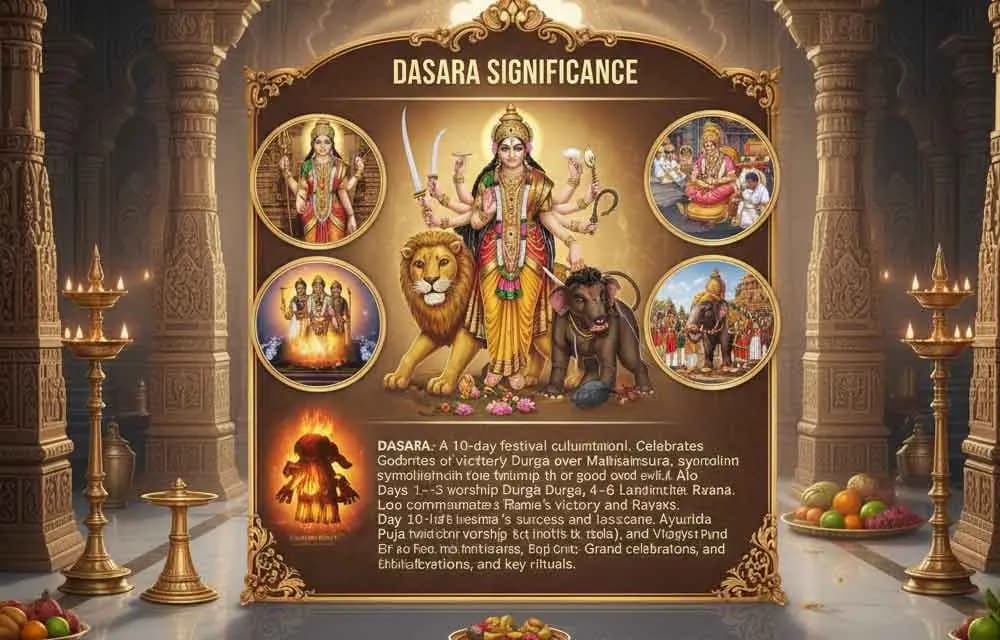
Vijayadashami, also known as Dasara, holds great significance in Hindu culture.
Vijayadashami, also known as Dasara, holds great significance in Hindu culture. It symbolizes victory of good over evil, dharma over adharma, and truth over falsehood.
Origin of the Name “Dasara”
The name Dasara is derived from the Sanskrit term “Dasha Hara”, which means the destruction of ten negative qualities within us:
- Kama (lust)
- Krodha (anger)
- Lobh (greed)
- Moha (attachment/illusion)
- Ahankara (ego)
- Irsha (envy)
- Dvesha (hatred)
- Raga (passion/anger)
- Swarth (selfishness)
- Somaritanam (laziness)
By overcoming these ten qualities, one attains victory. This is why the day is called Vijayadashami, especially commemorating the day Lord Rama defeated Ravana.
Connection Between Dasara and Navaratri
According to the Puranas:
- Goddess Durga slays the demon Mahishasura on the tenth day after nine days of battle.
- Therefore, Dasara is also celebrated as Sharannavaratri (Nine Nights of Durga).
During these nine days, Goddess Durga is worshipped in different forms:
- Bala Tripura Sundari Devi
- Gayatri Devi
- Annapurna Devi
- Katyayani Devi
- Mahalakshmi
- Lalita Tripura Sundari Devi
- Devichandi Devi
- Saraswati Devi
- Durga Devi
- Mahishasura Mardini
- Rajarajeshwari
Significance of the Kite (Palapitta) Sight
- According to tradition, when Lord Rama set out to battle Ravana, seeing a kite on Dasara was considered an omen of victory.
- Similarly, during the Pandavas’ return from their exile, the kite appeared, indicating the end of troubles and a return to prosperity.
In Telangana, this tradition is celebrated by worshipping the Jammi tree, circumambulating it, and touching elders’ feet on Dasara.
Importance of Dasara
- Represents victory of good over evil, dharma over adharma, and truth over falsehood.
- Helps remove negative qualities in individuals and brings auspicious results.
- Worshipping Goddess Durga in her various forms imparts strength, competence, and success.
- Brings peace, prosperity, and happiness to people.
Conclusion:
On this Dasara festival, let us sincerely pray to Goddess Durga for blessings of prosperity, happiness, and success for everyone.
“Sarve Jana Sukhinobhavantu” (May all beings be happy).
What does the Ramayana tell us about the origin of Vijayadashami?
The Valmiki Ramayana records that Lord Rama, before launching his final assault on Lanka, performed a special worship of Goddess Aparajita — the 'Undefeatable One' — on the tenth day of the bright fortnight in the month of Ashwin. The sage Agastya appeared before him and taught him the Aditya Hridayam, a hymn glorifying the Sun, which infused Rama with the divine energy needed to vanquish Ravana. This episode establishes Vijayadashami not merely as a date of victory, but as a day consecrated by the combination of devout worship, sacred knowledge, and righteous resolve.
Ravana himself is described in the Ramayana as the lord of ten heads, each representing one of the ten inner enemies elaborated in the Dasha Hara tradition. His defeat is therefore read at two levels: the outer military triumph of Rama and the inner moral conquest available to every devotee who subdues the same ten negative qualities through sincere self-discipline during the nine days of Navaratri.
How does the Devi Mahatmyam describe Durga's victory over Mahishasura on this day?
The Devi Mahatmyam, the central text of the Shakta tradition embedded within the Markandeya Purana, narrates in its fourth through thirteenth chapters how Goddess Durga — manifested from the combined radiance of all the devas — fought Mahishasura and his armies across nine consecutive nights. On the tenth day, the goddess finally decapitated Mahishasura with her trident, earning the title Mahishasura Mardini. The Puranic account specifies that the deva-s who had been driven from Svarga (heaven) were restored to their rightful realms on this precise day, which is why Vijayadashami is regarded as an auspicious threshold for new beginnings.
The thirteen verses of the Aparajita Stuti, recited specifically on Vijayadashami, invoke the goddess as the power that destroys every form of obstruction. In the Shakta interpretation, Navaratri worship thus culminates on the tenth day not with mourning but with jubilation — Vijayotsava, the festival of victory — making Dasara a day of profound thanksgiving to the Divine Mother for her protective grace.
What is the story of the Pandavas and the Shami tree, and why is it central to Dasara customs?
The Mahabharata records that during their thirteenth year of exile — the Agyatavasa, or year of incognito — the Pandavas concealed their divine weapons inside a Shami tree (Prosopis cineraria) near the city of Virata. On Vijayadashami, they retrieved those weapons before joining the battle to restore their kingdom. Because this retrieval fell on the same auspicious tenth day, the Shami tree became permanently associated with the festival as a symbol of power held in reserve and rightfully reclaimed.
In Telugu-speaking regions, including Telangana and Andhra Pradesh, the ritual of worshipping the Jammi tree (the Telugu name for Shami) on Dasara directly echoes this Mahabharata episode. Families circumambulate the tree, exchange its leaves as a token of gold and prosperity — a practice called Shami Puja — and then seek blessings from elders by touching their feet. The leaves are given with the words 'Shami shamath paapam' ('May the Shami tree destroy all sins'), linking the personal act of receiving blessings to the larger cosmic narrative of dharma's restoration.
Which famous Dasara celebrations across India carry their own distinct regional character?
The Mysuru Dasara, celebrated at Mysuru (formerly Mysore) in Karnataka, is one of the most visually magnificent state festivals in India. The Mysore royal family has observed this festival for nearly four centuries, and the Chamundeshwari Devi at the Chamundi Hills temple atop Chamundi Hills is worshipped with elaborate state honours across the ten days. On Vijayadashami evening, a grand procession called the Jamboo Savari carries the goddess's idol on a caparisoned elephant through the illuminated streets of the city, drawing hundreds of thousands of visitors.
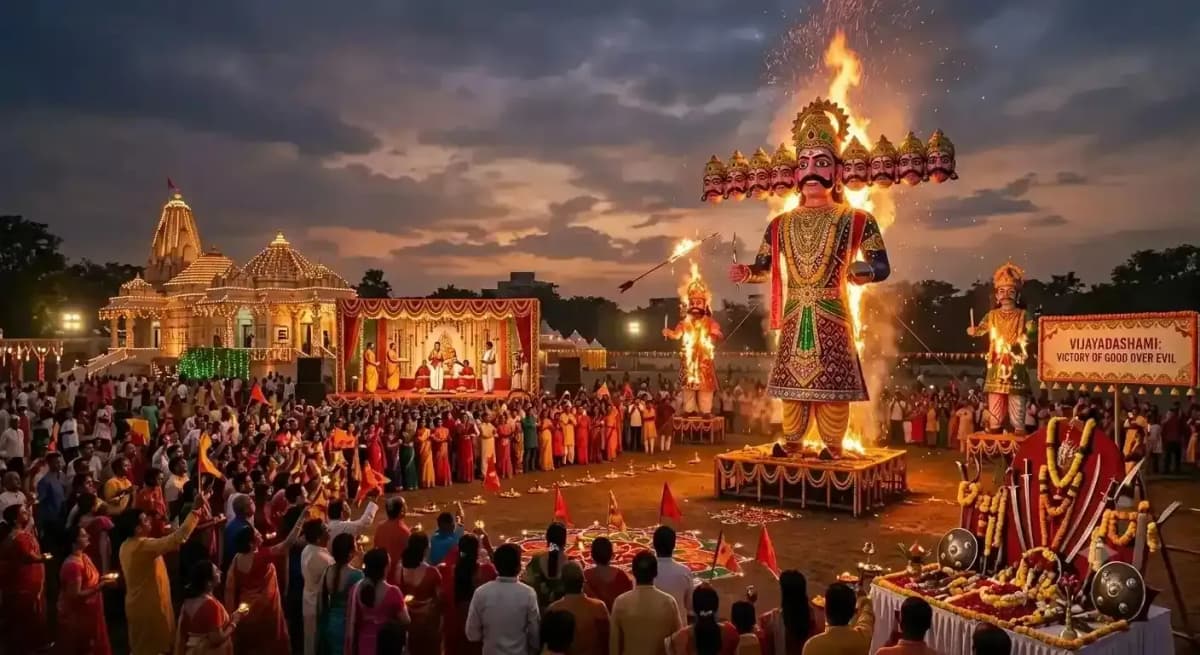
In the plains of northern India, particularly in Varanasi, Delhi, and Lucknow, the tradition of Ramlila — a dramatic re-enactment of the Ramayana performed over nine nights — reaches its climax on Dasara with the burning of giant effigies of Ravana, Kumbhakarna, and Meghanada, symbolizing the annihilation of ego, sloth, and arrogance respectively. In West Bengal and Odisha, the same tenth day marks Vijaya Dashami as the day Goddess Durga departs for her celestial home, and clay images immersed in rivers carry the prayer that she return again the following year — a custom called Sindoor Khela among women before the final immersion.
Why is Vijayadashami considered the most auspicious day for starting new endeavors?
Classical Hindu texts on muhurta (auspicious timing), including the Muhurta Chintamani, list Vijayadashami as one of the three and a half most auspicious moments of the year — called Sade Teen Muhurta — alongside Gudi Padwa, Akshaya Tritiya, and the first day of Kartik. Because the day itself is considered inherently powerful regardless of the planetary positions, no additional astrological calculation is required to begin new activities. This makes it the favored day for starting businesses, buying vehicles, signing agreements, or a child's first formal writing lesson.
The practice of Vidyarambham — initiating children into formal education — is performed on Vijayadashami in many parts of Kerala, Tamil Nadu, and Andhra Pradesh. Toddlers are made to trace the letters of their mother tongue in a tray of rice or sand while a priest guides their finger, symbolically invoking Goddess Saraswati's blessing on the learning journey. Similarly, artisans and craftspeople perform Ayudha Puja — worship of their tools and instruments — on the eve of Dasara, acknowledging that every skill and every implement of honest work is a form of divine Shakti deserving of reverence.
How can a devotee observe Vijayadashami in a personally meaningful and spiritually complete way?
A complete Vijayadashami observance traditionally begins before sunrise with a ritual bath followed by the recitation of the Devi Mahatmyam or at minimum the Mahishasura Mardini Stotram. After home puja, devotees visit a local Durga or Devi temple — such as Kanaka Durga Temple at Vijayawada, Varalakshmi Ammavari temple, or the nearest Shakti shrine in their community — to offer flowers, coconut, and kumkum. The day's worship is ideally concluded by reading a passage from the Valmiki Ramayana describing the Lanka vijaya, connecting the devotee to both the Shakta and Vaishnava dimensions of the festival.
On a personal level, Vijayadashami invites sincere reflection on the ten negative qualities listed in the Dasha Hara tradition. Many spiritual teachers recommend using the nine days of Navaratri as a period of fasting, journaling, or reduced speech to consciously weaken one or more of these inner tendencies, so that the tenth day becomes a genuine personal victory rather than only a cultural celebration. When outer ritual and inner practice align, Vijayadashami fulfills its deepest purpose: not the burning of an effigy far away, but the illumination of the inner darkness that each person carries.
Frequently Asked Questions
When is Dasara – The Significance and Traditions?
Dasara – The Significance and Traditions is observed on its traditional tithi in the Hindu lunar calendar; refer to the year's panchang for the exact date in your region.
What is the significance of Dasara – The Significance and Traditions?
Vijayadashami, also known as Dasara, holds great significance in Hindu culture. It symbolizes victory of good over evil , dharma over adharma , and truth over falsehood .
How is Dasara – The Significance and Traditions celebrated?
Devotees observe it with puja, fasting or special offerings, visiting temples, chanting mantras, and gathering with family. Customs vary by region and tradition.
What should devotees do on Dasara – The Significance and Traditions?
Take a sacred bath, perform the day's puja and charity (dana), observe any prescribed fast, and chant mantras with sincere devotion.
You might also like
Dussehra / Vijayadashami 2026: Complete Guide — Date, Muhurat, Rituals & Meaning
Hindu Festival Calendar 2026 — Complete Guide for NRIs (Dates, Tithis, Puja)
Karthika Purnima 2026: Significance, Rituals, and the Triple Festival Across Hindu, Sikh, and Jain Traditions