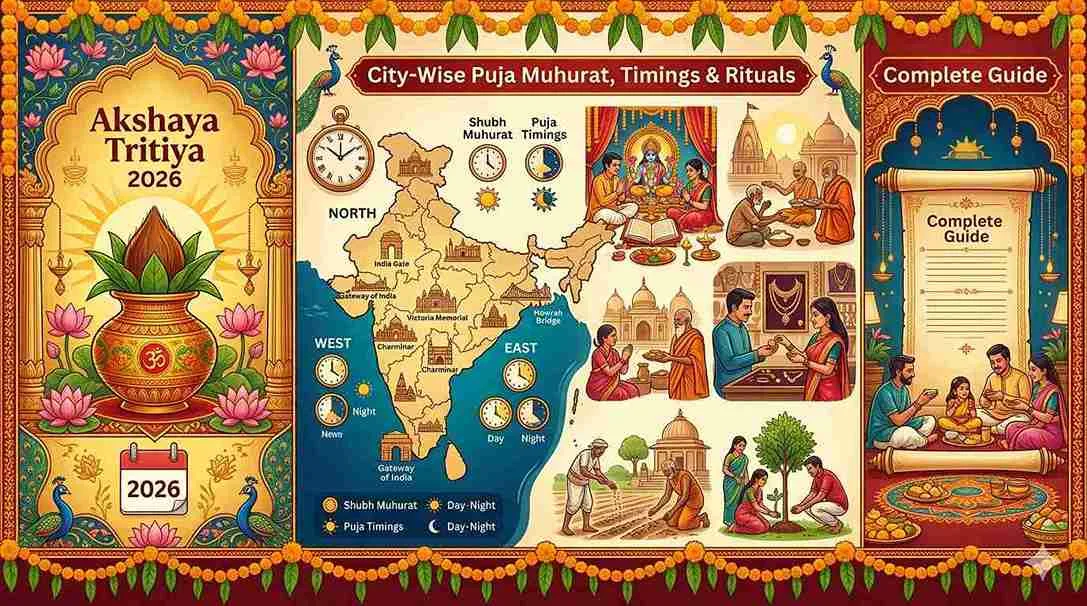
Akshaya Tritiya 2026: Wealth Day Significance
Introduction: The One Day When What You Begin Never Ends In the vast ocean of the Hindu sacred calendar — with its tithis, nakshatras, yogas, and karanas —…
Introduction: The One Day When What You Begin Never Ends In the vast ocean of the Hindu sacred calendar — with its tithis, nakshatras, yogas, and karanas —…
Introduction: The One Day When What You Begin Never Ends
In the vast ocean of the Hindu sacred calendar — with its tithis, nakshatras, yogas, and karanas — there are three days that stand apart from all others. Three days so cosmically auspicious that even the most demanding Vedic astronomer need not calculate a muhurta before beginning any endeavor. Three days when the universe itself declares: "Begin. This moment is blessed."
Those three days are:
- Yugadi — the beginning of a new cosmic age
- Vijayadashami (Dussehra) — the day good defeats evil
- Akshaya Tritiya — the day that never diminishes
Of these three, Akshaya Tritiya is the most universally celebrated, the most deeply woven into the fabric of Hindu daily life, and arguably the most spiritually potent for those seeking material and spiritual abundance.
Akshaya Tritiya 2026 falls on Sunday, April 19, 2026.
The word itself is a promise. Akshaya — from Sanskrit a (not) + kshaya (diminish/decay/erode) — means that which never diminishes, never decays, never ends. The very name of this day is a declaration: whatever you begin here, whatever you offer here, whatever you invest here in goodness and devotion — it will grow. It will compound. It will accumulate across lifetimes.
At HinduTone, we bring you the most complete and devotion-filled guide to Akshaya Tritiya 2026 — the sacred stories that make this day alive, the puja vidhi, the muhurta timings for every major city, the wisdom of what to do and what not to do, and most importantly: the inner secret of why this day truly never diminishes.
[image: 📅] Akshaya Tritiya 2026 — Complete Date & Muhurat
Key Timings
City-Wise Muhurat Table (Puja Window)
[image: ⚠️] All timings are IST (India Standard Time). For exact city-specific puja times, verify with your local Panchang or trusted astrologer. For international dates, check local Hindu temple resources.
The Auspicious Choghadiya Windows
[image: 🌟] Why Akshaya Tritiya Is Called Abuja Muhurta — The Self-Auspicious Day
Among the most significant teachings around Akshaya Tritiya is the concept of Abuja Muhurta — a day that does not require the calculation of any separate auspicious time window.
The Vedic tradition is highly precise about electional astrology (Muhurta Shastra) — the science of choosing the right moment for any important action. Before a marriage, a business launch, a house purchase, or even the planting of crops, a skilled Jyotishi (astrologer) consults the Panchang to find the ideal planetary alignment.
But three days in the Hindu calendar are themselves Abuja Muhurtas — self-auspicious days when the entire day is free from malefic effects:
- Yugadi (Hindu New Year)
- Akshaya Tritiya
- Vijayadashami (Dussehra)
As per Hindu electional astrology, these three lunar days — Yugadi, Akshaya Tritiya, and Vijaya Dashami — do not need any separate Muhurta to start or perform any auspicious work, as these three days are free from all malefic effects.
Why Is Akshaya Tritiya Naturally Auspicious?
On this day, a rare and powerful astronomical convergence occurs:
The Sun and Moon are simultaneously exalted:
- The Sun (Surya) is in its exaltation sign Aries (Mesha) during Vaishakha month — at the peak of its power, radiating maximum cosmic vitality.
- The Moon (Chandra) is in Taurus (Vrishabha) — its exaltation sign — at the height of its emotional and nurturing power.
When both the solar (masculine, active, consciousness) and lunar (feminine, receptive, wealth) principles are simultaneously at their peak, the universe is in perfect balance — and any action taken in that balance carries the imprint of that perfection.
This is why Akshaya Tritiya is called Swayam Siddha Muhurta — the muhurta that is accomplished by itself, requiring no additional calculation to be auspicious.
[image: 📖] The Sacred Stories of Akshaya Tritiya
Story 1: The Beginning of Treta Yuga — When Time Itself Was Blessed
The Hindu conception of cosmic time is divided into four great cycles — the Yugas: Satya (truth), Treta (three-quarters truth), Dwapara (half truth), and Kali (one-quarter truth). Each Yuga is progressively shorter and more challenged than the one before.
According to the Bhavishya Purana and other sacred texts, Treta Yuga — the second cosmic age — began on the day of Akshaya Tritiya. Treta Yuga was the age of the great avatars — Lord Parashurama, Lord Rama, and Lord Vamana all walked the Earth during this age. It was an era when righteousness still governed most of human life, when heroes were truly heroic and dharma was still the organizing principle of civilization.
The beginning of a cosmic Yuga on this day means that Akshaya Tritiya carries within it the energy of cosmic beginnings — of grand new cycles, of ages inaugurated with divine blessing. This is why any beginning made on Akshaya Tritiya carries the energy of a cosmic inauguration, not merely a personal one.
Every sunrise on Akshaya Tritiya is, in the deepest sense, the beginning of a new age for the one who observes it with sincerity.
Story 2: Lord Parashurama — The Warrior-Sage Who Broke the World to Rebuild It
Akshaya Tritiya is the birth anniversary of Lord Parashurama — the sixth avatar of Lord Vishnu and one of the most enigmatic, fierce, and deeply misunderstood figures in Hindu mythology.
Lord Parashurama was born to the sage Jamadagni and his wife Renuka as the son destined to restore balance to a world corrupted by the arrogance of the Kshatriya warrior class. In that era, kings had accumulated so much power that they had begun to oppress Brahmins, sages, and common people alike, believing their military strength made them beyond accountability.
Parashurama received from Lord Shiva the divine axe (Parashu) — a weapon that represents not violence, but the fierce cutting-away of what is corrupt and unjust.
When the arrogant king Kartavirya Arjuna — who had a thousand arms and terrorized the three worlds — stole the divine Kamadhenu (wish-granting cow) from Jamadagni's hermitage and killed the sage when he protested, Parashurama's cosmic mission was activated. He confronted and slew Kartavirya Arjuna and his armies.
In retaliation, Kartavirya's sons killed Jamadagni. Parashurama — in the burning grief of a son watching his father's murder — took a vow that became a cosmic reset: he would free the Earth from the tyranny of corrupt warrior-kings, and he fulfilled it twenty-one times over.
But the deepest teaching of Parashurama is not his ferocity — it is what came after. After restoring cosmic balance, he gave the land he had won to the sage Kashyapa and retired to Mount Mahendra to continue his meditation. He surrendered his victory. He did not hold on to power. He used divine force in service of dharma and then stepped back.
Parashurama's presence on Akshaya Tritiya infuses the day with the energy of righteous power — the courage to cut away what is wrong in your life, the strength to fight for what is just, and the wisdom to then surrender the fruits of your victory to the divine.
Story 3: Sudama and Krishna — The Most Beloved Akshaya Tritiya Story
Of all the stories associated with Akshaya Tritiya, none is more beloved, more moving, or more spiritually complete than the story of Sudama — the poor Brahmin who offered his childhood friend Lord Krishna a handful of flattened rice, and received a palace in return.
Sudama and Krishna had been students together at the hermitage of their guru Sandipani Muni — studying, playing, learning, growing up together in that sacred space where social class dissolves and souls meet. They were the closest of friends. But fate takes different paths: Krishna became the king of Dwarka, wealthy beyond imagination; Sudama became a poor Brahmin scholar, barely able to feed his family.
Years passed. Sudama's wife, watching her husband grow thinner and their children grow more desperate, finally said: "You have a friend — the Lord of Dwarka himself. Go to him. Not to beg — just to visit. Just to remember who you are to each other."
Sudama was ashamed. How could he go before his glorious friend empty-handed? His wife scraped together the only thing they had — a small cloth bundle of poha (flattened/beaten rice) — and tied it with a rough cord. Sudama tucked it under his arm and began the long walk to Dwarka.
When the guards of Dwarka saw this emaciated Brahmin at the gates, they nearly turned him away. But when Sudama said the name Krishna, the entire court was told. And Krishna — the king of Dwarka, master of 16,000 wives, lord of infinite wealth — ran to the gate himself.
He embraced Sudama, tears streaming down his face. He washed his friend's feet with his own hands. He seated him on his own throne. He sent for perfumes and garlands. And then — noticing the small bundle hidden under Sudama's arm — Krishna took it with gentle hands.
Sudama was overwhelmed with shame. What was this handful of flattened rice before the richness of Dwarka? He tried to hold back the bundle. But Krishna had already opened it. He took a handful and ate it with such pure joy — the joy of a heart receiving love, not wealth — that Goddess Rukmini placed her hand over the second handful, fearing Krishna's cosmic generosity might overflow.
Sudama spent three days in Dwarka, unable to bring himself to mention his poverty. Finally, he left — still not having asked for anything.
On the road home, his mind was filled with bittersweet peace. He had seen his friend. He had been loved. Perhaps that was enough.
And then he reached his village — and stopped walking.
Where his mud-walled hut had been, there now stood a golden palace. His wife, dressed in fine silk, came running with their children — all of them laughing, crying, radiating a joy he had never seen. The entire village had been transformed.
Not a single word had been spoken. Not a single request had been made. A handful of flattened rice — offered with pure love on this sacred day — had unlocked the inexhaustible treasury of the universe.
This is the innermost secret of Akshaya Tritiya: The universe does not measure the size of your offering. It measures the sincerity of your heart. The smallest act of genuine love and generosity on this day carries the weight of a cosmic investment — and its returns never diminish.
Story 4: The Akshaya Patra — The Bowl That Never Emptied
In the Mahabharata, when the five Pandava brothers were sent into the forest for twelve years of exile following their defeat in the dice game, they faced an immediate and terrible problem: how to feed the thousands of sages, relatives, and followers who had come to live with them in the forest out of loyalty and love?
The Pandavas had no kingdom, no treasury, no crops. Feeding thousands of people daily from a forest was an impossible task. Yudhishthira, the eldest and most dharmic of the brothers, prayed to the Sun God (Surya Deva) with absolute sincerity.
The Sun God appeared and gifted Draupadi — the Pandavas' wife — the Akshaya Patra: a sacred copper vessel (patra = vessel) inscribed with cosmic energy. This divine bowl would produce unlimited food every day — but only once per day, and only before Draupadi herself ate.
For twelve years in the forest, the Akshaya Patra fed thousands of people every single day without ever running empty. It was the living embodiment of the Akshaya principle — inexhaustible, self-renewing abundance, available to those who serve others before serving themselves.
The Akshaya Patra story contains the most practical teaching of the day: Abundance that never diminishes is not hoarder's wealth — it is giver's wealth. The bowl filled because Draupadi gave before she ate. The universe refills what is given away in service of others. Selfless giving is the only truly inexhaustible investment.
It is no coincidence that this gift was given on Akshaya Tritiya.
Story 5: Veda Vyasa and the Beginning of the Mahabharata
According to some sacred traditions, it was on the day of Akshaya Tritiya that the great sage Veda Vyasa began dictating the Mahabharata to Lord Ganesha — who agreed to write it down, on one condition: that Vyasa would never pause in his narration.
Vyasa agreed — on his own condition: that Ganesha would not write down a single word until he had fully understood it.
And so began the longest poem in human history — 100,000 verses, the most comprehensive account of dharma, ethics, war, love, and liberation ever composed. Begun on the day of Akshaya Tritiya — the day of eternal, never-diminishing things — the Mahabharata has indeed never diminished. It has been read, recited, performed, and lived by hundreds of millions of people for over three thousand years.
What you begin on Akshaya Tritiya with true sincerity has the potential to outlast everything.
Story 6: The Vrat Katha — The Merchant Mahoday and the Power of Devotion
The Vrat Katha of Akshaya Tritiya — the traditional story recited during the day's ritual observance — tells of a merchant named Mahoday who lived in ancient Varanasi.
Mahoday was kind-hearted but impoverished. One day, a neighbor told him about Akshaya Tritiya — how observing a fast, bathing in sacred waters, worshipping Lord Vishnu, and performing charity on this day could transform one's fortune across multiple lifetimes.
Mahoday took the teaching to heart. On Akshaya Tritiya, he woke before dawn, bathed in the sacred Ganga, worshipped Lord Vishnu with flowers and incense, and gave away what little food he had to hungry Brahmins and the poor — going without himself for the day.
He repeated this practice every year without fail, with increasing devotion, until the end of his life.
In his next birth, Mahoday was reborn as a mighty king — the King of Kushavati — wealthy, righteous, beloved by his people, victorious in all endeavors. His ministers and subjects wondered: "How did he earn such extraordinary fortune?"
The cosmic answer was simple: one day of sincere devotion, charity, and fasting on Akshaya Tritiya — performed with a pure heart and without expectation — had accumulated enough karmic merit to transform an entire lifetime, and then the next.
The teaching: You do not need great wealth to observe Akshaya Tritiya rightly. You need great sincerity.
[image: 🌸] The Deep Meaning of Akshaya Tritiya — What "Never Diminishing" Really Means
The Four Dimensions of Akshaya
The word Akshaya applies on four dimensions — each more profound than the last:
1. The Karmic Dimension: Every act of dharma — every mantra chanted, every fire ritual performed, every donation given, every prayer offered — on Akshaya Tritiya generates Punya (merit) that is permanent. It does not decay with time. It does not diminish across births. It accumulates in the cosmic ledger as an unbreakable investment.
2. The Astrological Dimension: The Sun in exaltation and Moon in exaltation simultaneously creates a period of maximum cosmic vitality in both masculine (solar/active) and feminine (lunar/receptive) energies. Actions taken in this perfect balance carry the energetic imprint of that completeness.
3. The Material Dimension: Gold, silver, and other forms of wealth purchased on this day are believed to grow and appreciate, representing the universe's confirmation that this investment is aligned with cosmic prosperity. More broadly, any business, property, or venture begun on this day begins with cosmic tailwind.
4. The Spiritual Dimension: The deepest level of Akshaya Tritiya is the realization that the only thing that truly never diminishes is consciousness itself — the Atman, the Self. Every act of dharma on this day is an investment in the recognition of your own imperishable nature.
[image: 🪔] Akshaya Tritiya Puja Vidhi — Complete Step-by-Step
Morning Rituals (Before Puja Muhurta)
Before Sunrise:
- Wake up early — ideally at Brahma Muhurta (4–6 AM)
- Apply sesame oil (til ka tel) and take a ritual bath — the oil bath on Akshaya Tritiya mirrors the purification of Abhyanga Snan
- If near a sacred river — Ganga, Yamuna, Godavari, or any flowing water — bathing there on this day is considered especially meritorious
- Wear clean, new, or freshly washed clothes — yellow, gold, or white are most auspicious on this day (yellow honors both Vishnu and the Sun in his exaltation)
- Fast through the morning until puja is complete
Setting Up the Puja (Before 10:49 AM)
- Clean the puja room thoroughly. Sprinkle Gangajal in all corners.
- Set up the altar with a yellow or red cloth on the chowki.
- Place the idol or image of Lord Vishnu in the center.
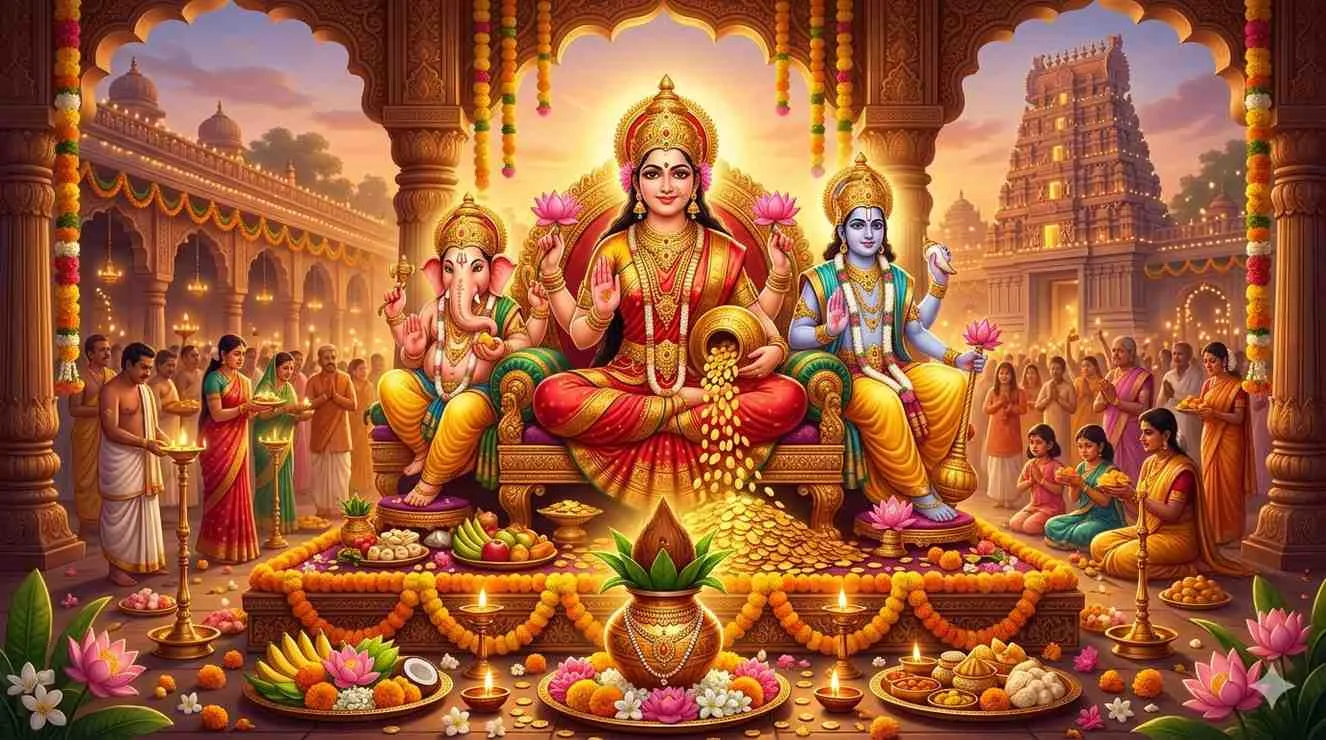
- Beside Vishnu: Goddess Lakshmi (his eternal consort — she is always worshipped alongside him).
- Optionally add Lord Kubera (divine treasurer) and Lord Ganesha (remover of obstacles).
- Arrange a Kalash (copper pot) filled with water, mango leaves, and a coconut on top.
- Place new coins and gold/silver items on the altar — they will be energized during puja.
- Prepare the Naivedya (food offering) in advance.
The Puja Sequence
Step 1 — Ganesh Puja (Always First):
"Om Gam Ganapataye Namah" — chant 21 times, offer red flowers and modak
Step 2 — Sankalpa (Sacred Intention): State your sankalpa clearly before the deity — your name, your gotra, the date, and your sincere intention: "On this sacred day of Akshaya Tritiya, Vaishakha Shukla Tritiya, Vikram Samvat 2083 — I, , perform this puja with the sincere intention of and for the welfare of all. May Lord Vishnu and Maa Lakshmi bless this intention that it never diminishes."
Step 3 — Vishnu Puja (Shodashopachar): Offer the sixteen services to Lord Vishnu in sequence:
- Invocation (Avahana): "Om Namo Narayanaya — Aavahayami"
- Sacred seat (Asana)
- Foot washing (Padya) with Gangajal
- Water offering (Arghya)
- Panchamrit Abhishek — bathe the idol with milk, curd, ghee, honey, and sugar in sequence; then with rose water, then Gangajal
- New clothes/yellow fabric (Vastra)
- Sacred thread (Yagnopavita)
- Sandalwood paste (Chandan) — apply to forehead
- Yellow flowers — especially marigold and lotus (Pushpa)
- Incense (Dhupa)
- Ghee lamp (Deepa)
- Food offering (Naivedya)
- Betel leaf (Tamboolam)
- Circumambulation (Pradakshina) — three clockwise rounds
- Aarti
- Prostration (Shashtanga Pranam)
Step 4 — Lakshmi Puja: After Vishnu puja, offer the same reverence to Maa Lakshmi:
"Om Shreem Mahalakshmyai Namah" Offer lotus flowers, marigold, kumkum, and the special Akshaya Tritiya Naivedya (see below).
Step 5 — Kubera Puja:
"Om Yakshaya Kuberaya Vaishravanaya Dhanadhanyaadhipataye Dhanadhanya Samriddhim Me Dehi Dapaya Svaha" Place gold coins and new currency before Kubera's image. This triple puja — Vishnu, Lakshmi, Kubera — is the most complete Akshaya Tritiya worship.
Step 6 — Vishnu Sahasranama: Recite the Vishnu Sahasranama (1000 names of Vishnu) or at minimum the Dwadasha Nama (12 sacred names) on Akshaya Tritiya:
"Om Keshavaya Namah, Om Narayanaya Namah, Om Madhavaya Namah, Om Govindaya Namah, Om Vishnave Namah, Om Madhusudanaya Namah, Om Trivikramaya Namah, Om Vamanaya Namah, Om Shridharaya Namah, Om Hrishikeshaya Namah, Om Padmanabhaya Namah, Om Damodaraya Namah"
Step 7 — Aarti: Perform the complete Vishnu Aarti with a ghee lamp, bell, and full voice.
Step 8 — Prasad Distribution and Daan: After puja, distribute prasad generously — not just to family, but to neighbors, workers, and anyone present. Then perform the Daan (donation) that is the most important act of the day.
[image: 🎁] What to Do on Akshaya Tritiya 2026 — The Complete Auspicious Actions
1. Daan (Charity) — The Most Sacred Act of the Day
The scriptures unanimously declare: On Akshaya Tritiya, the merit from charity is imperishable. What you give away on this day, you receive back — multiplied — across all lifetimes.
Most meritorious donations:
- Anna Daan (Food donation): Feed the hungry — at orphanages, old age homes, roadside workers, migrant laborers. This directly invokes the Akshaya Patra's blessing.
- Jal Daan (Water/Sharbat donation): In April heat, distributing cool water, lemon sharbat, or coconut water to travelers and workers is considered extremely meritorious.
- Vastra Daan (Clothes donation): New or good-quality clothes donated to the poor.
- Gold/Silver donation: Even a tiny gold or silver coin donated to a temple or spiritual institution carries extraordinary Akshaya merit.
- Cow donation (Go Daan): One of the highest forms of Daan in the Hindu tradition.
- Book donation: Especially books of knowledge and scripture.
- Feeding Brahmins / Sages: Inviting Brahmins for a meal and offering Dakshina.
- Pitru Tarpan: Performing ancestral offerings (Tarpan) on this day liberates ancestors and generates merit that flows both upward (to ancestors) and downward (to the practitioner's own life).
"Japa, yajna, pitra-tarpan, dan-punya performed on Akshaya Tritiya never diminish — they remain with the person forever." — Vedic Panchang tradition
2. Gold Purchase — The Symbol and the Substance
Purchasing gold on Akshaya Tritiya is one of the most widespread Hindu traditions — practiced by hundreds of millions of families across India and the global Hindu diaspora.
Why gold specifically?
- Gold is Suvarna — the color of the sun, which is in exaltation on this day
- Gold does not tarnish, rust, or decay — it is akshaya in its very nature
- Gold is associated with Goddess Lakshmi — every gram of gold is a form of her energy welcomed into the home
- Gold purchased on this day is believed to grow and appreciate — financially as an investment, and spiritually as an anchor for Lakshmi's presence
What to buy if gold is not accessible:
- Silver coins (especially with Lakshmi's image)
- New copper or brass utensils — symbols of nourishment
- New vessels for the kitchen — representing the Akshaya Patra's blessing
- Seeds — for planting new crops or gardens (literal and metaphorical new beginnings)
- Books — especially Vedic texts, Bhagavad Gita, or sacred scriptures
3. New Beginnings — The Most Powerful Use of This Day
Akshaya Tritiya is the most auspicious day in the Hindu calendar for beginning anything significant:
Marriages and Engagements: Akshaya Tritiya is regarded as an excellent occasion for marriages, as it is considered a Swayam Siddha Muhurta — a time inherently auspicious, requiring no additional astrological considerations. Weddings performed on this day are believed to be blessed with eternal happiness, prosperity, and harmony.
Business Launches: Open a new business, register a company, sign a key contract, or make a major business investment. The universe's "never diminishing" energy becomes the foundation of the venture.
Home-Related:
- Griha Pravesh (housewarming) — entering a new home on this day is extraordinarily auspicious
- Bhoomi Puja (ground-breaking ceremony for construction)
- Buying new property or land
Education:
- Vidyarambha (beginning of formal education for children)
- Enrolling in a new course
- Beginning the study of sacred texts
Sacred Thread Ceremony (Upanayana): The Yagnopavita Sanskar (sacred thread ceremony) performed on Akshaya Tritiya carries lifelong auspiciousness.
Investments: Beginning a new SIP (Systematic Investment Plan), opening a new bank account, making a first investment in stocks, property, or gold — all carry the Akshaya blessing of growth without diminishment.
4. Ganga Snan — Sacred River Bath
Bathing in the Ganga also has special significance on Akshaya Tritiya. One who performs Ganga Snana on this day gets rid of all negativities.
If not near the Ganga, bathing in any sacred river, lake, or even adding Gangajal to your bath water at home carries merit on this day.
5. Pitru Tarpan — Honoring Ancestors
Performing ancestral water-offerings (Pitru Tarpan) on Akshaya Tritiya is one of the most meritorious acts possible. Since whatever is done on this day never diminishes, the liberation and peace sent to ancestors through Tarpan on this day permanently relieves them of any karmic burden and permanently blesses the practitioner.
[image: 🕉️] Akshaya Tritiya Mantras — Sacred Sounds of Eternal Abundance
Vishnu Mantra — Primary Mantra of the Day
"Om Namo Bhagavate Vasudevaya"
The twelve-syllable Vishnu mantra — the Dvadasharsha Mantra — is the supreme mantra of Lord Vishnu. Chanting it 108 times on Akshaya Tritiya during the muhurta window generates merit that accumulates indefinitely.
Meaning: "I bow to Lord Vasudeva (Vishnu) — the one in whom all beings abide and who abides in all beings."
Vishnu Gayatri Mantra
"Om Narayanaya Vidmahe, Vasudevaya Dhimahi, Tanno Vishnu Prachodayat"
Meaning: "We meditate on Lord Narayana, we contemplate Lord Vasudeva — may Lord Vishnu inspire and illuminate our intellect."
Chant: 108 times during the muhurta window for maximum karmic investment.
Lakshmi Mantra for Akshaya Tritiya
"Om Shreem Hreem Shreem Kamale Kamalalaye Praseed Praseed Om Shreem Hreem Shreem Mahalakshmyai Namah"
Chant: 108 times while offering flowers to Maa Lakshmi.
Kubera Mantra for Akshaya Tritiya
"Om Yakshaya Kuberaya Vaishravanaya Dhanadhanyaadhipataye Dhanadhanya Samriddhim Me Dehi Dapaya Svaha"
Chant: 108 times while energizing gold or silver items placed before Kubera.
Parashurama Mantra (For Protection and Righteous Power)
"Om Jam Parashuramaya Namah"
Chant: 21 or 108 times on this day to invoke Parashurama's energy of righteous courage and the ability to cut away what is wrong in one's life.
The Akshaya Tritiya Sankalpa Mantra
"Akshaya Tritiya Punya Dinena, Sarva Papam Nashayantu| Akshaya Dharma Phalena, Sarva Sampat Vriddhirastu||"
Meaning: "On the meritorious day of Akshaya Tritiya, may all sins be destroyed. Through the never-diminishing fruit of dharma, may all prosperity grow."
[image: 💍] Akshaya Tritiya 2026 — Auspicious Activities at a Glance
[image: ✅] Do On Akshaya Tritiya:
[figure: 🛕]
[figure: 🥣]
[figure: 💧]
[figure: 🪙]
[figure: 💍]
[figure: 🏠]
[figure: 📚]
[figure: 🌱]
[figure: 🙏]
[figure: 📖]
[figure: 🕯️]
[image: ❌] Avoid On Akshaya Tritiya:
- Non-vegetarian food — reduces the sattvic purity of the day
- Alcohol and intoxicants — blocks divine energy flow
- Harsh words, anger, disputes — karmic negativity accumulated on this day also never diminishes
- Unnecessary purchases made out of greed rather than devotion
- Breaking the fast before completing puja
- Sleeping during the muhurta window — Lakshmi passes by sleeping households
[image: 🌍] Akshaya Tritiya Across India — Regional Celebrations
North India (UP, Delhi, Rajasthan, Punjab)
The most commercially vibrant celebration — gold bazaars remain open from before sunrise and see massive footfall. Families perform Vishnu-Lakshmi puja at home and temple, buy gold jewelry, and visit the Ganga for ritual baths. In Varanasi and Prayagraj, massive Daan events are organized at the ghats.
Gujarat and Rajasthan — Akha Teej
In Gujarat and Rajasthan, Akshaya Tritiya is popularly called Akha Teej and is the most auspicious wedding day of the year. Thousands of weddings are performed on this single day — requiring no separate muhurta calculation. Farmland is also symbolically touched and new agricultural seasons are inaugurated.
Odisha — Chandan Yatra Begins
In Odisha, Akshaya Tritiya marks the beginning of the Chandan Yatra — a 21-day festival at the Jagannath Temple in Puri where the deities are ceremonially placed on boat rides across the sacred tank. This is one of Odisha's most distinctive and beautiful traditions.
West Bengal — Hal Khata
Bengali merchants celebrate Hal Khata — the opening of new account books for the business year. New ledgers are begun with prayers to Goddess Lakshmi and Lord Ganesha, symbolizing a fresh financial beginning under divine blessing.
South India (Tamil Nadu, Karnataka, Andhra, Kerala)
Akshaya Tritiya is observed with Vishnu puja, gold purchases, and especially the beginning of new ventures and education. The Vidyarambha (beginning of formal education for young children) is particularly common in Tamil Nadu and Kerala on this day.
Jain Tradition — Akshaya Tritiya as Varshi Tapa Breaking
For Jains, Akshaya Tritiya has an extraordinary significance. It is the day on which the first Tirthankara, Lord Rishabhanatha (Adinatha), broke his one-year-long fast (Varshi Tapa) by accepting sugarcane juice from King Shreyans — the first act of Daan in Jain history. Jain devotees across the world observe a fast on this day and break it with sugarcane juice, recreating this sacred moment. It is one of the most important days in the Jain calendar.
[image: 🌟] The Astrological Significance — Sun and Moon in Simultaneous Exaltation
The Sun and Moon are astrologically exalted simultaneously on Akshaya Tritiya, creating an "Abuja Muhurta" — a failure-proof time.
In Vedic astrology, each of the nine planets (Navagraha) has one zodiac sign where it performs at its maximum potential — its exaltation sign (Uccha Rashi). When a planet is in exaltation, its beneficial qualities are maximized and its negative qualities are minimized.
Sun in Aries (Mesha): The Sun — Atmakaraka (significator of the soul), ruler of self-confidence, authority, leadership, and vitality — is in its exaltation sign Aries during the month of Vaishakha. The Sun in Aries radiates its maximum power: clarity of purpose, righteous authority, the courage to begin.
Moon in Taurus (Vrishabha): The Moon — Manakaraka (significator of mind and emotions), ruler of wealth, nourishment, and the receptive feminine — is exalted in Taurus. Moon in Taurus gives maximum emotional stability, abundance consciousness, and the wealth-attracting qualities associated with Goddess Lakshmi.
Together, Sun in Aries + Moon in Taurus = solar consciousness at peak + lunar abundance at peak — the perfect cosmic state for inaugurating any endeavor with both the will (Sun) and the receptivity (Moon) required for it to flourish.
[image: 💛] Akshaya Tritiya Naivedya — Sacred Food Offerings
The food offered to deities on Akshaya Tritiya carries the day's inexhaustible blessing when distributed as prasad.
For Lord Vishnu:
- Panchamrit (milk, curd, ghee, honey, sugar)
- Tulsi leaves — Vishnu will not accept any offering without Tulsi
- Yellow sweet rice (Kesar Chawal) — saffron-infused yellow rice
- Kheer (rice pudding) with cardamom and saffron
- Pancha Mewa (five dry fruits)
- Coconut
- Seasonal fruits — mango is particularly beloved on Akshaya Tritiya
For Maa Lakshmi:
- Lotus seeds (Makhana) — her most beloved offering
- Kheer with lotus seeds
- Coconut barfi
- Yellow sweets — besan ke ladoo, kesar peda
For Lord Kubera:
- Yellow rice
- Dry fruits — cashews, almonds, raisins
- Coconut with jaggery
Traditional Akshaya Tritiya Food:
- Sattu (roasted gram flour) — a sattvic food traditionally distributed as Daan on this day
- Jaggery and Gram (Chana-Gur) — classic Akshaya Tritiya prasad
- Aam Panna (raw mango drink) — the first mangoes of the season, distributed as prasad
- Curd-Rice — cooling, sattvic, beloved by Vishnu
[image: 🔑] Akshaya Tritiya 2026 — Complete FAQ
Q: When is Akshaya Tritiya in 2026? A: Akshaya Tritiya 2026 falls on Sunday, April 19. The Tritiya Tithi begins at 10:49 AM on April 19 and ends at 7:27 AM on April 20.
Q: What is the puja muhurat for Akshaya Tritiya 2026? A: The core puja muhurat is 10:49 AM to 12:21 PM (New Delhi IST). However, the entire Tritiya Tithi is auspicious for gold purchase — from 10:49 AM on April 19 to 7:27 AM on April 20, giving a window of over 20 hours.
Q: Does Akshaya Tritiya need a separate muhurta? A: No. As per Hindu electional astrology, Akshaya Tritiya does not need any Muhurta to start or perform any auspicious work, as the entire day is free from all malefic effects.
Q: What is the best thing to do on Akshaya Tritiya? A: The scriptures prioritize: (1) Daan/charity — especially Anna Daan (food donation); (2) Pitru Tarpan (ancestral offerings); (3) Vishnu-Lakshmi Puja; (4) New beginnings; (5) Gold purchase. Charity brings the highest, most lasting karmic return.
Q: Is buying gold compulsory on Akshaya Tritiya? A: No — gold purchase is a tradition, not a religious requirement. What matters is devotion, charity, and puja. If one cannot afford gold, buying silver, copper, or even symbolic items carries the day's blessing. The smallest act of sincere devotion matters infinitely more than the largest purchase made without awareness.
Q: Can marriages be conducted on Akshaya Tritiya 2026? A: Yes — Akshaya Tritiya is one of the most auspicious days for marriage in the Hindu calendar, considered a self-auspicious Swayam Siddha Muhurta requiring no additional astrological calculation.
Q: What is Parashurama Jayanti and is it on Akshaya Tritiya 2026? A: Parashurama Jayanti — the birth anniversary of the sixth avatar of Lord Vishnu — is also observed on April 19, 2026, coinciding with Akshaya Tritiya. This adds the energy of divine righteous power to the day's auspiciousness.
Q: How is Akshaya Tritiya observed in Jainism? A: In Jain tradition, Akshaya Tritiya marks the day when the first Tirthankara, Lord Rishabhanatha, broke his year-long fast with sugarcane juice. Jains observe a fast and break it with sugarcane juice, recreating this first act of Daan in Jain history.
Q: Can Akshaya Tritiya puja be done at home without a pandit? A: Absolutely. A heartfelt home puja to Vishnu and Lakshmi, followed by sincere charity and a new auspicious beginning, fulfills the complete spiritual requirement of the day. The stories of Sudama and Mahoday both demonstrate that sincerity of heart matters infinitely more than elaborate external ritual.
[image: 🙏] The Inner Akshaya Tritiya — The Secret of What Truly Never Diminishes
Throughout this guide, we have explored the outer dimensions of Akshaya Tritiya — its dates, its rituals, its stories, its gold. But the deepest teaching of this sacred day — the one hidden behind all the rest — is this:
What truly never diminishes is not gold. It is not karma. It is not even merit. What truly never diminishes is the Self — the Atman — the consciousness within you that has never been born and can never die.
Every external Akshaya is a pointer to this internal reality.
The gold you buy never diminishes — pointing to the truth that your essential worth never diminishes.
The merit of charity never diminishes — pointing to the truth that love, once truly given, expands infinitely rather than depleting.
The Akshaya Patra never emptied when Draupadi gave before she ate — pointing to the truth that the one who gives without holding back is the one who is never truly empty.
The Mahabharata was begun on this day and has never diminished — pointing to the truth that what is created from a place of dharmic purpose outlasts all empires and ages.
Observe Akshaya Tritiya 2026 not just with gold in your hand, but with this recognition in your heart: that the most Akshaya thing in the universe is already within you — unchanging, undiminishing, eternal.
Give generously. Begin boldly. Worship devotedly. And know that in doing these things on this sacred day, you are aligning your small human story with the infinite story of the cosmos itself.
Akshaya Tritiya ki Shubh Kamnayein — Jai Shri Vishnu, Jai Maa Lakshmi. [image: 🙏] [image: ✨]
[image: 🔗] Related Articles on HinduTone
- Kubera Mantra for Wealth — The Most Powerful Treasure Invocation
- Lakshmi Puja Vidhi 2026 — Complete Step-by-Step Guide
- Diwali 2026 — Complete 5-Day Festival of Lights Guide
- Lord Parashurama — The Warrior-Sage Avatar of Vishnu
- Vishnu Sahasranama — 1000 Names of Lord Vishnu with Meanings
- Navratri 2026 — Complete 9-Day Devi Worship Guide
- Dhanteras 2026 — Gold Buying Muhurat, Story & Kubera Puja
- Griha Pravesh Muhurat 2026 — Auspicious Dates for Housewarming
- Vivah Muhurat 2026 — Most Auspicious Wedding Dates
- Vidyarambha Muhurat 2026 — Best Day to Begin Education
- Gold Investment on Akshaya Tritiya — Spiritual & Financial Guide
- The Akshaya Patra — The Sacred Story of the Bowl That Never Emptied
- Pitru Tarpan Vidhi — Complete Ancestral Offering Guide
- Jain Akshaya Tritiya — Varshi Tapa and Lord Rishabhanatha's Story
Frequently Asked Questions
When is Akshaya Tritiya in 2026?
Akshaya Tritiya 2026 falls on Sunday, April 19, 2026. Timings given are in IST, so verify your local panchang for exact puja times in your city.
What does the word Akshaya mean?
Akshaya comes from the Sanskrit a (not) and kshaya (diminish or decay), meaning that which never diminishes. Hence whatever is begun or offered with devotion on this day is believed to keep growing.
Why is Akshaya Tritiya called Abuja Muhurta?
It is one of three days, with Yugadi and Vijayadashami, that need no separate muhurta because they are considered free from malefic effects. It is also called Swayam Siddha Muhurta, the muhurta accomplished by itself.
Which stories are associated with Akshaya Tritiya?
As commonly told, Treta Yuga began on this day, and it is the birth anniversary of Lord Parashurama, the sixth avatar of Vishnu. It is also linked with Sudama offering poha to his friend Krishna.
Why are the Sun and Moon important on Akshaya Tritiya?
The Sun is exalted in Aries during Vaishakha and the Moon is exalted in Taurus. This simultaneous exaltation is said to give the day its naturally auspicious character.
How can Hindus abroad find the right puja time for Akshaya Tritiya?
The listed timings are in IST, so Hindus abroad should check their local Hindu temple resources or a local panchang. International dates and timings can differ from India.
You might also like
Akshaya Tritiya 2026: Complete Festival Guide
Akshaya Tritiya 2026 in the USA: Date, Significance, Puja Vidhi, Gold Buying & Eternal Prosperity Guide for Hindus
Akshaya Tritiya 2026 — The Eternal Wealth Day of the Hindu Calendar