
Dussehra 2026 in Bangladesh, City by City: Date, Vijay Muhurat, Durga Puja and Hindu Temples
Vijayadashami falls on Tuesday 20 October 2026 across Bangladesh. Local Vijay Muhurat, Aparahna and Dashami times for Dhaka, Chattogram, Sylhet, Khulna, Rajshahi and Mymensingh, verified temples, how Bangladesh celebrates Durga Puja and Bijoya Dashami, and how to mark the day at home.
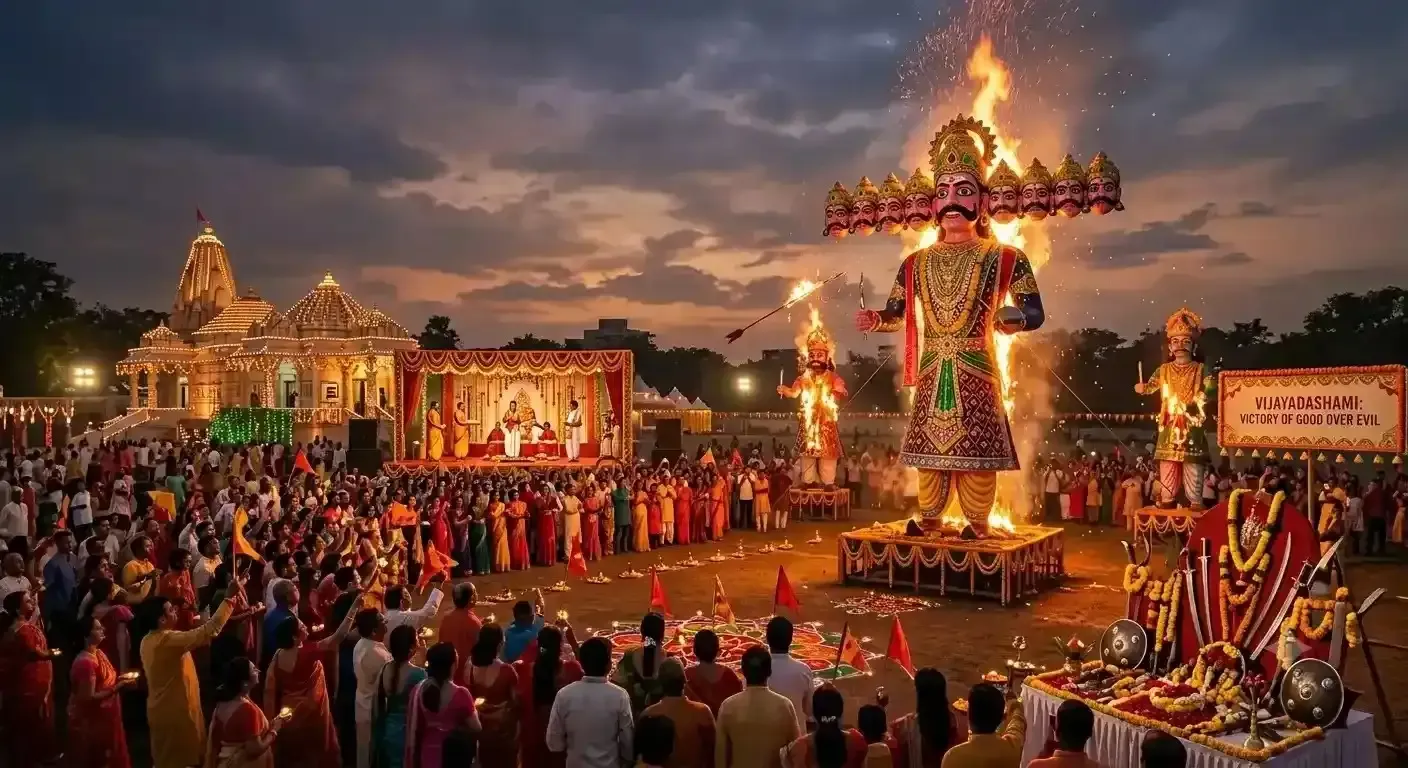
Vijayadashami falls on Tuesday 20 October 2026 across Bangladesh. Local Vijay Muhurat, Aparahna and Dashami times for Dhaka, Chattogram, Sylhet, Khulna, Rajshahi and Mymensingh, verified temples, how Bangladesh celebrates Durga Puja and Bijoya Dashami, and how to mark the day at home.
Quick answer: Dussehra (Vijayadashami) 2026 in Bangladesh is on Tuesday 20 October 2026 across the whole country. The Vijay Muhurat, calculated by the Drik Panchang method, is 1:38 PM – 2:24 PM in Dhaka, 1:33 PM – 2:19 PM in Chattogram and 1:45 PM – 2:31 PM in Rajshahi (Bangladesh Standard Time, UTC+6). Navratri runs from Sunday 11 to Monday 19 October 2026; Bengal-tradition Bijoya Dashami follows the panjika used by your puja committee.
Editor's note (5 October 2026): The local times on this page were calculated for each city from the Drik Panchang tithi (Dashami from 12:50 PM IST on 20 October to 2:11 PM IST on 21 October 2026), using Bangladesh Standard Time, which stays at UTC+6 all year with no daylight saving. The Vijay Muhurat is the 11th of the 15 daytime muhurtas, calculated by the Drik Panchang method. We do not list 2026 event schedules, mandap lists or immersion times, because temples, puja committees and the authorities announce their own arrangements; please check with them directly.
Hindus are Bangladesh's largest religious minority, around one in twelve people, or well over ten million — one of the largest Hindu populations of any country in the world. Almost all are Bengali Hindus, and for them the autumn festival is above all Durga Puja: the five days from Shashthi to Bijoya Dashami, when tens of thousands of temporary mandaps are set up across the country, from the lanes of Old Dhaka to villages in every district. Vijayadashami, the day of Rama's victory over Ravana and of Durga's victory over Mahishasura, is the last day of this cycle. Alongside the Bengali majority, there are smaller Hindu communities among tea-garden workers in Sylhet, Manipuri Vaishnavas, and Indian expatriates in Dhaka, some of whom mark Navratri with garba and Dussehra with a Ramayana programme.
Dussehra 2026 in Bangladesh: dates and Vijay Muhurat by city
The whole country is on Bangladesh Standard Time (UTC+0600). The Dashami tithi begins and ends at the same moment everywhere, so only the sun-based windows differ — by about a quarter of an hour between Sylhet in the north-east and Rajshahi in the west.
| Region (division) | City | Dussehra date | Vijay Muhurat (Drik Panchang method) | Dashami begins → ends |
|---|---|---|---|---|
| Dhaka | Dhaka | Tue 20 Oct | 1:38 PM – 2:24 PM | Tue 20 Oct, 1:20 PM → Wed 21 Oct, 2:41 PM |
| Chattogram | Chattogram | Tue 20 Oct | 1:33 PM – 2:19 PM | Tue 20 Oct, 1:20 PM → Wed 21 Oct, 2:41 PM |
| Sylhet | Sylhet | Tue 20 Oct | 1:32 PM – 2:18 PM | Tue 20 Oct, 1:20 PM → Wed 21 Oct, 2:41 PM |
| Khulna | Khulna | Tue 20 Oct | 1:42 PM – 2:28 PM | Tue 20 Oct, 1:20 PM → Wed 21 Oct, 2:41 PM |
| Rajshahi | Rajshahi | Tue 20 Oct | 1:45 PM – 2:31 PM | Tue 20 Oct, 1:20 PM → Wed 21 Oct, 2:41 PM |
| Mymensingh | Mymensingh | Tue 20 Oct | 1:37 PM – 2:23 PM | Tue 20 Oct, 1:20 PM → Wed 21 Oct, 2:41 PM |
The Aparahna (afternoon period) is the traditional window for Aparajita and Shami puja, and sunset marks the time for evening aarti and any Ravan Dahan:
| City | Aparahna, 20 Oct | Sunset, 20 Oct |
|---|---|---|
| Dhaka | 12:52 PM – 3:10 PM | 5:28 PM |
| Chattogram | 12:46 PM – 3:05 PM | 5:24 PM |
| Sylhet | 12:46 PM – 3:03 PM | 5:21 PM |
| Khulna | 12:55 PM – 3:14 PM | 5:32 PM |
| Rajshahi | 12:59 PM – 3:17 PM | 5:35 PM |
| Mymensingh | 12:51 PM – 3:09 PM | 5:27 PM |
Key Navratri and Dussehra dates 2026
| Observance | Date (2026) |
|---|---|
| Navratri begins (Ghatasthapana) | Sunday 11 October |
| Durga Ashtami and Maha Navami | Monday 19 October |
| Dussehra / Vijayadashami in Bangladesh | Tuesday 20 October |
| Dashami tithi, Bangladesh time | Tue 20 Oct, 1:20 PM → Wed 21 Oct, 2:41 PM |
| Bijoya Dashami / Sindoor Khela (India, Bengal tradition, Drik Kolkata) | Wednesday 21 October |
Ashtami and Navami share Monday 19 October in India's calendar this year. In every Bangladeshi city the Dashami tithi begins shortly after the Aparahna starts and then covers the rest of it, and the Vijay Muhurat falls entirely within Dashami, so 20 October is clear for Vijayadashami. Durga Puja committees, however, follow the Bengali panjika for the five puja days and for Bijoya Dashami, which in India's Bengal-tradition calendar falls on Wednesday 21 October 2026 — follow your committee's announcement.
Hindu temples in Bangladesh for Navratri & Dussehra
These temples and organisations have been confirmed to exist in each city or area. We list name and area only; check their own websites or social pages for festival plans. Temples and community groups usually announce Navratri garba, Durga Puja, Ramlila and Ravan Dahan programmes a few weeks ahead — check their websites/social pages.
Nationally, the Bangladesh Puja Udjapan Parishad (Durga Puja celebration council) coordinates mandaps, security liaison and immersion arrangements with the authorities, and the Ramakrishna Mission and ISKCON Bangladesh run centres in several cities.
Dhaka
Dhaka's Vijay Muhurat is 1:38 PM – 2:24 PM, with the Aparahna from 12:52 PM to 3:10 PM and sunset at 5:28 PM. The capital has hundreds of puja mandaps every year, from Old Dhaka's Shankhari Bazar to Banani and Kalabagan.
- Dhakeshwari National Temple — Old Dhaka. The state-owned National Temple, dedicated to the goddess Dhakeshwari, a form of Durga; traditionally the city's biggest Durga Puja, visited by national leaders.
- Ramakrishna Math and Mission — Gopibagh/Tikatuli area. Known for its Durga Puja and especially the Kumari Puja on Ashtami.
- Ramna Kali Mandir — Ramna, by Suhrawardy Udyan. The historic Kali temple destroyed in 1971 and rebuilt, reopened in 2021; the complex includes a Durga Mandir.
- Swamibagh Temple (ISKCON) — Swamibagh, Gendaria. A Vaishnava temple founded in 1902 and run by ISKCON, starting point of Dhaka's Rath Yatra.
Chattogram
Chattogram's Vijay Muhurat is 1:33 PM – 2:19 PM, with the Aparahna from 12:46 PM to 3:05 PM and sunset at 5:24 PM. The port city and its district have one of the country's densest networks of puja mandaps.
- JM Sen Hall — Rahmatganj. Not a temple but traditionally the largest Durga Puja mandap in the city.
- Chandranath Temple — Chandranath Hill, Sitakunda, north of the city. A hilltop Shiva shrine and Shakti Peetha reached by a long stone stairway, one of the country's most important pilgrimage sites.
Sylhet
Sylhet's Vijay Muhurat is 1:32 PM – 2:18 PM, the earliest of the six cities, with the Aparahna from 12:46 PM to 3:03 PM and sunset at 5:21 PM. Sylhet division has a large Hindu population, including tea-garden communities and Manipuri Vaishnavas, and the city sets up dozens of mandaps for Durga Puja.
- Ramakrishna Mission, Sylhet — Sylhet city. One of the oldest Ramakrishna Mission centres in Bangladesh, founded in 1916.
- ISKCON Sylhet — Sylhet city. The ISKCON temple, with deities of Jagannath, Baladeva and Subhadra.
Khulna
Khulna's Vijay Muhurat is 1:42 PM – 2:28 PM, with the Aparahna from 12:55 PM to 3:14 PM and sunset at 5:32 PM. Khulna and the surrounding south-west have a large Hindu community, and the city's older temples are known for ambitious pandal designs.
- Khulna Kalibari — central Khulna. The city's historic Kali temple and a major Durga Puja venue.
- Sonapotti temple — Sonapotti, central Khulna, known for its large themed Durga Puja pandals.
- Arya Dharma Sabha Mandir — Khulna city.
Rajshahi
Rajshahi's Vijay Muhurat is 1:45 PM – 2:31 PM, the latest of the six cities, with the Aparahna from 12:59 PM to 3:17 PM and sunset at 5:35 PM.
- Puthia Temple Complex — Puthia, about 23 km east of Rajshahi city. Around fourteen historic temples built by the Puthia zamindars, including the Bhubaneshwar Shiva Temple, the largest Shiva temple in Bangladesh, and the terracotta Govinda temples.
Mymensingh
Mymensingh's Vijay Muhurat is 1:37 PM – 2:23 PM, with the Aparahna from 12:51 PM to 3:09 PM and sunset at 5:27 PM.
- Boro Kali Bari — central Mymensingh. One of the oldest Hindu temples in the city, where Durga Puja, Lakshmi Puja and Saraswati Puja are celebrated every year.
- Durga Bari — central Mymensingh, a long-established temple of the Goddess in the heart of the old town.
- Muktagachha Shiva temple — Muktagachha, west of Mymensingh city, part of the old Muktagachha zamindar estate.
How Bangladesh celebrates Navratri and Dussehra
For Bengali Hindus, the nine nights are Durga Puja. The festival begins with Mahalaya, when families offer tarpan to ancestors and listen to the dawn Chandipath, and the main puja runs from Shashthi (the goddess's bodhon or awakening) through Saptami, Ashtami and Navami to Bijoya Dashami. Each mandap houses a clay image of Durga with Lakshmi, Saraswati, Ganesha and Kartik, made by local artisans in the weeks before. The days are filled with the beat of the dhak, evening aarti with dhunuchi dance, Ashtami anjali (flower offerings) and Sandhi Puja at the meeting of Ashtami and Navami, and Kumari Puja at a few centres such as the Ramakrishna Mission. Mandaps also host cultural programmes and food stalls, and families visit many mandaps in one evening.
On Bijoya Dashami, married women offer sindoor to the goddess and to one another in Sindoor Khela, the idols are taken in procession to rivers and ponds for immersion, and families exchange "Shubho Bijoya" greetings, touching elders' feet and sharing sweets such as narkel naru. A Bijoya Sammilani — a reunion and cultural evening — often follows a few days later, including the well-known gathering at the Dhakeshwari National Temple grounds.
North Indian-style Ramlila and Ravan Dahan are not a large part of Bangladeshi tradition, but some Indian expatriate groups and Hindi- or Gujarati-speaking families in Dhaka hold Navratri garba and dandiya evenings and a Dussehra programme, sometimes with a symbolic Ravana effigy, usually on a weekend. Tamil and Telugu expatriates may set up Golu or celebrate Bathukamma at home or in small groups. Ayudha Puja, the blessing of tools and books, has a Bengali counterpart in the Vishwakarma and Saraswati pujas held at other times of year.
Dussehra puja at home
If you cannot reach a temple, a short puja at home in the afternoon is entirely traditional. Ideally do it during your city's Vijay Muhurat, or at least within the Aparahna after Dashami has begun at 1:20 PM:
- Aparajita puja: draw an eight-petalled lotus with kumkum or rice flour, place a lamp, and worship Devi Aparajita, the goddess of victory, with flowers, akshat and a prayer for success over obstacles. In Bengal, Aparajita puja is traditionally done on Bijoya Dashami after the immersion.
- Shami puja: if you have Shami (or apta) leaves, offer them to the Devi and exchange them with family as "gold", a custom of Maharashtra and Karnataka followed by some expatriate families.
- Ayudha Puja / Shastra puja: clean and decorate tools, books, laptops and vehicles, apply sandal paste or kumkum and offer flowers.
- Vidyarambham: Vijayadashami is a traditional day for small children to begin learning, writing "Om" or the first letters of the alphabet in rice.
- Bijoya greetings: after the puja, touch elders' feet, embrace friends and share sweets, as Bengali families do on Bijoya.
A simple order: bathe, light a lamp, pray to Ganesha, do the Aparajita and Shami puja, then Ayudha puja, offer naivedya (sweets, fruit), do aarti and share prasad. For full step-by-step vidhi and the stories behind the festival, see our Dussehra / Vijayadashami 2026 pillar guide.
Practical tips for Dussehra in Bangladesh
- Holidays: Bijoya Dashami has traditionally been a public holiday in Bangladesh, but its date follows the official holiday list and the panjika, not necessarily 20 October. Tuesday 20 and Wednesday 21 October are weekdays, so check your employer's or school's notice.
- Crowds and security: major mandaps such as Dhakeshwari draw very large crowds, and the authorities and puja committees usually deploy police and volunteers. Keep children close, carry minimal valuables and follow volunteers' instructions.
- Fireworks and fire: rules on fireworks, sky lanterns and any effigy burning are set by local authorities and the police, and some cities have banned them during the puja. Check current orders before using any.
- Immersion day: immersion processions can close roads near rivers and ghats in Dhaka, Chattogram, Khulna and other cities, and traffic police usually issue advisories. Allow extra time or travel earlier in the day.
- Weather: October is the end of the monsoon and showers are still possible, so carry an umbrella for mandap-hopping.
- Muhurat: use your own city's times from the tables above; never convert India's times into Bangladesh time.
Frequently asked questions
When is Dussehra 2026 in Bangladesh?
Tuesday 20 October 2026 in every city on this page. The Dashami tithi begins at 1:20 PM Bangladesh time on 20 October and ends at 2:41 PM on Wednesday 21 October, so it covers almost the whole Aparahna (afternoon period) of the 20th.
What is the Vijay Muhurat in Dhaka on Dussehra 2026?
Calculated by the Drik Panchang method, the Vijay Muhurat in Dhaka on Tuesday 20 October 2026 is 1:38 PM – 2:24 PM Bangladesh Standard Time (UTC+6). In Chattogram it is 1:33 PM – 2:19 PM, in Sylhet 1:32 PM – 2:18 PM, in Khulna 1:42 PM – 2:28 PM, in Rajshahi 1:45 PM – 2:31 PM and in Mymensingh 1:37 PM – 2:23 PM.
Is Bijoya Dashami the same day as Dussehra in Bangladesh?
Not necessarily. Durga Puja committees in Bangladesh follow the Bengali panjika for Bijoya Dashami and the immersion of the idols. In India's Bengal-tradition calendar (Drik Panchang, Kolkata), Bijoya Dashami and Sindoor Khela fall on Wednesday 21 October 2026. Check the announcements of the Bangladesh Puja Udjapan Parishad and your local puja committee for the date they follow.
Can I convert India's Dussehra muhurat into Bangladesh time?
No. The Vijay Muhurat depends on local sunrise and sunset, so it has to be calculated for your own city. Use the Bangladesh times on this page or your temple's panjika, not India's times shifted by the half-hour time difference.
Why do the times differ between Sylhet and Rajshahi?
The whole country uses one clock time, but the sun sets earlier in the east than in the west. On 20 October sunset is at 5:21 PM in Sylhet and 5:35 PM in Rajshahi, so every sun-based window, including the Vijay Muhurat, comes about a quarter of an hour earlier in Sylhet. The Dashami tithi itself begins at the same moment everywhere.
Where can I see Durga Puja and Bijoya programmes in 2026?
Temples and community groups usually announce Navratri garba, Durga Puja, Ramlila and Ravan Dahan programmes a few weeks ahead — check their websites/social pages. In Bangladesh, the Puja Udjapan Parishad and city puja committees publish mandap lists and immersion arrangements each year.
Related guides
- Dussehra / Vijayadashami 2026: complete guide
- Durga Puja and Bijoya Dashami 2026 in West Bengal
- Durga Puja and Dussehra 2026 in Tripura
- Dussehra 2026 in Assam
- Dussehra 2026 in Meghalaya
- Dashain 2026 in Nepal
- Dussehra 2026 in Bhutan, city by city
- Dussehra 2026 in Sri Lanka, city by city
- Navratri 2026: complete guide for NRI families
- October 2026 Hindu festival calendar
You might also like
Dussehra 2026 in Victoria, BC: Date, Vijay Muhurat, Temples and Navratri Celebrations
Dussehra 2026 in Surrey: Date, Vijay Muhurat, Temples and Navratri Celebrations
Dussehra 2026 in Vancouver: Date, Vijay Muhurat, Temples and Navratri Celebrations