
Dussehra 2026 in Fiji, City by City: Date, Vijay Muhurat and Hindu Temples
Vijayadashami falls on Wednesday 21 October 2026 across Fiji, a day after India. Local Vijay Muhurat, Aparahna and Dashami times for Suva, Nadi, Lautoka, Ba and Labasa, Hindu temples and organisations, and how to mark the day at home.
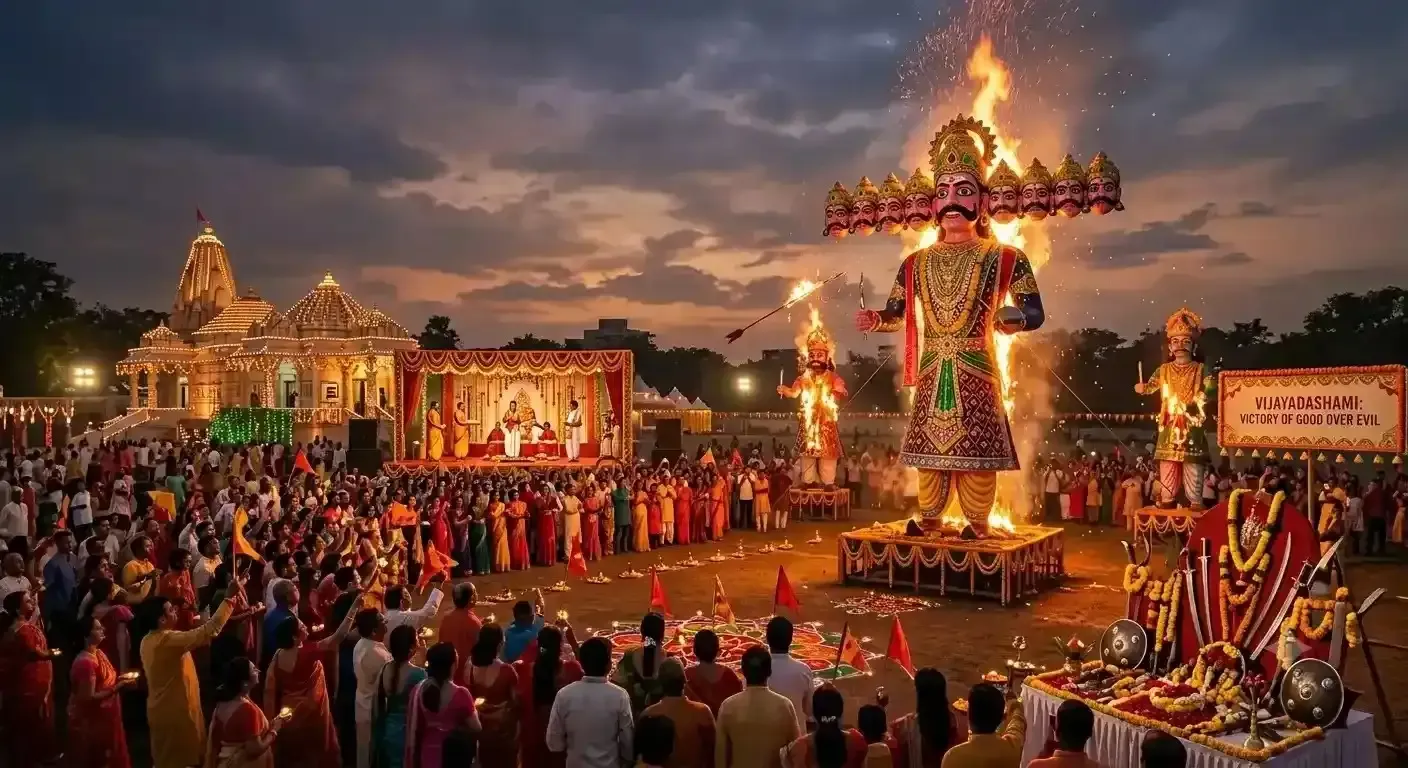
Vijayadashami falls on Wednesday 21 October 2026 across Fiji, a day after India. Local Vijay Muhurat, Aparahna and Dashami times for Suva, Nadi, Lautoka, Ba and Labasa, Hindu temples and organisations, and how to mark the day at home.
Quick answer: Dussehra (Vijayadashami) 2026 in Fiji is on Wednesday 21 October 2026 in every city, one day after India. The Vijay Muhurat, calculated by the Drik Panchang method, is 1:56 PM – 2:47 PM in Suva, 2:00 PM – 2:51 PM in Nadi and Lautoka and 1:52 PM – 2:42 PM in Labasa (Fiji Time, UTC+12). Navratri runs from Sunday 11 to Monday 19 October 2026 in India's calendar.
Editor's note (5 October 2026): The local times on this page were calculated for each city from the Drik Panchang tithi (Dashami from 12:50 PM IST on 20 October to 2:11 PM IST on 21 October 2026, India time), shown in Fiji Time, which has no daylight saving. The Vijay Muhurat is the 11th of the 15 daytime muhurtas, calculated by the Drik Panchang method. We do not list 2026 event schedules, because temples, Sabhas and Ramayan Mandalis announce their own programmes; please check with them directly.
Fiji has one of the oldest and most rooted Hindu communities outside South Asia. Between 1879 and 1916 more than 60,000 indentured labourers, the girmitiyas, were brought from India to work on the sugar plantations, mostly from today's Uttar Pradesh and Bihar and later from the Madras Presidency. Their descendants make up most of Fiji's Indo-Fijian population, and Hinduism is the country's second-largest religion. Fiji Hindi, temple-based Sanatan worship, Arya Samaj havan, South Indian Sangam traditions and a deep love of the Ramayan, sung in Ramayan Mandalis in villages and towns, all shape how Navratri and Dussehra are kept here. Gujarati and Punjabi families, who arrived later as free migrants, add garba and their own customs.
Dussehra 2026 in Fiji: dates and Vijay Muhurat by city
All of Fiji is on Fiji Time (UTC+1200) on 20 and 21 October. Because Fiji is so far east of India, the Dashami tithi only begins at 7:20 PM on Tuesday 20 October, after sunset, so the afternoon that counts for Vijayadashami is Wednesday's. The tithi begins and ends at the same moment everywhere in the country; only the sun-based windows shift slightly, with Labasa in the north-east earliest and Nadi and Lautoka in the west latest.
| Region | City | Dussehra date | Vijay Muhurat (Drik Panchang method) | Dashami begins → ends |
|---|---|---|---|---|
| Central | Suva | Wed 21 Oct | 1:56 PM – 2:47 PM | Tue 20 Oct, 7:20 PM → Wed 21 Oct, 8:41 PM |
| Western | Nadi | Wed 21 Oct | 2:00 PM – 2:51 PM | Tue 20 Oct, 7:20 PM → Wed 21 Oct, 8:41 PM |
| Western | Lautoka | Wed 21 Oct | 2:00 PM – 2:51 PM | Tue 20 Oct, 7:20 PM → Wed 21 Oct, 8:41 PM |
| Western | Ba | Wed 21 Oct | 1:59 PM – 2:50 PM | Tue 20 Oct, 7:20 PM → Wed 21 Oct, 8:41 PM |
| Northern | Labasa | Wed 21 Oct | 1:52 PM – 2:42 PM | Tue 20 Oct, 7:20 PM → Wed 21 Oct, 8:41 PM |
The Aparahna (afternoon period) on Wednesday 21 October is the traditional window for Aparajita and Shami puja, and sunset marks the time for any evening Ravan Dahan or aarti:
| City | Aparahna, 21 Oct | Sunset, 21 Oct |
|---|---|---|
| Suva | 1:06 PM – 3:37 PM | 6:08 PM |
| Nadi | 1:10 PM – 3:41 PM | 6:12 PM |
| Lautoka | 1:10 PM – 3:41 PM | 6:12 PM |
| Ba | 1:09 PM – 3:40 PM | 6:11 PM |
| Labasa | 1:02 PM – 3:32 PM | 6:03 PM |
Key Navratri and Dussehra dates 2026
| Observance | Date (2026) |
|---|---|
| Navratri begins (Ghatasthapana), India | Sunday 11 October |
| Durga Ashtami and Maha Navami, India | Monday 19 October |
| Dussehra / Vijayadashami, India | Tuesday 20 October |
| Dussehra / Vijayadashami in Fiji | Wednesday 21 October |
| Dashami tithi, Fiji Time | Tue 20 Oct, 7:20 PM → Wed 21 Oct, 8:41 PM |
| Bijoya Dashami / Sindoor Khela (India, Bengal tradition) | Wednesday 21 October |
In every Fijian city the Dashami tithi covers the whole Aparahna on 21 October, by about two and a half hours, so there is no doubt about the date. Because Fiji is ahead of India, local Fiji patras can also place other Navratri days, such as Ashtami, Navami or Kanya pujan, a day later than India; follow your own mandir's calendar for those.
Hindu temples in Fiji for Navratri & Dussehra
These temples and organisations have been confirmed to exist in or near each city. We list name and area only; check their own websites or social pages for opening hours and festival plans. Temples and community groups usually announce Navratri garba, Durga Puja, Ramlila and Ravan Dahan programmes a few weeks ahead — check their websites/social pages.
Central Division: Suva
Suva's Vijay Muhurat is 1:56 PM – 2:47 PM, within an Aparahna of 1:06 PM – 3:37 PM, and sunset is at 6:08 PM. The capital is home to the national headquarters of Fiji's two oldest Hindu organisations, both in Samabula.
- Shiv Mandir, Samabula — Samabula, Suva. A historic Sanatan temple whose origins go back to a kuti built by girmitiya families; the Shree Sanatan Dharam Pratinidhi Sabha of Fiji, the country's largest Hindu organisation, was founded here in 1958.
- Arya Pratinidhi Sabha of Fiji — Samabula, Suva. The national body of the Arya Samaj, whose first Samaj in Fiji was formed in Samabula in 1904; it also runs many schools and the University of Fiji.
- Sri Sri Radha Golokabihari Temple (ISKCON Suva) — Brewster Street, Suva. The Hare Krishna temple of the capital, opened in 2004.
During Navratri, Suva's Sanatan mandirs hold daily Durga puja, Durga Chalisa and evening aarti, while Arya Samaj families mark the season with havan and discourses rather than murti puja. Ramayan Mandalis in the suburbs and nearby Nausori area keep up the singing of the Ramcharitmanas, and the city's smaller Gujarati and Bengali circles may hold garba nights or a Durga Puja in a hired hall.
Western Division: Nadi, Lautoka and Ba
The Western Division, the heart of Fiji's cane belt, has the largest share of Indo-Fijian families. The Vijay Muhurat is 2:00 PM – 2:51 PM in Nadi and Lautoka (Aparahna 1:10 PM – 3:41 PM, sunset 6:12 PM) and 1:59 PM – 2:50 PM in Ba (Aparahna 1:09 PM – 3:40 PM, sunset 6:11 PM).
- Sri Siva Subramaniya Swami Temple — southern end of Nadi town. Built in South Indian Dravidian style and consecrated in 1994, it is often described as the largest Hindu temple in the Southern Hemisphere, and is the flagship temple of the TISI Sangam (Then India Sanmarga Ikya Sangam), formed in 1926.
- Sri Krishna Kaliya Temple (ISKCON Lautoka) — central Lautoka. The first ISKCON temple in Fiji, whose main deity is Krishna dancing on the serpent Kaliya.
- Shree Vishnu Temple — Vitogo Parade, Lautoka. A long-established Sanatan temple, founded as the Atithi Sewa Samiti Sanatan Dharam Sabha, with a Shiv temple in its complex.
- Wailailai Kutti Temple — Wailailai, Ba. A Sanatan temple that has hosted Shree Sanatan Dharam Pratinidhi Sabha celebrations in Ba.
Sangam temples in the west keep Navaratri in the Tamil way, with special abhishekam and alankaram for the Goddess each night, Saraswati Puja and Ayudha Puja near the end of the nine days, and Vijayadashami worship of Murugan. Sanatan mandirs and Ramayan Mandalis in Nadi, Lautoka and Ba hold Navratri puja and Ramayan path, and many cane-belt families keep the nine-day fast at home.
Northern Division: Labasa
Labasa, on Vanua Levu, has the earliest Vijay Muhurat in Fiji at 1:52 PM – 2:42 PM, with an Aparahna of 1:02 PM – 3:32 PM and sunset at 6:03 PM. The town and its surrounding cane districts are strongly Indo-Fijian.
- Naag Mandir — Nagigi, about 12 km north-east of Labasa. Famous for a large cobra-shaped rock that devotees believe has grown over the decades.
- Shree Sai Ambaji Darbaar Temple — Labasa. A Devi temple that draws devotees, including visitors from abroad, during Navratri.
On Vanua Levu, Navratri is largely temple- and home-based, with Durga Chalisa, daily hawan, colour-of-the-day dress and Kanya puja on Ashtami or Navami. Families who have moved to Suva, Australia or New Zealand often come home to Labasa for the festival season.
How Fiji celebrates Navratri and Dussehra
For most Indo-Fijian Hindus, Navratri is a time of temple worship and fasting rather than big public festivities. Families set up a kalash, keep a vrat, recite the Durga Chalisa and Durga Saptashati, perform hawan and end the nine days with Kanya puja, when young girls are honoured as forms of the Devi. Ramayan Mandalis, a hallmark of Fiji Hindu life, sing the Ramcharitmanas in homes and temples, and Dussehra is the natural climax of that devotion to Lord Rama.
Sangam and other South Indian families keep Navaratri with Saraswati Puja, Ayudha Puja and Vidyarambham, and some set up Golu displays of dolls. Gujarati families and younger Indo-Fijians enjoy garba and dandiya nights, and the country's small Bengali community may celebrate Durga Puja with pushpanjali and bhog. Ramleela plays and Ravan Dahan are held by some temples and communities, usually on a smaller scale than in North India; where an effigy is burnt, it is usually a modest, supervised one. Dussehra also opens the run-up to Diwali, Fiji's national Hindu holiday, when homes across the country are lit with diyas.
Dussehra puja at home
If you cannot reach a temple on a Wednesday, a short puja at home in the afternoon is entirely traditional. Ideally do it during your town's Vijay Muhurat, or at least within the Aparahna on 21 October:
- Aparajita puja: draw an eight-petalled lotus with kumkum or rice flour, place a diya, and worship Devi Aparajita, the goddess of victory, with flowers, akshat and a simple prayer for success over obstacles.
- Shami puja: if you have Shami leaves, or a traditional substitute, offer them to the Devi and share them with family as a sign of prosperity.
- Ayudha Puja / Shastra puja: clean and decorate tools, cane knives, books, laptops, the car or the carrier, apply kumkum and offer flowers, thanking them for their service.
- Vidyarambham: Vijayadashami is the traditional day for small children to begin learning — writing "Om" or the first letters of the alphabet in rice.
- Ramayan path: read or sing the Lanka Kand or the victory of Rama from the Ramcharitmanas, as many Fiji families and Mandalis do.
A simple order: bathe, light a diya, pray to Ganesha, do the Aparajita and Shami puja, then Ayudha puja, offer naivedya (sweets, fruit), do aarti and share prasad. For full step-by-step vidhi and the stories behind the festival, see our Dussehra / Vijayadashami 2026 pillar guide.
Practical tips for Dussehra in Fiji
- Use the right date: Fiji keeps Dussehra on Wednesday 21 October, not on India's Tuesday 20 October. Online calendars set to India can mislead you.
- Working day: Wednesday 21 October is a normal working and school day. The Vijay Muhurat falls in the early afternoon, so consider a short break, or do the puja later within the Aparahna if you can.
- Fireworks and fire: rules on fireworks, open fires and effigy burning are set by the authorities, so check current rules with your town council and the police before any Ravan Dahan.
- Getting to temples: parking near popular temples in Nadi, Suva and Lautoka fills up on festival evenings. Car-share with family, allow time for traffic and check the last bus or carrier times home.
- Weather: late October is warm and humid, with sunset between 6:03 PM and 6:12 PM depending on the town, so carry water and mosquito repellent for evening programmes.
- Muhurat: use your own town's times from the table above; never convert India's times into Fiji time.
Frequently asked questions
When is Dussehra 2026 in Fiji?
Wednesday 21 October 2026 in every Fijian city, one day after India. The Dashami tithi begins at 7:20 PM Fiji time on Tuesday 20 October, after the afternoon is over, and ends at 8:41 PM on Wednesday 21 October, so it covers the whole afternoon of the 21st.
Why is Dussehra on 21 October in Fiji but 20 October in India?
Fiji is six and a half hours ahead of India. The Dashami tithi starts at 12:50 PM IST on 20 October, which is already evening in Fiji. Vijayadashami is kept on the day when Dashami covers the afternoon (Aparahna), and in Fiji that is Wednesday 21 October.
What is the Vijay Muhurat in Suva, Nadi and Labasa?
Calculated by the Drik Panchang method for each city, on Wednesday 21 October 2026 in Fiji Time (UTC+12): Suva 1:56 PM – 2:47 PM, Nadi and Lautoka 2:00 PM – 2:51 PM, Ba 1:59 PM – 2:50 PM and Labasa 1:52 PM – 2:42 PM.
Can I convert India's Dussehra muhurat into Fiji time?
No. The Vijay Muhurat depends on local sunrise and sunset, so it has to be calculated for your own town. Use the Fiji times on this page or your mandir's patra, not India's times shifted by the time difference.
Where will Ramleela, Navratri and Ravan Dahan programmes take place in Fiji?
Temples and community groups usually announce Navratri garba, Durga Puja, Ramlila and Ravan Dahan programmes a few weeks ahead — check their websites/social pages. In Fiji, the Sanatan, Arya Samaj, Sangam and ISKCON networks and local Ramayan Mandalis are the best places to ask.
Is Dussehra a public holiday in Fiji?
No. Diwali is Fiji's national Hindu public holiday, but Wednesday 21 October 2026 is a normal working and school day, so many families do the afternoon puja at home and join temple programmes in the evening or at the weekend.
Related guides
- Dussehra / Vijayadashami 2026: complete guide
- Navratri 2026: complete guide for NRI families
- Dussehra 2026 in New Zealand, city by city
- Dussehra 2026 Australia, city by city
- Dussehra 2026 in Sydney
- Dussehra 2026 in Brisbane
- Dussehra 2026 in Mauritius, city by city
- Dussehra 2026 in Trinidad and Tobago, city by city
- October 2026 Hindu festival calendar
You might also like
Dussehra 2026 in Victoria, BC: Date, Vijay Muhurat, Temples and Navratri Celebrations
Dussehra 2026 in Surrey: Date, Vijay Muhurat, Temples and Navratri Celebrations
Dussehra 2026 in Vancouver: Date, Vijay Muhurat, Temples and Navratri Celebrations