

Tarpan Vidhi: How to Perform Tarpan at Home, Step by Step
A gentle, practical walkthrough for offering tarpan at home with water, sesame (til) and kusha grass, remembering your ancestors by name and gotra. A plain offering of water with a sincere heart is complete.
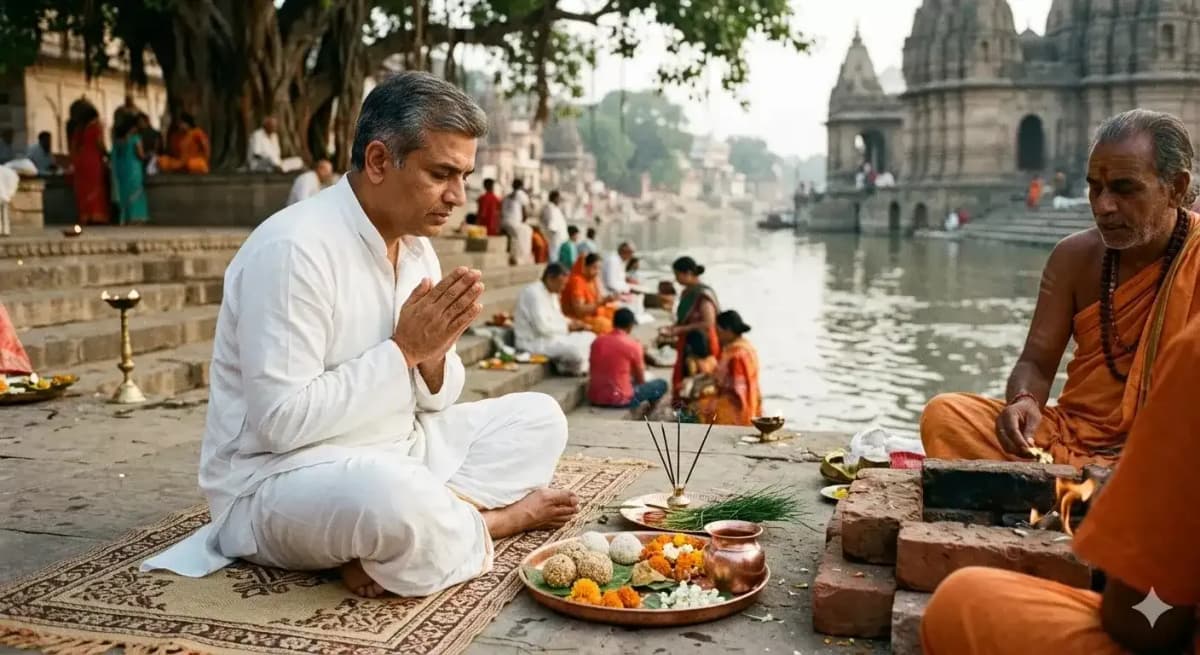
A gentle, practical walkthrough for offering tarpan at home with water, sesame (til) and kusha grass, remembering your ancestors by name and gotra. A plain offering of water with a sincere heart is complete.
Quick answer: Tarpan at home is simple: sit clean and facing south, hold water with a little sesame (til) and kusha grass, remember your ancestors by name and gotra, and let the water flow slowly through your fingers as an offering. Even plain water offered with a sincere, remembering heart is complete.
Tarpan is one of the gentlest acts of remembrance in Hindu practice: offering water to those who came before us. During Pitru Paksha it is done with special care, but it does not require a temple, a large ritual, or elaborate arrangements. A clean corner, a little water, and a quiet heart are enough to begin.
This guide describes a simple way to offer tarpan at home, step by step. Where families follow specific traditions or mantras from their own lineage or region, please follow those; what is written here is a plain, respectful framework you can adapt. If you are unsure of a detail, a family elder or your own priest can guide you kindly.
- Occasion: Pitru Paksha 2026 (daily tarpan)
- Dates: 26/27 Sep - 10 Oct 2026
- Sarva Pitru Amavasya: Sat, 10 Oct 2026
- What you offer: Water, ideally with til (sesame) and kusha grass
- Direction: Traditionally facing south
- Time: Morning after bathing; confirm local muhurat if you wish
- Minimum needed: Clean water and a sincere, remembering heart
What tarpan means
The word tarpan comes from the sense of satisfying or offering water to give contentment. In the context of Pitru Paksha, it is water offered to the pitru (departed ancestors) as a gesture of gratitude, love, and remembrance. It is not a transaction and it promises no particular result; it is simply how many families keep a bond of care with those who are no longer here.
Because it is an act of the heart, the outer form can be very simple. Many teachers say that the intention (sankalpa) and the sincerity behind the offering matter more than perfection of procedure. If you can only offer plain water with love, that offering is complete.
What you will need
- A clean, quiet place to sit (a mat or low seat)
- A vessel or bowl of clean water
- A small quantity of til (black sesame seeds), if available
- A few blades of kusha (darbha) grass, if available
- A plate or wide bowl to catch the offered water
- Clean clothes; a fresh bath beforehand where possible
Til and kusha are traditional but not always easy to find, especially abroad. If you cannot source them, do not let that stop you. Water alone, offered with remembrance, is accepted in this spirit. Where families keep a pavitra (a ring of kusha worn on the ring finger), they may do so; if you have none, offer with a clean hand and a settled mind.
Step by step: tarpan at home
- Bathe and wear clean clothes. Choose a quiet time, ideally in the morning.
- Sit facing south on a clean mat, in a calm and settled frame of mind.
- Place the plate or wide bowl before you and fill your vessel with clean water. Add a pinch of til and, if you have it, a blade or two of kusha grass.
- Take a moment to settle. Silently form your intention (sankalpa): that you are offering this water to your ancestors with gratitude and love, remembering them by name and gotra where you know these.
- Cup water in your right hand (traditionally offered over the base of the thumb, the pitru tirtha). Slowly let the water flow through your fingers into the plate as you remember each ancestor.
- Offer for your immediate departed elders first, then more broadly for all ancestors of your lineage, and for all departed souls who may have none to remember them.
- Repeat the offering as many times as feels right; three offerings per ancestor is a common simple pattern, but there is no rigid count required to make it sincere.
- Sit for a few quiet moments afterwards. Many families then feed someone, give a little in charity, or offer food to a cow, bird, or the needy in the ancestors' memory.
- Dispose of the offered water respectfully, ideally at the base of a plant or a clean patch of earth.
If you do not know a mantra, you do not need to invent one. You may simply say, in your own words or in silence: “I offer this water to my ancestors with gratitude; may they be at peace.” The intent, sincerely held, is what carries the offering.
Doing tarpan in an apartment or abroad
Many readers live in flats or in countries where a river, open earth, or Indian provisions are hard to reach. Tarpan adapts gracefully to these settings. You do not need a river; a bowl and a plate at home are enough. Offered water can be given to a potted plant afterwards.
| Situation | A simple way to manage |
|---|---|
| No til or kusha available | Offer plain water; the remembrance is what matters |
| Living in an apartment | Use a plate to catch the water; give it to a plant afterwards |
| No river nearby | A clean bowl of water at home is sufficient |
| Don’t know the exact tithi | Offer on Sarva Pitru Amavasya (10 Oct 2026), which covers all ancestors |
| No male relative in the family | Many priests and families now accept daughters and women offering tarpan |
| Cannot do it at all this year | Feeding someone or a quiet act of charity in their memory is also honoured |
If you cannot do it a particular day
Not everyone can perform tarpan on the right tithi, or every day of Pitru Paksha. Work, travel, illness, or simply not knowing a date are all common. Traditionally, Sarva Pitru Amavasya (Mahalaya Amavasya, Saturday 10 October 2026) is the day that gathers all ancestors together, and offering on that day is widely held to cover those whose tithi is unknown or missed. If even that is not possible, a sincere act of remembrance — feeding another, a small daan, a quiet moment — is never wasted.
Who may offer tarpan
Traditionally the eldest son or a male descendant offered tarpan, and many families still follow this. But there is no need to feel excluded if that is not your situation. Many priests and families today accept daughters, wives, and other family members offering tarpan and shraddha with the same sincerity. Where you are unsure, a priest who knows your family tradition can guide you gently. What is not in question is your right to remember and honour those you love.
Related reading
Frequently Asked Questions
Can I do tarpan with only plain water?
Yes. Til and kusha are traditional additions, but where they are not available, plain water offered with remembrance and a sincere heart is accepted in this spirit. The intention behind the offering is what matters most, not the completeness of the materials.
I live in an apartment abroad with no river nearby. Is that a problem?
No. Tarpan adapts well to small spaces. A bowl of clean water and a plate to catch it are enough. Offer at home, then give the water to a potted plant or a clean patch of earth. You do not need a river or open ground to remember your ancestors.
I don’t know my ancestors’ exact tithi. When should I offer?
Sarva Pitru Amavasya (Mahalaya Amavasya), Saturday 10 October 2026, is traditionally the day that gathers all ancestors, including those whose tithi is unknown or missed. Offering tarpan on that day is widely held to cover them.
Which direction should I face?
Tarpan is traditionally offered facing south, and water is offered over the base of the thumb (the pitru tirtha). If your family follows a different custom, follow that. The direction is part of the form, but a sincere heart is the essence.
Can a daughter or a woman offer tarpan?
Many priests and families today accept daughters, wives, and women offering tarpan and shraddha. Traditions vary by family and region, so where you are unsure, a priest who knows your lineage can guide you. Your wish to remember and honour your ancestors is fully valid.
What if I don’t know any mantra?
You do not need to invent or borrow a mantra you are unsure of. You may offer in silence or in your own words, forming the simple intention that you offer this water to your ancestors with gratitude. The sincerity of the intent carries the offering.
Where do I get til and kusha, especially abroad?
Til (black sesame) is often found in Indian grocery stores, and kusha (darbha) grass may be available at temples or online. If you cannot source either, offer plain water instead — the remembrance, not the materials, is the heart of tarpan.
I couldn’t do tarpan this year at all. What can I do instead?
A sincere act of remembrance is always honoured. Feeding someone, offering food to a cow, bird, or the needy, or a small quiet act of charity in your ancestors’ memory is a meaningful way to keep the bond, even when a formal ritual is not possible.
Related guides you may find helpful
You might also like

Rama Ekadashi 2026: Date, Vrat Katha, Puja Vidhi & Significance

Navratri 2026: 9 Days, Colors, Goddess Names, Puja & Significance
Navratri 2026 USA: Dates, Garba, Dandiya, Durga Puja & NRI Celebration Guide
