Vinayagar Chaturthi in Malaysia 2026: Permits & Immersion Guide
Vinayagar Chaturthi 2026 in Malaysia falls on Monday 14 September, with Anant Chaturdashi immersion on Friday 25 September. Here is which council you file with, why processions are exempt, and where you can legally immerse.
Vinayagar Chaturthi 2026 in Malaysia falls on Monday 14 September, with Anant Chaturdashi immersion on Friday 25 September. Here is which council you file with, why processions are exempt, and where you can legally immerse.
Quick answer: In Malaysia a home Vinayagar Chaturthi puja needs no permit; a temple chariot procession is a religious assembly exempt from the Peaceful Assembly Act (still notify your OCPD and request traffic assistance); separate council (PBT) permits are required for tents, stages, banners, road closures and food stalls; immerse via a temple-organised group, an artificial pond, or at home, using only clay or cassava idols — never plaster of Paris.
Vinayagar Chaturthi 2026 falls on Monday, 14 September. Anant Chaturdashi, the principal immersion day, is Friday, 25 September. It is not a public holiday in Malaysia, so temple festivals and chariot processions will be timed around the weekends of 12-13 and 19-20 September. In the Gulf the festival is confined to homes and temple compounds; in the US it runs into municipal permits; in Malaysia Lord Ganesha travels through the streets of Kuala Lumpur on a golden chariot and the police direct the traffic. Because so much is permitted, the real questions are which council you file with and where you can legally immerse.
What Makes Malaysia Different
The Tamil Tradition Is the Main Tradition
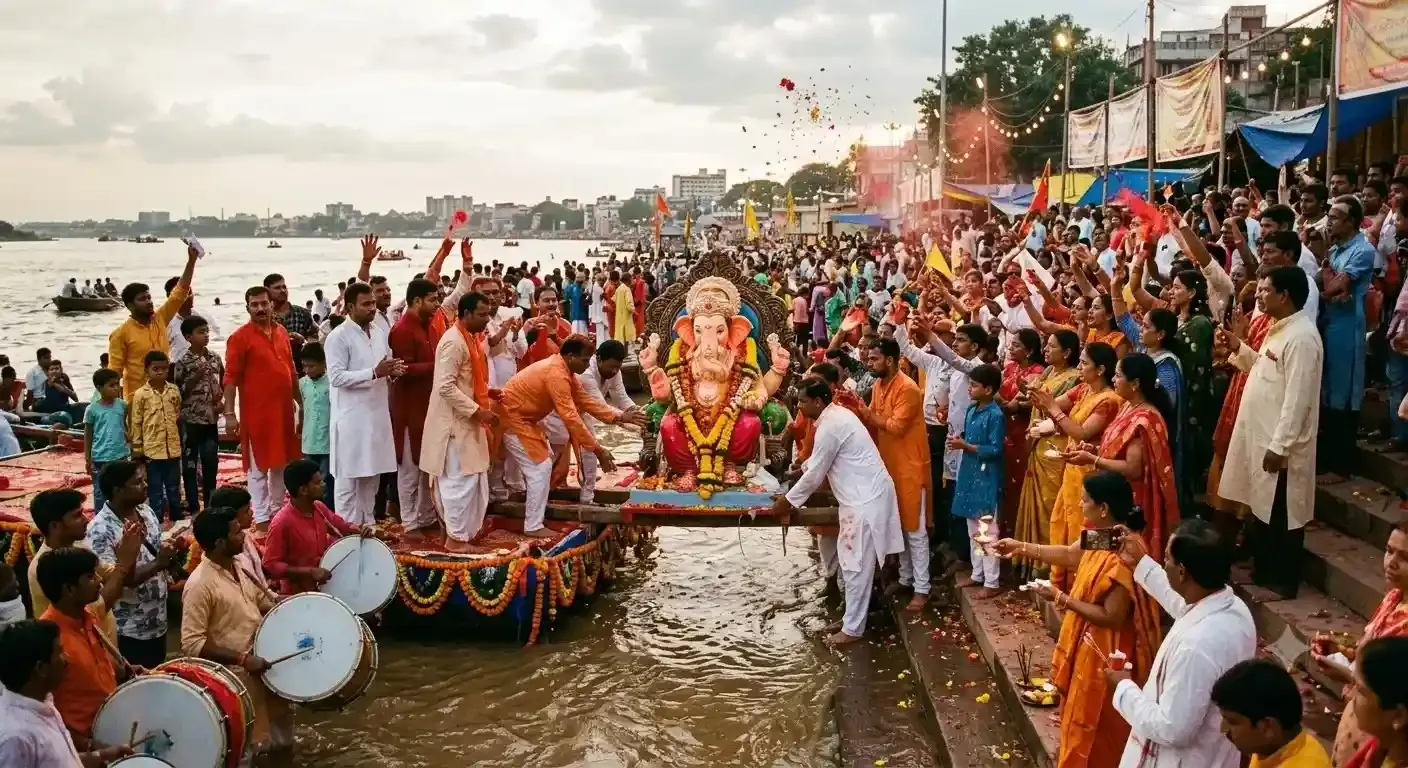
The dominant Malaysian form is the Tamil temple tradition — Vinayagar Chaturthi centred on the temple with abhishekam, special poojas, kodiyetram (flag-raising), and a ratham urvalam (chariot procession through surrounding streets). The Maharashtrian model (a household clay murti for ten days then carried to water) also exists and has grown with North Indian and Telugu communities. In Malaysia the temple chariot procession is the tradition.
The Brickfields Centrepiece
The most prominent public celebration is in Brickfields, Kuala Lumpur, where a very large Ganesha murti (reported around 5.5 metres) is installed along Jalan Tun Sambanthan; it is produced in India and assembled on site by local artisans, and the idol has been made from cassava, a biodegradable material that breaks down in water and is safe for marine life. Brickfields also hosts the Kortumalai Ganesar Temple chariot procession, and the Court Hill Sri Ganesar Temple in KL runs its own grand Vinayagar Chaturthi festival with a golden chariot procession.
Processions Are Normal Here
At Thaipusam silver and gold chariots travel from Sri Maha Mariamman Temple on Jalan Tun H.S. Lee to Batu Caves, and in Penang from Lebuh Queen to the hilltop temples, with police and Federal Reserve Unit managing traffic, and thaneer panthal tents lining the routes with free food and drink. The same infrastructure applies to Vinayagar Chaturthi processions.
Permissions
Note: this is a general framework, not legal advice. Requirements differ by state and local council (PBT), and laws change — the Peaceful Assembly Act has been amended repeatedly and was the subject of a significant Federal Court ruling in 2025. Confirm current requirements with your local council, your district police (OCPD), and Malaysia Hindu Sangam before finalising plans.
At Home: Nothing Required
A puja in your own home with family and guests requires no permit — ordinary religious practice, constitutionally protected under Article 11 of the Federal Constitution. Practical only: strata/condominium rules on common-area use and amplified sound hours; consideration for neighbours in a multi-faith society; standard open-flame fire caution in high-rise units.
The Peaceful Assembly Act: Religious Assemblies Are Exempt
Public assemblies are governed by the Peaceful Assembly Act 2012 (Act 736), which replaced the old police permit system under Section 27 of the Police Act 1967. Under the PAA there is no permit requirement — the old "everything prohibited unless permitted" regime was replaced with a notification system.
Religious assemblies sit in an even more favourable position: Section 9(3) provides that where the assembly is a religious assembly or funeral procession, the organiser may inform the Officer in Charge of the Police District (permissive, not mandatory) and may request assistance for traffic or crowd control; Section 11 exempts religious assemblies from the requirement to obtain consent of the owner or occupier of the place of assembly; the Third Schedule lists assemblies for which notification is not required, and religious assemblies, festival open houses, wedding receptions, funeral processions and family gatherings fall outside the notification regime. In July 2025 the Federal Court struck down Section 9(5) — criminalising failure to give advance notice — as unconstitutional; 2019 amendments repealed the prohibition on assemblies in motion and shortened the notice period.
Practically: a temple chariot procession or urvalam is a religious assembly; you are not applying for permission to hold it. What you should still do: notify your OCPD in advance and formally request traffic and crowd-control assistance (Section 9(3) exists for this). Treat it as coordination, not application.
What You Do Need Permits For
The PAA exemption covers the assembly, not the physical infrastructure.
| Permit | Authority | Applies to |
|---|---|---|
| Temporary structure / stage (pentas) permit | Local council (PBT) under the Local Government Act 1976 | Pandal, stage, raised platform |
| Tent / canopy (khemah) permit | Local council | Marquees, thaneer panthal tents, large canopies |
| Road closure / traffic management | PDRM (district police) + local council; JKR if a federal road | Procession routes, street events |
| Banner / bunting / signage permit | Local council | Every banner; councils enforce and fine for unpermitted bunting |
| Food stall / hawker licence | Local council; state health department | Prasadam distribution at scale, food stalls, annadhanam |
| Fire safety clearance | Bomba (Jabatan Bomba dan Penyelamat Malaysia) | Large temporary structures, large gatherings, pyrotechnics |
| Public address / amplified sound | Local council by-laws | Loudspeakers, live music, PA |
| Electricity supply | TNB / licensed contractor | Temporary power, generators |
| Organisation registration | ROS (Jabatan Pendaftaran Pertubuhan Malaysia) under the Societies Act 1966 | Your temple committee or organising body must be a registered society |
Local Council (PBT) by area:
| Area | Council |
|---|---|
| Kuala Lumpur | DBKL |
| Petaling Jaya | MBPJ |
| Shah Alam | MBSA |
| Klang | MBDK |
| Subang Jaya | MBSJ |
| Penang Island | MBPP |
| Seberang Perai | MBSP |
| Ipoh | MBI |
| Johor Bahru | MBJB |
| Seremban | MBS |
| Melaka | MBMB |
Lead time: file council applications 4-8 weeks ahead; late applications get refused on process grounds.
Malaysia Hindu Sangam — Use It
MHS is the national umbrella body for Hindu temples and organisations; for a first-time organiser, going through MHS or an established registered temple committee is far easier than approaching councils cold — they have relationships with DBKL, PDRM district offices and state authorities.
Land and Site Sensitivity
Temple land status has historically been sensitive, particularly for temples on plantation, state or private land. If your mandapam or event is on land your organisation does not clearly hold title or approved use over, resolve that first. Do not build a structure on contested land and then apply for a tent permit.
Nimajjanam: The Immersion Guide
The Legal Framework
Unlike the Gulf, immersion in natural water bodies is practised in Malaysia, but it is regulated and the framework has tightened.
| Authority | Governs |
|---|---|
| Department of Environment (Jabatan Alam Sekitar, DOE/JAS) | Water pollution under the Environmental Quality Act 1974 |
| Local council (PBT) | Beaches, public parks, riverbanks, foreshore access, gatherings |
| Marine Department (Jabatan Laut Malaysia) | Navigable waterways and port areas |
| State authorities | Rivers, state parks, water catchment areas |
| PDRM | Crowd safety, traffic at immersion sites |
Practical position: immersion at established customary sites with a biodegradable murti is generally accommodated; immersion of a plaster-of-Paris murti with chemical paint into a river or reservoir is an environmental offence and should never be advised.
The Four Immersion Options, Ranked
- Temple-Organised Collective Immersion (Best) — coordinated convoy, chosen site, police notification for traffic, volunteers managing safety in the water; contact your temple in early September as buses fill.
- Artificial Immersion Ponds — temporary tanks/ponds on temple grounds; full ritual integrity, no travel, no drowning risk, no environmental impact, dissolved clay returned to temple gardens.
- Home Immersion — for a small household murti, immersion in a large tub or drum at home; perform the full uttar pooja, let the clay dissolve over 24-48 hours, then use the water and sediment for plants.
- Sea or River Immersion at a Customary Site — traditional and widely practised, but go with an organised group, use only biodegradable materials, remove all non-biodegradable items before immersion, and read the safety section.
Commonly Used Immersion Areas by State
Do not treat any list as authorisation; access is controlled by the local council and can change.
| State | Commonly used areas |
|---|---|
| Selangor / KL | Coastal areas around Port Klang, Morib, Bagan Lalang, Sepang coastline |
| Negeri Sembilan | Port Dickson coastline |
| Penang | Northern and western beach areas of the island, Seberang Perai coastal points |
| Perak | Lumut / Teluk Batik, Manjung coastline |
| Johor | Southern and eastern coastal areas near Johor Bahru and Batu Pahat |
| Melaka | Coastal strip south of Melaka town |
| Kedah / Perlis | Northern coastal areas near Sungai Petani and Kuala Kedah |
| Sabah / Sarawak | Coastal areas near Kota Kinabalu and Kuching, temple-organised |
Always confirm the specific site with your temple and the local council for the current year.
Materials
Acceptable: natural clay (mann/shadu) with natural pigments (turmeric, kumkum, plant dyes); cassava-based biodegradable murtis; paper mache with natural binders; fresh flowers and organic offerings in reasonable quantity.
Never: Plaster of Paris (POP); chemical and synthetic paints; thermocol, polystyrene, fibreglass; plastic-threaded garlands (remove thread, immerse only flowers); glitter, foil, plastic ornaments, synthetic fabric; any electrical component, battery, or LED.
The pre-immersion strip-down: before the murti enters the water, remove every ornament, cloth, garland thread, plastic flower and decorative item; bag them, take them home, dispose properly.
Water Safety (read this properly)
Drownings occur at immersion events every year. Malaysian coastal waters carry sudden drop-offs, strong currents, rip currents and soft mud at river mouths. Non-negotiable rules:
- Never enter deep water carrying a murti — immerse from shallow standing depth or release from a boat with an experienced boatman.
- Never immerse alone — go with an organised group.
- Waist-deep is the limit, for anyone.
- Children stay on shore.
- Assign designated spotters — sober strong swimmers, not participating, watching the water only.
- Nobody who cannot swim enters the water.
- No alcohol.
- Immerse in daylight.
- Check tide and weather before travelling — September is inter-monsoon, afternoon thunderstorms are common.
- Know where the nearest clinic or hospital is before you start.
Artificial ponds and home immersion eliminate this risk entirely; for families with young children, elderly members or non-swimmers that is the correct choice, and the uttar pooja and sankalpa are complete either way.
The Nimajjanam Sequence
- Uttar pooja — final aarti, offerings, request for Ganesha's blessing and return.
- Sankalpa — the concluding vow.
- Strip the murti of all non-biodegradable items.
- Transport — secure the murti properly.
- At the site — brief the group, position spotters, confirm depth.
- Immersion — from standing depth, family together.
- The prayer for his swift return.
- Clean the site completely before leaving; take every bag with you.
Mandapam Design for Malaysia
Climate Reality
Malaysia is hot and very humid year-round (32-34 degrees Celsius, humidity above 80 percent), and September is inter-monsoon with frequent afternoon/evening thunderstorms; the enemy is moisture, not dry heat. Fresh flowers last better here than in the Gulf; paper, cardboard and untreated MDF warp and sag (avoid or seal); outdoor setups need genuine rain protection; use weatherproof electrical fittings and RCD protection; mould forms fast on damp fabric — dry everything before storage.
Home Mandapam Ideas
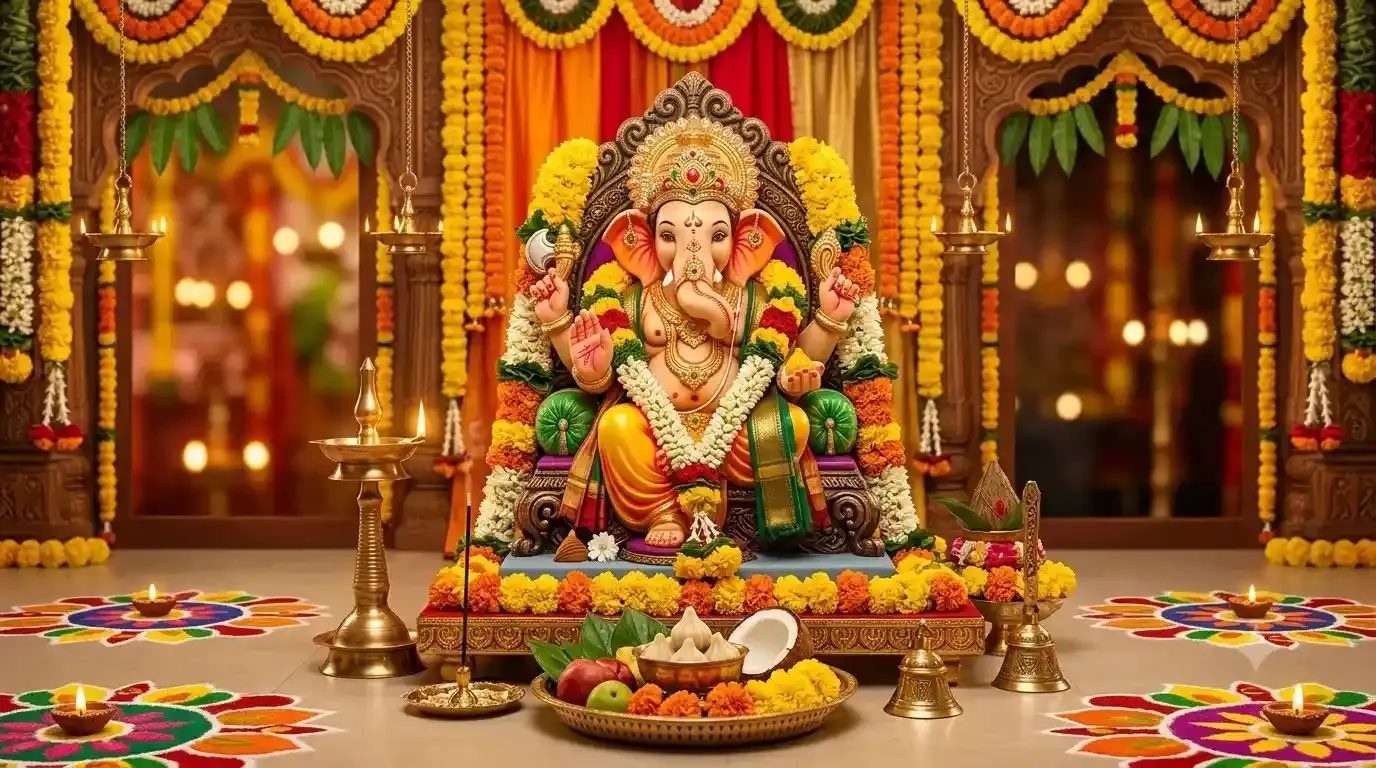
- Kolam-anchored floor mandapam (rice-flour or coloured kolam refreshed daily) — the Tamil element that most distinguishes a Malaysian mandapam.
- Mango leaf thoranam across the arch.
- Banana trunk pillars flanking the mandapam.
- Silk saree backdrop.
- Brass and kuthuvilakku lamps.
- Tension-rod arch for condominium units.
- Three-point lighting (warm key, soft fill, cool backlight).
- Turn off the overhead fluorescent during pooja.
Community and Temple Pandal Ideas
- Cassava or clay murti (commission early).
- Modular aluminium truss hired from KL/Penang suppliers with documentation.
- Printed tension backdrop on flame-retardant fabric (specify FR at quotation).
- CNC-cut layered gopuram silhouette-backlit.
- Proper rain cover — pitched, guttered, drained.
- Thaneer panthal along procession routes (coordinate the food licence).
- Accessible darshan path.
- Live-stream to India (Malaysia is 2.5 hours ahead of IST; a 9pm Malaysian aarti is 6:30pm IST).
- Trilingual QR storytelling placards (Tamil, English, Bahasa Malaysia).
Sourcing
| Item | Where |
|---|---|
| Murtis / pooja items / samagri | Brickfields (Jalan Tun Sambanthan) KL, Little India Klang, Little India Penang (Lebuh Queen/Lebuh Pasar), Ipoh Little India, Little India JB |
| Fresh flowers / garlands / mango leaves | Local wet markets, Brickfields flower vendors, Klang market |
| Banana trunks / plantain leaves | Any wet market |
| Fabric / silk / brocade | Jalan Masjid India KL, Little India areas statewide |
| Truss / staging / drape hire | KL, PJ, Penang suppliers |
| Printing / signage / FR fabric | Sungai Besi, Balakong, Prai |
| Sweets / modak / prasadam | Brickfields, Little India Klang, Indian grocers statewide |
State and City Breakdown
| State / City | Notes |
|---|---|
| Kuala Lumpur (Brickfields) | Flagship, highest search volume; Jalan Tun Sambanthan large murti, Kortumalai Ganesar Temple chariot procession, Sri Kandaswamy Kovil; council DBKL |
| Kuala Lumpur City Centre | Court Hill Sri Ganesar Temple golden chariot procession, Sri Maha Mariamman on Jalan Tun H.S. Lee; DBKL |
| Klang / Selangor | Very large Tamil community, Little India Klang; MBDK/MBSA/MBPJ/MBSJ |
| Batu Caves | Sri Subramaniar Swamy Temple; Selayang council |
| Penang George Town | Second-highest volume, Little India on Lebuh Queen; MBPP |
| Seberang Perai | Mainland Penang; MBSP |
| Ipoh / Perak | Established community, Little India; MBI |
| Johor Bahru | Southern hub, Singapore cross-border readership; MBJB |
| Seremban / Negeri Sembilan | Port Dickson immersion access; MBS |
| Melaka | Historic Chitty community, Sri Poyatha Moorthi Temple; MBMB |
| Kedah / Sungai Petani | Northern community |
| Kota Kinabalu / Kuching | East Malaysia, temple-organised |
This article is general information, not legal advice. Requirements vary by state and local council and change over time — the Peaceful Assembly Act has been amended repeatedly and was subject to a significant Federal Court ruling in 2025. Confirm current requirements with your local council, district police, Malaysia Hindu Sangam, and your temple committee before finalising plans.
Frequently Asked Questions
When is Vinayagar Chaturthi 2026 in Malaysia?
It falls on Monday 14 September 2026, with the main immersion day, Anant Chaturdashi, on Friday 25 September. It is not a public holiday, so most temple festivals and chariot processions are scheduled around the surrounding weekends.
Do I need a police permit for a Ganesh Chaturthi procession in Malaysia?
No. Under the Peaceful Assembly Act 2012 there is no permit system, and religious assemblies and processions sit outside the notification requirement — Section 9(3) makes informing the police optional for a religious assembly. Organisers should still notify their district OCPD in advance and formally request traffic and crowd-control assistance. Separate permits from the local council are still required for tents, stages, banners, road closures and food stalls.
Do I need permission to celebrate Vinayagar Chaturthi at home?
No. A pooja in your own home requires no permit or notification of any kind.
Where can I immerse the Ganesha idol in Malaysia?
Immersion takes place at customary coastal and river sites, but the best options are a temple-organised collective immersion, an artificial immersion pond at a temple, or immersion at home in a large tub for smaller murtis. Confirm your site with your temple and the relevant local council for the current year, and use only biodegradable materials.
Can I immerse a plaster of Paris idol in Malaysia?
No. Plaster of Paris does not dissolve and releases pollutants into the water. Use natural clay with natural colours, or a cassava-based biodegradable murti. Discharging pollutants into water bodies is regulated under the Environmental Quality Act 1974.
What is the Brickfields Ganesha made of?
The large Ganesha murti installed along Jalan Tun Sambanthan in Brickfields has been made from cassava, a biodegradable material that breaks down safely in water and is not harmful to marine life. It is produced in India and assembled on site by local artisans.
Which permits do I need for a temple pandal in Kuala Lumpur?
For a temporary structure, stage, tent or banner in KL you apply to DBKL. Fire safety clearance comes from Bomba, food stalls require a council licence, and road closures are coordinated with district police. Your organising body must be a society registered with ROS. Apply four to eight weeks ahead.
You might also like
Ganesh Chaturthi 2026 in Fahaheel: Mandapam Ideas, Where to Buy & Visarjan
Ganesh Chaturthi 2026 in Salmiya: Mandapam Ideas, Where to Buy & Visarjan
Ganesh Chaturthi 2026 in Doha: Mandapam Ideas, Where to Buy & Visarjan