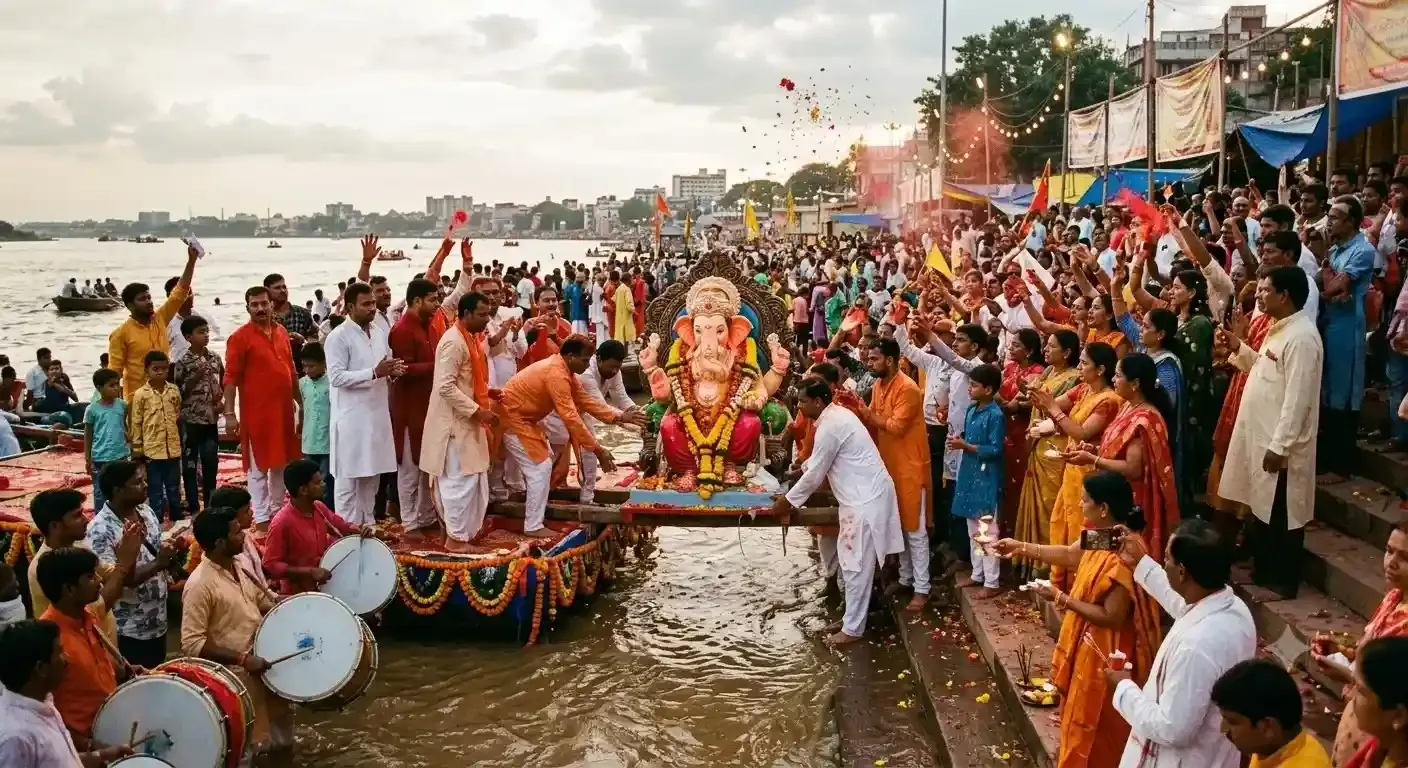
Vinayagar Chaturthi in Sri Lanka 2026: Pillaiyar Worship & Immersion
In Sri Lanka the festival is Vinayagar Chaturthi or Pillaiyar Chaturthi, centred on the Pillaiyar kovil. A complete 2026 guide to worship, permissions and immersion across Jaffna, Colombo, the upcountry and the East.
In Sri Lanka the festival is Vinayagar Chaturthi or Pillaiyar Chaturthi, centred on the Pillaiyar kovil. A complete 2026 guide to worship, permissions and immersion across Jaffna, Colombo, the upcountry and the East.
Quick answer: In Sri Lanka the festival is Vinayagar Chaturthi / Pillaiyar Chaturthi (Monday 14 September 2026), centred on the Pillaiyar kovil — abhishekam, archanai, kozhukattai and arugampul — not the Maharashtrian pandal; three communities observe it differently (Sri Lankan Tamils temple-centred, up-country Malaiyaha Tamils with collective pond immersion, and Colombo's Indian community with the ten-day form). It is not a public holiday. Home worship needs no permit; public processions go through your kovil, Grama Niladhari, police and local authority. Immerse via a kovil-organised site, a community pond (the Kotagala model), or at home with clay or a manjal Pillaiyar — never in irrigation tanks or reservoirs; north/east seas are calmer in September while the west coast can be rough.
The deity is Pillaiyar. In Sri Lanka, Ganesha is Pillaiyar or Vinayagar; the festival is Vinayagar Chaturthi or Pillaiyar Chaturthi, and "Ganesh Chaturthi" is secondary. Tamil is an official language of Sri Lanka and the community's first language.
There are three distinct communities, and they observe the day in different ways.
| Community | Where | How they observe |
|---|---|---|
| Sri Lankan Tamils | Jaffna, Northern Province, Batticaloa, Trincomalee, Eastern Province, Colombo | Temple-centred: Pillaiyar kovils, special poojas, abhishekam, kovil festivals and processions; the indigenous tradition. |
| Malaiyaha (Up-country) Tamils | Central highlands — Hatton, Kotagala, Nuwara Eliya, Badulla, Kandy | Descendants of plantation labourers brought from Tamil Nadu in the 19th century; numerous small estate Pillaiyar shrines; community celebrations with collective immersion in local ponds. |
| Colombo Indian community | Colombo — Marathi, Sindhi, Gujarati, North Indian | Indian-style pranapratishtha, ten-day observance, dhol-tasha and lezim, and immersion; organised through the Indian Cultural Association, Marathi Mandali and the Swami Vivekananda Cultural Centre. |
In Sri Lanka the kovil is the centre. Vinayagar Chaturthi 2026 falls on Monday 14 September, with the concluding day for those observing the longer form on Friday 25 September.
In Sri Lanka the day belongs to Pillaiyar — small shrines at road junctions, at the entrance of every kovil, under bo and banyan trees, at the head of every village lane, and in tiny chapels through the tea estates. Travellers on the A9 to Jaffna still stop at Murikandy Pillaiyar to break a coconut before continuing north; Pillaiyar is petitioned before every beginning, journey and undertaking.
Part 1 — Pillaiyar in Sri Lanka
The shrine on every corner: most large Sri Lankan Hindu temples are dedicated to Murugan (hence the many Kandaswamy Kovils), but Pillaiyar shrines are by far the most numerous, clustering in the Tamil north and east, throughout Colombo, and as small estate chapels across the tea-growing hill country.
Historical weight: many Jaffna temples were destroyed when the Jaffna Kingdom fell to the Portuguese in 1621; the rebuilt shrines carry those memories. The Pillaiyar temple at Kalvalai, Sandilipay in Jaffna is known as Kannai Koththy Kaththa Pillaiyar ("the Pillaiyar who caused the crows to peck the eye") after a tradition that a Portuguese demolition party was set upon by a flock of crows, blinding their leader. Murikandy Pillaiyar, the roadside shrine on the northern highway, has its own origin story tied to British-era road construction and the search for water in the Vanni dry zone.
Key temples
| Temple | Where |
|---|---|
| Sri Kailawasanathan Swami Devasthanam | Colombo, near Pettah and Beira Lake — the most prominent of Colombo's Tamil temples. |
| Sea Street kovils, Pettah | Including Sri Muthu Vinayagar Swamy Kovil, southernmost of three temples in a row; the New and Old Kathiresan Kovils. |
| Sri Ponnambalawaneswaram Kovil | Kochchikade, Colombo — remarkable granite construction. |
| Sammankodu Sri Kathirvelayutha Swamy Temple (Maanikka Pillaiyar Thirukoyil) | Bambalapitiya, on Galle Road. |
| Muthu Vinayagar Kovil | Jaffna. |
| Veyil Ugantha Pillaiyar Kovil | Nallur, Jaffna. |
| Kalvalai Pillaiyar Kovil | Sandilipay, Jaffna. |
| Murikandy Pillaiyar Shrine | A9 highway, Vanni. |
| Sri Sitthi Vinayagar Temple | Puthunagar, Batticaloa. |
| Nallur Kandaswamy Kovil | Jaffna — Murugan, and the island's most famous Hindu temple. |
Part 2 — The weather split
| Region | September Conditions | Implication |
|---|---|---|
| North (Jaffna, Vanni) and East (Trincomalee, Batticaloa) | Dry and hot, between monsoons (northeast monsoon arrives around October) | Excellent conditions; outdoor kovil festivals and processions comfortable; seas generally calmer than the west. |
| Colombo and the west coast | Tail of the southwest monsoon, wet, humid, rain likely, transitioning into inter-monsoon | Plan covered venues; west coast seas can still be rough. |
| Central highlands (Kandy, Hatton, Nuwara Eliya, Kotagala) | Wet, misty, genuinely cold by Sri Lankan standards especially at night | Indoor venues; advise warm clothing. |
| South (Galle, Matara) | Southwest monsoon tail, wet, seas can be rough | Covered venues; caution at the coast. |
Poya days: Sri Lanka observes each full moon Poya day as a public holiday with restrictions on liquor sales, meat sales and some public entertainment. The Binara Poya falls in September and, given Anant Chaturdashi sits close to the full moon, the two may land within a day or two in 2026; check the gazetted holiday list before scheduling entertainment.
Vinayagar Chaturthi is not itself a public holiday in Sri Lanka — Thai Pongal, Maha Sivarathri and Deepavali have holiday status; this day does not.
Part 3 — How the day is observed
At the kovil (the main tradition)
- Special abhishekam to Pillaiyar (milk, honey, curd, sandal, panchamirtham).
- Archanai in the family's name and star.
- Kozhukattai / modakam offered and distributed.
- Arugampul (durva grass) garlands, essential to Pillaiyar worship.
- Vel and vahanam processions at larger kovils, sometimes over several days.
- Annadhanam (communal feeding).
- Go early morning.
At home (modest, no large mandapam)
- A clean pooja space.
- A permanent brass, bronze or stone Pillaiyar (most households keep one) or a small clay murti.
- Arugampul, red flowers, and coconut.
- Kuthuvilakku (the traditional Tamil lamp).
- Kozhukattai (steamed sweet dumplings, the correct offering).
- Manjal Pillaiyar — a small Pillaiyar formed from turmeric paste, a genuinely Tamil practice, simple and traditional, perfect for families who want to observe without buying a murti.
The ten-day form: Colombo's Marathi, Sindhi and North Indian community observes the full Indian form — pranapratishtha, daily aarti across several days, dhol-tasha and lezim, cultural programmes, and a concluding immersion (via the Indian Cultural Association, Marathi Mandali and the Swami Vivekananda Cultural Centre). The up-country Malaiyaha community has its own collective model: murtis from multiple estates and villages brought together to one location for a maha aarti before a joint immersion in a local pond, as done at Kotagala in the Hatton area.
Part 4 — Mandapam and decoration
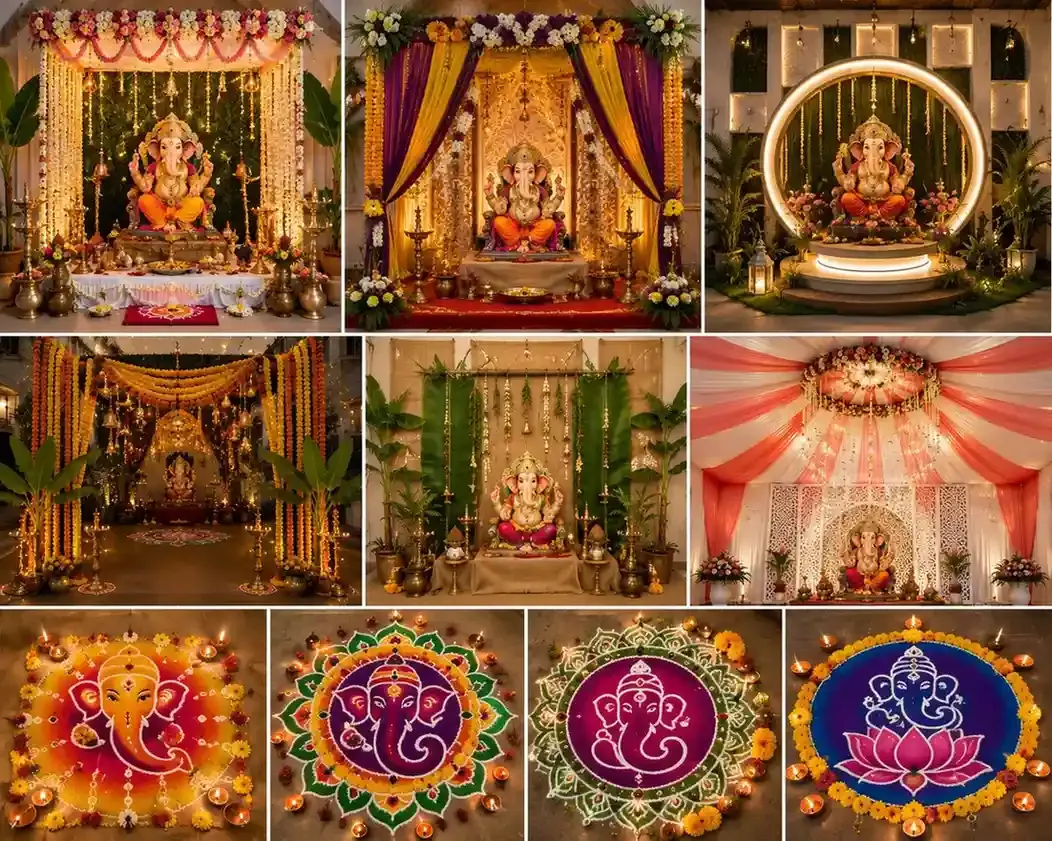
- Console or altar-table mandapam.
- Removable adhesive hooks for backdrops.
- Tension-rod arch.
- Thoranam of mango leaves and coconut fronds across the arch.
- Kolam at the base refreshed daily.
- Banana trunk pillars from any market.
- Kuthuvilakku and brass lamps as the primary light, unaffected by any power interruption.
- Three-point lighting (warm key front-left, soft fill front-right, cool backlight).
- Battery LED backup for every element.
- Turn off the overhead fluorescent during pooja.
- Rain cover with proper drainage for anything outdoors in Colombo or the hill country.
- Warm shelter for elders at up-country events.
Sourcing
| What | Where |
|---|---|
| Murtis, pooja items, brass lamps | Sea Street (Pettah), Colombo — the temple and jewellery street, the best source in the country; Kotahena and Wellawatte; Jaffna town; Batticaloa town; Hatton and Nuwara Eliya for the up-country. |
| Flowers, arugampul, garlands | Kovil-adjacent vendors; Colombo Manning Market; local markets. |
| Banana leaf, trunk, coconut | Any local market. |
| Fabric and textiles | Pettah, Colombo. |
| Clay murtis | Limited supply, order early through your kovil or a Sea Street supplier. |
Order your murti in early August.
Part 5 — Permissions
Note: this is a general framework, not legal advice; confirm with your Grama Niladhari, Divisional Secretariat, and the officer in charge of your local police station before organising anything public.
At home: nothing required
Household pooja requires no permission; religious freedom is constitutionally protected under Articles 10 and 14(1)(e) of Sri Lanka's Constitution. Keep amplified sound moderate and observe noise regulations at night.
The local administrative chain: Grama Niladhari (GN) then Divisional Secretariat (DS) then District Secretariat then local authority. For a community event, start with your Grama Niladhari.
Public events and processions
| Requirement | Authority |
|---|---|
| Permission for processions and public gatherings | Sri Lanka Police — the OIC of your local police station, with the Divisional Secretariat. |
| Local administrative clearance | Grama Niladhari to Divisional Secretariat. |
| Use of public roads and spaces, temporary structures | Local authority — Municipal Council (e.g. Colombo MC, Jaffna MC), Urban Council, or Pradeshiya Sabha. |
| Public performances and cultural programmes | Public Performances Ordinance requirements; local authority. |
| Amplified sound | Central Environmental Authority and local authority — the National Environmental Act noise control regulations set limits and restrict loudspeakers at night. |
| Food service, annadhanam at scale | Public Health Inspector (PHI). |
| Fire safety | Municipal fire service. |
| Religious and cultural coordination, grants | Department of Hindu Religious and Cultural Affairs. |
| Traffic management | Police traffic division. |
Two pieces of advice: go through your kovil (Colombo's Vel festival — the gold chariot procession from Pettah to Bambalapitiya — proves large Hindu street processions are normal and understood here); and engage the Department of Hindu Religious and Cultural Affairs. Lead time 4 to 8 weeks.
Part 6 — Immersion
The coastal zone is regulated
| Instrument / Authority | Role |
|---|---|
| Coast Conservation Act No. 57 of 1981 | Activities within the defined coastal zone require permits from the Coast Conservation and Coastal Resource Management Department. |
| National Environmental Act No. 47 of 1980 | Central Environmental Authority — pollution and water quality. |
| Marine Environment Protection Authority (MEPA) | Marine pollution. |
| Local authority | Beach access, public space, cleanup. |
| Police | Crowd safety at the site. |
Important: a specific Sri Lankan warning — do not immerse in irrigation tanks (wewa) or reservoirs. Sri Lanka's ancient tank system supplies drinking and agricultural water and is a matter of serious national importance.
The four options, ranked
- Kovil-organised collective immersion (best) — your temple coordinates site, transport, safety and cleanup; contact them in early September.
- The Kotagala model — a designated community pond; the up-country practice of bringing murtis from many villages to one pond for a joint maha aarti and immersion, well-suited to inland areas, controllable and safe.
- Home immersion — a large tub or drum for a household clay murti; full uttar pooja, dissolve over 24 to 48 hours, return the clay to the garden.
- Sea immersion at an organised site, with the safety discipline below.
Regional guidance
| Region | Guidance |
|---|---|
| North (Jaffna) and East (Trincomalee, Batticaloa) | September is the dry, calmer season; coastal immersion most feasible; coordinate through your kovil. |
| Colombo and the west coast | The southwest monsoon means west coast seas can be rough into September (Wellawatte, Mount Lavinia and Dehiwala can carry strong surf and rip currents); use a kovil-organised site or immerse at home. |
| Up-country (Hatton, Kotagala, Nuwara Eliya) | Designated community ponds, not tanks or reservoirs used for water supply. |
| South (Galle, Matara) | Monsoon tail, treat as Colombo. |
Materials — acceptable
- Natural clay with natural pigments.
- Paper mache with natural binders.
- A manjal (turmeric) Pillaiyar which dissolves entirely.
- Fresh flowers and organic offerings.
Never use: plaster of Paris; chemical or synthetic paints; thermocol; plastic-threaded garlands; glitter, foil, plastic ornaments; batteries or electrical parts. Strip the murti completely before immersion.
Water safety
Sri Lanka has a high drowning rate and its coastal rip currents are notorious. Follow these rules.
- Immerse only at a beach with lifeguards, in calm conditions; if waves are breaking, that beach is wrong.
- Waist-deep is the absolute limit, for anyone.
- Never turn your back on the sea.
- Children stay on the sand.
- Designated spotters — sober, strong swimmers, not participating, watching the water only.
- Nobody who cannot swim enters the water.
- No alcohol.
- Daylight only.
- Ask local fishermen about conditions at that spot on that day.
- If caught in a rip, do not fight it — swim parallel to shore until free, then in; float and signal.
Ponds, purpose-arranged tanks, and home immersion carry none of this risk.
Part 7 — Regional briefs
Jaffna and the North — the heartland; Muthu Vinayagar Kovil, the Nallur temples, Kalvalai Pillaiyar at Sandilipay, and hundreds of village Pillaiyar shrines; September weather dry and favourable; strong material for a history-led page (Portuguese destruction of 1621, the rebuilt temples and their legends).
Colombo — three audiences in one city: Sea Street and Pettah for the Tamil community and sourcing; Bambalapitiya, Wellawatte and Kotahena for residential concentration; and the Indian community's ten-day observance with dhol-tasha; monsoon-tail weather, plan covered venues.
Up-country (Hatton, Kotagala, Nuwara Eliya, Badulla) — the Malaiyaha Tamil community, small estate Pillaiyar shrines, and the collective pond-immersion model; the most underserved audience on the island online; cold, wet September, indoor venues and warm clothing.
Batticaloa and the East — Sri Sitthi Vinayagar and the eastern kovils; dry September weather, calmer seas.
Kandy and Matale — Sri Muthumariamman kovils and an established Tamil community; cool, wet September.
This article is general information, not legal advice. Requirements vary by district and local authority and change over time. Confirm current requirements with your Grama Niladhari, Divisional Secretariat, local police station and kovil committee before finalising plans.
Frequently Asked Questions
When is Vinayagar Chaturthi 2026 in Sri Lanka?
Vinayagar Chaturthi 2026 falls on Monday 14 September, with the concluding day for those observing the longer form on Friday 25 September. It is not a public holiday in Sri Lanka — Thai Pongal, Maha Sivarathri and Deepavali have holiday status, but this day does not.
What is Pillaiyar Chaturthi?
Pillaiyar Chaturthi is the Sri Lankan Tamil name for the festival. Ganesha is known as Pillaiyar or Vinayagar in Tamil, and Pillaiyar shrines are the most numerous Hindu shrines on the island, found at road junctions, temple entrances, village lanes and throughout the hill country tea estates.
Do I need permission for a Hindu procession in Sri Lanka?
For a public procession you need clearance from the officer in charge of your local police station and the Divisional Secretariat, with the process typically starting through your Grama Niladhari. Local authority approval is required for use of public roads and temporary structures, amplified sound is regulated under the National Environmental Act, and food service requires Public Health Inspector clearance. Working through your kovil committee is by far the easiest route.
Where can I immerse the Pillaiyar idol in Sri Lanka?
The best options are a kovil-organised collective immersion, a designated community pond as practised in the up-country, or home immersion in a large tub. Coastal immersion is more feasible in the north and east where September is the dry, calmer season. Do not immerse in irrigation tanks or reservoirs, which supply drinking and agricultural water.
Is the sea safe for immersion in Colombo in September?
Often not. September is the tail of the southwest monsoon, and west coast seas can be rough with strong rip currents. Use a kovil-organised site in confirmed calm conditions, or immerse at home. Only immerse at a lifeguarded beach, in waist-deep water at most, in daylight.
What is a Manjal Pillaiyar?
A small Pillaiyar formed from turmeric paste, a traditional Tamil practice. It requires no purchase, is fully biodegradable, and dissolves completely at immersion — an excellent option for households wanting to observe simply and sustainably.
Where can I buy Pillaiyar statues and pooja items in Colombo?
Sea Street in Pettah is the main temple and pooja-supply street and the best source in the country, along with shops in Kotahena and Wellawatte. In the north, Jaffna town; in the east, Batticaloa town; in the hill country, Hatton and Nuwara Eliya. Order clay murtis early, as supply is limited.
What is the weather like across Sri Lanka during the festival?
The island is split. Jaffna and the east are dry and hot, between monsoons. Colombo, the west coast and the south are at the tail of the southwest monsoon and wet. The central highlands are wet, misty and genuinely cold at night.
You might also like
Ganesh Chaturthi 2026 in Fahaheel: Mandapam Ideas, Where to Buy & Visarjan
Ganesh Chaturthi 2026 in Salmiya: Mandapam Ideas, Where to Buy & Visarjan
Ganesh Chaturthi 2026 in Doha: Mandapam Ideas, Where to Buy & Visarjan