Surya Jayanti 2026: The Festival of the Sun God — Complete Guide to Significance, Rituals & Mantras
Surya Jayanti 2026 — Celebrating the Birthday of the Cosmic Light Before there was a temple, before there was a mantra, before the first human being had words…
Surya Jayanti 2026 — Celebrating the Birthday of the Cosmic Light Before there was a temple, before there was a mantra, before the first human being had words…
Surya Jayanti 2026 — Celebrating the Birthday of the Cosmic Light
Before there was a temple, before there was a mantra, before the first human being had words for the divine — there was the Sun.
Rising every morning without fail. Flooding the world with light. Warming the cold earth back into life. Pulling the tides of the ocean and the sap of the tree and the blood in every living creature's veins — the same golden force, working through all of creation, sustaining every heartbeat on this planet.
The ancient Vedic rishis — those extraordinary seers who sat in the early morning silence and looked at the sunrise with the full, undivided attention of enlightened consciousness — saw something that modern human beings have largely forgotten: the Sun is not merely a star.
It is the most immediate, most tangible, most accessible manifestation of the divine in the observable universe. It is Brahman made visible — the infinite consciousness expressing itself as light, as warmth, as the energy that makes all life possible. To worship the Sun is not primitive nature worship. It is the most direct act of devotion available to a human being in a physical body — the worship of the divine as it most obviously, most generously, most continuously reveals itself to us.
Surya Jayanti — the celestial birthday of Lord Surya, the Sun God — is the annual festival that honors this extraordinary being and the extraordinary gift he gives: not just the physical light that allows us to see, but the divine light of consciousness that allows us to know.
In 2026, Surya Jayanti arrives with all the power and grace of the sun himself — rising over the sacred horizon of a new year with the promise that has never been broken in the history of this earth: the light always returns.
At HinduTone, we offer you the most complete, most spiritually rich guide to Surya Jayanti 2026 — the date, the mythology, the sacred stories, the complete puja vidhi, the fasting rules, the mantras, the Surya Namaskara practice, and the profound spiritual wisdom that makes this festival one of the most important in the Hindu calendar.
[image: 📅] Surya Jayanti 2026 — Date and Tithi Details
Surya Jayanti is also widely celebrated as Ratha Saptami — the seventh day (Saptami) of the bright fortnight (Shukla Paksha) of the month of Magha — the day on which Surya's divine chariot is said to turn northward in its annual journey, heralding the approach of spring.
[image: ⚠️] The following dates are based on traditional Panchangam calculations for 2026. Always confirm with your local panchangam or astrologer for region-specific timing.
The Significance of Magha Shukla Saptami
The Magha month (January-February) is itself one of the most sacred months in the Hindu calendar — a time when the sun is in Makara Rashi (Capricorn) and beginning its northward journey (Uttarayan). The bright seventh day of this month is considered the moment of maximum solar power in the winter season — the turning point when the sun's energy, which had been waning through the months of Dakshinayan (southward journey), begins to strengthen and grow.
The number 7 — Saptami — has special solar significance:
- 7 horses pull Surya's divine chariot
- 7 colors make up the spectrum of visible light from the Sun
- 7 days in a week (each ruled by a celestial body, Sunday by the Sun)
- 7 chakras in the human body activated by solar energy
- The 7th day of the bright fortnight represents the sun at his most actively accessible — neither too far away (new moon) nor hidden by the full moon's overwhelming presence
[image: 🌟] The Many Names of Surya Jayanti
The festival of the Sun God's birthday is celebrated under different names across the regions of India, each name reflecting a specific aspect of the solar tradition:
[image: 🌞] The Mythology of Surya Jayanti — Sacred Stories of the Sun God
Story 1: The Birth of Surya — From the Cosmic Womb of Aditi
The Rigveda and the Vishnu Purana tell the story of Surya's birth as one of the most cosmically significant events in all of Hindu mythology.
In the beginning, when the universe was still in its primordial state, the great mother goddess Aditi — whose very name means "infinity" or "the unlimited one" — was the cosmic womb from which all divine beings would emerge. She was the mother of the Adityas — the twelve divine solar beings who would govern the twelve months of the cosmic year.
But when Surya was born, his radiance was so overwhelming — so absolutely blinding and total — that neither the gods nor any created being could bear to look directly at him or be in his presence. The universe itself recoiled from his brilliance.
Aditi carried her blazing son, burning with divine light, to the great divine craftsman Vishvakarma (also called Tvashta) — the architect of the gods, the builder of celestial weapons and divine vehicles — and asked him to do the unthinkable: reduce Surya's radiance.
Vishvakarma placed Surya on his divine lathe — a cosmic instrument of unimaginable precision — and carefully, with infinite care, shaved away the excess radiance from the solar deity. The shaved portions of Surya's light did not disappear — they were fashioned by Vishvakarma into the most sacred objects in the divine realm:
- The Sudarshana Chakra (the spinning disc weapon of Lord Vishnu — made from Surya's light)
- The Pushpaka Vimana (the divine aerial vehicle — also from Surya's light)
- The Trishula (Lord Shiva's trident — crafted from solar radiance)
- The Shakti of the goddess Kali (her fierce power — from the sun's reduced but still blazing excess)
Even after this cosmic trimming, Surya remained the most luminous being in existence — simply now at a level that the created universe could sustain and benefit from, rather than be destroyed by.
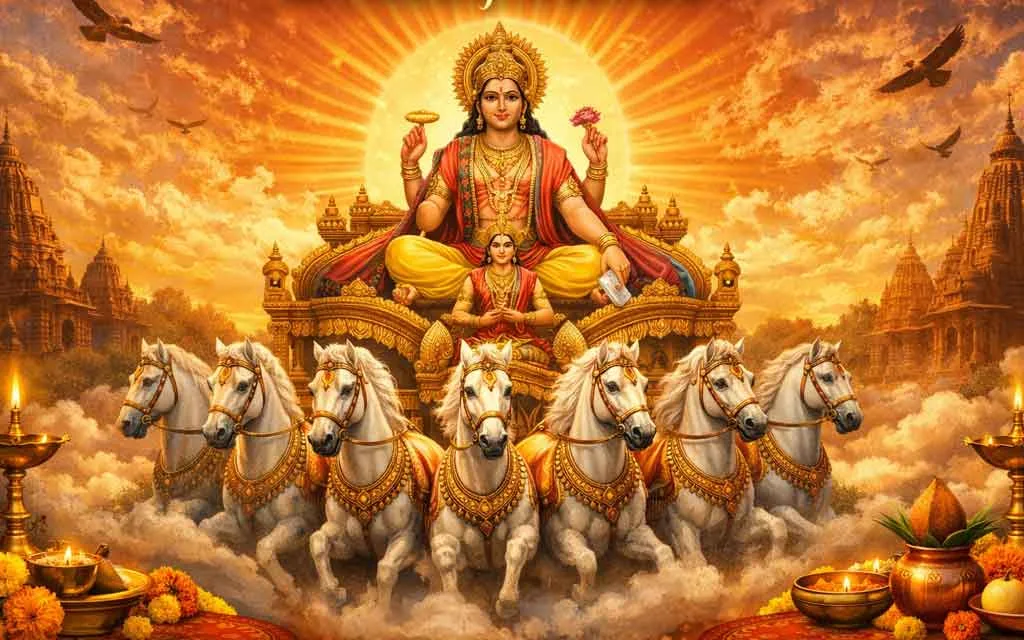
Ratha Saptami is the day traditionally associated with the moment Surya's chariot first moved — when the newly formed, perfectly calibrated Sun God, seated on his magnificent golden chariot drawn by seven divine horses, first set out on his eternal journey through the sky.
It was the beginning of the cosmic day. It was the first sunrise.
Every Ratha Saptami, every Surya Jayanti, we celebrate that first sunrise — the original act of divine generosity when the Sun decided to give his light to a universe that had existed in darkness.
Story 2: The Turning of the Chariot — Ratha Saptami's Cosmic Significance
In the Vedic cosmological system, the Sun does not simply rise and set — it travels through an elaborate cosmic circuit, governing not just the daily cycle but the annual cycle and the vast cycles of cosmic time called Yugas.
Each year, the Sun makes two great directional transitions:
Dakshinayan — the southward journey, from the summer solstice (around June 21) to the winter solstice (around December 21): The Sun moves progressively south, its days grow shorter in the northern hemisphere, its energy becomes gentler, more introspective — associated with the energy of withdrawal, death, ancestors, and the dark half of the year.
Uttarayan — the northward journey, from the winter solstice (around December 21) to the summer solstice (around June 21): The Sun begins moving north, days grow longer, its energy becomes more active, creative, generous — associated with the energy of life, birth, growth, and the light half of the year.
Makar Sankranti (January 14-15) marks the astronomical beginning of Uttarayan.
Ratha Saptami — approximately six weeks later — marks the day when the Sun's northward journey has gathered enough momentum that Surya's chariot is now fully committed to the northern direction, the seven horses pulling with maximum divine energy toward the spring and summer that are now inevitable.
The image of the Ratha (chariot) turning is one of the most powerful symbols in all of Hindu cosmic iconography. The chariot cannot stop. Its horses cannot be turned back. The sun's movement through the cosmos is achala — immovable, unstoppable, as certain as existence itself.
On Ratha Saptami, we celebrate not just the Sun's birthday but the affirmation that the direction of the divine is always toward light, always toward growth, always toward life. The chariot always turns north. Spring always comes. The sun always rises.
Story 3: Samba's Healing — The Origin of Surya Worship at Konark
This story — which we have encountered in the context of the Konark Sun Temple — is also the foundational story of Samba Dashami, the Odia celebration of Surya Jayanti.
Samba, the son of Lord Krishna and Jambavati, was cursed with leprosy by the sages whose meditations he had disturbed. He performed twelve years of tapasya at the Chandrabhaga River (present-day Konark, Odisha) and was healed by Lord Surya's direct grace.
After his healing, Samba returned to Dwaraka and established the tradition of Surya worship — building the first temple at Konark and teaching the practices that would eventually flower into the great Surya tradition of eastern India.
Samba Dashami — observed on Magha Shukla Dashami in Odisha — commemorates Samba's healing and celebrates the Sun God's role as the supreme healer of all disease, both physical and karmic.
The traditional ritual of Samba Dashami involves:
- The Samba Puja — worship of both Samba and Surya together
- Bathing in the Chandrabhaga River (or any sacred river, symbolically)
- Offering of seven arka (Calotropis) leaves on the head and shoulders during the bath
- Chanting of the Aditya Hridayam and Samba Stuti
- Preparation and offering of Pitha (Odia rice cakes) to the Sun
In the Samba story, the Sun God heals the one who comes to him with twelve years of unbroken devotion. Surya Jayanti teaches: the Sun does not discriminate. He does not check whether you are worthy before shining. He simply shines — on all, always. Come to him in sincere devotion, and healing — of body, mind, and soul — is inevitable.
Story 4: Kunti and Surya — The Sun's Gift of Divine Progeny
One of the most moving stories connecting Lord Surya to human history is the story of Kunti — the mother of the Pandavas — and her extraordinary relationship with the Sun God.
When Kunti was still a young girl in her father Kuntibhoja's household, she was given the responsibility of serving the great and unpredictable sage Durvasa — known for his terrible temper and his powerful curses. Kunti served the sage with such perfect patience, such complete attention, and such genuine warmth that Durvasa was deeply moved.
Before departing, he taught her a sacred mantra — the Putra Kameshti mantra — by which she could invoke any deity and ask for a child of divine power. But he warned her: "The mantra works — test it only when you truly need it, not out of mere curiosity."
Kunti, still a girl, could not resist the temptation of testing such an extraordinary gift. She sat alone in her room, faced the rising sun, and chanted the mantra — invoking Surya.
Lord Surya appeared before her — blazing with golden light, magnificent beyond any mortal's imagination. He spoke gently:
"You have invoked me with this sacred mantra, and a mantra sincerely chanted cannot go unanswered. I must fulfill its purpose — you shall have a son of divine power from me. But I see you are not yet ready. Tell me how to honor both your request and your innocence."
Kunti, terrified by what she had started, begged Surya to forgive her impulsive mistake. But Surya's response was the response of pure dharma, pure grace:
"I cannot unhear a sincere prayer. The mantra has been chanted. A son of the Sun will be born to you — brilliant, powerful, the equal of any warrior who ever lived. And I will restore your maidenhood after his birth, so that your life remains unaffected."
That son was Karna — the greatest archer in the Mahabharata, the man described as equal to Arjuna, the hero whose tragedy is one of the deepest in all of Sanskrit literature. Karna was born with Kavacha and Kundala — divine armor and earrings that made him invulnerable — gifts from his divine father Surya, who knew his son would face extraordinary adversity.
Throughout Karna's life, Surya maintained a silent, watchful connection with his son — appearing in Karna's dreams to warn him, trying to protect him, suffering with the knowledge that Karna's destiny would ultimately lead to tragedy despite his divine gifts.
Surya's relationship with Karna embodies one of the deepest teaching of solar theology: the Sun gives his gifts equally to all — even to those whose lives are destined for suffering, even when the gifts cannot prevent the tragedy. Surya gave Karna his armor not because it would save him but because a divine father cannot withhold divine gifts from his child.
On Surya Jayanti, we remember Karna — the son of the Sun, the unsung hero, the greatest giver in the Mahabharata. In his story, we see the full complexity of Surya's nature: the Sun gives without reservation, gives even knowing the gift may not be enough, gives because giving is what the Sun IS.
Story 5: The Twelve Adityas and the Cosmic Year
In the Vishnu Purana and the Bhagavata Purana, the twelve Adityas are described in extraordinary detail. Each of the twelve divine solar beings governs one month of the year — riding in Surya's chariot alongside the Sun God, each bringing their specific divine quality to the month they govern.
The retinue of Surya's chariot changes with each month, bringing new divine presences to the sky:
Each month, as the new Aditya takes his place in the chariot, the quality of solar energy available to the earth shifts — creating the cycle of seasons, the cycle of agriculture, the cycle of human emotional and spiritual life.
Magha Saptami — Surya Jayanti — falls in the month governed by Bhaga (one of the Adityas whose name means "the giver of fortune"). The specific quality of solar energy available during Surya Jayanti is thus the energy of bhaga — auspiciousness, fortune, divine grace freely given.
[image: 🛕] The Temples of Surya — Sacred Sites for Surya Jayanti Pilgrimage
Surya Jayanti is most powerfully observed at the great Surya temples of India. If you are planning a pilgrimage for Surya Jayanti 2026, these are the most sacred destinations:
1. Konark Sun Temple — Odisha
The greatest Surya temple in the world — the cosmic chariot of stone — is the supreme destination for Ratha Saptami. On Surya Jayanti, the first rays of the sunrise are aligned through the temple's eastern entrance exactly as the original builders intended. Thousands of devotees gather at dawn for this extraordinary experience.
Special Surya Jayanti events at Konark:
- Pre-dawn puja and abhishek
- Sunrise arghya offering from the temple steps
- Classical Odissi dance performances
- Cultural programs and temple processions
2. Suryanar Kovil — Tamil Nadu
The Suryanar Kovil (Suryanarayana Temple) at Sirkazhi, Nagapattinam district, is one of the nine Navagraha temples of Tamil Nadu — and the only temple dedicated to Surya as the primary deity in the Navagraha circuit. Surya Jayanti here is celebrated with extraordinary grandeur — the chariot festival (Ther), special abhishek, and thousands of devotees.
3. Modhera Sun Temple — Gujarat
The Modhera Sun Temple (11th century CE) in Mehsana district, Gujarat, is one of the finest examples of Solanki architecture and one of India's most beautiful Surya temples. On the equinoxes, sunrise light falls directly on the main Surya idol. Ratha Saptami here brings large numbers of devotees for the sunrise celebration.
4. Dakshinarka Temple — Gaya, Bihar
At Gaya — the supreme pilgrimage site for ancestor worship — the Dakshinarka Temple (Southern Sun Temple) is one of the oldest Surya temples in India. Surya Jayanti here is combined with ancestral rites — making it especially powerful for those with Pitru Dosha.
5. Suryanarayana Temple — Arasavalli, Andhra Pradesh
The Suryanarayana Swamy Temple at Arasavalli (Srikakulam district, Andhra Pradesh) is one of India's most ancient Surya temples — over 1,300 years old. Twice a year (March and September), the sunrise light falls directly on the main idol. Surya Jayanti here is one of the largest festivals of the Kalinga coast.
6. Brahma Kund — Kashi (Varanasi)
The Brahma Kund and the Lolarka Kund in Varanasi are ancient solar tanks where Surya worship has been performed since Vedic times. On Surya Jayanti, thousands of devotees bathe in these sacred tanks before sunrise and offer arghya to the rising sun.
7. Surya Mandir — Ranchi, Jharkhand
The Surya Mandir at Ranchi — built on a hilltop with a stepped pathway of 18 steps — is one of the most visited Surya temples in eastern India. The view of the sunrise from the temple hilltop on Ratha Saptami is extraordinary.
[image: 🌅] The Special Bath — Ratha Saptami Snanam
The most important and most universally observed ritual of Ratha Saptami / Surya Jayanti is the sacred pre-dawn bath — performed with seven Arka leaves placed on specific points of the body.
The Arka Leaf Ritual — Why Seven Leaves?
Arka (Calotropis procera / Madar plant) is the most sacred plant in Surya worship — Surya's own plant, associated with solar energy in Ayurveda and the tantric tradition. Its leaves are used specifically in this Ratha Saptami bath because:
- Arka means "the Sun" in Sanskrit — the plant carries solar energy in its very name and nature
- The Arka plant blooms toward the sun and is associated with the sun's healing properties
- In Ayurveda, Arka is one of the most powerful medicinal plants — connected to the Sun's role as the supreme healer
- The white flowers of the Arka are offered to Surya in worship as they symbolize purity and solar radiance
The Seven Arka Leaves Placement
Place seven Arka leaves (or in their absence, seven blades of Dharba/Darbha grass, or seven Tulsi leaves as a substitute) on these seven specific points:
The Snanam Mantra
While placing each leaf and during the bath, chant:
यत्पापं जन्मना दत्तं माता पित्रोः स्वकर्मभिः।
तत्पापं हरतु सवितुः नमस्कृत्य समाहिताः ॥
Yat papam janmana dattam mata pitroh svakarmabhih
Tat papam haratu savituh namaskritya samahatah
Meaning: May all the sins accumulated from birth — whether inherited from parents or self-created through one's own actions — be destroyed by Lord Savitri, to whom we bow with focused minds.
The Complete Snanam Procedure
Step 1 — The Night Before (Surya Jayanti Eve)
- Eat a light sattvic meal
- Collect seven Arka leaves (or substitutes) and keep them ready
- Set your intention for the morning bath
- Sleep early to wake at Brahma Muhurta
Step 2 — Brahma Muhurta Wake (90 minutes before sunrise)
- Wake quietly and immediately sit for a few minutes of silence
- Mentally offer your first thought of the day to Lord Surya
Step 3 — The Bath
- Place the seven Arka leaves at the seven body points described above
- Enter the bath (river, tank, or home bathroom — all are valid)
- Chant the Snanam Mantra while bathing
- If bathing in a river, face east and immerse three times
- After bathing, offer the seven leaves to the river or place them at the base of an east-facing plant or tree
Step 4 — Dress and Preparation
- Wear clean, fresh clothes — preferably saffron, orange, or red (solar colors)
- Proceed immediately to the puja space or outdoor Surya worship
[image: 🛕] Surya Jayanti Puja Vidhanam — Complete Step-by-Step Procedure
Puja Items Required (Samagri List)
The Complete Puja — Seven Sacred Steps
Step 1: Sankalpa (Sacred Intention)
Hold the copper vessel with water in both hands, flowers in the right hand, and state your Sankalpa clearly:
"Om Asya Magha Shukla Saptami Tithau, Ratha Saptami Nimitte, Surya Jayanti Mahotsave, Shri Suryanarayana Prasanna Artham, Sarva Papa Kshaya Artham, Arogya Siddhi Artham, Artham, Surya Namaskar Puja Karishye."
"On this Magha Shukla Saptami tithi, on the occasion of Ratha Saptami and Surya Jayanti, for the pleasure of Lord Suryanarayana, for the destruction of all sins, for the attainment of health, and for , I perform this Surya worship."
Step 2: Ganapati Vandana
Begin all puja with Lord Ganesha's invocation. Offer red flowers, a piece of jaggery, and chant:
ॐ गं गणपतये नमः ॥ (11 times)
Step 3: Surya Dhyana (Meditation on Surya's Form)
Close the eyes and visualize Lord Surya as described in the Vishnu Purana:
A being of blazing golden light, seated on a golden chariot drawn by seven green-golden horses, holding a lotus in each hand, wearing a crown of blazing solar rays, surrounded by the Arka plant's white flowers, attended by Danda (the dawn god) and Pingala (the dusk god), and preceded by the charioteer Aruna.
Sit with this visualization for three to five minutes before beginning the verbal worship. The visual impression of the deity established in the mind makes all subsequent worship more powerful.
Step 4: Shodashopachara Puja (16 Steps of Complete Worship)
Perform the following sixteen offerings to Lord Surya's idol or image:
Step 5: The Arghya — The Supreme Offering of Surya Jayanti
The Arghya (water offering to the rising sun) is the central, most sacred act of Surya Jayanti worship — performed directly to the physical rising sun, not to an idol.
How to Offer Arghya:
- Fill a copper vessel (lota) with clean water
- Add red flowers (hibiscus or lotus petals), a few drops of rosewater, red sandalwood powder, and a pinch of saffron — making the water fragrant and beautifully colored
- Stand facing east, both feet together, the copper vessel held in both hands at chest height
- As the sun rises above the horizon — at the precise moment the golden disc becomes visible — begin slowly pouring the water in a gentle arc toward the sun, from the vessel held at chest height, so the water falls in a thin stream between you and the rising sun
- Through this arc of falling water, you will see the rainbow spectrum of the sun's light — the seven colors of the solar horses made visible in the falling water drops
- Chant the Arghya Mantra as you pour:
ॐ सूर्याय नमः। एहि सूर्य सहस्रांशो तेजोराशे जगत्पते।
अनुकम्पय मां भक्त्या गृहाणार्घ्यं दिवाकर ॥
Om Suryaya Namah. Ehi Surya sahasramsho tejorashi jagatpate
Anukampaya mam bhaktya grihanaarghyam Divakara
Meaning: O Surya, salutations to you. Come, O thousand-rayed Sun, treasury of splendor, lord of the universe — bless me with your compassion and accept this water offering, O maker of the day.
- Offer arghya three times — the first for Brahma (creation), the second for Vishnu (preservation), the third for Shiva (liberation)
The Rainbow in the Arghya: When you pour the arghya correctly — a thin stream of water between yourself and the rising sun — the water droplets act as prisms, dispersing the white sunlight into its constituent spectrum of seven colors. You see, for a few seconds, a tiny rainbow in the falling water. This is not an accident. The ancient practitioners of Surya worship understood that the seven-colored spectrum represents the seven horses of Surya's chariot made visible in water. The arghya ritual makes the invisible visible — the divine solar spectrum made manifest in the space between the devotee and the deity.
Step 6: Surya Namaskara — The Body's Prayer to the Sun
After arghya, perform twelve rounds of Surya Namaskara (Sun Salutation) — the ancient body-prayer to the Sun God — chanting one of the twelve Surya names with each round:
Step 7: Prasad Distribution
The traditional prasad offerings for Surya Jayanti that are prepared, offered to the deity, and then distributed:
- Wheat halwa (sweet pudding) — Surya's grain made sacred
- Sesame and jaggery sweets (til-gul or ellu bella)
- Pongal (in South India) — sweetened rice with jaggery
- Arghya water — the water that touched the sun's morning rays
- Arka flowers — blessed by the ceremony
- Fruits — especially pomegranate, the solar fruit
[image: 🌾] Fasting Rules for Surya Jayanti
Who Should Fast
The Surya Jayanti fast is recommended for:
- Those suffering from chronic health conditions — particularly skin diseases, eye problems, bone disorders, and heart conditions (all governed by Surya in Ayurveda)
- Those with unfavorable Sun placement in their birth chart (Sun in the 6th, 8th, or 12th house; debilitated Sun in Libra)
- Those experiencing professional setbacks, lack of confidence, or difficulty being seen/recognized in their field
- Those seeking healing for a parent (particularly father — Surya governs the father in Vedic astrology)
- Anyone seeking general vitality, confidence, and radiance
The Fasting Method
Complete Fast (Nirjala Surya Vrat): No food or water from sunrise to sunset — considered the most powerful form, recommended for those with strong constitutions or specific serious intentions.
Ekabhukta (One-Meal Fast): One sattvic meal taken before sunrise (before the fast begins) or after sunset (after the fast is broken). No food during daylight hours.
Phalahar (Fruit Fast): Fruits, milk, coconut water, and nuts throughout the day — the most accessible form, suitable for most practitioners.
Foods Allowed During Surya Jayanti Fast
[image: ✅] Wheat-based preparations (wheat is Surya's grain)
[image: ✅] Jaggery and sesame preparations
[image: ✅] Fruits — especially pomegranate, mango, orange
[image: ✅] Milk and milk products
[image: ✅] Coconut and coconut water
[image: ✅] Water charged in the sunlight
[image: ✅] Sendha namak (rock salt)
Foods to Avoid
[image: ❌] Rice (reserved for Lunar deities)
[image: ❌] Non-vegetarian food
[image: ❌] Onion and garlic
[image: ❌] Alcohol and tobacco
[image: ❌] Sour foods (excess sourness imbalances Pitta — the solar dosha)
Breaking the Fast
The fast is broken at sunset — facing west, offering a final arghya to the setting sun, and then consuming the prasad prepared in the morning.
Sunset Arghya Mantra:
ॐ सूर्याय नमः। साक्षी भव दिनकर ॥
Om Suryaya Namah. Sakshi bhava Dinakara.
"Salutations to Surya. O maker of the day — be our witness."
[image: 🕉️] Complete Surya Mantras for Surya Jayanti
1. The Gayatri Mantra — The Supreme Solar Prayer
Chant 108 times at sunrise — the most powerful Surya mantra
ॐ भूर्भुवः स्वः। तत्सवितुर्वरेण्यम्।
भर्गो देवस्य धीमहि। धियो यो नः प्रचोदयात् ॥
Om Bhur Bhuvah Svah. Tat Savitur Varenyam
Bhargo Devasya Dhimahi. Dhiyo Yo Nah Prachodayat
2. Surya Beeja Mantra — The Seed Syllable of the Sun
Chant 108 times for direct activation of solar energy in the body
ॐ ह्रां ह्रीं ह्रौं सः सूर्याय नमः ॥
Om Hraam Hreem Hraum Sah Suryaya Namah
The Four Beeja Syllables:
- Hraam — invokes Surya's creative energy
- Hreem — invokes Surya's sustaining energy
- Hraum — invokes Surya's transforming energy
- Sah — the seed of the solar consciousness itself
3. Surya Ashtakshara Mantra — The Eight-Syllable Sun Mantra
Chant 108 times for protection and victory
ॐ नमो भगवते सूर्याय ॥
Om Namo Bhagavate Suryaya
4. Surya Dwadasha Nama Stotram — The Twelve Names
Chant each name 108 times for complete solar blessings across all 12 months
आदित्यः प्रथमं नाम द्वितीयं तु दिवाकरः।
तृतीयं भास्करं प्रोक्तं चतुर्थं तु प्रभाकरः ॥
पञ्चमं तु सहस्रांशुः षष्ठं त्रिभुवनेश्वरः।
सप्तमं हरिदश्वं च अष्टमं विश्वकर्मणे ॥
नवमं रविमित्यक्तं दशमं लोकभावनः।
एकादशं त्रयीमूर्तिः द्वादशं सूर्य एव च ॥
Adityah prathamam nama dvitiyam tu Divakarah
Tritiyam Bhaskaram proktam chaturtham tu Prabhakara
Panchamam tu Sahasramshu shashtham Tribhuvaneshvarah
Saptamam Haridashvam cha ashtamam Vishvakarmane
Navamam Ravim ity uktam dashamam Lokabhavanah
Ekadashham Trayimurtih dvadashham Surya eva cha
The Twelve Sacred Names:
- Aditya — Son of Aditi (the infinite mother)
- Divakara — Maker of the day
- Bhaskara — The light-maker
- Prabhakara — The illuminator
- Sahasramshu — Thousand-rayed
- Tribhuvaneshvara — Lord of the three worlds
- Haridashva — Golden-horsed
- Vishvakarma — The divine craftsman
- Ravi — The radiant
- Lokabhavana — Sustainer of the worlds
- Trayimurti — The form of the three Vedas
- Surya — The luminous Supreme
5. Surya Kavacham — The Protective Armor of the Sun
The supreme protective mantra — chant once in the morning for complete protection throughout the day
ॐ सूर्यः शिरसि मे पातु ललाटे मे विभावसुः।
नेत्रे मे पद्मिनीनाथः श्रोत्रे मे जयतां पतिः ॥
Om Suryah shirasi me patu lalate me Vibhavasuh
Netre me Padminnatah shrotre me Jayatam patih
Meaning: May Surya protect my head. May Vibhavasu (the brilliant) protect my forehead. May the lord of the lotus (who opens at sunrise) protect my eyes. May the lord of all victorious beings protect my ears.
6. Surya Ashtottara Shatanamavali — 108 Names of the Sun God
For those observing the complete Surya Jayanti puja, chanting the Ashtottara Shatanamavali (108 names of Surya) is the most complete form of solar worship. Here are the foundational names:
ॐ सूर्याय नमः। ॐ अर्याम्णे नमः। ॐ भगाय नमः। ॐ त्वष्ट्रे नमः।
ॐ पूष्णे नमः। ॐ विवस्वते नमः। ॐ अंशुमते नमः। ॐ मित्राय नमः।
ॐ वरुणाय नमः। ॐ अंशाय नमः। ॐ इन्द्राय नमः। ॐ विष्णवे नमः ॥
Om Suryaya Namah. Om Aryamne Namah. Om Bhagaya Namah. Om Tvashtre Namah.
Om Pushne Namah. Om Vivasvate Namah. Om Anshumate Namah. Om Mitraya Namah.
Om Varunaya Namah. Om Amshaya Namah. Om Indraya Namah. Om Vishnave Namah.
7. Aditya Hridayam Opening Verse
The complete Aditya Hridayam is traditionally chanted on Surya Jayanti — here is the key verse
आदित्यहृदयं पुण्यं सर्वशत्रुविनाशनम्।
जयावहं जपेन्नित्यम् अक्षय्यं परमं शिवम् ॥
Aditya Hridayam punyam sarva-shatru-vinashanam
Jayavaham japen nityam akshayam paramam shivam
Chant the complete Aditya Hridayam (31 verses) once on Surya Jayanti for complete solar blessing.
8. Ratha Saptami Stotram — The Chariot Festival Prayer
Specific to Ratha Saptami / Surya Jayanti
सप्तसप्ति वहप्रीत सप्तलोकप्रदीपन।
सप्तमीसहित: सूर्य गृहाणार्घ्यं दिवाकर ॥
Sapta-sapti vaha-prita Sapta-loka-pradipana
Saptami-sahitah Surya grihanaarghyam Divakara
Meaning: O Sun, who is delighted by the seven-horsed chariot, who illuminates the seven worlds — on this Saptami (seventh day), O Divakara (maker of the day), accept this arghya offering.
The Surya Yantra — Worshipping the Geometric Form of the Sun
The Surya Yantra is the sacred geometric representation of Lord Surya's cosmic form — a mandala of intersecting triangles, circles, and lotus petals that encodes the mathematical structure of solar consciousness.
The Meaning of the Surya Yantra
The Surya Yantra consists of:
- A central bindu (point) — the source, the sun at the center of all experience
- Six-pointed star (Shatkonam) — the masculine and feminine solar energies in perfect union
- Eight-petaled lotus — the eight directions of solar radiance
- Outer square with four gateways — the four cardinal directions into which solar energy flows
How to Energize and Use the Surya Yantra on Surya Jayanti
On Surya Jayanti morning:
- Place the Surya Yantra (copper is ideal) on a clean red cloth facing east
- Wash with panchamrit and water
- Apply red sandalwood paste
- Offer red flowers
- Light a ghee lamp before it
- Chant the Surya Beeja Mantra (Om Hraam Hreem Hraum Sah Suryaya Namah) 108 times
- Keep the energized Yantra in your home or worship space throughout the year
- Re-energize on every Sunday and every subsequent Surya Jayanti
Surya Dhyana — Meditation on the Inner Sun
Beyond the external rituals, the most profound practice of Surya Jayanti is the inner solar meditation — the direct contemplation of the Sun of consciousness within one's own heart.
The Practice
Sit facing east in a comfortable meditative posture. The morning sun is rising. Close your eyes.
Phase 1 — Outer Solar Awareness (5 minutes)
Feel the warmth of the morning sun on your face and body. Without analyzing or naming the experience — simply feel it. The warmth is not just temperature. It is the actual touch of a divine being on your skin. Allow this recognition to settle in your body as a felt sense of being touched by the sacred.
Phase 2 — Internalization (5 minutes)
Visualize the external golden sun moving inside the body through the crown of the head. See it settling at the center of the chest — the Anahata Chakra (heart center). This inner sun is your own self-luminous awareness — the witness of all experience, the knower that cannot be known because it is the knower of everything.
Phase 3 — The Non-Dual Recognition (5–10 minutes)
Hold the following contemplation:
The sun outside is illuminating all external objects.
The sun inside is illuminating all internal experience — thoughts, feelings, perceptions.
Both are the same light — Savitri, the divine solar consciousness.
There is only one Sun. It appears as "outside" and "inside" — but these are not two.
I am not the one who is illuminated by this light. I am this light.
Rest in this recognition for as long as it holds naturally — without forcing, without fighting the thoughts that arise, simply returning to the recognition each time it is lost.
This is the Jnana aspect of Surya Jayanti — the path of knowledge through which the festival's deepest meaning is directly realized, not merely intellectually understood.
The Extraordinary Benefits of Surya Jayanti Observance
Benefits Described in the Vedic Tradition
The Bhavishya Purana — which contains the most extensive teaching on Surya worship in all of Sanskrit literature — describes the following benefits for those who sincerely observe Ratha Saptami / Surya Jayanti:
Astrological Benefits
For those with specific planetary challenges in their birth chart, Surya Jayanti worship is especially beneficial:
Surya Jayanti Across India — Regional Celebrations
Maharashtra — Achala Saptami
In Maharashtra, Achala Saptami (the Immovable Seventh) is observed on Ratha Saptami day with great devotion. The name refers to Surya's quality of achala — immovable, constant, unfailing. Married women perform the puja for the health and longevity of their husbands, following the pattern of the Vat Pournami vrat. The traditional offering is Panchakhadya — a mixture of five specific foods — along with the seven Arka leaf bath.
Odisha — Samba Dashami (Related Festival)
Samba Dashami (observed three days after Ratha Saptami, on Magha Shukla Dashami) is one of the most important festivals in Odisha — celebrating Samba's healing by Lord Surya. Families prepare special Pitha (rice cakes) and Enduri Pitha as offering. Women observe the fast for the health of their children. The Chandrabhaga River near Konark is the most sacred site for this observance.
Gujarat — Til Saptami
In Gujarat, Til (Sesame) Saptami is observed as both Ratha Saptami and a celebration connected to the Makar Sankranti season. Sesame plays a central role — sesame oil bath, sesame offerings to Surya, distribution of sesame sweets. The sesame plant is considered deeply connected to Surya in Ayurvedic tradition — its oil is warming, nourishing, and deeply solar in its properties.
Tamil Nadu — Ratha Saptami at Suryanar Kovil
At the Suryanar Kovil in Nagapattinam district, Ratha Saptami is celebrated as the temple's most important annual festival. A grand Ther (chariot procession) carries the Surya idol through the temple streets, preceded by music, bhajans, and devotees bearing lamps. The chariot — decorated with seven wooden horses — is an exact replica of Surya's cosmic chariot.
Andhra Pradesh & Telangana
Ratha Saptami in Andhra Pradesh and Telangana is observed as a major festival for women's vrats (fasting and worship) — particularly for married women fasting for the health and longevity of their husbands, and for those seeking recovery from illness. Special Surya puja is performed at homes and temples, and the Aditya Hridayam is chanted collectively.
North India
In North India — particularly in Varanasi, Prayagraj, and Gaya — Ratha Saptami coincides with ritual bathing in sacred rivers. The most powerful location is Lolarka Kund in Varanasi — an ancient solar tank where Surya worship has been performed since Vedic times. Thousands gather before sunrise for the ritual bath and arghya.
Surya Jayanti Wishes — Greetings in the Spirit of the Sun
On this sacred day of Surya Jayanti 2026, HinduTone offers these solar blessings:
May Lord Surya's golden light dissolve every darkness in your life — within and without.
As the Sun rises without fail every morning, may your courage, confidence, and clarity rise unfailingly — day after day, year after year.
May the seven horses of Surya's chariot carry your every righteous endeavor to its complete and glorious fulfillment.
May your health be as radiant as the noonday sun, your wisdom as steady as the sun's movement through the seasons, and your life as luminous as the dawn breaking over the horizon.
Surya Jayanti ki Hardik Shubhkamnayein — Jai Surya Deva!
Surya Jayanti 2026 — Quick Reference Guide
Do's and Don'ts on Surya Jayanti
Do's
- Wake before sunrise and perform the seven Arka leaf bath
- Offer arghya directly to the rising sun, facing east
- Chant the Gayatri Mantra and Aditya Hridayam
- Perform 12 rounds of Surya Namaskara
- Observe the fast sincerely — even a partial fast is meritorious
- Donate wheat, jaggery, sesame, and copper to Brahmins or the poor
- Visit a Surya temple if possible
- Spend time outdoors in the morning sun mindfully — as a spiritual practice
- Light seven-wick ghee lamps in the evening
Don'ts
- Do not sleep after sunrise on Surya Jayanti
- Avoid all non-vegetarian food throughout the day
- Do not speak harshly, gossip, or engage in negative activity
- Avoid cutting hair and nails on this day
- Do not conduct business transactions primarily for personal gain on this sacred day
- Avoid staying indoors all day — go out, face the sun
- Do not break the fast before sunset
Surya in Vedic Astrology — Understanding His Power in Your Chart
In Jyotish (Vedic Astrology), Surya (the Sun) is the king of the planetary cabinet — the supreme authority among the nine grahas. His placement in your birth chart determines:
- Your vitality, health, and life force (Ayus)
- Your confidence, self-expression, and personal power (Atma)
- Your relationship with your father and authority figures
- Your career in government, administration, and leadership
- The quality of your bones, heart, eyes, and immune system
- Your capacity for dharmic action — righteous living in alignment with your true purpose
Surya's Exaltation and Debilitation
Surya Remedies in Jyotish
For those with a challenging Sun in the birth chart, Surya Jayanti is the supreme day for performing remedies:
The Eternal Teaching of Surya Jayanti
Every morning — without exception, without failure, without asking anything in return — the Sun rises.
It does not check whether the world deserves its light. It does not withhold its warmth from those who have wronged it. It does not save its best rays for the most pious. It rises. It shines. It gives. Completely. Unreservedly. To all.
This is the deepest teaching of Surya Jayanti — not a doctrine to be believed but a truth to be observed, every morning, with eyes open and heart awake.
The Sun is the universe's most continuous, most eloquent teaching on unconditional love.
To worship the Sun — on Surya Jayanti, on Ratha Saptami, on every morning when we face east and lift our cupped hands to the rising light — is to aspire to that same quality. To become, in our own human way, a source of warmth and light for those around us. To rise — even when it is difficult. To shine — even when it is unreciprocated. To give — without accounting for who receives.
This is the Sun's gift to every worshipper:
Not just the relief of disease, the winning of battles, the restoration of vitality — though all of these come.
But the slow, steady transformation of the worshipper's own consciousness into something that resembles what they worship — something that gives its light freely, rises faithfully, and illuminates the world it inhabits simply by being what it is.
The world needs that now.
It always has.
The Sun knows. He has been teaching it since before the first word was written.
Om Suryaya Namah | Om Adityaya Namah | Jai Ratha Saptami — Surya Jayanti Ki Jai
Frequently Asked Questions
Q1. When is Surya Jayanti in 2026?
A: Surya Jayanti 2026 (also celebrated as Ratha Saptami) falls on February 25, 2026 (Wednesday). It is observed on the Saptami (seventh day) of the bright fortnight (Shukla Paksha) of the month of Magha. The most auspicious time is at the exact moment of sunrise. Samba Dashami — the related Odia festival — falls three days later on February 28, 2026.
Q2. What is the difference between Surya Jayanti and Ratha Saptami?
A: They refer to the same festival but emphasize different aspects. Ratha Saptami emphasizes the mythological event of Surya's chariot turning northward on the seventh day of Magha's bright fortnight — the cosmic turning point toward spring and warmth. Surya Jayanti specifically celebrates Surya's divine birthday — the day Lord Surya first set out on his eternal journey through the cosmic sky. In practice, the same rituals are performed for both names.
Q3. Why are seven Arka leaves used in the Ratha Saptami bath?
A: Seven Arka (Calotropis) leaves are used because seven is Surya's sacred number — his chariot is drawn by seven horses representing the seven colors of light, seven days of the week, and seven planes of consciousness. Arka is Surya's own plant — its name literally means "the Sun" in Sanskrit, and it carries strong solar energy in Ayurvedic tradition. The leaves are placed at seven specific body points corresponding to the seven chakras, purifying the entire energetic system through the bath.
Q4. Can I offer arghya to the Sun at home if I cannot go to a river?
A: Absolutely yes. Arghya can be offered from your home's terrace, balcony, garden, or even through an east-facing window. Fill a copper vessel with water mixed with red flowers, saffron, and a little red sandalwood powder. Face east at the moment of sunrise, hold the vessel at chest height, and pour the water in a slow arc while chanting the Arghya Mantra. The arc of falling water between you and the rising sun is itself sacred — no river is required for a sincere offering.
Q5. What is the significance of Surya Jayanti for people with health problems?
A: Surya Jayanti is considered the most powerful annual day for healing prayers. The Sun governs vitality, immunity, the heart, bones, eyes, and the body's overall life force in Ayurveda and Vedic tradition. The Samba legend — where the Sun healed Samba's leprosy through devoted worship — is the mythological foundation for Surya's role as the supreme healer. Those suffering from chronic illness, particularly skin conditions, eye problems, heart disorders, and bone conditions, traditionally undertake the Ratha Saptami vrat and puja for healing. The morning bath with Arka leaves, the arghya offering, and the chanting of the Aditya Hridayam constitute the traditional healing practice.
Q6. How is Samba Dashami different from Ratha Saptami?
A: Both festivals celebrate Surya's healing of Samba (Lord Krishna's son who was cured of leprosy) and honor the Sun God. Ratha Saptami (Magha Shukla Saptami — the 7th) is the pan-India festival celebrating Surya's chariot turning northward and Surya's birthday. Samba Dashami (Magha Shukla Dashami — the 10th) is the specifically Odia festival that commemorates Samba's healing, observed three days after Ratha Saptami with special Odia pitha preparations, family worship, and bathing in the Chandrabhaga River near Konark.
Q7. What charity (dana) is most meritorious on Surya Jayanti?
A: The traditional dana for Surya Jayanti includes: wheat (Surya's grain), jaggery (his sweet offering), sesame (til) in sesame oil or sesame seeds, copper utensils (Surya's metal), and red-colored items. Donating to those who are blind or have eye diseases is considered especially meritorious on this day, as Surya governs vision. Feeding cows with jaggery and green fodder, donating to temples with Surya shrines, and sponsoring medical treatment for those with diseases associated with Surya (skin, heart, bones) are also highly recommended.
© 2026 HinduTone.com | All Rights Reserved
www.hindutone.com — Your Trusted Guide to Hindu Spirituality, Festivals, and Sacred Traditions
Related Posts You May Like:
- Aditya Hridayam: The Heart of the Sun — Complete Text, Meaning & Benefits
- Gayatri Mantra: Complete Meaning, Power & How to Chant
- Konark Sun Temple: Spiritual Significance & Hidden Symbolism
- Ratha Saptami 2026: The Complete Guide to the Sun Chariot Festival
- Makar Sankranti 2026: Significance, Rituals & Celebrations Across India
- Chhath Puja 2026: The Grand Festival of the Sun in Bihar & Jharkhand
- Surya in Vedic Astrology: Complete Guide to the Sun in Your Birth Chart