The Hindu Awakening Begins Around the World: A Global Cultural and Spiritual Renaissance
Across continents, from bustling metropolises to serene towns, a powerful spiritual and cultural movement is taking shape—The Hindu Awakening.
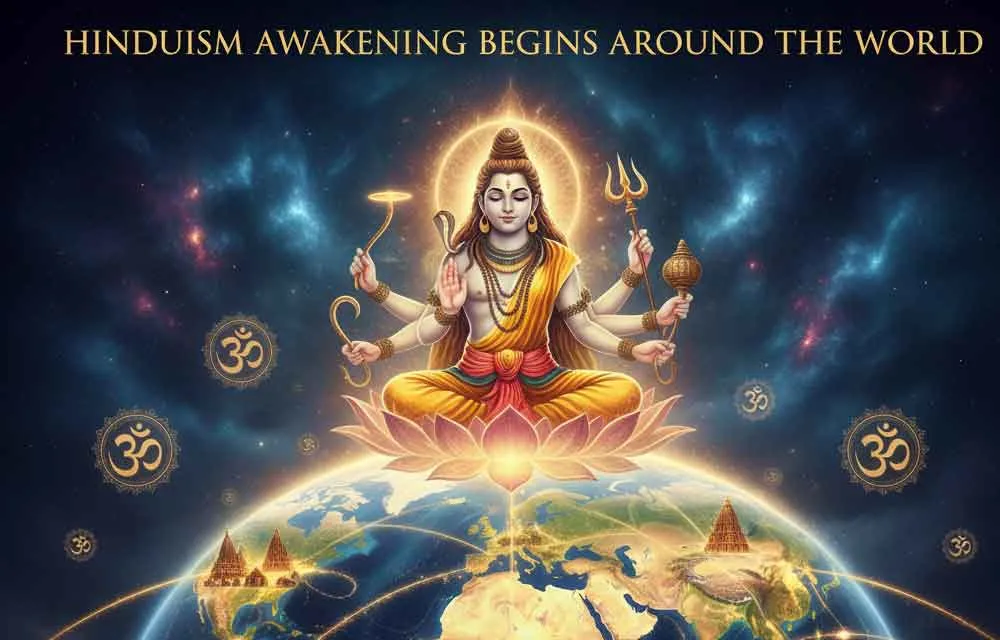
Across continents, from bustling metropolises to serene towns, a powerful spiritual and cultural movement is taking shape—The Hindu Awakening.
Across continents, from bustling metropolises to serene towns, a powerful spiritual and cultural movement is taking shape—The Hindu Awakening. No longer confined to the boundaries of the Indian subcontinent, Hindu traditions, festivals, and philosophies are resonating with people across the globe. This awakening is not merely about religion; it is about rediscovering timeless wisdom, fostering inclusivity, and celebrating the diversity of human spirituality.
The Roots of the Awakening
Hinduism, often regarded as the world’s oldest living faith, has always emphasized universal values—truth (satya), non-violence (ahimsa), and harmony with nature. In today’s era of rapid globalization, these values are striking a deep chord with individuals and communities worldwide who are seeking meaning beyond materialism.
From yoga and meditation practices in New York and London to grand Navratri and Diwali celebrations in Toronto, Sydney, and Johannesburg, Hindu cultural expressions are finding vibrant platforms on the global stage.
Festivals Becoming Global
- Diwali is now celebrated in iconic locations like Times Square (New York), London’s Trafalgar Square, and Sydney Opera House, symbolizing light triumphing over darkness.
- Navratri and Garba dances draw thousands of participants in cities like Chicago, Nairobi, and Dubai.
- International Yoga Day, recognized by the United Nations, showcases the universal appeal of Hindu wisdom and physical well-being.
These celebrations are not just for the Indian diaspora—they are increasingly embraced by people of all backgrounds.
Spiritual Philosophy Beyond Borders
The teachings of the Bhagavad Gita, Vedanta, and Upanishads are studied in universities worldwide. Spiritual leaders and gurus conduct global discourses, attracting seekers eager for knowledge about mindfulness, dharma, and the path of self-realization.
Communities in Europe, North America, Africa, and Asia are witnessing a rise in temple constructions, satsangs (spiritual gatherings), and youth-driven cultural organizations, signifying continuity of traditions across generations.
Why Now?
The Hindu Awakening is being fueled by:
- Global diaspora expansion – Millions of Hindus living abroad are carrying their traditions proudly.
- Search for holistic living – In a world burdened by stress, Hindu practices like yoga, Ayurveda, and meditation are seen as healing tools.
- Cultural diplomacy – Governments and organizations are promoting festivals and values to foster cultural harmony.
- Digital platforms – Live-streamed rituals, online satsangs, and social media communities are connecting Hindus across borders like never before.
A Movement of Inclusivity
Unlike rigid structures, Hinduism thrives on diversity—many deities, many paths, but one essence of truth. This inclusivity is resonating globally, creating a sense of belonging for people from all walks of life.
Conclusion: The Dawn of a Global Dharma
The Hindu Awakening is more than a revival—it is a renaissance. As temples rise in foreign lands, as sacred chants echo in world capitals, and as youth embrace their cultural identity with pride, a new chapter in global spirituality is being written.
It is not just the awakening of a religion—it is the awakening of humanity’s shared values of peace, compassion, and balance. The world is not only watching, but also participating in this journey.
✨ The Hindu Awakening has begun—and it is here to stay, lighting the path of dharma for generations to come.
What Ancient Scriptures Say About a Universal Spiritual Resurgence
The Vishnu Purana and the Bhagavata Purana both describe cycles of time — the four yugas — and specifically predict that even within the Kali Yuga, pockets of dharmic renewal will emerge wherever sincere seekers gather. The Bhagavata Purana (XII.3.51) notably states: 'kaler dosha-nidhe rajan, asti hy eko mahan gunah' — that despite the ocean of faults in Kali Yuga, its singular great virtue is that through kirtan and sincere inquiry, liberation becomes accessible to all, irrespective of geography or birth.
The Rigveda's foundational declaration, 'Ekam sat vipra bahudha vadanti' — Truth is one; the wise call it by many names — has long provided the philosophical foundation for Hinduism's capacity to expand across cultures without demanding uniformity. This universalist impulse is precisely what makes the current global awakening feel organic rather than evangelical, an invitation rather than an imposition.
The Role of Major Temples Abroad as Living Centers of Dharma
Temple construction outside India has accelerated dramatically in recent decades and now serves as one of the most tangible markers of the Hindu awakening. The BAPS Swaminarayan Akshardham in Robbinsville, New Jersey — the largest Hindu temple complex in the world outside India — draws hundreds of thousands of visitors annually, including scholars, interfaith delegations, and curious non-Hindus. Similarly, the Shri Venkateshwara Temple in Tridham, Helensburgh (near Sydney, Australia) and the Shri Swaminarayan Mandir in London's Neasden are architectural and spiritual landmarks that anchor diaspora communities while drawing broader public interest.
These temples are not merely places of worship; they function as cultural academies, hosting Sanskrit classes, Bharatanatyam and Kathak instruction, Vedic discourse series, and Ayurveda wellness programs. In doing so, they replicate the ancient model of the temple as a complete civilizational institution — what the Agama Shastra tradition describes as a sacred space that integrates the cosmic, the communal, and the individual into one living whole.
How Vedanta and Advaita Philosophy Are Shaping Western Intellectual Discourse
Since Swami Vivekananda's landmark address at the Parliament of the World's Religions in Chicago in 1893, Advaita Vedanta — the non-dualistic school expounded most rigorously by Adi Shankaracharya in the 8th century CE — has held a unique fascination for Western philosophers and scientists. Today, academic departments at institutions such as Harvard Divinity School, Oxford's Faculty of Theology, and the California Institute of Integral Studies offer coursework that engages seriously with the Upanishads, the Brahma Sutras, and the concept of Brahman as the ground of all being.
Concepts such as 'consciousness as primary' (chit), the illusory nature of separateness (maya), and the realized state of non-dual awareness (turiya) are increasingly entering mainstream philosophical and cognitive-science conversations. Researchers exploring the hard problem of consciousness have begun engaging with texts like the Mandukya Upanishad, which outlines four states of consciousness — jagrat (waking), svapna (dreaming), sushupti (deep sleep), and turiya (transcendence) — finding in them a precision that complements rather than conflicts with empirical inquiry.
Youth and the Digital Renaissance: How a New Generation Is Reclaiming Dharma
Perhaps the most striking dimension of the contemporary Hindu awakening is the leading role being played by young people, both within India and across the diaspora. Platforms such as YouTube, Instagram, and podcasting have given rise to a new generation of dharmic communicators who present the Bhagavad Gita, Ramayana, and Mahabharata not as archaic texts but as living guides to ethics, leadership, and psychological resilience. Channels dedicated to Vedic knowledge now routinely attract millions of views from audiences spanning India, the United States, the United Kingdom, Canada, and Southeast Asia.
Hindu student organizations at universities — from the Hindu Students Council chapters across North America to similar bodies in the United Kingdom and Australia — are organizing events that range from Gita reading circles and Sanskrit workshops to panel discussions on dharmic environmentalism rooted in the concept of Vasudhaiva Kutumbakam ('the world is one family'), a verse from the Maha Upanishad. This grassroots intellectual engagement signals that the awakening is generationally self-sustaining, not dependent solely on temple institutions or established religious authorities.
Dharmic Ecology: The Ancient Hindu Vision of Nature as Sacred
As environmental anxiety grows worldwide, many seekers are turning to Hindu cosmology for a framework that regards nature not as a resource to be exploited but as a manifestation of the divine. The Atharvaveda's Prithvi Sukta (Hymn to the Earth) opens with the declaration 'Mata Bhumih, Putro aham Prithivyah' — the Earth is my mother, I am her son — establishing an ethic of reciprocal care that predates modern environmentalism by millennia. Rivers such as the Ganga and Yamuna are understood in the Puranic tradition not merely as water bodies but as goddesses — Devi Ganga and Devi Yamuna — whose honor demands active stewardship.
This perspective is gaining traction in global sustainability conversations. The United Nations' recognition of International Yoga Day in 2015 was itself an implicit acknowledgment that holistic well-being — physical, mental, and ecological — cannot be separated. Hindu temples in countries like the United Kingdom and the United States have begun establishing community gardens, river-cleaning drives, and zero-waste festival initiatives explicitly framed in terms of the Vedic concept of Yajna, the sacred act of giving back to creation that sustains cosmic and social order.
Interfaith Dialogue and the Hindu Model of Pluralism
Unlike proselytizing religions, Hinduism's approach to interfaith engagement is rooted in the Vedantic axiom of anekantavada-adjacent thinking — the recognition that multiple valid paths can lead to the same ultimate reality. This posture has made Hindu voices particularly sought after in formal interfaith settings, including the Parliament of the World's Religions (held in cities such as Chicago, Cape Town, Salt Lake City, and Toronto across its modern iterations) and UNESCO-affiliated cultural dialogues.
Shankaracharyas, Shankaracharya-lineage monastics, and Vaishnava acharyas from institutions such as the Sringeri Sharada Peetham, the Kanchi Kamakoti Peetham, and ISKCON have all engaged in formal interfaith dialogue, consistently offering the concept of dharma — righteous living aligned with cosmic order — as a universal ethic rather than a sectarian doctrine. This diplomatic spiritual generosity, grounded in the Mahavakyas of the Upanishads such as 'Aham Brahmasmi' and 'Tat Tvam Asi,' is one of the least reported yet most consequential aspects of the Hindu global awakening currently unfolding.
Frequently Asked Questions
What is the Hindu Awakening happening around the world?
It is a global cultural and spiritual movement in which Hindu traditions, festivals and philosophies are reaching people far beyond the Indian subcontinent. It centres on rediscovering timeless wisdom, inclusivity and the diversity of human spirituality.
Which Hindu festivals are celebrated in global cities?
Diwali is celebrated at Times Square in New York, Trafalgar Square in London and the Sydney Opera House. Navratri and Garba draw thousands in cities like Chicago, Nairobi and Dubai, and International Yoga Day is recognized by the United Nations.
What is driving the Hindu Awakening among the diaspora and others?
Four forces are named: the expanding global diaspora, a search for holistic living through yoga, Ayurveda and meditation, cultural diplomacy by governments and organizations, and digital platforms such as live-streamed rituals and online satsangs.
How are Hindu temples abroad supporting the awakening?
Temples such as BAPS Swaminarayan Akshardham in Robbinsville, New Jersey, the Shri Venkateshwara Temple in Helensburgh near Sydney, and the Swaminarayan Mandir in Neasden, London anchor diaspora communities. They also host Sanskrit classes, dance instruction, Vedic discourses and Ayurveda programs.
How can Hindus in the USA, UK or Australia take part in this movement?
They can join temple programs, satsangs, Diwali and Navratri celebrations, and youth groups such as Hindu Students Council chapters in North America or similar bodies in the UK and Australia. Online satsangs and live-streamed rituals also connect them across borders.
How is Vedanta influencing Western universities?
Since Swami Vivekananda's 1893 address in Chicago, Advaita Vedanta has fascinated Western thinkers. Institutions such as Harvard Divinity School, Oxford's Faculty of Theology and the California Institute of Integral Studies offer coursework engaging with the Upanishads and Brahma Sutras.