Gandhi Jayanti 2025: Remembering the Father of the Nation
Every year on October 2nd, India pays homage to Mahatma Gandhi, the Father of the Nation, on his birth anniversary.
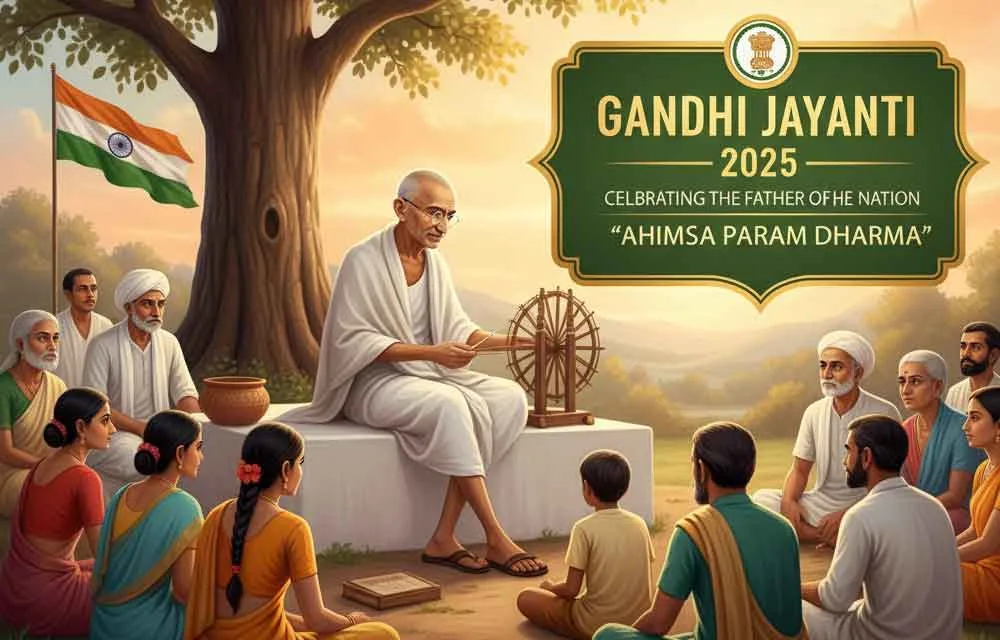
Every year on October 2nd, India pays homage to Mahatma Gandhi, the Father of the Nation, on his birth anniversary.
Every year on October 2nd, India pays homage to Mahatma Gandhi, the Father of the Nation, on his birth anniversary. In 2025, we mark the 156th birth anniversary of Gandhiji, a day that not only honors his life but also inspires us to walk the path of truth, peace, and non-violence.
The Legacy of Mahatma Gandhi
Mohandas Karamchand Gandhi, born in 1869 at Porbandar, Gujarat, became the torchbearer of India’s freedom struggle through his unique philosophy of ahimsa (non-violence) and satyagraha (truth-force). Unlike other freedom movements worldwide that relied on armed struggle, Gandhi led India’s fight with peace, compassion, and unwavering courage.
His principles of:
- Truth (Satya) – living with honesty and integrity
- Non-Violence (Ahimsa) – seeking justice without hatred or harm
- Simplicity – leading a life of humility and minimalism
- Self-reliance (Swadeshi) – promoting indigenous goods and rejecting foreign domination
continue to hold relevance in today’s world filled with conflict and inequality.
Global Significance
October 2nd is also observed as the International Day of Non-Violence, as declared by the United Nations in 2007. This reflects Gandhi’s universal influence and his message of peace that resonates across nations, cultures, and generations.
Celebrations Across India
On Gandhi Jayanti, people across India pay tribute by:
- Offering flowers and prayers at Raj Ghat, New Delhi, where Gandhiji was cremated
- Organizing prayer meetings, bhajans, and peace rallies in schools, colleges, and public institutions
- Promoting cleanliness drives and campaigns, inspired by his belief that “Cleanliness is next to Godliness”
- Reflecting on his writings, teachings, and life stories
Message for 2025
As we celebrate Gandhi Jayanti in 2025, let us remember that Gandhiji’s teachings are not relics of the past, but guiding principles for the present and the future. In times of division and unrest, his message of peace, unity, and moral courage becomes even more essential.
Let us pledge to:
- Speak the truth even when it is difficult
- Practice kindness and compassion in daily life
- Resolve conflicts with dialogue instead of anger
- Work towards harmony, justice, and sustainability
Closing Thought
Mahatma Gandhi once said, “Be the change that you wish to see in the world.”
This Gandhi Jayanti, may we not just remember his words, but live by them.
The Hindu Philosophical Roots of Gandhi's Core Principles
Gandhi's twin pillars of Satya and Ahimsa were not abstract political strategies — they were deeply rooted in the Sanatana Dharma he absorbed from childhood. The Bhagavad Gita, which he called his 'eternal mother,' shaped his understanding of nishkama karma — selfless action without attachment to results. He read the Gita daily, carrying a pocket edition even during fasts and imprisonments, and drew from it the conviction that a person's duty is to act righteously, regardless of personal cost.
The principle of Ahimsa itself appears in the Mahabharata's Anushasana Parva: 'Ahimsa paramo dharma' — non-violence is the highest dharma. Gandhi extended this ancient Vedic and Jain-influenced teaching from personal conduct into a mass political instrument. Similarly, the Yajurveda's emphasis on Satya as the foundation of cosmic and social order (Rita) gave Gandhi's satyagraha its spiritual weight beyond mere civil disobedience.
His practice of brahmacharya (celibacy and self-discipline), fasting as tapasya (austerity), and the wearing of khadi as a symbol of aparigraha (non-possessiveness) all correspond directly to values enshrined in Patanjali's Yoga Sutras and the Bhagavata Purana. For Gandhi, political action was inseparable from spiritual discipline — what the Gita calls yoga in its broadest sense.
Porbandar to Sabarmati: The Sacred Geography of Gandhi's Life
Gandhi was born in Porbandar, a coastal town in present-day Gujarat, in a Vaishnava household devoted to Vishnu. The town's spiritual atmosphere, its proximity to Dwaraka — one of the four sacred dhamas established by Adi Shankaracharya — and the strong Vaishnava bhakti tradition of Gujarat all left an indelible mark on his religious consciousness. His mother Putlibai's devout observances, including regular vrats (fasts) and temple visits, were his earliest lessons in dharma.
The Sabarmati Ashram in Ahmedabad, which Gandhi founded in 1917, became the living laboratory of his philosophy. Situated on the banks of the Sabarmati River, the ashram's daily schedule was structured around prayer, spinning the charkha, communal labour, and study of scripture — echoing the ancient gurukula tradition. From this ashram, Gandhi launched the historic Dandi March in March 1930, walking 241 miles to the Arabian Sea coast to protest the British salt tax.
Raj Ghat in New Delhi, where Gandhi was cremated on January 31, 1948, has become a national tirtha of sorts — a place of pilgrimage where heads of state, ordinary citizens, and schoolchildren alike offer flowers and observe silence. The eternal flame maintained there symbolises the undying relevance of his ideals.
Gandhi's Engagement with the Ramayana and Bhagavata Traditions
Gandhi's vision of an ideal society was deeply influenced by the concept of Rama Rajya — the reign of Sri Rama as described in Valmiki's Ramayana and elaborated in Tulsidas's Ramcharitmanas. For Gandhi, Rama Rajya did not mean a theocratic Hindu state but a society governed by dharma, where justice, compassion, and truthfulness prevail for every citizen regardless of caste or creed. He repeatedly invoked this ideal in his public speeches and writings as the goal India should aspire to after independence.
The bhajan 'Raghupati Raghava Raja Ram,' drawn from the Vaishnava kirtan tradition and popularised during Gandhi's prayer meetings, became almost an anthem of the freedom movement. Gandhi deliberately included the line 'Ishvar Allah tero naam' to emphasise that the divine truth underlying Rama's name is universal — a message of harmony consistent with the Vedic understanding of Ekam sat vipra bahudha vadanti (Truth is one; the wise call it by many names, Rigveda 1.164.46).
His admiration for the Bhagavata Purana's portrayal of Prahlada — who upheld satya against the most powerful tyranny — further reinforced his conviction that an individual armed with truth and moral courage is mightier than any empire. This narrative gave ordinary satyagrahis a mythological archetype of fearless, nonviolent resistance.
Swadeshi and Aparigraha: Ancient Economic Ethics in Modern Practice
Gandhi's Swadeshi movement drew on the Dharmashastra principle that a community's self-sufficiency is a form of collective dharma. The charkha — the hand-spinning wheel — was not merely an economic tool but a symbol of aparigraha (non-greed) and svaraj (self-rule) at once. By spinning cotton himself each day, Gandhi demonstrated that the highest leader must embody the simplest virtues, a teaching aligned with the Bhagavad Gita's concept of the sthitaprajna, the person of steady wisdom who is free from craving.
The concept of trusteeship that Gandhi developed — wherein the wealthy are not owners of their riches but trustees holding them on behalf of society — resonates with the Isha Upanishad's opening verse: 'Ishavasyam idam sarvam' (All this is pervaded and owned by the Divine). Gandhi cited this very verse to argue that no individual can claim absolute ownership of resources; wealth must be used for the welfare of all, echoing the Vedic vision of shared abundance.
In 2025, as conversations around sustainable living, ethical consumption, and economic inequality grow louder globally, Gandhi's integration of these ancient Dharmic economic ethics into practical policy offers a framework that is both spiritually grounded and urgently contemporary.
How Gandhi Jayanti Is Observed Beyond Raj Ghat: Ashrams, Schools, and Living Traditions
Beyond the official ceremonies at Raj Ghat in New Delhi, Gandhi Jayanti is observed with particular depth at institutions Gandhi himself established. The Sabarmati Ashram in Ahmedabad holds special prayer meetings and opens its archives of Gandhi's personal letters and manuscripts to visitors. The Sevagram Ashram near Wardha in Maharashtra — Gandhi's base during the final years of the freedom struggle — organises village-service camps that carry forward his constructive programme.
Across India, Gandhi Jayanti coincides with a renewed push for cleanliness and community service. The day holds special resonance in schools where students recite verses from the Bhagavad Gita, sing Vaishnava bhajans Gandhi loved, and stage plays depicting episodes from his life. Many state governments observe it as a day of prohibition, honouring Gandhi's lifelong campaign against alcohol, which he grounded in the concept of shauch (purity of body and environment) listed among the niyamas in classical yoga philosophy.
Internationally, Indian diaspora communities from Durban — where Gandhi first developed satyagraha in 1906 — to London, New York, and Singapore mark the day with peace walks and readings of Gandhi's writings. The United Nations' designation of October 2nd as the International Day of Non-Violence has further institutionalised global reflection on the dharmic values he brought from India's ancient philosophical heritage to the world stage.
Frequently Asked Questions
When is Gandhi Jayanti?
Gandhi Jayanti is observed on its traditional tithi in the Hindu lunar calendar; refer to the year's panchang for the exact date in your region.
What is the significance of Gandhi Jayanti?
Every year on October 2nd , India pays homage to Mahatma Gandhi , the Father of the Nation, on his birth anniversary. In 2025, we mark the 156th birth anniversary of Gandhiji, a day that not only honors his life but also inspires us to walk the path of truth, peace, and non-violence.
How is Gandhi Jayanti celebrated?
Devotees observe it with puja, fasting or special offerings, visiting temples, chanting mantras, and gathering with family. Customs vary by region and tradition.
What should devotees do on Gandhi Jayanti?
Take a sacred bath, perform the day's puja and charity (dana), observe any prescribed fast, and chant mantras with sincere devotion.
You might also like
Shani Deva Temples Worldwide & Must-Performed Rituals — Complete Devotee's Guide
June 2026 Hindu Festival Calendar — Complete Dates, Vrat & Puja Guide for NRIs
Gayatri Jayanti 2026: Date, Gayatri Mantra, Puja Vidhi & Significance