108 Surya Namaskar — The Sacred Sun Salutation Practice
Surya Namaskar is a flowing sequence of yoga asanas offered to Surya, the Sun God. Learn the 12 classic poses, the 12 Surya mantras, and how the sacred 108-round practice is built up gradually — with tone, timing, and safety kept devotional and grounded.
Surya Namaskar is a flowing sequence of yoga asanas offered to Surya, the Sun God. Learn the 12 classic poses, the 12 Surya mantras, and how the sacred 108-round practice is built up gradually — with tone, timing, and safety kept devotional and grounded.
Quick answer: Surya Namaskar (Sun Salutation) is a devotional sequence of twelve yoga asanas offered to Surya, the Sun God, blending body, breath, and mantra. One round moves through the twelve classic poses, and a full practice may chant one of the twelve Surya mantras per round. Doing 108 rounds is a traditional sadhana tied to the sacred number 108, often taken up on days like Rathasaptami or Makar Sankranti. It is best practised at sunrise, on an empty stomach, and learned gradually under a qualified teacher.
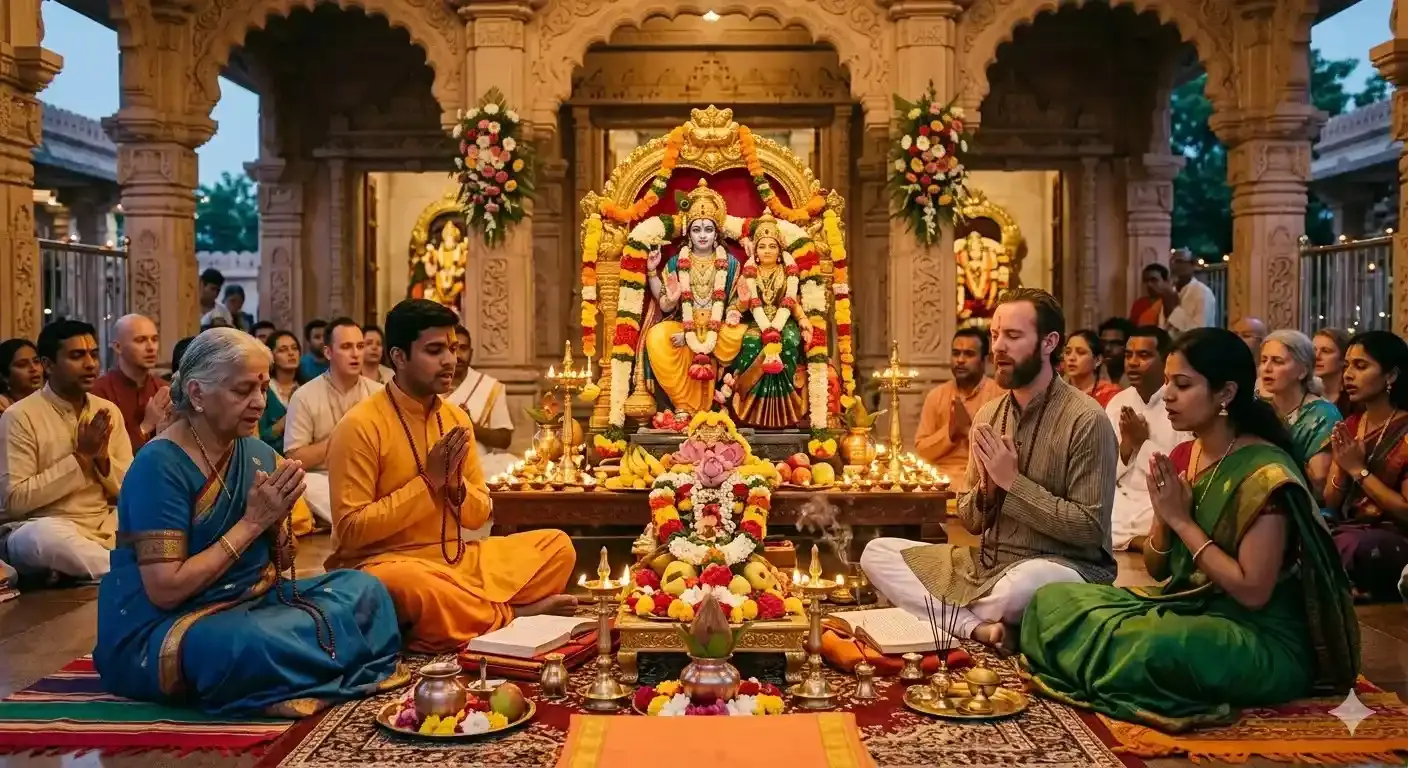
Surya Namaskar, the Sun Salutation, is one of the most beloved practices in the Hindu and yogic tradition — a flowing sequence of asanas performed not merely as exercise but as a devotional offering to Surya, the radiant Sun God. Each round weaves together body, breath, and mantra, turning movement into worship. Traditionally it is practised at sunrise, facing east, as the first light touches the earth and the sadhaka greets the giver of all life.
In this guide we walk through the twelve classic poses of one round, the twelve sacred Surya mantras chanted in a full practice, why the number 108 carries such deep meaning, and how a 108-round sadhana is built up gradually and safely. Throughout, the spirit is reverence: the Sun is honoured as Mitra the friend, Aditya the son of Aditi, and Bhaskara the maker of light.
What is Surya Namaskar?
Surya Namaskar is a cyclical sequence of yoga asanas that flows from a standing prayer posture, folds forward and back through the body, and returns to prayer. Performed with awareness of breath and, ideally, with mantra, it becomes a moving meditation and a namaskar — a bowing salutation — to Surya. The word itself joins Surya (Sun) and Namaskar (salutation, an act of reverent bowing).
Because it blends the physical, the breath, and the devotional, Surya Namaskar sits at the meeting point of asana practice and bhakti. It can be done slowly with mantra and long breaths as a spiritual offering, or more briskly as a warming, energising flow. Both approaches share the same inner attitude: gratitude to the source of light and life.
The 12 Poses of One Round
One classic round of Surya Namaskar (the common Hatha sequence) moves through twelve postures. The sequence is symmetrical: it descends from standing to the ground and rises back to standing, mirroring poses on the way in and the way out. Note that minor lineage variations exist — some schools use Parvatasana in place of Adho Mukha Svanasana, or vary the fifth pose — but the shape below is the widely taught form.
- Pranamasana — Prayer pose. Stand upright, palms joined at the heart in namaskar.
- Hasta Uttanasana — Raised arms pose. Stretch the arms up and gently back, lengthening the spine.
- Hasta Padasana (Uttanasana) — Hand to foot pose. Fold forward, bringing the hands toward the feet.
- Ashwa Sanchalanasana — Equestrian pose. Step one leg back into a low lunge, gaze forward.
- Dandasana (Phalakasana) — Plank pose. Step back into a straight, strong plank.
- Ashtanga Namaskara — Eight-limbed salute. Lower knees, chest, and chin to the ground, hips lifted.
- Bhujangasana — Cobra pose. Slide forward and lift the chest, opening the heart.
- Adho Mukha Svanasana (Parvatasana) — Downward dog / mountain pose. Lift the hips into an inverted V.
- Ashwa Sanchalanasana — Equestrian pose. Step the same leg forward into a low lunge.
- Hasta Padasana (Uttanasana) — Hand to foot pose. Bring the back foot forward and fold over the legs.
- Hasta Uttanasana — Raised arms pose. Rise and stretch the arms up and gently back.
- Pranamasana — Prayer pose. Return the palms to the heart, completing the round.
What counts as one round?
One full cycle through all twelve poses is generally counted as one round. Because the lunge (Ashwa Sanchalanasana) leads with one leg on the way down and the other on the way up, many practitioners treat leading with the right leg and then leading with the left leg as two half-rounds that together make a complete round. This distinction matters when you count toward a target like 108: some traditions reach 108 as 108 full cycles, others as 108 half-rounds (54 leading each leg). Decide your counting method in advance and keep it consistent.
The 12 Surya Mantras
In a full devotional practice of twelve rounds, one Surya mantra is chanted per round. Each mantra salutes the Sun by a different name, honouring a distinct quality of the divine light. Chant them silently or aloud with the breath, offering each round to the epithet named.
| Mantra | Meaning of the Sun-epithet |
|---|---|
| Om Mitraya Namah | To the friend of all — the Sun as benevolent companion of every being. |
| Om Ravaye Namah | To the shining one — the radiant cause of change and brilliance. |
| Om Suryaya Namah | To the dispeller of darkness — the one who activates and awakens. |
| Om Bhanave Namah | To the illuminator — the one who spreads light and lustre. |
| Om Khagaya Namah | To the one who moves through the sky — the traveller across the heavens. |
| Om Pushne Namah | To the nourisher — the giver of strength and sustenance. |
| Om Hiranyagarbhaya Namah | To the golden-wombed one — the cosmic seed and source of creation. |
| Om Marichaye Namah | To the lord of the dawn's rays — the radiance at the edge of light. |
| Om Adityaya Namah | To the son of Aditi — the boundless, infinite aspect of the Sun. |
| Om Savitre Namah | To the vivifier — the one who impels, awakens, and gives life. |
| Om Arkaya Namah | To the one worthy of praise — fit to be worshipped and adored. |
| Om Bhaskaraya Namah | To the maker of light — the one who brings enlightenment and clarity. |
When a practice extends beyond twelve rounds, practitioners often cycle back through the same twelve mantras, or settle into a single core mantra such as Om Suryaya Namah, letting it carry the whole session.
Why 108?
The number 108 is among the most sacred in the Hindu tradition. A japa mala carries 108 beads; deities are honoured with 108 names (ashtottara shatanamavali); and countless practices are counted in multiples of 108. It is held to reflect a completeness that spans the cosmos, the body, and the breath. Offering 108 rounds of Surya Namaskar therefore turns the practice into a complete, mala-like cycle of salutations to the Sun.
A practice of 108 rounds is a traditional sadhana and a well-known challenge, often undertaken on auspicious solar occasions — Rathasaptami (celebrated as Surya's birthday), Makar Sankranti (when the Sun turns northward into Uttarayana), or during focused sadhana intensives and retreats. Completing 108 becomes both a physical feat and a devotional offering, a way of giving the Sun a full mala of salutations in a single sitting.
How a 108-round practice is built up
No one begins at 108. The count is built gradually over weeks or months so the body, breath, and attention can grow to meet it. A typical progression looks like this:
- Start with a warm-up and 3 to 5 unhurried rounds, focusing on alignment and steady breath.
- Add a few rounds each week — for example 5, then 9, then 12 — only when the current count feels comfortable.
- Practise in sets, resting briefly between them, so 108 might be reached as several rounds of 12 or 27 rather than one unbroken block.
- Refine the breath so each movement is led by an inhale or exhale; the rhythm carries you when strength alone would tire.
- Reserve the full 108 for a special day, treating it as a sadhana rather than a daily routine, and honour it with mantra.
Benefits of the Practice
Practised with regularity and care, Surya Namaskar is valued for a range of benefits across body, mind, and spirit. These are best understood as the natural fruits of consistent, mindful movement — not as medical treatments or cures.
Physical
- Gently warms and mobilises the spine, shoulders, hips, and hamstrings.
- Builds strength, stamina, and flexibility through the whole body in one sequence.
- Encourages steady, rhythmic breathing that supports circulation and vitality.
Mental
- Calms and focuses the mind through the repetition of breath-linked movement.
- Cultivates discipline and steadiness when practised daily.
- Offers a settling, meditative rhythm that eases restlessness.
Spiritual
- Turns exercise into worship — each round a namaskar offered to Surya.
- Deepens devotion and gratitude to the source of light and life.
- Draws the practitioner into the sacred rhythm of dawn and the turning day.
Best Time to Practise
The most auspicious and traditional time for Surya Namaskar is at sunrise, facing east, as an offering to the rising Sun. Practise on an empty stomach — early morning before breakfast is ideal — so the body can move and fold freely. If dawn is not possible, an early, unhurried practice at another quiet time is far better than skipping it; the reverence you bring matters more than perfection of timing.
Safety and Guidance
Surya Namaskar is powerful precisely because it engages the whole body, so it deserves respect and care. Please keep these points in mind:
- Always warm up gently before you begin, and never force a stretch or a joint.
- Build up the number of rounds gradually over weeks; do not attempt a large count unprepared.
- If you are pregnant, injured, recovering from surgery, or living with high blood pressure, heart conditions, or hernia, do not practise without qualified medical and yoga guidance.
- Learn the poses first from a qualified, experienced teacher rather than from pictures alone, so your alignment is safe.
- Stop and rest if you feel dizzy, breathless, or any sharp pain; listen to your body over any target.
- This practice supports general wellbeing but is not a treatment or cure for any medical condition.
An Offering to Surya
However many rounds you complete — three at dawn or a full mala of 108 on a sacred day — let the practice end as it begins: with palms joined at the heart in Pranamasana, and gratitude turned toward the light. Offer the effort not to yourself but to the giver of that light, the friend of all beings, the maker of every day.
Om Suryaya Namah.