Maha Shivaratri 2026 Significance & Katha | Shiva Stories
Maha Shivaratri 2026 Significance & Katha: Shiva-Parvati Marriage, Samudra Manthan & Spiritual Meaning Published on HinduTone.com Introduction: The Great Night…
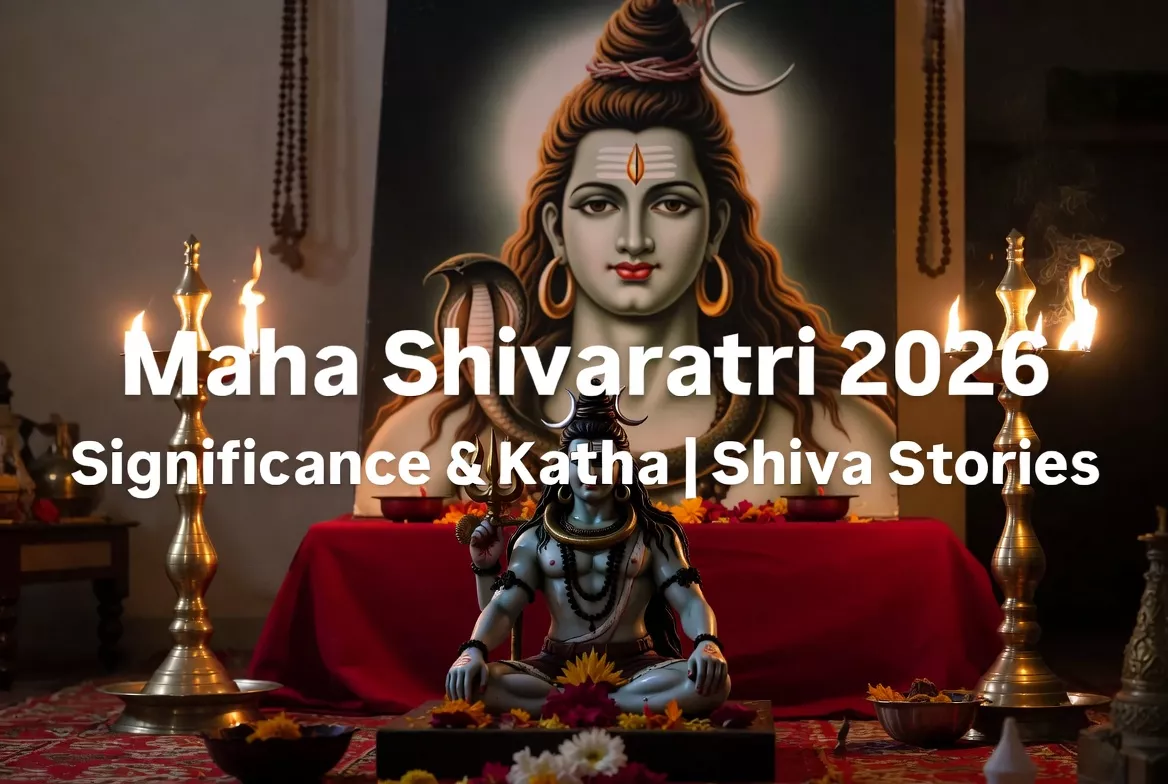
Maha Shivaratri 2026 Significance & Katha: Shiva-Parvati Marriage, Samudra Manthan & Spiritual Meaning
Published on HinduTone.com
Introduction: The Great Night of Shiva
Maha Shivaratri, observed on Sunday, February 15, 2026, stands as one of the most profound spiritual occasions in the Hindu calendar. Unlike most festivals that celebrate light and joy during the daytime, Maha Shivaratri embraces the darkness of night, inviting devotees into deep introspection, meditation, and divine communion with Lord Shiva.
The festival's significance transcends mere ritualistic observance. It represents the convergence of the manifest and the unmanifest, the celebration of consciousness meeting energy, and the eternal dance between creation and dissolution. This sacred night offers seekers a unique opportunity to experience spiritual awakening and liberation from the cycle of birth and death.
What Does "Maha Shivaratri" Mean?
Breaking Down the Name
Maha (महा) = Great, Supreme Shiva (शिव) = The Auspicious One, Lord of Transformation Ratri (रात्रि) = Night
Together, Maha Shivaratri translates to "The Great Night of Shiva" — a night when the veil between the material and spiritual worlds becomes thinnest, and divine grace flows most abundantly.
Understanding "Shiva"
The word "Shiva" literally means "that which is not." While creation represents "that which is," Shiva embodies the vast emptiness that holds all existence. Modern science confirms that the universe is mostly empty space, with galaxies forming tiny specks in an infinite void. This boundless emptiness, this pure consciousness, is what we call Shiva.
In the yogic tradition, Shiva is not merely worshipped as a deity but revered as Adi Guru — the first teacher from whom the science of yoga originated. He represents the ultimate stillness, the supreme consciousness that underlies all existence.
The Multifaceted Significance of Maha Shivaratri 2026
1. Astronomical & Cosmic Significance
On the night of Maha Shivaratri, the northern hemisphere of the planet is positioned in such a way that there is a natural upsurge of energy in human beings. The celestial alignment creates a unique opportunity for spiritual elevation.
This isn't merely ancient wisdom — modern science recognizes how planetary alignments affect Earth's magnetic field and human consciousness. Maha Shivaratri occurs when these cosmic effects are particularly potent, making it easier for seekers to access deeper states of meditation and awareness.
The fourteenth day of the lunar month (the darkest night before the new moon) holds special significance. While logic suggests celebrating light over darkness, the profound truth is that darkness is eternal and all-encompassing, while light exists only in relation to darkness.
2. Spiritual Significance for Different Seekers
Maha Shivaratri holds meaning for people across different spiritual paths:
For Spiritual Seekers (Sadhaks): This night marks when Shiva became absolutely still in meditation — achieving complete transcendence. Ascetics see this as the night of ultimate stillness, where even the most subtle movements of thought cease. It represents the possibility of reaching one's spiritual peak through unwavering focus and discipline.
For Householders & Families: This night commemorates the divine marriage of Shiva and Parvati, symbolizing the perfect union of masculine and feminine energies. Married couples celebrate this sacred bond, and unmarried individuals pray for an ideal life partner embodying divine qualities.
For the Ambitious: Legends speak of this as the day when Shiva conquered all his enemies, representing victory over inner demons — ego, anger, jealousy, and ignorance.
3. Philosophical & Vedantic Meaning
From a Vedantic perspective, Maha Shivaratri represents:
- Realization of Brahman: The recognition that Shiva represents the supreme consciousness (Brahman) that is omnipresent, eternal, and beyond all attributes
- Dissolution of Ego and Ignorance: The night symbolizes overcoming the darkness of ignorance through the light of spiritual knowledge
- Unity of Existence: Understanding that all beings are manifestations of the same ultimate reality, and recognizing the divine in all
- The Union of Consciousness and Energy: The merging of Shiva (pure consciousness) with Shakti (cosmic energy), representing the harmony needed in both life and the universe
The Sacred Stories of Maha Shivaratri
Story 1: The Divine Marriage of Shiva and Parvati
Background: The Story of Sati
Long before Shiva married Parvati, he was wedded to Sati, the daughter of King Daksha (son of Lord Brahma). Sati was deeply devoted to Shiva and married him against her father's wishes, as Daksha disapproved of Shiva's unconventional lifestyle as an ascetic.
One day, Daksha organized a grand yajna (fire sacrifice) and deliberately excluded Shiva and Sati from the invitation list. Despite Shiva's advice not to attend, Sati insisted on going to her father's ceremony, hoping to heal the family rift.
At the yajna, Daksha publicly insulted and humiliated Shiva, calling him an uncivilized hermit unworthy of his daughter. Unable to bear her husband's dishonor, Sati proclaimed, "I am ashamed to be born as your daughter. Since you have insulted my husband, I renounce this body given by you."
In front of the assembled crowd, Sati immolated herself in the sacrificial fire, declaring that in her next birth, she would be born to a father who would respect her husband.
Shiva's Grief and Tandava:
When Shiva learned of Sati's death, his grief transformed into cosmic rage. Carrying Sati's lifeless body, he performed the Rudra Tandava — the dance of destruction — obliterating Daksha's kingdom. The intensity of his dance threatened to destroy the entire universe.
To calm Shiva and save creation, Lord Vishnu severed Sati's body into 12 (some texts say 51) pieces, which fell at different locations on Earth. These sites became the sacred Shakti Peethas, where the Divine Feminine is worshipped.
After this catastrophic event, Shiva retreated to Mount Kailash, where he sat in deep meditation for thousands of years, completely detached from the world.
Parvati's Birth and Determination
Sati was reincarnated as Parvati (also called Uma), the daughter of Himavan (King of the Himalayas) and Queen Mena. From childhood, Parvati knew she was destined to unite with Shiva.
Despite being a princess of extraordinary beauty, grace, and royal upbringing, Parvati had only one desire — to win Shiva's heart and become his consort. However, Shiva remained absorbed in meditation, completely indifferent to worldly affairs.
The Impossible Penance
Determined to awaken Shiva from his meditation, Parvati undertook severe tapasya (austerities) in the harsh Himalayan wilderness:
- She renounced all comforts of royal life
- Meditated in freezing cold and scorching heat
- Survived on dry leaves, then air alone (earning the name Aparna — "one who doesn't eat even leaves")
- Sat motionless for years in deep meditation
- Endured torrential rains, snow, and wild animals
Her unwavering devotion moved even the gods. The devas, worried about the balance of cosmic energies, sought help from Kamadeva (the God of Love) to awaken desire in Shiva's heart.
Kamadeva's Sacrifice
Kamadeva shot his flower arrow of desire at Shiva during his meditation. The moment the arrow struck, Shiva's meditation was disturbed. Enraged at this interruption, Shiva opened his third eye, releasing a powerful flame that instantly reduced Kamadeva to ashes.
Rati, Kamadeva's wife, pleaded with Shiva for mercy. Moved by compassion, Shiva promised that Kamadeva would be reborn as Pradyumna, the son of Lord Krishna and Rukmini, where he would reunite with Rati.
Despite this incident, Parvati remained undeterred. Her penance became even more intense, demonstrating that true devotion requires no external catalyst — it flows from pure, selfless love.
Shiva's Test
Impressed but wanting to test Parvati's resolve, Shiva disguised himself as an elderly Brahmin and approached her. The disguised Shiva spoke harshly about Shiva's qualities:
"Why would a beautiful princess like you waste your life meditating for Shiva? He is a homeless wanderer who lives in cremation grounds, wears a tiger skin and ashes, adorns himself with serpents and skulls, and has a blue throat from drinking poison. He has no wealth, no kingdom, no family — he is not worthy of you!"
Parvati responded with fierce devotion: "I know who Shiva truly is. He is the Supreme Lord, the destroyer of darkness, the embodiment of pure consciousness. His appearance means nothing to me — I seek the eternal truth he represents. Whether you approve or not, I will marry only Shiva, even if it takes a thousand lifetimes."
Deeply moved by her unwavering faith, Shiva revealed his true form. His heart, untouched for millennia, finally opened to love again. He recognized that Parvati was indeed Shakti herself — the cosmic energy that complements his consciousness.
The Celestial Wedding
The wedding was scheduled for the 14th night of the lunar month of Phalguna — the night we now celebrate as Maha Shivaratri.
The Groom's Arrival:
When Shiva arrived for the wedding with his entourage, the scene shocked everyone:
- Shiva appeared with matted, ash-covered hair
- His body was smeared with ashes from cremation grounds
- He wore the fresh, blood-dripping skin of an elephant
- His entourage consisted of ghosts, ghouls, and deformed beings making strange noises
- He arrived in a state of complete divine intoxication, blissed out beyond worldly consciousness
Seeing this unusual groom, Parvati's mother Mena fainted in shock, and the assembled royal guests whispered in disbelief.
Transformation:
Seeing her mother's distress, Parvati gently requested, "I accept you exactly as you are. But for my mother's peace of mind, could you show a more conventional form?"
Moved by her request, Shiva transformed into Sundaramurti — the most beautiful being the worlds had ever seen. He appeared as a magnificent figure, approximately nine feet tall, radiating divine grace and beauty that left everyone awestruck.
The Sacred Union:
The wedding ceremony was conducted with great devotion by sage Vasishta and other celestial sages. Gods, goddesses, sages, kings, and celestial beings from all realms attended this cosmic celebration.
The marriage wasn't merely a union of two individuals — it represented:
- The merging of Purusha (consciousness) and Prakriti (nature)
- The balance of Shiva (stillness) and Shakti (dynamic energy)
- The harmony between asceticism and household life
- The cosmic dance of creation and dissolution
This divine union on Maha Shivaratri symbolizes that when consciousness and energy unite in perfect harmony, the universe functions in balance, and spiritual evolution becomes possible.
Spiritual Lessons from the Marriage
- True Love Transcends Appearances: Parvati's devotion wasn't based on Shiva's form but on his essence
- Patience and Perseverance: Years of unwavering penance demonstrate that spiritual goals require sustained effort
- Balance of Energies: The marriage shows that masculine and feminine principles must unite for cosmic harmony
- Unconditional Acceptance: Parvati accepted Shiva completely — as the fierce ascetic and as the beautiful Sundaramurti
- The Power of Devotion: Pure devotion can awaken even the most detached consciousness
Story 2: Samudra Manthan — The Churning of the Ocean
Background: The Curse of Sage Durvasa
The story begins with Indra, the king of the gods, riding his celestial elephant Airavata. Sage Durvasa, known for his short temper, offered Indra a sacred garland blessed by a celestial nymph.
Intoxicated with pride, Indra casually placed the divine garland on Airavata's trunk. The elephant, agitated by the fragrance, threw the garland to the ground and trampled it.
Enraged by this disrespect, Sage Durvasa cursed Indra and all the Devas: "Just as you have discarded this sacred garland, so shall all your wealth, power, and fortune be discarded from you!"
The curse took immediate effect. The Devas lost their strength, prosperity, and immortality. The Asuras (demons), led by King Bali, seized this opportunity and defeated the weakened gods, taking control of the three worlds.
Lord Vishnu's Solution
In desperation, the Devas approached Lord Vishnu for help. After hearing their plight, Vishnu advised them to churn the Ksheer Sagar (Ocean of Milk) to obtain Amrita (the nectar of immortality), which would restore their strength and immortality.
However, the task was enormous and required the cooperation of the Asuras. Vishnu advised the Devas to make a temporary truce with the Asuras, promising to share the Amrita equally.
The Churning Process
The Equipment:
- Churning Rod: Mount Mandara (a massive mountain)
- Churning Rope: Vasuki (the serpent king who resides around Shiva's neck)
- Base Support: Lord Vishnu himself incarnated as Kurma (a giant tortoise) to support the mountain on his back
The Devas held Vasuki's tail, while the Asuras insisted on holding the hood (head). As they pulled back and forth, the mountain rotated, churning the cosmic ocean.
The Emergence of Divine Treasures
As the churning progressed, fourteen precious treasures (Ratnas) emerged from the ocean:
- Halahala (deadly poison)
- Kamadhenu (the wish-fulfilling cow)
- Ucchaisravas (the divine seven-headed horse)
- Airavata (the white elephant with multiple trunks)
- Kaustubha (precious jewel worn by Vishnu)
- Parijata (the celestial wish-granting tree)
- Lakshmi (goddess of wealth and fortune)
- Varuni (goddess of wine)
- Chandra (the moon, claimed by Shiva)
- Apsaras (celestial dancers)
- Dhanvantari (the divine physician carrying Amrita)
- Shankha (the conch)
- Sharanga (the divine bow)
- Amrita (the nectar of immortality)
The Deadly Poison — Halahala
Before the precious treasures could fully emerge, a terrifying Halahala (also called Kalakuta) poison surfaced from the ocean depths. This wasn't ordinary poison — it was so potent that:
- Its fumes alone could destroy all of creation
- Both Devas and Asuras began suffocating and collapsing
- The entire universe trembled in fear
- Even mighty beings like Brahma couldn't contain it
The poison threatened to annihilate everything — gods, demons, humans, animals, plants — all of existence faced imminent destruction.
Lord Shiva's Supreme Sacrifice
In this moment of cosmic crisis, both Devas and Asuras abandoned their rivalry and together approached Mount Kailash, where Lord Shiva resided with his consort Parvati.
They prostrated before Shiva and pleaded: "O Mahadev! You are the destroyer of all evil, the protector of the universe! Only you have the power to save creation from this catastrophic poison. Please help us!"
Shiva's Compassion:
Lord Shiva, moved by their genuine distress and recognizing the duty of the master to protect dependents in distress, decided to consume the poison himself. He said to Parvati:
"It is the responsibility of those who have power to protect those who suffer. Though people may conflict with each other, true devotees strive to save others, even risking their own lives. This poison must not destroy creation."
The Consumption:
With supreme calm and selflessness, Shiva took the deadly Halahala poison in his palm and drank it. But he did not swallow it completely. As the poison began traveling down his throat, Goddess Parvati, alarmed for her husband's safety, quickly placed her hand on his throat.
Her touch stopped the poison from entering Shiva's stomach or spreading through his body. The poison remained lodged in his throat, turning it a brilliant blue color.
From that moment onward, Lord Shiva became known as Neelkanth (नीलकंठ) — "The Blue-Throated One."
The blue throat became an eternal ornament, a symbol of his sacrifice for the welfare of all beings.
According to some versions:
- The God of Wind, Vayu, also helped by collecting some poison and absorbing it
- Some texts say Vayu rubbed the poison between his hands to reduce its potency
- The combined efforts of Shiva and Vayu saved creation
Continuation of Churning
With the poison safely contained in Shiva's throat, the churning resumed. Eventually, Dhanvantari, the divine physician, emerged holding a pot (kumbha) containing the Amrita (nectar of immortality).
A fierce battle ensued between Devas and Asuras for possession of the Amrita. Lord Vishnu then took the enchanting form of Mohini, a beautiful maiden, and through divine deception, ensured that the Devas received the nectar while the Asuras were distracted.
One demon, Rahu, disguised himself and managed to drink a drop of Amrita. The Sun and Moon gods recognized him and informed Vishnu. Using his Sudarshana Chakra, Vishnu severed Rahu's head. However, since Rahu had already consumed Amrita, he became immortal. His head became Rahu and his body became Ketu — both now celestial entities associated with eclipses.
Spiritual Symbolism of Samudra Manthan
The story of ocean churning contains profound metaphorical meanings:
1. The Inner Churning:
- The ocean represents the human mind/consciousness
- Churning symbolizes spiritual practice and self-discipline
- Mount Mandara represents the physical body
- Vasuki (the serpent) represents challenges and obstacles
- Kurma (tortoise) represents dharma (the eternal foundation)
2. The Poison as Negativity:
- Halahala represents toxic emotions, anger, jealousy, ego, pain
- Shiva drinking it symbolizes confronting and containing negativity
- Not swallowing it teaches managing darkness without letting it consume you
- The blue throat represents transformation of poison into beauty
3. Yogic Interpretation:
- Shiva's throat corresponds to the Vishuddha Chakra (throat chakra)
- This chakra governs purification, truth, and communication
- Holding poison here means filtering thoughts and words
- It teaches speaking truth while containing negativity
4. The Role of Shakti:
- Parvati stopping the poison shows the protective divine feminine
- It represents the balance of Shiva (consciousness) and Shakti (energy)
- Her intervention demonstrates that even the mightiest need love and support
- Together they maintain cosmic equilibrium
5. The Treasures:
- The fourteen Ratnas represent spiritual and material blessings
- They emerge only after facing the poison — growth comes through challenges
- Lakshmi (wealth), Chandra (serenity), wisdom all come from inner churning
Life Lessons from Samudra Manthan
- Cooperation Over Competition: Even enemies (Devas and Asuras) must cooperate for greater goals
- Selfless Sacrifice: Shiva's willingness to suffer for universal welfare is the highest form of devotion
- Managing Negativity: True strength lies in containing and transforming negativity, not avoiding it
- Patience in Practice: Good things (Amrita) emerge only after perseverance through difficulties (poison)
- Balance is Essential: Masculine and feminine energies must work together for cosmic harmony
- Purification: The throat chakra teaches us to purify what we consume (information, emotions, food)
Story 3: The Cosmic Tandava — Shiva's Dance of Creation
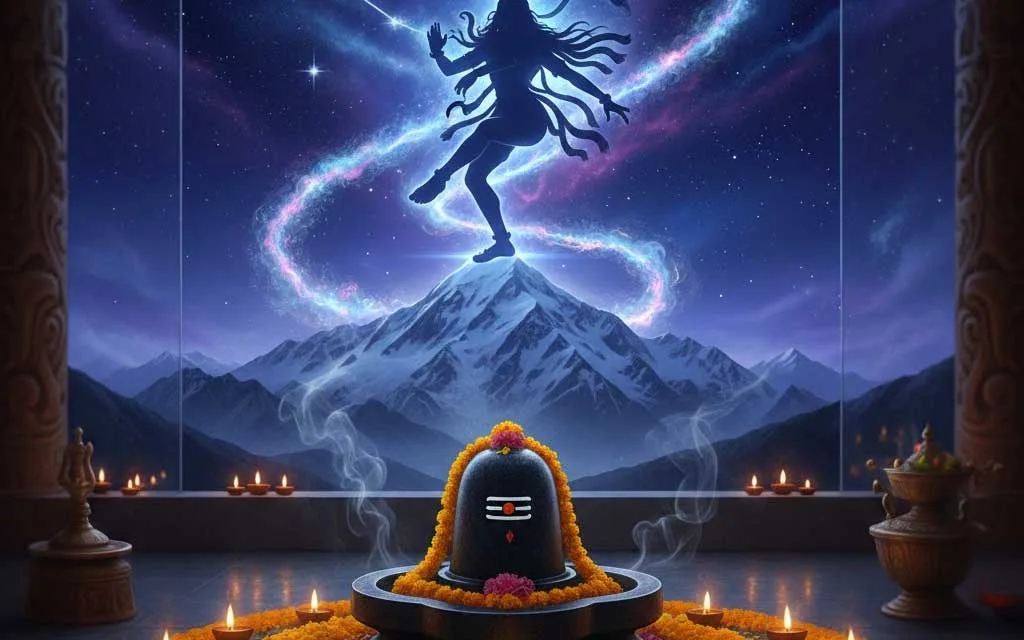
Another prominent legend associated with Maha Shivaratri describes this night as when Lord Shiva performed the Tandava — the cosmic dance that creates, preserves, and destroys the universe in eternal cycles.
The Nature of Tandava
Tandava is not merely a dance — it represents:
- The rhythmic movement of the universe — expansion and contraction
- The heartbeat of creation — cosmic vibrations (Nada)
- The balance of forces — creation, preservation, destruction
- The flow of time — past, present, future in eternal cycles
On Maha Shivaratri night, devotees believe that Shiva performs this divine dance with heightened cosmic energy. The entire universe participates:
- Mountains sway in rhythm
- Rivers flow in synchrony
- Stars move in patterns
- All existence joins the cosmic celebration
Symbolism:
- Damaru (drum): The primordial sound (Aum) of creation
- Fire: Destruction and transformation
- Raised foot: Liberation from earthly bonds
- Extended arm: Protection and fearlessness
- Snake around neck: Control over ego and time
- Third eye: Wisdom destroying ignorance
By chanting hymns, reading scriptures, and staying awake in devotion, devotees symbolically join Shiva's cosmic dance, remembering his presence in every atom of existence.
Story 4: The Legend of the Hunter (Lubdhaka)
This lesser-known but beautiful story demonstrates how even unknowing devotion pleases Lord Shiva.
The Story
A poor hunter named Lubdhaka got lost in a dense forest. As night fell, he climbed a Bilva tree (wood apple tree) to protect himself from wild animals prowling below.
To stay awake through the terrifying night, he plucked leaves from the tree and dropped them one by one while remaining alert. Unknown to him:
- It was the night of Maha Shivaratri
- A Shiva Linga was situated directly below the tree
- The leaves he dropped were Bilva leaves — most sacred to Shiva
- He was inadvertently performing night-long worship
Throughout the night, the hunter:
- Stayed awake (jagaran)
- Fasted unknowingly (vrat)
- Offered Bilva leaves (puja)
- Remained focused on survival (meditation)
By dawn, the hunter had unknowingly completed a perfect Shivaratri vrat. Lord Shiva, pleased by this innocent devotion, appeared before him and granted him liberation (moksha) and divine wisdom.
The Teaching
This story illustrates profound truths:
- Purity of Intent: Even without knowledge of rituals, sincere actions are blessed
- Shiva's Compassion: God sees the heart, not just the ceremony
- Accidental Devotion: Sometimes our greatest spiritual experiences come unexpectedly
- The Power of Simplicity: Elaborate rituals aren't always necessary
- Divine Grace: Shiva's blessings flow to all sincere seekers, regardless of their knowledge
The Deeper Spiritual Meanings of Maha Shivaratri
1. Celebrating the Formless
While Shiva is often depicted with a form, his true nature is formless, infinite consciousness. Maha Shivaratri celebrates this formless aspect — the vast emptiness that contains all creation.
Modern science confirms that most of the universe is empty space. Similarly, mystics recognize that the silent gaps between thoughts, the stillness between breaths, the space between atoms — this is where Shiva resides.
2. The Night of Stillness
In yogic tradition, Maha Shivaratri commemorates the night when Shiva achieved absolute stillness. After millennia of meditation, all movement within him ceased:
- Physical movement stopped
- Mental activity ceased
- Emotional fluctuations dissolved
- Only pure awareness remained
This state represents the goal of all spiritual practice — complete transcendence of the mind-body complex, resting in pure consciousness.
3. Overcoming Darkness and Ignorance
The festival's celebration of darkness has profound meaning. It's not about choosing darkness over light, but recognizing that:
- Ignorance (avidya) is the root cause of suffering
- Spiritual darkness means forgetting our true nature
- The night represents turning inward, away from external distractions
- Staying awake symbolizes remaining conscious through life's challenges
Shivaratri is the night when we confront our inner darkness — fears, attachments, ego — and overcome them through divine grace and self-awareness.
4. The Union of Opposites
Shiva embodies paradoxes:
- The destroyer who creates
- The ascetic who loves
- The fierce one who is gentle
- The formless with form
- The silent who dances
This teaches us that life isn't about choosing between extremes but integrating opposites:
- Material and spiritual
- Action and meditation
- Attachment and detachment
- Individual and universal
5. Dissolution of Ego (Ahamkara)
The celebration encourages:
- Fasting to control bodily desires
- Staying awake to transcend sleep (unconsciousness)
- Meditation to quiet the mind
- Silence to still speech
- Devotion to surrender ego
All these practices aim at dissolving the false sense of individual self and experiencing union with the cosmic Self (Shivoham — I am Shiva).
6. The Vedantic Realization
From the Vedantic perspective, Maha Shivaratri represents:
Shivam, Shantam, Advaitam:
- Shivam = Your innermost Self, the pure consciousness
- Shantam = Peace, tranquility, innocence
- Advaitam = Non-dual reality where only One exists
The night encourages the realization: "I am not this body, not this mind, not these thoughts. I am the eternal, unchanging consciousness — I am Shiva" (Shivoham).
Why Stay Awake on Maha Shivaratri? (Jagaran)
The all-night vigil (Jagaran) isn't merely a ritual but serves profound purposes:
1. Planetary Energy Alignment
The Earth's position creates an upward movement of energy along the spine when kept vertical. Staying awake with an erect spine allows this natural energy upsurge to facilitate:
- Deeper meditation states
- Enhanced awareness
- Easier access to higher consciousness
2. Conquering Tamas (Inertia)
Sleep represents Tamas — darkness, inertia, unconsciousness. By staying awake, we:
- Overcome laziness and dullness
- Cultivate Sattva (purity and illumination)
- Remain alert and conscious
- Practice self-discipline
3. Symbolic Spiritual Awakening
Physical wakefulness symbolizes spiritual awakening:
- Not sleeping through life
- Remaining conscious of our divine nature
- Being alert to spiritual opportunities
- Transcending unconscious patterns
4. Maximizing Sacred Time
Since this night offers heightened spiritual energy, every moment is precious:
- Each hour of wakefulness multiplies spiritual merit
- Prayers during Nishita Kaal (midnight) are especially powerful
- The boundary between material and spiritual worlds is thinnest
The Four Prahars: Structure of the Night Vigil
The night is traditionally divided into four equal parts (Prahars), each with specific worship:
First Prahar (Evening)
- Abhishekam with water
- Offering Bilva leaves
- Chanting Om Namah Shivaya
- Symbolizes purification
Second Prahar (Late Night)
- Abhishekam with milk and yogurt
- Offering flowers and incense
- Reading Shiva Purana
- Symbolizes nourishment and devotion
Third Prahar (Midnight — Nishita Kaal)
Most Auspicious Time
- Abhishekam with honey and ghee
- Special prayers and meditation
- Maha Mrityunjaya Mantra
- Symbolizes transformation and immortality
Fourth Prahar (Pre-Dawn)
- Final abhishekam with water
- Offering fruits and sweets
- Arati and final prayers
- Symbolizes completion and grace
Philosophical Interpretations Across Traditions
Shaiva Philosophy
For Shaivites, Maha Shivaratri represents:
- Recognition of Shiva as the Supreme Reality
- The possibility of liberation through devotion
- Transcendence of duality
- Union with the Divine
Tantra
Tantric traditions see this night as:
- Peak of spiritual energy (Kundalini awakening)
- Union of Shiva and Shakti principles within
- Transformation of base desires into spiritual power
- Activation of higher chakras
Yoga
Yogic understanding emphasizes:
- The night of perfect stillness (like Shiva on Mount Kailash)
- Opportunity for deepest meditation
- Realization of oneness with existence
- Experience of pure consciousness beyond mind
Advaita Vedanta
Non-dualists interpret it as:
- Celebration of the formless Absolute (Brahman)
- Recognition that you and Shiva are not separate
- Dissolution of illusion (Maya)
- Direct experience of "I am That" (Tat Tvam Asi)
Modern Relevance: Maha Shivaratri in Contemporary Life
1. Managing Modern Toxicity
Like Shiva drinking poison, we can learn to:
- Consume negativity without being poisoned (media, criticism, stress)
- Hold it in the throat — acknowledge without internalizing
- Transform poison into beauty — turn challenges into growth
- Protect others from our negativity
2. Balancing Energies
The Shiva-Parvati union teaches modern relationships:
- Complementary rather than identical — celebrating differences
- Mutual support — Parvati protecting Shiva from poison
- Respect and devotion — unconditional acceptance
- Balance of power and compassion
3. Stillness in a Busy World
Shiva's stillness offers an antidote to modern chaos:
- Digital detox — stepping back from constant stimulation
- Meditation practices — finding inner silence
- Mindful living — being fully present
- Reducing mental clutter — simplifying life
4. Environmental Consciousness
The ocean churning story reminds us:
- Cooperation is essential — global problems need collective solutions
- Before treasures come challenges — sustainable development requires patience
- Balance ecosystems — maintaining harmony with nature
- Shared responsibility — protecting Earth for all beings
Spiritual Practices for Maha Shivaratri 2026
Morning (Sunrise to Noon)
- Wake during Brahma Muhurta (pre-dawn)
- Holy bath with Gangajal or rock salt
- Set intention (Sankalp) for the fast
- Clean home and puja space
- Light lamp before Shiva image/Shivling
Afternoon
- Read Shiva Purana or Shiva Chalisa
- Listen to Shiva Bhajans
- Practice meditation
- Visit Shiva temple if possible
- Perform abhishekam at home or temple
Evening (First Prahar)
- Light lamps and incense
- First quarter puja
- Bilva leaves offering
- Chant Om Namah Shivaya (108 times)
- Avoid heavy conversation
Night (Second and Third Prahars)
- Continue meditation and chanting
- Nishita Kaal (midnight) — most important
- Maha Mrityunjaya Mantra
- Stay awake with vertical spine
- Group bhajan/kirtan if possible
Pre-Dawn (Fourth Prahar)
- Final puja and abhishekam
- Complete final rounds of chanting
- Offer gratitude to Lord Shiva
- Prepare for parana (breaking fast)
Morning After (Parana)
- Complete morning prayers
- Offer final prostrations
- Break fast with prasadam after sunrise
- Return to normal routine with renewed consciousness
Key Mantras for Maha Shivaratri
Shiva Panchakshara Mantra
ॐ नमः शिवाय Om Namah Shivaya
Meaning: "I bow to Shiva" — surrender to the divine consciousness within
Chant continuously or 108/1008 times
Maha Mrityunjaya Mantra
ॐ त्र्यम्बकं यजामहे सुगन्धिं पुष्टिवर्धनम्। उर्वारुकमिव बन्धनान् मृत्योर्मुक्षीय मामृतात्।।
Om Tryambakam Yajamahe Sugandhim Pushtivardhanam Urvarukamiva Bandhanan Mrityor Mukshiya Maamritat
Meaning: "We worship the three-eyed one (Shiva) who is fragrant and nourishes all beings. May he liberate us from death (cycle of rebirth) for the sake of immortality, just as a ripe cucumber is effortlessly separated from its vine."
Shiva Gayatri Mantra
ॐ तत्पुरुषाय विद्महे महादेवाय धीमहि। तन्नो रुद्रः प्रचोदयात्।।
Om Tatpurushaya Vidmahe Mahadevaya Dhimahi Tanno Rudrah Prachodayat
Meaning: "We meditate on the Supreme Person, the Great God. May Rudra enlighten our intellect."
Rudram and Chamakam
For advanced practitioners, chanting of Sri Rudram and Chamakam from Yajurveda is highly auspicious.
Benefits of Observing Maha Shivaratri with Devotion
Spiritual Benefits
- Purification of karma — past sins are washed away
- Spiritual awakening — consciousness expands
- Deeper meditation — easier access to stillness
- Divine grace — blessings of Lord Shiva
- Liberation (Moksha) — freedom from birth-death cycle
- Inner peace — lasting tranquility
Material Benefits
- Removal of obstacles — challenges dissolve
- Health and vitality — physical well-being
- Prosperity — material blessings
- Protection — divine shield from negativity
- Harmonious relationships — family peace
- Wish fulfillment — sincere prayers answered
Psychological Benefits
- Mental clarity — clear thinking
- Emotional stability — balanced feelings
- Reduced stress — inner calm
- Enhanced willpower — strengthened discipline
- Positive transformation — character development
- Increased compassion — empathy for all beings
Sacred Places to Visit on Maha Shivaratri
The 12 Jyotirlingas
Considered most sacred Shiva shrines where devotees experience maximum divine energy:
- Somnath — Gujarat
- Mallikarjuna — Andhra Pradesh
- Mahakaleshwar — Madhya Pradesh
- Omkareshwar — Madhya Pradesh
- Kedarnath — Uttarakhand
- Bhimashankar — Maharashtra
- Vishwanath (Kashi) — Uttar Pradesh
- Trimbakeshwar — Maharashtra
- Vaidyanath — Jharkhand
- Nageshwar — Gujarat
- Rameshwaram — Tamil Nadu
- Grishneshwar — Maharashtra
Other Important Shiva Temples
- Pashupatinath — Nepal
- Amarnath — Jammu & Kashmir
- Tiruvannamalai — Tamil Nadu
- Chidambaram — Tamil Nadu
- Varanasi (Kashi Vishwanath) — Uttar Pradesh
- Haridwar — Uttarakhand
Conclusion: The Eternal Message of Maha Shivaratri
Maha Shivaratri 2026 offers each of us a precious opportunity — a night when the cosmos itself conspires to awaken human consciousness. The stories of Shiva and Parvati's marriage, the drinking of poison during Samudra Manthan, and the cosmic Tandava are not mere mythology but profound spiritual teachings encoded in narrative form.
These timeless tales teach us:
From the Marriage: Love that transcends form, devotion that awakens the divine, and the necessity of balancing our inner masculine and feminine energies.
From Samudra Manthan: The courage to face life's poisons, the strength to contain negativity without being consumed, and the wisdom to know that treasures emerge only after confronting challenges.
From the Tandava: That destruction is not negative but transformative, that the universe dances in eternal cycles, and that we are all part of this cosmic rhythm.
From the Hunter's Story: That innocent devotion pleases the divine more than elaborate rituals, and grace flows to all who seek with sincerity.
As we observe Maha Shivaratri on February 15, 2026, let us remember that this festival is not about external observances alone. It's an invitation to:
- Turn inward and discover the Shiva within
- Embrace stillness amidst life's chaos
- Transcend duality and experience oneness
- Transform poison into nectar through awareness
- Stay awake to our true nature as pure consciousness
May this Maha Shivaratri bring you:
- Peace in your heart
- Clarity in your mind
- Strength in your spirit
- Grace in your life
- Liberation in your consciousness
Har Har Mahadev! Om Namah Shivaya!
Quick Reference: Maha Shivaratri 2026
Date: Sunday, February 15, 2026
Chaturdashi Tithi:
- Begins: 5:04 PM, Feb 15
- Ends: 5:34 PM, Feb 16
Nishita Kaal (Most Auspicious):
- 12:09 AM to 12:59 AM, Feb 16
Parana Time:
- 6:59 AM to 3:24 PM, Feb 16
Essential Practices:
- Fasting (Nirjala or Phalahar)
- Night-long vigil (Jagaran)
- Four Prahar puja
- Abhishekam to Shivling
- Bilva leaves offering
- Mantra chanting
- Meditation and stillness
Published on: www.hindutone.com Category: Hindu Festivals, Spirituality, Mythology Tags: Maha Shivaratri 2026, Shiva Parvati Marriage, Samudra Manthan, Hindu Stories, Spiritual Significance
Disclaimer: This article presents traditional Hindu beliefs and spiritual interpretations. Practices should be followed according to individual capacity and health conditions. Consult with spiritual guides for personalized advice.
शिवाय नमः । हर हर महादेव ।
Frequently Asked Questions
When is Maha Shivaratri 2026?
Maha Shivaratri 2026 is observed on Sunday, February 15, 2026. It is the night of the fourteenth day of the lunar month, the darkest night before the new moon.
What does Maha Shivaratri mean?
Maha means great, Shiva means the auspicious one and Lord of Transformation, and Ratri means night. Together it is The Great Night of Shiva.
Why is Maha Shivaratri celebrated at night?
The night embraces darkness for introspection, meditation and communion with Shiva. It is said that on this night the northern hemisphere is positioned so as to give a natural upsurge of energy in human beings.
What is the story of Shiva and Parvati's marriage?
As commonly told, Sati was reborn as Parvati and performed severe penance in the Himalayas to win Shiva. After Shiva tested her disguised as an elderly Brahmin, he revealed his true form, and the night commemorates their divine marriage.
How does Maha Shivaratri matter to householders and seekers?
Householders mark the union of Shiva and Parvati; married couples celebrate the bond and unmarried people pray for an ideal life partner. Ascetics see it as the night Shiva became absolutely still in meditation.
What is the Vedantic meaning of Maha Shivaratri?
It represents realization of Brahman, dissolution of ego and ignorance, unity of existence, and the union of Shiva (pure consciousness) with Shakti (cosmic energy).
Share this with family and friends
Send it on WhatsApp, post it, or copy the link.
More from Maha Shivaratri 2026
- Maha Shivaratri Four Prahar Puja — The Complete Night-by-Night Ritual Guide
- Devotion in the Sands: The Inspiring Story of a Karnataka Couple Crafting 1008 Shiva Lingams Every Maha Shivaratri
- Isha Foundation's Mahashivratri 2026 Sets New Record as Most Viewed Celebration on YouTube
- The 33rd Mahashivratri at Isha Yoga Center
- Maha Shivaratri 2026 Celebrations in Germany: How the Hindu Community Honored Lord Shiva Yesterday – A Complete Guide to Cities, Temples, and Events
You might also like
Maha Shivaratri 2027 in Cambodia: Your Complete Celebration Guide
Maha Shivaratri 2027 Celebrations in Australia: How the Hindu Diaspora Honored Lord Shiva Yesterday – A Complete Guide to Cities, Temples, and Events
Maha Shivaratri 2026 Celebrations in New Zealand: How the Hindu Community Honored Lord Shiva Yesterday – A Complete Guide to Cities, Temples, and Events