Gauresh
Gauresh (गौरीश) is a Sanskrit-origin Hindu boy-name meaning “Lord of Gauri; an epithet of Shiva”. Find pronunciation, origin, deity association, popularity and similar Hindu baby names.
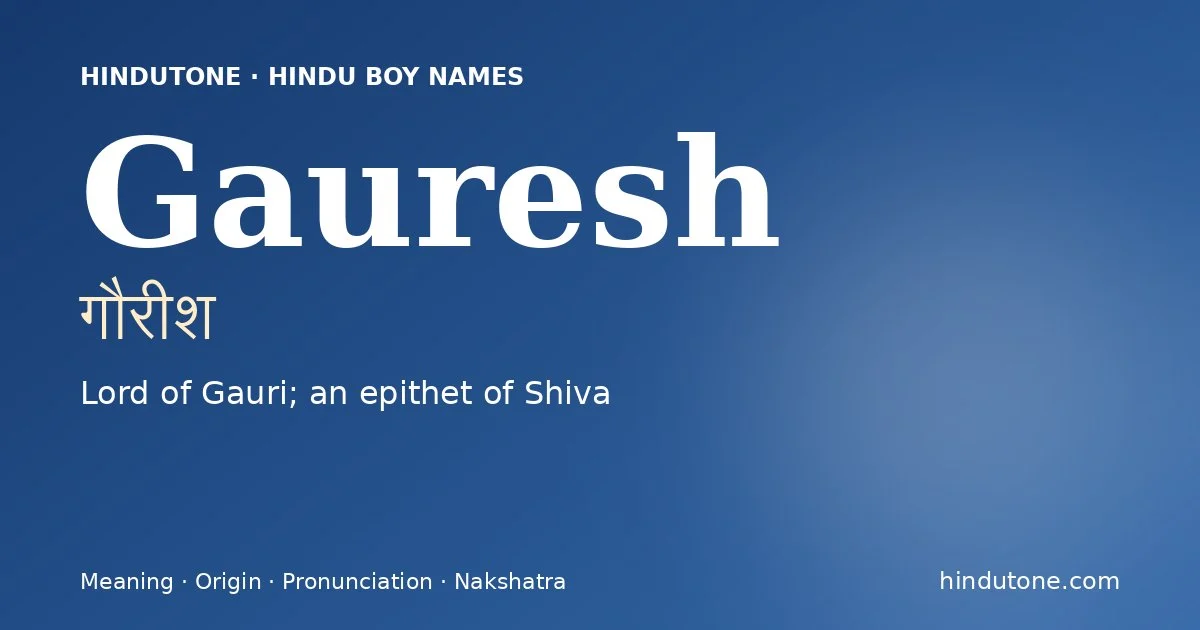
Gauresh (गौरीश) is a Sanskrit-origin Hindu boy-name meaning “Lord of Gauri; an epithet of Shiva”. Find pronunciation, origin, deity association, popularity and similar Hindu baby names.
Gauresh (गौरीश, IAST: gaurīśa) is a Sanskrit-origin Hindu boy-name meaning “Lord of Gauri; an epithet of Shiva”. Compound of Gauri (Parvati) + īśa (lord); Shiva as Parvati's consort.
Meaning, etymology & significance
Gauresh (गौरीश) is built from Gauri — "the fair one," one of the most beloved names of Parvati — and īśa (lord). The literal sense is "lord of Gauri" — Shiva specifically in his role as the consort of Parvati.
In the Shiva Purana the Gauri-Gauresh pair represents the complete divine couple: Shiva as the cosmic-ascetic and Gauri as the dharmically-married śakti. Their union is the cosmic ideal of householder dharma.
A child named Gauresh is therefore named with this Shaiva-householder tradition.
Pronunciation: gau-RAYSH. Pair with classical Shaiva surnames.
Astrology — nakshatra & rashi
By the standard Vedic correspondence between the first syllable of a name and the lunar mansion (nakshatra), Gauresh aligns with the Dhanishta nakshatra, under the Makara rashi (Moon sign).
Similar names
Hindu names with a similar feel or meaning include: Girish, Shankar, Mahadev. Each is a distinct choice with its own etymology — explore them on their own pages for fuller context.
Quick Facts
Attribute: Details
AdvertisementGender: Boy
Origin: Sanskrit
Meaning: Lord of Gauri; epithet of Shiva
Pronunciation: gau-RAYSH (गौ-रेश)
Syllables: 2
Lucky Number: 8
AdvertisementRashi: Makara (Capricorn)
Nakshatra: Dhanishta
Sanskrit Etymology & Devanagari
The name Gauresh is written in Devanagari as गौरीश and in IAST transliteration as gaurīśa. It is a tatpuruṣa compound (determinative compound) combining two elements: gaurī (गौरी), meaning "the fair one" or "the golden one," a principal name of Goddess Parvati, and īśa (ईश), meaning "lord" or "master."
The root gaura (गौर) denotes fairness, brightness, or a golden hue, and is commonly used in Sanskrit literature to describe both physical beauty and spiritual luminosity. When applied to Parvati, Gaurī emphasizes her radiant, auspicious form—the benevolent mother goddess who complements Shiva's ascetic intensity.
The suffix īśa derives from the verbal root īś (ईश्), "to rule" or "to possess power." It appears in many divine epithets: Parameśvara (Supreme Lord), Jagadīśa (Lord of the Universe), and Umāpati (Lord of Uma, another name for Parvati).
Culturally, Gauresh carries a deeply Shaiva connotation. It is not merely a generic "lord" title but specifically anchors the bearer in the tradition of Shiva-Parvati devotion. The name evokes the image of Shiva seated beside Gauri on Mount Kailash, embodying the balance of renunciation and household life, asceticism and love, stillness and creative energy.
Mythological & Historical Figures
While Gauresh itself is not the personal name of a character in the Puranas or epics, it is a well-documented epithet of Lord Shiva in devotional and liturgical texts. The Shiva Sahasranama (Thousand Names of Shiva) and various stotras invoke Shiva as Gaurīśa, Gaurīpati, and Gaurīnātha—all meaning "Lord of Gauri."
In the Shiva Purana, the marriage of Shiva and Parvati (Gauri) is described in elaborate detail. After Sati's self-immolation, Parvati is born as the daughter of Himavan and wins Shiva's heart through intense penance. Their union restores cosmic balance and produces two divine sons: Ganesha and Kartikeya. Shiva's role as Gaurīśa—the devoted consort—is central to this narrative.
The name also appears in temple inscriptions and medieval devotional poetry across India, particularly in regions with strong Shaiva traditions such as Tamil Nadu, Karnataka, and Kashmir. Poets like the Nayanars and Lingayat saints frequently addressed Shiva as Gaurīśa in their hymns.
Regional Popularity in India
Gauresh enjoys moderate popularity in several Indian states, particularly those with strong Shaiva traditions. In Maharashtra, the name is favoured among Brahmin and Maratha families who worship Shiva as the family deity. It pairs naturally with surnames like Joshi, Kulkarni, and Deshmukh.
In Karnataka, especially in the Lingayat community, names derived from Shiva epithets are common, and Gauresh fits comfortably within this tradition alongside names like Basava, Shivakumar, and Lingesh.
In Tamil Nadu, while Shaiva names are widespread, Gauresh is less common than Tamil-language equivalents like Sivakumar or Thirukumar. However, it is occasionally chosen by families seeking a pan-Indian, Sanskrit-rooted name.
In West Bengal and Odisha, where Shiva worship is deeply embedded in local culture, Gauresh is recognized and respected, though regional variants like Girish or Hara may be more prevalent.
Among the North Indian Hindi belt (Uttar Pradesh, Madhya Pradesh, Rajasthan), the name is understood and appreciated but less frequently used than shorter, more colloquial Shaiva names like Shiv, Shankar, or Mahadev.
Numerology & Astrology
According to traditional Hindu numerology, Gauresh is commonly associated with the lucky number 8. The number 8 is ruled by Saturn (Shani) and is believed to bestow discipline, resilience, and a strong sense of duty. Children with this number are thought to be serious, responsible, and capable of overcoming obstacles through perseverance.
Astrologically, the name corresponds to the Makara rashi (Capricorn), governed by Saturn, and the Dhanishta nakshatra, ruled by Mars. Dhanishta is symbolized by a drum or flute and is associated with prosperity, rhythm, and musical talent. Individuals born under this nakshatra are often believed to be ambitious, resourceful, and socially adept.
The combination of Saturn's discipline and Mars's energy suggests a personality that is both grounded and dynamic—traits that align well with the name's association with Shiva, the lord of both meditation and cosmic dance.
Personality Traits
Parents who choose the name Gauresh often associate it with the following qualities:
Devotion and Spirituality: A natural inclination toward religious practice, meditation, and reverence for tradition.
Strength and Resilience: The ability to face challenges with calm determination, much like Shiva's steadfast nature.
Balance: A harmonious blend of ascetic discipline and worldly responsibility, reflecting Shiva's dual role as yogi and householder.
Leadership: The "lord" component of the name suggests authority, confidence, and the capacity to guide others.
Creativity: An appreciation for art, music, and beauty, inspired by Shiva's role as Nataraja, the cosmic dancer.
Compassion: A gentle, protective demeanor toward family and community, mirroring Shiva's love for Gauri and his devotees.
Variants & Similar Names
Spelling Variants: Gauresh, Gaurish, Gowresh, Gowrish
Similar Hindu Names: Girish (Lord of the Mountain), Shankar (Shiva, the benevolent one), Mahadev (Great God), Shivendra (Lord Shiva), Umapati (Lord of Uma), Hara (Shiva, the remover), Rudra (Shiva in fierce form), Ishaan (another name for Shiva)
FAQ
How do you pronounce Gauresh correctly?
The correct pronunciation is gau-RAYSH, with the stress on the second syllable. The first syllable "gau" rhymes with "cow," and "resh" sounds like "raysh" with a soft "sh" at the end. In Devanagari, it is written गौरेश. Non-Hindi speakers may initially pronounce it as "GAW-resh," but the authentic pronunciation emphasizes the second syllable.
Is Gauresh suitable for modern, urban, and diaspora families?
Yes, Gauresh works well in contemporary settings. It is easy to spell in English, has a clear two-syllable structure, and carries a dignified, classical resonance without being overly ornate. For NRI families in North America, the UK, or Australia, the name is phonetically accessible and avoids common mispronunciation pitfalls. It also pairs well with both traditional Indian surnames and Anglicized middle names.
Is Gauresh religiously appropriate across Hindu communities?
Absolutely. Gauresh is a Shaiva name, making it especially meaningful for families who worship Shiva as their ishta devata (chosen deity). However, it is not sectarian in a narrow sense—Shiva is revered across nearly all Hindu traditions, including Smartha, Shaiva, and even many Vaishnava families who honor the Trimurti. The name is respectful, auspicious, and carries no regional or caste-specific connotations that would limit its use.
Frequently Asked Questions
What does the name Gauresh mean?
Gauresh ( गौरीश , IAST: gaurīśa ) is a Sanskrit-origin Hindu boy-name meaning “Lord of Gauri; an epithet of Shiva ” . Compound of Gauri (Parvati) + īśa (lord); Shiva as Parvati's consort.
Is Gauresh a good Hindu baby name?
Yes — it is a traditional Hindu name with an auspicious meaning, suitable for a baby and rooted in Sanatana Dharma values.
What is the origin of the name Gauresh?
It has Sanskrit/Hindu origins; its roots, deity association and significance are detailed above.
Are there variations or similar names to Gauresh?
Related and similarly-themed Hindu names, along with their meanings, are listed in the guide above to help you choose.
Gauresh — Name Facts
- Meaning
- Lord of Gauri; an epithet of Shiva
- Gender
- Hindu boy name
- Nakshatra
- Shatabhisha
- Rashi
- Kumbha (Aquarius)
- Numerology
- 7
Frequently asked questions
What does the name Gauresh mean?
Gauresh is a Sanskrit-origin Hindu boy name meaning “Lord of Gauri; an epithet of Shiva”.
Is Gauresh a boy or girl name?
Gauresh is traditionally a Hindu boy name.
Which nakshatra and rashi suit the name Gauresh?
By the first-syllable rule of Vedic naming, Gauresh aligns with the Shatabhisha nakshatra, under the Kumbha (Aquarius) rashi.
What is the numerology number of Gauresh?
The Chaldean name number of Gauresh is 7.
Explore more: Shatabhisha nakshatra names · Kumbha rashi names · Hindu boy names with G · All Hindu names A–Z