Pitru Paksha 2026 — 16 Days of Ancestor Worship (September 26 – October 10), Daily Rituals & Complete NRI Tarpan Guide for USA, UK, Canada
Pitru Paksha 2026 — September 26 to October 10. 16 days of ancestor worship, daily tarpan vidhi, Mahalaya Amavasya, NRI shradh from USA UK Canada Australia.
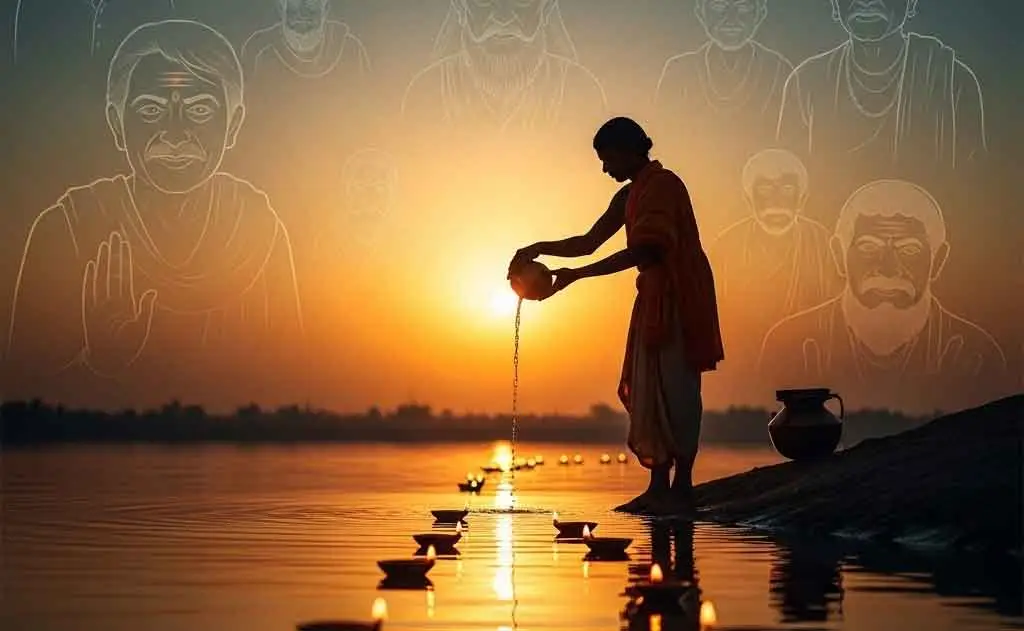
Pitru Paksha 2026 — September 26 to October 10. 16 days of ancestor worship, daily tarpan vidhi, Mahalaya Amavasya, NRI shradh from USA UK Canada Australia.
Quick Answer: Pitru Paksha 2026 runs Saturday, September 26 to Saturday, October 10, 2026 — 16 lunar days dedicated to honouring ancestors (*pitrus*). The window opens on Bhadrapada Purnima and closes on Ashwija Amavasya (also known as Sarvapitri Amavasya or Mahalaya Amavasya — the single most powerful tarpan day of the year). Daily tarpan (libation of water with sesame seeds) and shraddha (rice-ball offerings) sustain the pitrus' nourishment. For NRIs in USA, UK, Canada, Australia, Germany, GCC, Singapore and Malaysia, Pitru Paksha 2026 brings the most important annual ritual for honouring departed parents, grandparents, and the three preceding generations.
The Garuda Purana, the Brahma Purana, and the Vayu Purana all dedicate substantial passages to pitru karma — the duty owed by the living to the departed lineage. Pitru Paksha is the consolidated 16-day window when this obligation is most powerfully discharged. Mahalaya Amavasya alone — the final day — is said to release pitrus from many cycles of suffering if the descendants' offerings are performed with proper bhava.
1. Pitru Paksha 2026 — Exact Dates
- Saturday, Sep 26, 2026 · Bhadrapada Purnima · Pitru Paksha begins — first tarpan day
- Sunday, Sep 27 · Pratipada (waning 1) · Day 2
- Monday, Sep 28 · Dwitiya · Day 3
- Tuesday, Sep 29 · Tritiya · Day 4
- Wednesday, Sep 30 · Chaturthi · Day 5
- Thursday, Oct 1 · Panchami · Day 6 — Bharani Shradh (for those who died young)
- Friday, Oct 2 · Shashti · Day 7
- Saturday, Oct 3 · Saptami · Day 8
- Sunday, Oct 4 · Ashtami · Day 9
- Monday, Oct 5 · Navami · Day 10 — Avidhava Navami (for departed women)
- Tuesday, Oct 6 · Dashami · Day 11
- Wednesday, Oct 7 · Ekadashi · Day 12
- Thursday, Oct 8 · Dwadashi · Day 13 — Sanyasi Shradh (for monks)
- Friday, Oct 9 · Trayodashi · Day 14 — Magha Shradh (for departed children)
- Saturday, Oct 10 · Chaturdashi / Amavasya · Mahalaya Amavasya — Sarvapitri Amavasya — most powerful day
If you can perform only one shradh in the year, perform it on Mahalaya Amavasya (Saturday, October 10, 2026). The tradition holds that this single day's tarpan, done with sincere bhava, releases pitrus from generations of accumulated transitions.
2. The 16 Days — Daily Significance
Pitru Paksha is structured so that the tithi on which your ancestor died is the most powerful day for their personal shradh. The tradition:
- If your father died on a Saptami tithi, perform his shradh on the Pitru Paksha Saptami (Day 8, Oct 3, 2026 in this case)
- If your mother died on a Panchami, her shradh falls on Pitru Paksha Panchami (Day 6, Oct 1)
- If you don't know the death tithi (common for older deaths), perform on Mahalaya Amavasya (Day 16)
Special-purpose days within Pitru Paksha:
- Bharani Shradh (Day 6, Oct 1): For those who died young or by accident
- Avidhava Navami (Day 10, Oct 5): For departed sumangali women (women who died as wives)
- Sanyasi Shradh (Day 13, Oct 8): For renunciate ancestors
- Magha Shradh (Day 14, Oct 9): For children who died young
- Mahalaya Amavasya (Day 16, Oct 10): Universal day — for all pitrus, known and unknown
3. Tarpan vs Shraddha — The Difference
Tarpan (तर्पण): The daily offering of water mixed with sesame seeds (kala til) and barley. Simple, brief — can be done daily during Pitru Paksha. Requires only water, sesame seeds, and a quiet space facing south.
Shraddha (श्राद्ध): The full ceremonial offering of food (especially pinda — rice balls), water, and prayers, performed by a Brahmin priest with the karta (you) participating. More elaborate; typically done once during Pitru Paksha (on your ancestor's tithi day or on Mahalaya Amavasya).
Most NRI families perform daily tarpan at home + one full shraddha via an online priest service on Mahalaya Amavasya.
4. Who Can Perform Pitru Karma
Traditional rules state the eldest son performs pitru karma. Modern practice — and several traditional sources (including parts of the Garuda Purana itself) — accept much broader participation:
- Any son or daughter can perform the rituals
- Daughters-in-law, sons-in-law can perform as proxies
- Adopted children with grandparent recognition can perform
- Grandchildren when no children survive
- A priest as proxy when family cannot
- Women — increasingly recognized as fully qualified; classical sources are mixed but the dominant modern view accepts women's full participation
For NRIs whose only descendant is a daughter — perform the rituals yourself. The bhava is what makes the offering effective; gender is not the gatekeeper.
5. Daily Home Ritual — Apartment-Friendly
Setup (10 minutes)
- A small clean corner facing south (the direction of Yamloka and pitrus)
- A glass or kalash of water
- A handful of kala til (black sesame seeds) — available at Patel Brothers, Indian groceries
- A few grains of barley (jau)
- A small dish for the offering
- Optional: a printed photo of your departed parent/grandparent
- A diya (LED acceptable in apartments)
Daily tarpan (15 minutes)
- Bathe and wear clean light-colored clothes
- Sit facing south
- Take darbha grass (substitute: kusha or even a few blades of any grass)
- Hold water with sesame and barley in your right palm
- Recite the tarpan mantras (3 generations: father, grandfather, great-grandfather; and on mother's side equivalently)
- Pour the water/sesame mixture into the dish (or onto soil/plant in garden)
- Repeat the offering 3 times for each ancestor named
- Conclude with: Om Pitrubhyo Namah
Mantras for tarpan (basic version)
Om Pitrebhyah Swadha Namastarpayami* (for father's lineage)
Om Matrubhyah Swadha Namastarpayami* (for mother's lineage)
For the more elaborate Yajurvedic Tarpan vidhi, use the priest version with a Brahmin guiding via online video.
6. Which Day for Which Ancestor — A Practical Guide
The general rule: shradh on the lunar tithi matching your ancestor's death day.
If you don't know the exact tithi:
- For father: try Day 5 (Panchami) — common default
- For mother: try Day 10 (Navami — Avidhava Navami) if she died as a wife
- For all unknown ancestors: Mahalaya Amavasya (Day 16)
For NRIs whose family history is partially documented, just do Mahalaya Amavasya as the universal day. The pitrus accept the bhava.
7. NRI Pitru Paksha 2026 — Country-Specific Adaptations
🇺🇸 USA
- Most Hindu temples in USA conduct Pitru Paksha shradh services through this 16-day window
- Pittsburgh Sri Venkateswara Temple, BAPS Robbinsville NJ, Atlanta Hindu Temple, Bay Area Sunnyvale Hindu Temple, Houston Meenakshi Temple — all offer scheduled Pitru Paksha rituals
- Many US temples connect families to Gaya-based priests for distance shradh
- Online platforms: TTD International Donor desk (best for South Indian families), Sri Mandir app, OnlinePuja.com
🇬🇧 UK
- BAPS Neasden, Shree Sanatan Mandir Leicester, ISKCON Bhaktivedanta Manor all host community Pitru Paksha pujas
- London Hindu Bhajan Mandal organizes regular evening satsang during Pitru Paksha window
- Online options: same as USA platforms
🇨🇦 Canada
- Hindu Sabha Mandir Brampton, BAPS Toronto, Surrey BC Hindu Mandir — community Pitru Paksha services
- Strong Indo-Canadian community organizing in Brampton and Surrey
🇦🇺 Australia
- Sri Venkateswara Helensburgh NSW — strong South Indian Pitru Paksha programme
- Sri Shiva Vishnu Carrum Downs Melbourne — community shradh services
- Sydney Murugan Temple Mays Hill
🇦🇪 GCC
- BAPS Hindu Mandir Abu Dhabi, Bur Dubai Krishna Mandir, Jebel Ali Hindu Temple — full Pitru Paksha calendar
🇮🇳 India (for visiting NRIs)
- Gaya, Bihar — the supreme pitru-tarpan tirtha; the only place where shradh is said to immediately liberate ancestors from rebirth cycles
- Triveni Sangam Prayagraj — the second most powerful tirtha
- Brahmakapal at Badrinath — high-Himalayan tarpan site
- Pushkar, Rajasthan — Brahma's only temple; sacred for tarpan
- Tirumala (Kapila Theertham) — Vishnu-flavoured tarpan at the foot of Tirupati hill
8. Online Shradh Services 2026
The diaspora has driven significant innovation in online pitru karma. Major platforms in 2026:
- TTD International Donor Desk — pairs you with Tirupati priests for video-guided shradh
- Sri Mandir App — Gaya-based priest network, full Pitru Paksha booking
- OnlinePuja.com — multi-tirtha priest matching (Gaya, Prayagraj, Pushkar)
- BookMyPandit — North India + South India priest network
- Hindu Heritage Foundation — community-organized priest services for diaspora
Typical online shradh process:
- Book 1-2 weeks ahead (Mahalaya Amavasya slots fill 6+ weeks early)
- Provide: deceased's name, gotra, death tithi (if known), parent/spouse names
- Priest performs the ritual; you participate via video call
- Donation/dakshina paid via the platform
- You may receive prasad / shradh certificate post-ritual
Cost: ₹1,500 (basic tarpan) to ₹25,000+ (full Gaya-based mahashradh with multiple generations)
9. The Famous Tirthas for Pitru Tarpan
Gaya — Pre-eminent
The Phalgu River. Vishnu's Vishnupada footprint. Tradition: shraddha at Gaya, performed correctly, liberates pitrus from the cycle of rebirth. NRI pilgrims who visit Gaya for shraddha typically do a one-day Gaya visit + 2-3 days of related observances in Varanasi or Prayagraj.
Prayagraj (Triveni Sangam)
The confluence of Ganga, Yamuna, and the underground Saraswati. The Magh Mela window each year + Pitru Paksha overlap with substantial annual flow of tarpan pilgrims.
Brahmakapal (Badrinath)
High-Himalayan tarpan site. The site where Shiva placed Brahma's fifth head during the cosmic narrative. Tarpan here is said to fulfill three lifetimes of pitru obligations.
Pushkar (Rajasthan)
Brahma's only major temple worldwide. The Pushkar lake's pitru ghat is among the most-frequented tarpan sites.
Kashi (Varanasi)
The Manikarnika and Harishchandra ghats — the eternal cremation ghats. Tarpan and asthi-visarjan converge here.
Tirumala (Kapila Theertham at the foot of the hill)
South India's primary tarpan site. NRI pilgrims combining Tirumala darshan with Pitru Paksha can do tarpan at Kapila Theertham before climbing the hill.
10. FAQs
Q: When is Pitru Paksha 2026?
A: Saturday, September 26 to Saturday, October 10, 2026. Mahalaya Amavasya (most powerful day) falls on October 10.
Q: Can women perform Pitru Paksha rituals?
A: Yes — the modern dominant tradition accepts women's full participation. Several classical sources also support this; the Garuda Purana itself does not categorically prohibit women.
Q: I don't know my father's exact death tithi. What do I do?
A: Perform on Mahalaya Amavasya (October 10, 2026) — the universal day for all pitrus, known and unknown.
Q: Can I observe Pitru Paksha from the USA without a temple?
A: Yes — daily tarpan at home (water + sesame + barley + south-facing direction) is fully valid. For Mahalaya Amavasya, book an online shradh with an Indian priest.
Q: Do I need to fast during Pitru Paksha?
A: Traditional practice avoids onion, garlic, alcohol, non-vegetarian food, sexual activity. Some families fast one meal daily. Adapt to your capacity — the bhava is more important than rigid observance.
Q: What if I miss Mahalaya Amavasya?
A: Perform on the next available shradh day; or visit Gaya in any subsequent month for special shradh. Some traditions also offer annual shradh on your parent's solar death anniversary (Hindu calendar tithi).
Q: How much should I donate to the priest performing shradh?
A: Standard dakshina ₹2,500-15,000 for full shradh, depending on tirtha (Gaya highest). Online platforms publish their tiered pricing. Donate also to anna daana (feeding hungry/poor) — this directly benefits pitrus.
Q: My parent died only a few months ago. Should I still do Pitru Paksha?
A: Yes — and this Pitru Paksha is especially important. The first-year shradh cycles particularly benefit the recently-departed soul's integration with the pitru lineage.
Q: I'm vegetarian; can my non-vegetarian family members perform tarpan?
A: Yes — diet during the actual ritual matters, but otherwise family members of any dietary practice can participate. During the 16 days, sattvic diet is recommended; on shradh day, strict vegetarian observance.
Final Words
Pitru Paksha 2026 — September 26 to October 10 — is the most spiritually loaded annual window for honouring those who came before us. From Edison NJ to Wembley to Brampton to Frankfurt to Dubai to Singapore — wherever you carry the lineage of your parents and grandparents, this 16-day window is when the relationship between the living and the pitrus is most thinned.
Light a diya. Offer water + sesame seeds. Speak the names. Feed someone hungry. Sit silently for ten minutes facing south. The bhava of remembrance is what the pitrus require — not the location, not the elaborateness, not even the language.
Pitrubhyo Namah. Pitamahebhyo Namah. Prapitamahebhyo Namah.
Salutations to my father, grandfather, great-grandfather.
Om Shanti. Shanti. Shanti.
HinduTone Editorial Team · Tags: Pitru Paksha 2026, Shradh 2026, Mahalaya Amavasya 2026, Pitru Tarpan, Gaya Shradh, NRI Pitru Paksha, Online Shradh
Frequently Asked Questions
What is Pitru Paksha?
Pitru Paksha 2026 runs Saturday, September 26 to Saturday, October 10, 2026 — 16 lunar days dedicated to honouring ancestors (*pitrus*). The window opens on Bhadrapada Purnima and closes on Ashwija Amavasya (also known as Sarvapitri Amavasya or Mahalaya Amavasya — the single most powerful tarpan day of the year).
What are the key points about Pitru Paksha?
Daily tarpan (libation of water with sesame seeds) and shraddha (rice-ball offerings) sustain the pitrus' nourishment. For NRIs in USA, UK, Canada, Australia, Germany, GCC, Singapore and Malaysia, Pitru Paksha 2026 brings the most important annual ritual for honouring departed parents, grandparents, and the three preceding generations.
Why does Pitru Paksha matter in Hinduism?
It reflects core values of Sanatana Dharma and offers practical and spiritual guidance that remains relevant across generations.
How can devotees apply Pitru Paksha in daily life?
By reflecting on its teaching, incorporating the related practices or observances into daily routine, and approaching it with sincere devotion and understanding.
You might also like
Garuda Purana Afterlife Guide 2026 — What Happens After Death, NRI Grieving Abroad & 13-Day Rituals From Anywhere

Navratri 2026 in Canada, City by City: Ghatasthapana Times, Garba, Dandiya and Durga Puja

Karthika Masam 2026 in the USA: Dates, Five Somavarams and Karthika Pournami Times City by City