Lalita Sahasranama — 1000 Names of the Goddess: Complete Guide, Meaning & Benefits
"Lalitā Tripurasundarī — She who is beautiful in the three worlds, She who plays the divine game of creation." The Lalita Sahasranama (Sanskrit: ललिता…
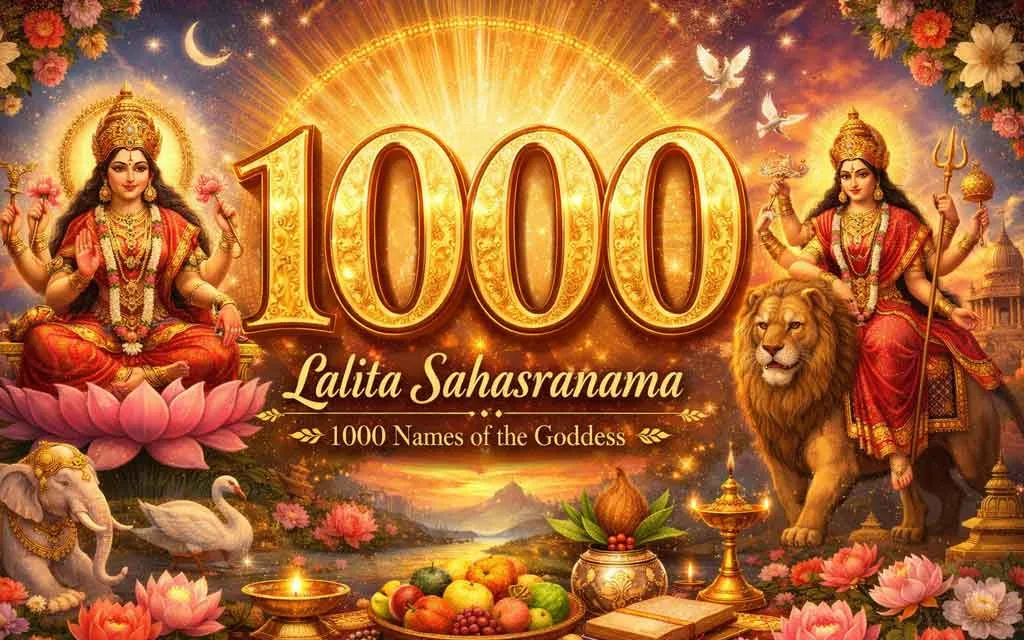
"Lalitā Tripurasundarī — She who is beautiful in the three worlds, She who plays the divine game of creation.
"Lalitā Tripurasundarī — She who is beautiful in the three worlds, She who plays the divine game of creation."
The Lalita Sahasranama (Sanskrit: ललिता सहस्रनाम) is one of the most exquisite and philosophically profound hymns in the entire Hindu tradition. Comprising exactly 1,000 sacred names of Goddess Lalita Tripura Sundari — the supreme form of Adi Shakti — this hymn is considered the crown jewel of Sri Vidya, the highest Shakta spiritual tradition.
Unlike most sacred hymns, the Lalita Sahasranama was not composed by a human sage — it was spoken by the eight Vak Devis (Goddesses of Speech) at the direct command of Goddess Lalita herself, making it uniquely self-revealed (Apaurusheya).
Recited daily by millions of devotees across India and the world, it encodes within its 1,000 names the entire cosmos, the complete map of the human body as a sacred geography, the secrets of Kundalini Yoga, Tantra, Vedanta, and the path to liberation.
[image: 📖] Table of Contents
- What Is the Lalita Sahasranama?
- Origin and Source Scripture
- Who Is Goddess Lalita Tripura Sundari?
- Structure of the Lalita Sahasranama
- The 1000 Names — Section by Section with Meanings
- Names 1–100: The Goddess's Form and Splendour
- Names 101–200: Her Cosmic Powers
- Names 201–300: Her Relationship with Shiva
- Names 301–400: Creation and Dissolution
- Names 401–500: Sri Chakra and Sri Vidya
- Names 501–600: Her Transcendence
- Names 601–700: Her Compassion and Grace
- Names 701–800: Her Esoteric Nature
- Names 801–900: Her Yogic and Tantric Aspects
- Names 901–1000: The Final Liberation
- 100 Most Important Names with Meanings
- The Phalashruti — Fruits of Recitation
- How to Chant Lalita Sahasranama
- Benefits of Reciting Lalita Sahasranama
- Lalita Sahasranama vs Other Sahasranamas
- FAQs
What Is the Lalita Sahasranama? {#what-is}
The word Lalita Sahasranama breaks down as:
- Lalita (ललिता) — She who plays; the one who is graceful, beautiful, and sportive
- Sahasra (सहस्र) — One thousand
- Nama (नाम) — Name(s)
Together: "The Thousand Names of Goddess Lalita."
Key facts:
Origin and Source Scripture {#origin}
The Lalita Sahasranama is found in the Brahmanda Purana, one of the 18 major Puranas of Hinduism, within a special section called the Lalitopakhyana (The Story of Lalita).
The Divine Origin Story
The origin of this hymn is itself a sacred narrative:
Goddess Lalita Tripura Sundari, the supreme ruler of Sri Chakra, had just vanquished the demon Bhandasura — a dark entity born from the ashes of Kamadeva (the god of love). After this cosmic victory, she held a grand celestial assembly on Manidvipa (her divine island).
In this assembly, Hayagriva — the horse-headed, all-knowing form of Vishnu and the great teacher of Sri Vidya — was present. Sage Agastya approached Hayagriva and asked him to reveal the greatest of all hymns to the Goddess.
Hayagriva explained that the Goddess had herself commanded the eight Vak Devis (Vasini, Kameshvari, Modini, Vimala, Aruna, Jayini, Sarveshvari, and Kaulini) to compose and recite the 1,000 names from their own divine knowledge of her nature. Since the names arose from the Goddesses of Speech themselves, the hymn is considered eternally true, self-revealed, and of unparalleled power.
Why Hayagriva Transmitted It
Hayagriva represents divine wisdom and the preservation of sacred knowledge. His transmission of this hymn to Agastya symbolizes the passing of Sri Vidya from the divine realm into the human plane of existence — making it accessible to devoted seekers.
Who Is Goddess Lalita Tripura Sundari? {#who-is-lalita}
Lalita Tripura Sundari (also known as Rajarajeshvari, Shodashi, Sri Vidya, and Kameshvari) is the supreme deity of the Sri Vidya tradition — the highest form of Shakta philosophy and practice.
Her Names and Their Meanings
Her Description (Dhyana Shloka)
The traditional meditation verse describes Lalita as:
- Complexion: Rising sun — crimson-red, the colour of dawn and passion
- Four arms: Holding a sugarcane bow (mind), five flower arrows (five senses), a noose (attachment), and an ankusha/goad (repulsion)
- Seated on: The Sri Chakra — the mystical geometric diagram that is both her body and the map of the cosmos
- Surrounded by: Oceans of nectar, wish-fulfilling trees, and billions of attendant deities
- Adorned with: The crescent moon, gems of every kind, and the fragrance of divine flowers
She is simultaneously the most immanent (present in every atom of creation) and the most transcendent (beyond all form, name, and description).
Structure of the Lalita Sahasranama {#structure}
The hymn begins with the Purva Bhaga (preliminary section) narrating the context, followed by the 1,000 names themselves, and ends with the Phalashruti (fruition section).
Poetic Meter
All 1,000 names are set in Anushtubh Chhandas — the most sacred Vedic meter of 8 syllables per quarter verse, also used in the Bhagavad Gita and Vishnu Sahasranama.
Thematic Divisions (Traditional)
The 1,000 names are traditionally grouped into sections based on subject matter:
The 1,000 Names — Section by Section with Meanings {#names}
[image: 🌺] Names 1–100: The Goddess's Radiant Form and Splendour
The opening hundred names describe the physical and luminous form of Goddess Lalita in breathtaking detail — from the crown of her head to the lotus of her feet. This section is essentially a sacred poetry of the divine body, where each body part becomes a window into cosmic reality.
Notable names in this section:
Spiritual significance of Names 1–100: These names establish that the Goddess's very body IS the universe. Her crimson complexion is the dawn of consciousness. Her bow is the mind. Her arrows are the five senses. Her throne is the Sri Chakra. Every ornament she wears corresponds to a cosmic principle (tattva).
[image: 🌸] Names 101–200: Her Cosmic Powers and Divine Attributes
This section shifts from her form to her functions, powers, and relationships with cosmic forces. The Goddess is described as the mother of all deities, the power behind all natural forces, and the sovereign of time itself.
Notable names:
Spiritual significance of Names 101–200: This section reveals the Goddess as the Shakti (energy) behind everything that exists. Every natural phenomenon — ocean, forest, sky, time, seasons — is her expression. She is not separate from creation; she IS creation playing with herself.
[image: 🌙] Names 201–300: Her Relationship with Shiva and the Non-Dual Reality
One of the most philosophically rich sections, these names describe the Goddess's relationship with Shiva — not as two separate beings, but as the two poles of a single non-dual Reality. Shiva is Pure Consciousness (Chit); Lalita is the Power of that Consciousness (Chit-Shakti).
Notable names:
Spiritual significance of Names 201–300: This is the Advaita (non-dual) heart of the Lalita Sahasranama. The Goddess is not a deity separate from ultimate reality — she IS the ultimate reality. Shiva without Shakti is inert; Shakti without Shiva is unconscious. Together they are the One Truth.
[image: 🔱] Names 301–400: Creation, Preservation, Dissolution, and the Play of Maya
These names describe the Goddess as the source and controller of the cosmic processes — how she creates the universe through her own divine play (Lila), sustains it through her grace, and withdraws it back into herself.
Notable names:
Spiritual significance of Names 301–400: Maya is not deception — it is the creative power of the Goddess. Through Maya, the One appears as Many. Through spiritual practice, the Many is recognized as One. This section teaches that the world is not unreal — it is real as the Goddess's own play.
[image: 🔯] Names 401–500: Sri Chakra, Sri Vidya, and Sacred Geometry
This is the most esoteric and tantric section of the Lalita Sahasranama. These names describe the Goddess as identical with the Sri Chakra — the magnificent geometric yantra of 9 interlocking triangles, 43 sub-triangles, and the Bindu (point) at the center.
The Sri Chakra as Her Body:
Notable names:
Spiritual significance of Names 401–500: The Sri Chakra is not merely a symbol — it is the living body of the Goddess. Meditating on it is meditating on her. Each of its 43 triangles is guarded by a specific Shakti (attendant goddess). Worship of the Sri Chakra is considered the highest form of worship in the Sri Vidya tradition.
[image: ☀️] Names 501–600: Her Transcendence — Beyond All Concepts
These names approach the ultimate paradox of the Goddess — she who is beyond all name and form, yet whose names and forms are infinite. This section is deeply connected to Advaita Vedanta and the philosophy of Kashmir Shaivism.
Notable names:
Spiritual significance of Names 501–600: This section is a direct Upanishadic teaching. The famous Mahavakya "Tat Tvam Asi" (That Thou Art) is encoded here — revealing that the devotee's own deepest Self is identical with the Goddess. Liberation is not going somewhere — it is recognizing what you already are.
[image: 🌷] Names 601–700: Her Compassion, Grace, and Relationship with Devotees
These names reveal the personal, devotional face of the Goddess — her tenderness toward her children, her eagerness to grant boons, her delight in sincere devotion, and her fierce protection of those who take refuge in her.
Notable names:
Spiritual significance of Names 601–700: This is the Bhakti heart of the Sahasranama. The Goddess is not distant or indifferent — she is the most intimate being in existence, closer than breath, more loving than the most devoted mother. These names are especially beloved by devotional (bhakti) practitioners.
[image: 🕉️] Names 701–800: Her Esoteric, Tantric, and Yogic Nature
These names reveal the Goddess as the power behind all yogic and tantric practices — the force of Kundalini Shakti, the giver of all Siddhis (spiritual powers), and the sovereign of all sacred knowledge traditions.
Notable names:
Spiritual significance of Names 701–800: This section is the map of Kundalini awakening. The three Granthis (knots) — Brahma, Vishnu, and Rudra — correspond to the three major energy blockages in the subtle body. As the Goddess's power rises through the chakras, each knot is pierced, releasing the devotee progressively from physical, emotional, and mental bondage.
[image: 🌊] Names 801–900: Her Absolute Identity with Pure Awareness
This section contains some of the most philosophically elevated names in the entire hymn — names that directly identify the Goddess with the ultimate non-dual reality described in the Upanishads.
Notable names:
Spiritual significance of Names 801–900: Turiya — the fourth state of consciousness — is the substratum of all three ordinary states of mind. The Goddess IS this fourth state: pure awareness that witnesses all without being affected by any. To know her is to rest in Turiya — permanently.
[image: 🕊️] Names 901–1000: The Final Liberation and the Absolute
The closing hundred names bring the hymn to its culmination — the Goddess as Moksha (liberation) itself, as the final resting place of all existence, as the silence beyond all words, and as the love that underlies all of reality.
Notable names:
Spiritual significance of Names 901–1000: The 1,000th and final name is simply "Shakti" — pure power, pure energy, pure life. This is the ultimate truth: beneath every name, every form, every concept, every being — there is only Shakti. She is the alpha and the omega, the first word and the last silence.
100 Most Important Names with Meanings {#100-names}
Here is a curated reference of 100 key names most frequently cited by scholars, practitioners, and devotees:
The Phalashruti — Fruits of Recitation {#phalashruti}
The Phalashruti (fruition chapter) at the end of the Lalita Sahasranama directly states the benefits promised by Hayagriva. These are traditionally divided into three categories:
[image: 🌼] Worldly Benefits (Bhoga)
- Freedom from disease, poverty, and misfortune
- Success in business, legal matters, and relationships
- Harmonious family life and protection of children
- Victory over enemies
- Longevity and good health
[image: 🌟] Spiritual Benefits (Yoga)
- Deepening of meditation
- Purification of the subtle body and chakras
- Awakening of Kundalini Shakti
- Direct experience of the Goddess's presence
- Freedom from the cycle of rebirth (Samsara)
[image: 🕊️] Liberation (Moksha)
- Final liberation from the cycle of birth and death
- Merger with the absolute reality of Lalita Tripura Sundari
- The permanent state of Satchidananda (Existence-Consciousness-Bliss)
The Phalashruti states: "Whoever recites this Sahasranama with devotion, even once — they are freed from all sins accumulated over countless lifetimes. They become dear to the Goddess. Whatever they desire, they obtain."
How to Chant the Lalita Sahasranama {#how-to-chant}
[image: 🌅] Daily Practice (Nitya Puja Method)
Ideal time: Early morning (Brahma Muhurta — 4:30 to 6:00 AM) or evening at dusk.
Step-by-step:
1. Purification
- Take a bath or wash hands, face, and feet
- Wear clean, preferably red or white clothing
- Sit facing east or north on a clean mat
2. Set Up the Sacred Space
- Place an image or yantra of Goddess Lalita / Sri Chakra on the altar
- Light a ghee lamp (diya)
- Offer red flowers — especially red hibiscus (Japa Pushpa) and rose
- Offer kumkum (vermillion), turmeric, and betel leaves
3. Invocation (Sankalpa and Dhyana) Chant the Dhyana Shloka (meditation verse) visualizing the Goddess in her crimson splendour.
4. Recite the Sahasranama
- Read each name slowly and clearly
- At the end of each name, mentally bow to the Goddess
- Alternatively, use a mala (rosary) of 108 beads
5. Offering (Archana) Traditionally, as each name is recited, a flower petal or handful of rice is offered to the image or yantra — a practice called Pushparchana (flower worship). This transforms the recitation into an act of worship.
6. Arati and Closure End with arati (waving of the lamp), the Lalita Ashtakam, and distribution of prasad.
[image: 📅] Best Days and Occasions to Chant
[image: ⏱️] Time Required
- Full recitation with archana: 90–120 minutes
- Full recitation (reading only): 45–60 minutes
- Abbreviated (selected 108 names): 15–20 minutes
Benefits of Reciting Lalita Sahasranama {#benefits}
[figure: 🛡️]
[figure: 💰]
[figure: 🏥]
[figure: 👨👩👧]
[figure: 🧠]
[figure: ❤️]
[figure: 🔮]
[figure: ✨]
[figure: 🕉️]
[figure: 🌺]
Lalita Sahasranama vs Other Sahasranamas {#comparison}
Frequently Asked Questions (FAQs) {#faqs}
Q1. Can anyone recite the Lalita Sahasranama, or is initiation (diksha) required? Anyone can recite the Lalita Sahasranama with devotion. However, for deep Sri Vidya practices (especially mantra sadhana with the Panchadashi/Shodashi mantra), initiation from a qualified guru is traditionally recommended. For devotional recitation (Parayana), no initiation is required.
Q2. What is the difference between the Lalita Sahasranama and the Lalita Trishati? The Lalita Trishati is a shorter hymn of 300 names — each name beginning with one of the 15 syllables of the Panchadashi mantra. Both are found in the Brahmanda Purana and both are highly sacred, but the Sahasranama is more comprehensive.
Q3. What language should I chant it in? Traditionally in Sanskrit — even if pronunciation is imperfect, the vibration of the sacred syllables is spiritually potent. For understanding and study, reading an English translation alongside is highly beneficial.
Q4. Is the Lalita Sahasranama suitable for women? Yes, absolutely. Goddess Lalita herself is the divine feminine — the Sahasranama is especially potent for women and is traditionally recited by women on Fridays and during Navratri.
Q5. Can I recite it silently (mental recitation)? Yes. The Lalita Sahasranama can be recited aloud (Vachika), whispered (Upamsu), or mentally (Manasika). Mental recitation is considered the most powerful of the three.
Q6. What should I do if I make a mistake during recitation? Simply continue. The tradition holds that sincere devotion is more important than perfect pronunciation. If you wish, recite the Navaarna mantra ("Aim Hrim Klim Chamundayai Vichche") a few times after completion as a general purification.
Q7. What is the Navaarna Mantra and how does it relate? "Aim Hrim Klim Chamundayai Vichche" is the seed mantra of Goddess Chandi / Lalita. It is often chanted as a prefix and suffix to the Sahasranama recitation to charge the practice with Shakti energy.
Q8. How long before I see results? This varies by individual karma and sincerity of practice. Many report inner peace and clarity within days; deeper transformations typically unfold over weeks and months of consistent practice.
Conclusion
The Lalita Sahasranama is not merely a list of names — it is a complete spiritual university encoded in 1,000 sacred syllables. It contains within it:
- A cosmology (how the universe arises from the Goddess)
- A psychology (how the human mind relates to divine consciousness)
- A physiology (the subtle body, chakras, and Kundalini)
- A philosophy (Advaita Vedanta and Kashmir Shaivism)
- A devotional path (Bhakti and Upasana)
- A tantric sadhana (Sri Vidya and Sri Chakra worship)
- A promise of liberation (Moksha)
Whether you come to it as a devotee, a scholar, a meditator, or simply a seeker — the Lalita Sahasranama meets you exactly where you are and carries you exactly where you need to go.
Aum Aim Hrim Shrim Lalita Tripura Sundaryai Namah
श्री माता — श्री महाराज्ञी — श्रीमत् सिंहासनेश्वरी
Explore more sacred Hindu texts, mantras, stotras, and spiritual guides at HinduTone.com
You might also like
Powerful Mantras for Students & Parents Before Joining School
Powerful Hindu Mantras for Purushottam Maas 2026: Vishnu Bhakti, Chanting Guide & Global Devotion
Shani Deva Temples Worldwide & Must-Performed Rituals — Complete Devotee's Guide