Ganesh Chaturthi Naivedyam for NRI Kitchens: 10 Days of Offerings Beyond Modak
The full Ganesh Chaturthi naivedyam spread for NRI kitchens beyond modak — undrallu, kudumulu, pulihora, panchakajjaya, sundal and more, with an NRI substitution table and a 10-day offering plan.
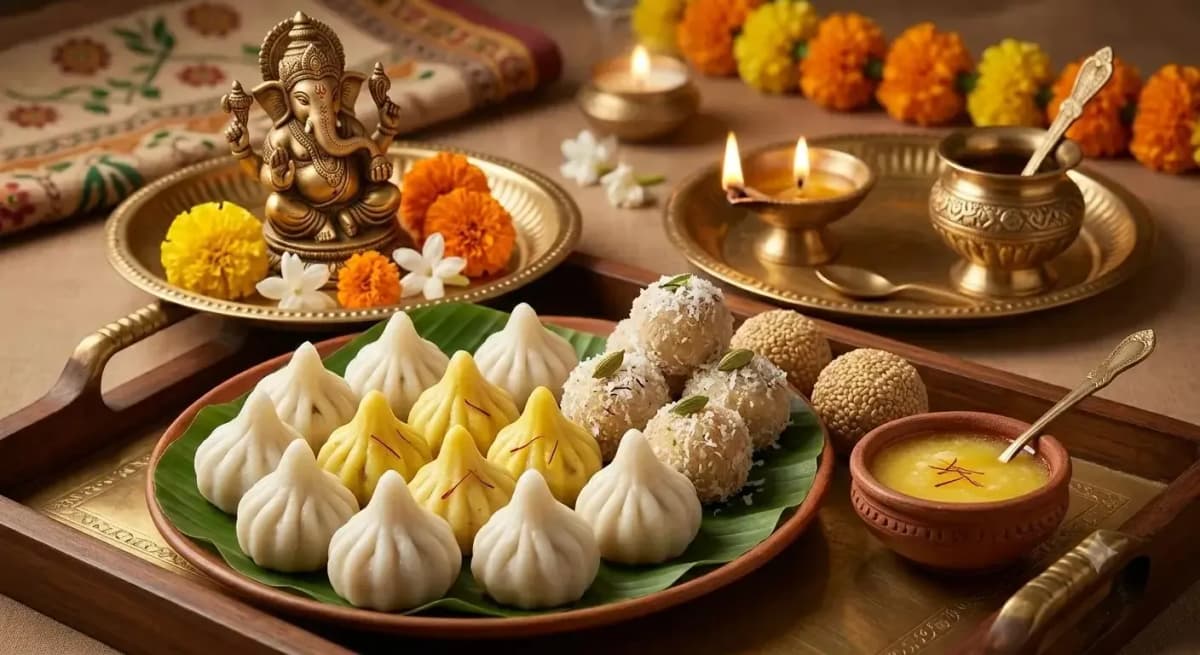
The full Ganesh Chaturthi naivedyam spread for NRI kitchens beyond modak — undrallu, kudumulu, pulihora, panchakajjaya, sundal and more, with an NRI substitution table and a 10-day offering plan.
Modak is the famous one. It is not the only one. If you are keeping Bappa for five or ten days you need a different offering every day — and most NRI families run out of ideas by day three. This guide covers the full traditional naivedyam spread: Telugu undrallu and kudumulu, Andhra pulihora, Karnataka panchakajjaya, Tamil sundal, and the ladoos and payasam that fill the rest of the ten days — written for a kitchen without fresh coconut, fresh curry leaves or a rice-rava aisle.
For modak specifically — ukadiche, fried and chocolate — see our dedicated modak recipes guide. This page covers everything else.
Short on time? Make Panchakajjaya — five ingredients, no cooking, five minutes, and a genuine traditional offering, not a shortcut. Recipe below.
The Rules of Naivedyam
- Do not taste while cooking. Naivedyam must be apurva — not previously partaken. Season by measure; check only after the offering.
- Cook after bathing, in clean clothes — the cooking is part of the worship.
- No onion, no garlic in anything destined for the altar.
- Fresh only — not reheated leftovers or yesterday’s batch.
- No tulsi for Ganesha. Omit the tulsi leaf from panchamrita; the one exception is the tulsi leaf within the 21-patri sequence.
- Offer to Bappa before the family eats, and keep the offering plate covered on its way to the altar.
If you cannot meet all of these — cooking after work, in a shared kitchen — cook anyway. Sincerity carries what circumstance cannot, and the Kshama Prarthana at visarjan exists for exactly this.
The NRI Substitution Table
The single most useful thing on this page.
- Fresh grated coconut → frozen grated coconut, thawed and gently squeezed (genuinely close to fresh), or desiccated coconut soaked in warm milk 10 minutes then drained. Avoid dry desiccated used straight — it gives a grainy filling.
- Jaggery (bellam/gur) → dark muscovado, panela or piloncillo — closest in flavour and moisture. Avoid light brown sugar, which lacks the depth.
- Rice rava (biyyapu ravva) → pulse raw sona masoori in a dry grinder to a coarse semolina texture in 3–4 second bursts. Avoid over-grinding into flour — you want grit.
- Fine rice flour → Indian idiyappam or modak flour; otherwise sift twice and add slightly more water. Coarse Western rice flour is why dumpling dough cracks.
- Curry leaves → frozen curry leaves from Indian/Asian grocers. Dried ones contribute almost nothing.
- Tamarind block → tamarind concentrate at about one-third the quantity — measuring it like pulp will ruin the pulihora.
- Roasted chana dal (putani) → unsalted roasted chickpea snack, powdered. Avoid salted/spiced versions.
- Ghee → make it — simmer unsalted butter 15 minutes on low and strain the solids. Better and cheaper than ghee-flavoured oil.
- Poppy seeds (khus khus) → restricted or prohibited in the UAE, Saudi Arabia, Singapore and elsewhere — omit entirely or use white sesame. This is a legal matter, not a culinary one; check your local rules.
Cup-to-gram (Indian recipes assume different cups): rice flour ~160 g, rava ~170 g, besan ~90 g, fresh coconut ~80 g, desiccated coconut ~90 g, grated jaggery ~160 g, sugar ~200 g, ghee ~220 g per cup. One US stick of butter (113 g) yields roughly 90 g ghee.
Equipment You Do Not Actually Need
- No idli steamer? A metal colander over a pot of simmering water, lid on, works — grease the surface.
- No modak mould? Make round kudumulu or undrallu instead — equally traditional, no pleating.
- Instant Pot? The steam function handles undrallu and kudumulu well — ten minutes, natural release.
The Recipes
1 — Panchakajjaya (Karnataka)
Ingredients
- [object Object]
- [object Object]
- [object Object]
- [object Object]
- [object Object]
- [object Object]
Method
- [object Object]
- [object Object]
NRI note: The best recipe here for a first-time or time-pressed cook — no heat, no equipment, five minutes, entirely traditional.
2 — Undrallu (Andhra / Telangana)
Ingredients
- [object Object]
- [object Object]
- [object Object]
- [object Object]
- [object Object]
- [object Object]
Method
- [object Object]
- [object Object]
- [object Object]
- [object Object]
- [object Object]
- [object Object]
NRI note: The 2–2½ cup water range depends on how coarse your rice rava is — home-ground absorbs less. Start at 2 cups and add if dry.
3 — Rava Kudumulu (sweet, 30 minutes)
Ingredients
- [object Object]
- [object Object]
- [object Object]
- [object Object]
- [object Object]
- [object Object]
Method
- [object Object]
- [object Object]
- [object Object]
- [object Object]
- [object Object]
- [object Object]
NRI note: A good beginner recipe — uses desiccated coconut, no fresh anything.
4 — Poornam Kudumulu (stuffed, chana dal)
Ingredients
- [object Object]
- [object Object]
Method
- [object Object]
- [object Object]
- [object Object]
- [object Object]
- [object Object]
- [object Object]
NRI note: Cracked dough means it cooled before kneading, or your rice flour is too coarse — sprinkle warm water and knead again.
5 — Pulihora (Andhra tamarind rice)
Ingredients
- [object Object]
- [object Object]
- [object Object]
- [object Object]
- [object Object]
- [object Object]
- [object Object]
Method
- [object Object]
- [object Object]
- [object Object]
- [object Object]
- [object Object]
NRI note: With concentrate, start at 2 tsp — it is ~3× the strength of block pulp and over-souring is irreversible.
6 — Kobbari Undalu (coconut ladoo, 15 minutes)
Ingredients
- [object Object]
- [object Object]
- [object Object]
- [object Object]
Method
- [object Object]
- [object Object]
- [object Object]
7 — Besan Ladoo
Ingredients
- [object Object]
- [object Object]
- [object Object]
- [object Object]
- [object Object]
Method
- [object Object]
- [object Object]
- [object Object]
- [object Object]
8 — Sundal (Tamil)
Ingredients
- [object Object]
- [object Object]
- [object Object]
- [object Object]
Method
- [object Object]
- [object Object]
- [object Object]
NRI note: Offer a different legume on successive days. Only planning needed is the overnight soak.
9 — Semiya Payasam
Ingredients
- [object Object]
- [object Object]
- [object Object]
- [object Object]
- [object Object]
Method
- [object Object]
- [object Object]
- [object Object]
10 — Panchamrita
Ingredients
- [object Object]
Method
- [object Object]
NRI note: Two minutes, and required for the sthapana puja.
The 10-Day Naivedyam Plan
A different offering each day, sequenced so the labour-intensive ones fall on days you are likely free:
- Day 1 (Mon 14 Sep) — Modak (21) + Panchamrita
- Day 2 (Tue 15 Sep) — Undrallu
- Day 3 (Wed 16 Sep) — Rava Kudumulu
- Day 4 (Thu 17 Sep) — Pulihora
- Day 5 (Fri 18 Sep) — Sundal (chickpea)
- Day 6 (Sat 19 Sep) — Poornam Kudumulu
- Day 7 (Sun 20 Sep) — Semiya Payasam
- Day 8 (Mon 21 Sep) — Besan Ladoo
- Day 9 (Tue 22 Sep) — Kobbari Undalu
- Day 10 (Wed 23 Sep) — Panchakajjaya
- Day 11 (Thu 24 Sep) — Sundal (black chana)
- Visarjan (Fri 25 Sep) — Modak + full spread + dahi-bhat
Keeping Bappa for a shorter cycle? Compress: modak on day one, low-effort dishes in the middle, and the full spread on your visarjan day. The dahi-bhat on visarjan day is not optional in Maharashtrian practice — curd rice offered as food for Ganesha’s journey home.
Make-Ahead & Storage for Working Families
- The weekend before: make ghee, grind rice rava, powder jaggery, buy and freeze grated coconut, soak and freeze cooked legumes.
- The night before Chaturthi: make the coconut-jaggery filling (keeps 3 days refrigerated, 2 months frozen), roast the besan, soak the chana dal.
- Chaturthi morning: dough and steaming only — steamed dumplings must be fresh.
- Freezing: shape dumplings uncooked and freeze; steam from frozen with +3 minutes. Ladoos keep 2 weeks refrigerated / 2 months frozen.
Dietary Notes
- Gluten-free: undrallu, kudumulu, steamed modak, panchakajjaya, coconut ladoo, sundal, pulihora and payasam are all naturally gluten-free. Check your asafoetida — compounded hing is usually wheat-based.
- Vegan: coconut ladoo with coconut condensed milk, sundal, pulihora and oil-steamed dumplings work. Note ghee is traditionally considered essential to naivedyam; one honest approach is ghee for the offering portion.
- Nut allergies: every recipe works without nuts except besan ladoo, which is fine plain.
Explore the Ganesh Chaturthi 2026 Complete Guide
This page is part of Hindutone’s Ganesh Chaturthi 2026 cluster:
- Complete Ganesh Chaturthi 2026 guide (hub)
- Date & city-wise muhurat
- Ganesh Sthapana (setup at home)
- Vinayaka Vrata Vidhanam (full puja)
- Ganesh Visarjan mantra
- Stories of Ganesha
- Wishes & quotes
Frequently Asked Questions
What is offered to Ganesha besides modak?
Undrallu, kudumulu, pulihora, panchakajjaya, sundal, besan and coconut ladoo, payasam and panchamrita are all traditional. Modak is the most celebrated, not the only one.
Can I taste the food while cooking naivedyam?
No. Naivedyam must not be previously partaken. Season by measure and check only after the offering has been made.
What can I use instead of fresh coconut?
Frozen grated coconut, thawed and lightly squeezed, is closest. Desiccated works if soaked in warm milk ten minutes first; used dry it gives a grainy filling.
What is a good jaggery substitute abroad?
Dark muscovado, panela or piloncillo. Light brown sugar sweetens but lacks the depth.
Why does my modak or kudumulu dough keep cracking?
Either the dough cooled before you kneaded it, or the rice flour is milled too coarse. Knead while hot and use fine Indian rice flour.
Is tulsi used in panchamrita for Ganesha?
No. Standard panchamrita includes tulsi, but it is omitted for Ganesha. The one exception in the festival is the tulsi leaf in the 21-patri sequence.
How many modak should be offered?
Twenty-one is traditional, matching the 21 durva and 21 patri.
Related Reading on Hindutone
You might also like

Ganesh Chaturthi 2026 Modak Recipes — Traditional Ukadiche, Fried, Chocolate Modak Complete NRI Guide

Janmashtami 2026 Prasad Recipes — Makhan, Panchamrit, Mishri & Complete NRI Krishna Birthday Food Guide

Ekadashi Fasting Recipes 2026 — Complete Phalahara Guide, 24 Annual Ekadashis & NRI-Friendly Vrat Foods