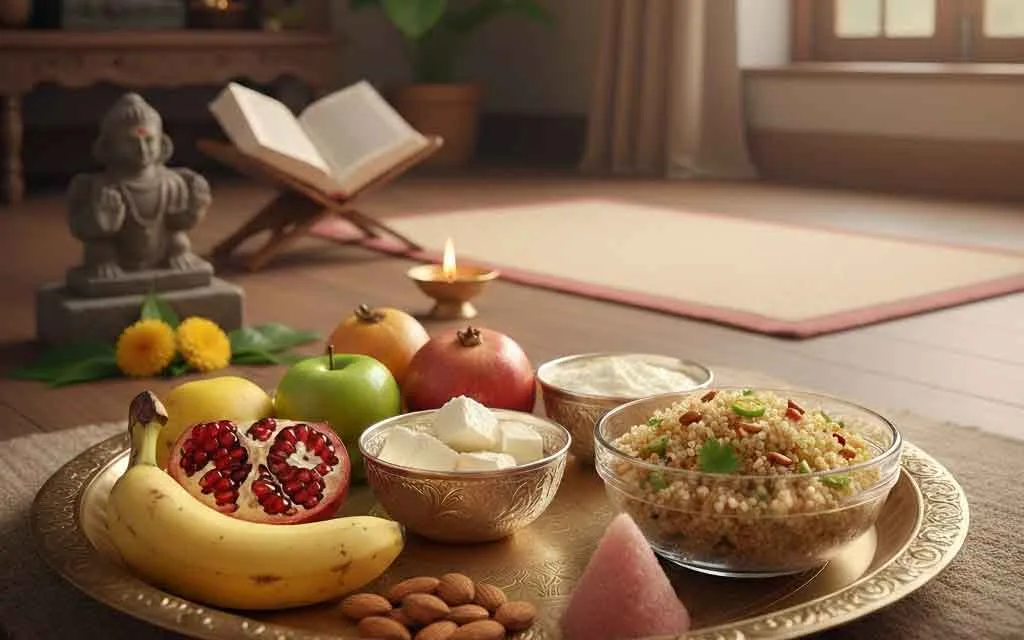
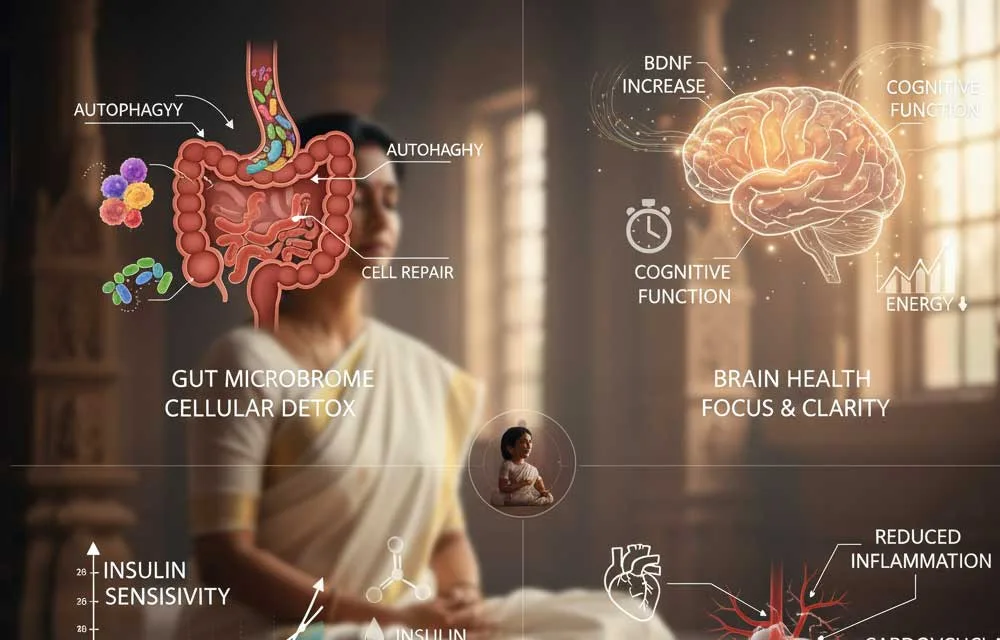
Fasting of Navaratri: Intellectual & Spiritual Purification
Navaratri fasting at the intellectual level symbolizes the purification of the soul through self-discipline, reflection, and conscious action over ten days:…

Navaratri fasting at the intellectual level symbolizes the purification of the soul through self-discipline, reflection, and conscious action over ten days:
Prathama – Day 1
I will let go of all my anger.
Dwitiya – Day 2
I will stop judging others.
Tritiya – Day 3
I will release all grudges.
Chaturthi – Day 4
I will forgive myself and everyone.
Panchami – Day 5
I will accept myself and others as they are.
Shashti – Day 6
I will love myself and everyone unconditionally.
Saptami – Day 7
I will let go of all jealousy and guilt.
Ashtami (Durga Ashtami) – Day 8
I will release all fears.
Navami (Maha Navami) – Day 9
I will offer gratitude for everything I have and everything I will receive.
Dashami (Vijayadashami) – Day 10
I will tap into the abundance of the universe and create what I desire through unconditional love, sadhana, selfless service, and faith.
Wishing you and your family a blessed and spiritually uplifting Navaratri.
Why does Navaratri prescribe ten days rather than nine for inner purification?
Although the festival is named Navaratri — literally 'nine nights' from the Sanskrit nava (nine) and ratri (night) — the inner journey the article maps runs across ten tithi-s, concluding on Vijayadashami. The Devi Bhagavata Purana explains that the nine nights represent the active sadhana of confronting and dissolving the nine principal obstacles of the mind: krodha (anger), dvesha (hatred), dambha (self-righteousness), kshama-hinata (lack of forgiveness), aswikara (non-acceptance), raga (conditional attachment), matsarya (envy), bhaya (fear), and akritatajnata (ingratitude). Each night corresponds to one such vritti being offered into the fire of awareness.
Vijayadashami, the tenth day, is the fruit of that nine-night discipline — vijaya meaning 'victory' over these inner enemies. The Ramayana tradition commemorates Rama's defeat of Ravana on this day, a narrative the Adhyatma Ramayana reads as the conscious self (Rama) vanquishing the ten-headed ego (Ravana), whose ten heads symbolise the same cluster of mental impurities. The tenth resolution in the article — tapping into universal abundance through unconditional love and selfless service — mirrors exactly this symbolism of inner victory made outwardly creative.
How do the three sets of three days map onto the three shaktis of the Goddess?
Classical Navaratri observance divides the nine nights into three triads. The first three days honour Durga Shakti — the power that destroys tamas, or the inertia of destructive habits such as anger, judgement, and grudges, which correspond to Days 1–3 in the article. The second triad is dedicated to Lakshmi Shakti, whose quality is poshana, nourishment — fostering forgiveness, self-acceptance, and unconditional love (Days 4–6). The final triad belongs to Saraswati Shakti, the illuminating force of vidya, which dissolves jealousy, fear, and ingratitude and opens the aspirant to wisdom and gratitude (Days 7–9).
This three-phase structure is referenced in the Markandeya Purana's Devi Mahatmya (also called Chandi Path or Durga Saptashati), where the Goddess appears in three primary manifestations — Mahakali, Mahalakshmi, and Mahasaraswati — each presiding over a specific layer of human consciousness: the subconscious, the vital, and the intellectual respectively. Aligning one's daily resolution with the presiding Shakti of that triad amplifies the fasting's purificatory effect, because the intent of the sadhaka resonates with the cosmic quality being invoked through puja, stotra, and havan during those same days.
What is the spiritual logic behind fasting as a vehicle for mental purification?
The Chandogya Upanishad (7.26.2) states: 'Ahara-shuddhau sattva-shuddhih' — when food is pure, the inner nature becomes pure. Fasting, understood not merely as abstinence from certain foods but as ahara-niyama (regulation of all intake), directly reduces the tamas and rajas in the anna-maya-kosha (the food body), which in turn calms agitation in the mano-maya-kosha (the mental body). This is why voluntary dietary restriction during Navaratri is not a cultural custom alone but a physio-spiritual technology.
The Bhagavad Gita (17.16) identifies manasa tapas — mental austerity — as comprising prasanna-manasam (mental serenity), maunam (thoughtful silence), atma-vinigrahah (self-restraint), and bhava-samshuddhi (purity of feeling). Each resolution listed across the ten days is precisely a unit of bhava-samshuddhi: one releases a contracted emotional state and replaces it with an expansive, sattvic orientation. The body-fast and the mind-fast thus work as a single integrated sadhana, each reinforcing the other.
How have India's great pilgrimage centres traditionally observed this inner dimension of Navaratri?
At the Vaishno Devi shrine in the Trikuta hills of Jammu, pilgrims observe a strict vrata that includes not only dietary restriction but also brahmacharya, silence during key sandhya periods, and the recitation of the Argala Stotram and Kilaka Stotram from the Devi Mahatmya before dawn each day. The physical climb to the cave temple is itself treated as a metaphor for the ascent through the inner resolutions: each kilometre walked in the cold mountain air is understood as shedding one layer of ahamkara. At Kolkata's Durga Puja, celebrated with extraordinary communal energy, the ashtami and navami sandhi-puja performed at the junction of the eighth and ninth tithis is specifically dedicated to the dissolution of fear — aligning with Day 8's resolution of releasing all fears.
The Mysore Dasara, observed at Mysore Palace in Karnataka since the Vijayanagara period, culminates on Vijayadashami with the royal procession and the symbolic gaja-puja and shastra-puja. These rituals honour the tools of one's dharmic vocation as sacred — a direct enactment of Day 10's call to 'create what I desire through sadhana and selfless service.' The tradition reflects the Arthashastra-era understanding that outer productivity and inner purification are not opposed; victory in the world is the legitimate expression of an inner victory already won.
What practical sadhana supports each day's resolution during Navaratri?
Traditional guidance pairs each inner resolution with a specific mantra or nama-japa to anchor the intention. For Days 1–3 (anger, judgement, grudges), recitation of the Mahishasura Mardini Stotram — which celebrates Durga's destruction of the buffalo-demon, a symbol of tamas — is recommended. For Days 4–6 (forgiveness, acceptance, unconditional love), the Sri Sukta from the Rigveda Khila serves as the complementary text, invoking Lakshmi's quality of sampat, which encompasses both material and emotional abundance. For Days 7–9 (jealousy, fear, gratitude), Saraswati Vandana and the last chapter of the Devi Mahatmya (Phala-shruti) are traditionally chanted.
Journalling the daily resolution in a dedicated vrata-pustika (vow-notebook) is a simple but powerful extension of the intellectual fast described in the article. Writing the sankalpa (intention) in the morning, reflecting on how one upheld or struggled with it during the day, and offering the reflection mentally to the presiding Devi form during evening deepa-aradhana creates the feedback loop that the Yoga Sutras of Patanjali call svadhyaya — self-study. This combination of mantra, reflection, and offering transforms what might otherwise remain a list of resolutions into a living, day-by-day yajna of the mind.
Frequently Asked Questions
Why does the inner Navaratri journey run for ten days instead of nine?
Navaratri means nine nights, but the inner journey runs across ten tithis and ends on Vijayadashami. The nine nights are the active sadhana, and the tenth day is the victory over inner enemies.
How do the three sets of three days map to the Goddess?
The first three days honour Durga Shakti, which destroys tamas. The next three honour Lakshmi Shakti, which nourishes, and the final three honour Saraswati Shakti, the force of wisdom.
What is the resolution for each day of Navaratri fasting?
The first days focus on letting go of anger, judgement and grudges. The middle days cover forgiveness, acceptance and love, and Days 7 to 9 release jealousy, guilt and fear and offer gratitude.
Is Navaratri fasting only about food?
No. Fasting is understood as regulating all intake, and the Chandogya Upanishad says pure food leads to a pure inner nature. The body fast and the mind fast work together as one sadhana.
Which texts can be chanted during Navaratri for each phase?
Days 1 to 3 pair with the Mahishasura Mardini Stotram, and Days 4 to 6 with the Sri Sukta. Days 7 to 9 pair with the Saraswati Vandana and the last chapter of the Devi Mahatmya.
How can I journal my Navaratri resolutions?
Keep a vrata-pustika, or vow-notebook. Write the sankalpa in the morning, reflect on how you kept it during the day, and offer that reflection mentally to the Devi in the evening.
Share this with family and friends
Send it on WhatsApp, post it, or copy the link.
More from Spirituality
- Chilkur Balaji 'Visa Balaji' Temple: The 11 and 108 Pradakshina Custom Explained for NRIs
- Ekagrata (One-Pointedness): Yoga Concentration and Samyama Glossary
- Complete MBBS Once in Life: The Spiritual Meaning of Mahabharata, Bhagavatam, Bhagavad Gita & Ramayana
- Sri Medha Dakshinamurthy Swami Dhyanam | Meditation Sloka for Intelligence, Eloquence & Self-Realization
- What Is True Poverty? | Dharma Is the Greatest Wealth | Sanatana Dharma