Upanayanam — Sacred Thread & Brahmopadesam (NRI Guide)
Upanayanam (the sacred-thread ceremony / Brahmopadesam) — its significance, eligibility & timing, step-by-step vidhi, the Gayatri Mantra, and how NRIs perform it abroad.
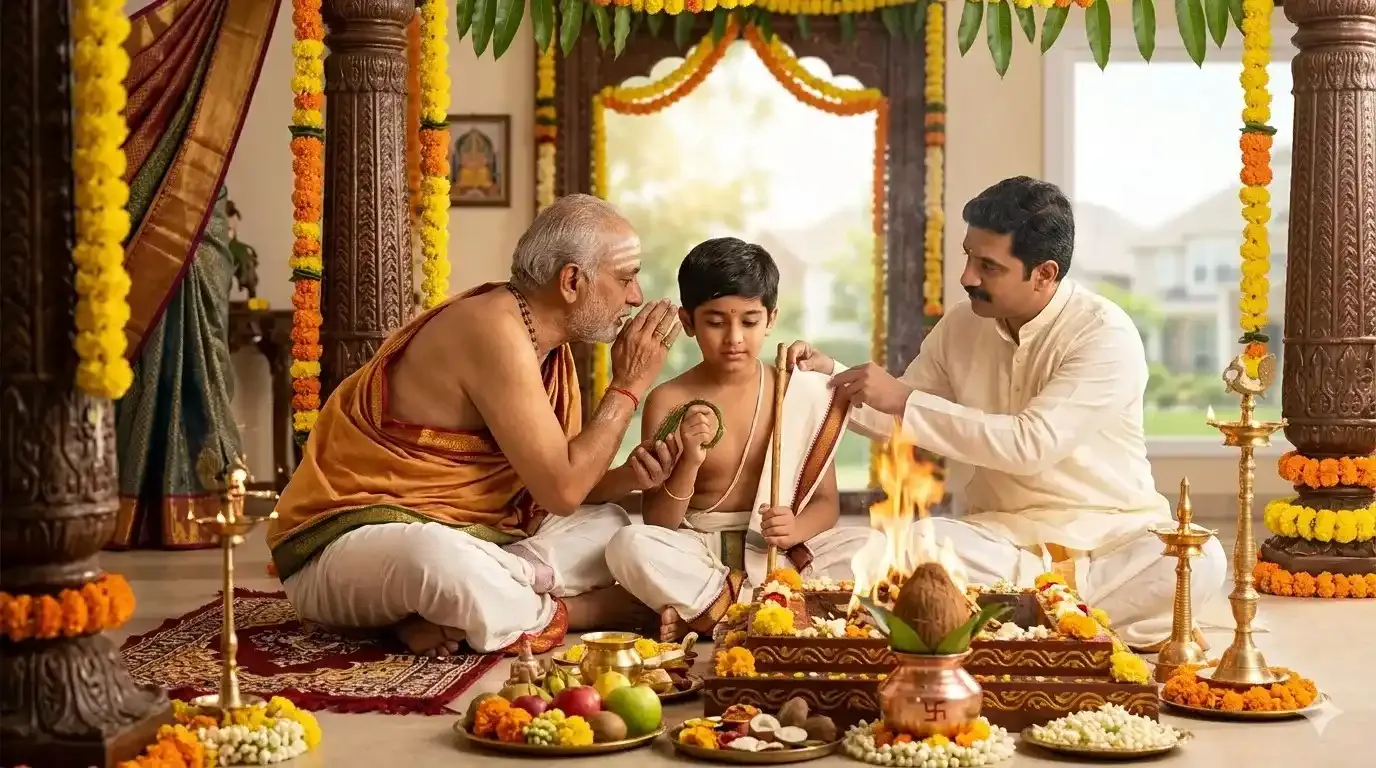
Upanayanam (the sacred-thread ceremony, also called Brahmopadesam or Janeu) is the samskara that initiates a young person into Vedic study and a disciplined spiritual life. It is often called a "second birth" (dwija), as the student is reborn into the world of learning under a guru’s guidance.
Significance
The heart of the ceremony is the Brahmopadesam — the imparting of the Gayatri Mantra by the father or guru, and the wearing of the yajnopavita (sacred thread). It marks a commitment to learning, discipline (brahmacharya), and the daily practice of Sandhyavandanam.
Eligibility & Timing
- Traditionally performed for boys, commonly between ages 7 and 9 (and before marriage); practices and the exact age vary by community and sampradaya.
- Choose a shubha muhurtam via a panchang or your purohit; many families align it with auspicious periods.
Items (Samagri)
- The yajnopavita (sacred thread), a new set of clothes/dhoti for the boy
- A lamp, items for the homa/havan (where performed), turmeric, kumkum, rice and flowers
- Fruits, sweets, and items for Bhiksha (the symbolic alms the new student receives from elders)
Step-by-Step (common form)
- Invoke Lord Ganesha — "Om Gam Ganapataye Namaha"; the purohit conducts the preliminary rites and homa.
- The boy is bathed and dressed; the yajnopavita is worn with the prescribed prayers.
- The father/guru imparts the Gayatri Mantra (Brahmopadesam), traditionally in a sheltered, sacred setting.
- The new brahmachari receives Bhiksha (alms) and blessings from elders; the family celebrates with prasadam.
The Gayatri Mantra
ॐ भूर्भुवः स्वः। तत्सवितुर्वरेण्यं। भर्गो देवस्य धीमहि। धियो यो नः प्रचोदयात्॥
Om bhūr bhuvaḥ svaḥ, tat savitur vareṇyaṁ, bhargo devasya dhīmahi, dhiyo yo naḥ pracodayāt.
In our own words, the Gayatri is a prayer to the divine light of Savitr (the Sun) to illumine and inspire our intellect toward what is right. It is received with reverence at the Upanayanam and recited daily thereafter.
How NRIs Perform It Abroad
- Invite a purohit in person, or arrange the ceremony online with a priest; many temples abroad host Upanayanam.
- Source the yajnopavita and samagri from Indian stores; involve grandparents over a video call.
- Many families later visit a temple in India to complete or commemorate the rite.
Note: eligibility, age and procedure vary by community and tradition — always follow your family purohit and elders.
See also the 16 Samskaras guide and Aksharabhyasam.
Frequently asked questions
What is Upanayanam and why is it called a second birth?
Upanayanam, also called Brahmopadesam or Janeu, is the samskara that initiates a young person into Vedic study and a disciplined spiritual life. It is called a second birth (dwija) because the student is reborn into the world of learning under a guru's guidance.
At what age is Upanayanam traditionally performed?
It is traditionally performed for boys, commonly between ages 7 and 9 and before marriage. The exact age varies by community and sampradaya, so follow your family purohit and elders.
What happens during the Upanayanam ceremony?
The purohit conducts preliminary rites and homa after invoking Ganesha, and the boy wears the yajnopavita. The father or guru imparts the Gayatri Mantra, and the new brahmachari receives Bhiksha and blessings from elders.
What is the Gayatri Mantra given at Upanayanam?
It is a prayer to the divine light of Savitr, the Sun, to illumine and inspire the intellect toward what is right. It is received with reverence at Upanayanam and recited daily afterwards.
How do NRIs perform Upanayanam abroad?
Invite a purohit in person or arrange the ceremony online with a priest, and note that many temples abroad host Upanayanam. Source the yajnopavita and samagri from Indian stores, and involve grandparents over a video call.
How is the Upanayanam muhurtam chosen?
Choose a shubha muhurtam through a panchang or your purohit. Many families align the ceremony with auspicious periods.
Share this with family and friends
Send it on WhatsApp, post it, or copy the link.
More from Spirituality
- Sri Medha Dakshinamurthy Swami Dhyanam | Meditation Sloka for Intelligence, Eloquence & Self-Realization
- What Is True Poverty? | Dharma Is the Greatest Wealth | Sanatana Dharma
- Correct Yourself First! | The Power of Constructive Criticism for Personal Growth
- Trees: Abodes of the Divine | Spiritual and Environmental Significance of Trees
- Dashaphala Rahasyalu Part 3: When Do Planetary Dashas Give Full Results?
You might also like
Daylight Saving & Hindu Puja Timings: An NRI Guide

Chilkur Balaji 'Visa Balaji' Temple: The 11 and 108 Pradakshina Custom Explained for NRIs
Ekagrata (One-Pointedness): Yoga Concentration and Samyama Glossary