Hindu Temple Hiring Religious Worker (Saiva Tradition)
Job Opportunity: Hindu Temple Religious Worker (Non-Pastoral) – Ordained Priest (Saiva Tradition) Organization: Shree Ghanapathy Temple Location: Wimbledon,…

Job Opportunity: Hindu Temple Religious Worker (Non-Pastoral) – Ordained Priest (Saiva Tradition) Organization: Shree Ghanapathy Temple Location: Wimbledon,…
Job Opportunity: Hindu Temple Religious Worker (Non-Pastoral) – Ordained Priest (Saiva Tradition)
Organization: Shree Ghanapathy Temple Location: Wimbledon, South-West London, UK
Job Overview Shree Ghanapathy Temple, the first fully consecrated South Indian-style Hindu temple in Europe dedicated to Lord Ganesha (Ghanapathy), has an urgent vacancy for a full-time Hindu Temple Religious Worker (Non-Pastoral) to support the senior priests in daily temple rituals and ceremonies (both in-temple and off-site where required). This role is in the Saiva (Shaivite) tradition and involves assisting with religious duties under the supervision of existing Ministers of Religion.
Key Responsibilities
- Waking up and tending to the Deities, performing daily rituals including pooja, bathing (abhishekam), and alangaram (dressing and decoration).
- Chanting traditional Sanskrit Vedic mantras, slokas, and texts.
- Maintaining cleanliness and tidiness of the deities, altars, and related areas.
- Organizing and arranging cupboards for deities' clothing, pooja items, and accessories on a daily basis.
- Supporting senior priests in basic traditional ceremonies (temple and off-site).
- Other associated religious duties (note: no preaching or leading congregational prayers involved).
Requirements and Qualifications
- Ordained/conferred to Kurukkalship (Veda Agamas) in the Saiva tradition.
- Minimum 2+ years' experience working in a Saiva Hindu Temple.
- Ability to recite/chant Vedic mantras and slokas fluently.
- Ability to perform basic traditional Saiva ceremonies independently (without supervision from senior priests).
- Fluency in Tamil (essential for communication and rituals).
- Recognized training in Hindu Vedas and Agamas (acceptable to the temple's selection panel).
- Willingness to learn and develop English language skills.
- Preferred: Brahmin lineage.
Additional Notes
- This position is exempt from certain equality laws due to genuine occupational requirements related to religion.
- Accommodation is provided on or near the temple premises (residence in the vicinity is a condition of employment).
- Benefits include discounted/free food and on-site accommodation.
Contract Details
- Full-time, Fixed Term (typically 2 years, under Religious Worker category).
- Salary: Competitive (details available on enquiry).
How to Apply Interested candidates should visit the official careers page: https://www.shreeghanapathy.co.uk/careers/ for full details. To apply or request further information, email: enquiries@ghanapathy.com
Shree Ghanapathy Temple is a prominent Saiva Hindu institution committed to religious worship, education, and community service. Suitable for ordained Saiva priests seeking to serve in a consecrated traditional temple in the UK.
Posted for www.hindutone.com – Apply promptly as this is an urgent vacancy!
What is Kurukkalship and Why Does It Matter for Saiva Temple Service?
Kurukkal (also spelled Gurukkal) is the ordained priestly title specific to the Shaiva Siddhanta tradition, predominantly practised by Tamil Shaivite communities. Unlike the broader Brahmin priesthood that may serve across multiple sampradayas, a Kurukkal receives initiation — called Samaya Diksha or Vishesha Diksha — through a lineage of qualified Shaiva acharyas, granting him authority to conduct Agamic rites before a consecrated Shivalinga or Ganesha murti.
The Shaiva Agamas, a corpus of 28 principal texts including the Kamika Agama and Karana Agama, prescribe the precise qualifications for those who may enter the inner sanctum (garbhagriha) and handle the murtis. Only a duly initiated Kurukkal is considered ritually eligible to perform panchakalasha abhishekam, conduct utsava processions, and invoke the divine presence through avahana mantras. This is why the requirement for Kurukkalship is not merely a professional credential but a foundational ritual necessity.
The Agamic Framework Behind Daily Rituals at a Ganesha Temple
The daily schedule at Shree Ghanapathy Temple follows the Agamic concept of Nitya Puja — obligatory daily worship conducted in six or more sessions (kalas) corresponding to specific times from pre-dawn to night. Each session involves waking the deity (thiruvanandal), bathing (abhishekam with milk, rose water, panchamrita, and water), dressing (alangaram), and the offering of naivedyam (consecrated food). The Ganesha Agama and sections of the Suprabhedagama detail these procedures specifically for Vinayaka worship.
Abhishekam holds special theological significance: it is not merely physical cleansing but a re-enactment of the cosmic purification described in the Shiva Mahapurana, where divine grace flows outward from the murti to the devotee through the sanctified waters. The priest's recitation of Ganesha Ashtottara, Sri Rudram, and Chamakam during the ablution charges the ritual with Vedic authority. Alangaram — the careful dressing and floral decoration of the deity — is considered a devotional discipline (kainkaryam) in itself, governed by seasonal and festival prescriptions outlined in the Agamic manuals.
Shree Ghanapathy Temple, Wimbledon: Its Place in the History of Hindu Worship in Europe
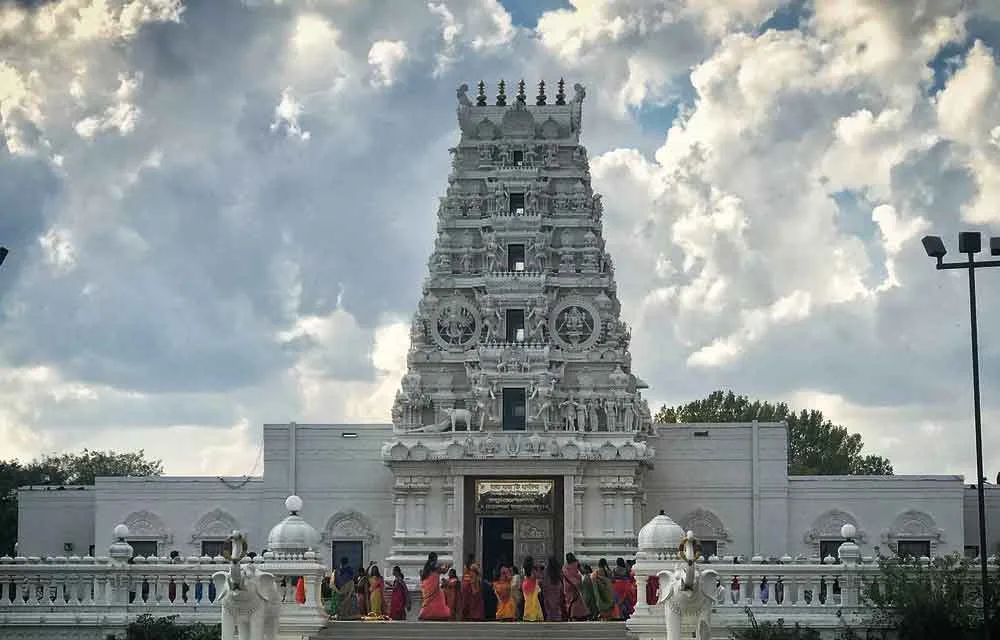
Shree Ghanapathy Temple in Wimbledon, South-West London, holds the distinction of being the first fully consecrated South Indian-style Hindu temple in Europe. Its Kumbhabhishekam (grand consecration ceremony) was performed according to the Shaiva Agamic rites, involving the installation of the Garbhagriha Vimanam and the consecration of the principal deity, Lord Ganesha in his Ghanapathy form. This event marked a watershed moment for the Hindu diaspora in Britain, establishing that authentic Agamic temple construction and consecration was possible outside the Indian subcontinent.
The temple's Dravidian architecture — featuring a traditional gopuram (entrance tower), mandapam (pillared hall), and garbhagriha — was constructed following the Vastu Shastra principles outlined in the Manasara and Mayamata, ancient treatises on sacred architecture. Priests and sthapathis (temple architects) were brought from Tamil Nadu to ensure adherence to these standards. Today, the temple serves a large Tamil and broader South Indian Hindu community across Greater London, functioning as a living centre of Agamic worship rather than a cultural museum.
The Role of Tamil Language in Saiva Liturgy and Why Fluency Is Essential
Tamil occupies a uniquely sacred status in the Shaiva tradition alongside Sanskrit. The Thevaram — a collection of devotional hymns composed by the three principal Nayanmars (Thirugnana Sambandar, Thirunavukkarasar, and Sundaramurti Nayanar) — forms part of the Panniru Thirumurai, the twelve-volume canonical scripture of Tamil Shaivism. These hymns are sung during daily puja and festival worship, and a Kurukkal serving in a Tamil Shaivite temple is expected to recite them with correct pronunciation and raga (melodic mode).
Beyond liturgy, Tamil is the working language of ritual instruction, community communication, and the oral transmission of Agamic procedures between senior and junior priests. Many Agamic commentaries and paddhati texts (ritual manuals) exist primarily in Tamil script and have not been fully translated. A priest who lacks Tamil fluency is therefore unable to fully access the living tradition as practised in temples following the Tamil Shaiva Siddhanta lineage, which explains the essential nature of this requirement in the job specification.
Off-Site Ceremonies: What Saiva Home Rituals Typically Involve
The role includes supporting off-site ceremonies, which in the Saiva Tamil tradition commonly encompass Ganapathy Homam (fire ritual to Ganesha performed before any major undertaking), Ayushya Homam (for longevity, especially at a child's first birthday), Griha Pravesham (house-warming ceremony), and Satabhishekam (a ritual marking an elder's 1,000th full-moon birthday). Each of these requires the priest to transport and set up a portable homa kunda (fire altar), arrange ritual materials, and conduct the proceedings in accordance with Agamic and Grihyasutra prescriptions.
Conducting these ceremonies independently — as specified in the job requirements — demands a thorough command of both the Sanskrit mantra sequences from the relevant Grihyasutras and the Tamil invocatory verses appropriate to each occasion. The priest must also guide the yajamana (the householder patron) and family members through their participatory roles (such as making ahuti offerings into the fire) correctly. This pastoral dimension of off-site work, while not involving congregational preaching, requires considerable ritual knowledge, composure, and the ability to adapt the setting to domestic environments.
Accommodation and the Traditional Gurukula Model of Temple Life
The provision of accommodation on or near temple premises reflects an ancient model of priestly life rooted in the concept of devalaya nivasam — residing in proximity to the deity as an extension of one's service. In classical Agamic temples of Tamil Nadu, the archakas (temple priests) traditionally lived within the temple complex or in agraharam settlements (Brahmin residential streets) immediately adjacent to it, ensuring they could conduct pre-dawn rituals and respond to any urgent ceremonial need without delay.
This arrangement also situates the priest within a community of religious practice rather than merely an employment relationship, echoing the gurukula tradition where learning, living, and service are unified. For a temple operating in a diaspora context such as London, providing accommodation helps maintain the continuity of the ritual schedule — particularly for early-morning and late-night kalas — and supports a priest relocating from India in establishing himself in an unfamiliar country. It is a practical necessity shaped by genuine liturgical requirements rather than merely a recruitment benefit.
Frequently Asked Questions
Where is Hindu Temple Hiring Religious Worker (Saiva located?
Job Opportunity: Hindu Temple Religious Worker (Non-Pastoral) – Ordained Priest (Saiva Tradition) Organization: Shree Ghanapathy Temple Location: Wimbledon, South-West London, UK Job Overview Shree Ghanapathy Temple, the first fully consecrated South Indian-style Hindu temple in Europe dedicated to Lord Ganesha (Ghanapathy), has an urgent vacancy for a full-
Who is the presiding deity of Hindu Temple Hiring Religious Worker (Saiva?
The temple's presiding deity and its significance are described in the guide above.
What are the timings and how do I reach Hindu Temple Hiring Religious Worker (Saiva?
Temples typically open early morning and evening; confirm current darshan timings before visiting. The nearest airport, railway station and road routes are covered in the guide above.
What is the best time to visit Hindu Temple Hiring Religious Worker (Saiva?
Major festival days and the cooler months are popular, though weekday mornings offer a calmer darshan. Plan around the temple's key festivals for the most vibrant experience.