
Lakshana Devi Temple, Bharmour
Durga as Mahishasuramardini, known locally as Lakshana Devi temple · Bharmour (Brahmaur), Chamba, Himachal Pradesh, India
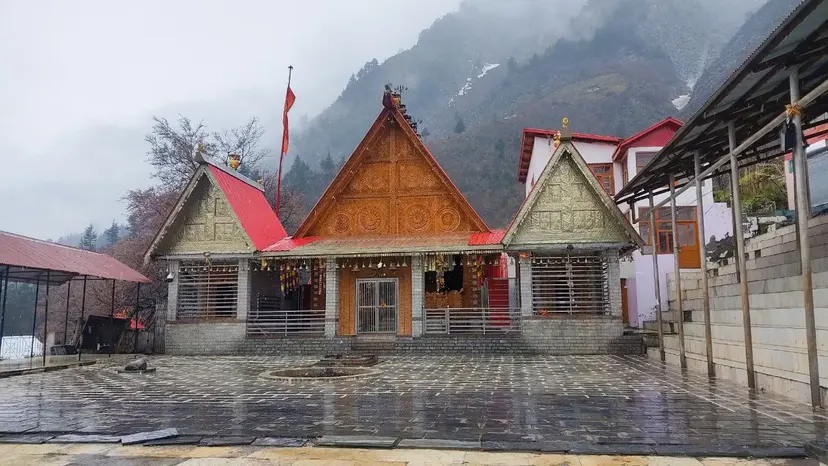
The Lakshana Devi temple at Bharmour (Brahmaur) in Chamba district, Himachal Pradesh, is a small wooden shrine in the Chaurasi temple complex at the centre of the town. It is dedicated to the goddess Lakshana, a form of Durga killing the buffalo demon Mahishasura. Wikipedia describes it as the oldest temple in the Chaurasi complex.
Its sanctum holds a brass image of the goddess. An inscription on the pedestal records that the image was made for the ruler Meru-varman, who reigned at Brahmaur about 700 CE. The temple is protected by the Archaeological Survey of India (ASI) as a Monument of National Importance.
Faith & Tradition
Religious Significance of Lakshana Devi Temple, Bharmour
The temple matters both as a shrine and as a historical record. Brahmaur, on the Budhal river, a tributary of the Ravi, was the early capital of the Chamba kingdom. In his ASI study Antiquities of Chamba State (1911), J. Ph. Vogel notes that the town's ancient importance is attested by four brass images, three of them inscribed as erected by Meru-varman. The Lakshana Devi image is one of these.
Vogel records that Lakshana is named in the Chamba chronicle (Vamshavali) as Bhadrakali and is also known by the general name Bhagavati. In popular belief she is Durga-Parvati, shown in her famous act of slaying Mahishasura. The image is four-armed. Her right foot rests on the buffalo demon's head as she pierces his neck with a trident, one left hand lifts his body, and her other hands hold a sword and a bell.
The temple is part of the Chaurasi complex, a group of shrines at the heart of Bharmour whose name means 'eighty-four'. The complex also includes the Manimahesh (Shiva) and Narasimha temples.
Heritage
History of Lakshana Devi Temple, Bharmour
The pedestal inscription, edited and translated by Vogel, traces Meru-varman's descent from Aditya-varman, Bala-varman and Divakara-varman, of the solar line and the house of Mosuna. It says that he had the holy image of the goddess Lakshana made by the craftsman Gugga for the increase of his spiritual merit. Vogel dates Meru-varman to about 700 CE, and the temple is generally placed in the late 7th or early 8th century.
Vogel considered the temple's profuse wood-carvings to be probably contemporary with the image. He drew attention to the facade, where a trefoil arch set within a triangular pediment recalls the temples of Kashmir. He took this as a sign that the Kashmir style was known in Chamba in Meru-varman's time. He also noted that the river goddesses Ganga and Yamuna are carved in wood at the entrance, each with her proper mount, the crocodile and the tortoise. In later temples these figures often lost their meaning.
According to Wikipedia, the ASI cleaned the entrance and facade after the 1950s, revealing finer details, and added a roof canopy to protect the carvings. The temple appears in the ASI list of Monuments of National Importance in Himachal Pradesh as 'Laxmi (Lakhana) Devi temple'.
Architecture and sacred features
Wikipedia describes the temple as a north-facing building of about 11.6 by 8.7 m on a raised platform, with walls originally of wood and stone that were later plastered with mud. Inside, a porch and a hall carried on six square pillars lead to a sanctum of about 3.6 by 2.5 m, with a path for circumambulation. The roof is pitched and gabled; scholars cited by Wikipedia believe the original design was altered over time to cope with snow and weather.
The carved wooden doorway has three bands of ornament, with figures of Shiva, Vishnu and Kartikeya alongside the river goddesses. The triangular pediment above shows Vishnu on Garuda and amorous couples. This mix of Shaiva, Vaishnava and Shakta imagery is described as typical of the Chamba valley.
Plan Your Visit
Darshan and Visitor Information
The Lakshana Devi temple is an ASI-protected wooden monument. Do not touch the carved woodwork or lean on the doorway, and follow any instructions on photography inside the shrine. Confirm current opening arrangements with the Chaurasi temple authorities and the ASI before visiting.
Timings and arrangements change with seasons and festivals. Confirm current details with Archaeological Survey of India (protected monument) before travelling. Last reviewed 1 November 2026.
Location
How to Reach Lakshana Devi Temple, Bharmour
Bharmour is reached by road from Chamba town. Wikipedia gives the distances as about 110 km from Dalhousie and about 180 km from Pathankot, which has the nearest airport. The temple stands in the Chaurasi complex in the town centre.
Wikipedia puts Bharmour at about 2,135 m above sea level. Mountain roads can be blocked by snow or landslides, so check road conditions before travelling, especially in winter and the monsoon.
Location: Bharmour (Brahmaur), Chamba, Himachal Pradesh, India
Nearest airport: Pathankot (about 180 km, per Wikipedia)
More in Hindu temples in Himachal Pradesh · Durga as Mahishasuramardini, known locally as Lakshana Devi temples · Temples in Bharmour (97) · Temples in Bharmour Tehsil · Temples in Chamba District
Questions
Lakshana Devi Temple, Bharmour: Frequently Asked Questions
Which goddess is worshipped at the Lakshana Devi temple?
Lakshana Devi, a form of Durga as Mahishasuramardini, slayer of the buffalo demon. The Chamba chronicle also calls her Bhadrakali.
How old is the Lakshana Devi temple?
Its brass image carries an inscription of the ruler Meru-varman, dated by Vogel to about 700 CE. The temple is generally placed in the late 7th or early 8th century.
Who made the brass image?
According to the pedestal inscription, the craftsman Gugga made it for Meru-varman, for the increase of the king's spiritual merit.
What is special about its architecture?
It is an early wooden temple with richly carved woodwork. Its facade has a trefoil arch inside a triangular pediment that recalls Kashmir temples, and wooden figures of Ganga and Yamuna flank the entrance.
Is the temple protected?
Yes. It is listed by the Archaeological Survey of India as a Monument of National Importance (N-HP-2).
Where is the temple in Bharmour?
It is inside the Chaurasi temple complex in the centre of Bharmour, Chamba district.
Sources and attribution
- Archaeological Survey of India (J. Ph. Vogel) — Antiquities of Chamba State, Part I: Inscriptions of the Pre-Muhammadan Period (1911), pp. 7–8, 138–144
- Wikipedia — Lakshana Devi Temple, Bharmour
- Wikipedia — List of Monuments of National Importance in Himachal Pradesh (from the ASI list)
- Wikipedia — Chaurasi Temple Bharmour
Further reading: Lakshana Devi Temple, Bharmour on Wikipedia (CC BY-SA 4.0).
Spotted an error? Write to info@hindutone.com — see our editorial policy.
Pilgrim Circuit