Maha Kumbh Mela 2025: Complete Recap, Highlights, Records, Updates, and Eternal Legacy – A Historic Spiritual Triumph in Prayagraj
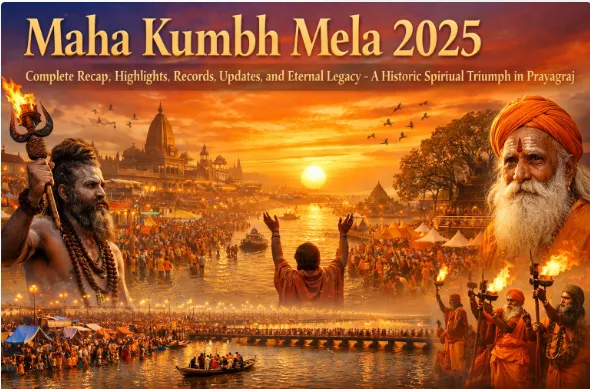
Maha Kumbh Mela 2025: Complete Recap, Highlights, Records, Updates, and Eternal Legacy – A Historic Spiritual Triumph in Prayagraj Published on www.
Maha Kumbh Mela 2025: Complete Recap, Highlights, Records, Updates, and Eternal Legacy – A Historic Spiritual Triumph in Prayagraj
Published on www.hindutone.com | January 01, 2026
The Maha Kumbh Mela 2025, held in Prayagraj (formerly Allahabad), Uttar Pradesh, from January 13 to February 26, 2025, has etched its name in history as the largest peaceful human gathering ever recorded. This once-in-144-years celestial event attracted an astonishing over 660 million (66 crore) devotees, far surpassing initial estimates of 400-450 million and breaking every previous record for religious congregations worldwide.
Organized under the theme of faith, unity, and cultural resurgence, the 45-day festival transformed the banks of the Triveni Sangam into a temporary mega-city of spirituality, devotion, and seamless administration. Devotees from every corner of India and over 100 countries converged to take holy dips, seek blessings from revered sadhus, attend spiritual discourses, and participate in cultural programs that showcased India's rich Sanatan heritage.
This in-depth SEO-optimized article provides a comprehensive recap of Maha Kumbh Mela 2025, covering its mythological significance, key dates and bathing rituals, record-breaking attendance figures, major highlights, government preparations, notable events, challenges faced, and the lasting legacy it leaves behind. Whether you are searching for "Maha Kumbh Mela 2025 highlights," "Prayagraj Kumbh records," "Shahi Snan updates," or "spiritual significance of Kumbh Mela," this detailed guide covers everything.
Mythological Roots and Spiritual Importance of Maha Kumbh Mela
The Kumbh Mela derives its name and sanctity from the ancient legend of Samudra Manthan (the churning of the cosmic ocean of milk), described in revered Hindu texts such as the Bhagavata Purana, Vishnu Purana, and Mahabharata. During this epic churning by the Devas (gods) and Asuras (demons) to obtain Amrita (nectar of immortality), drops of the divine nectar spilled at four sacred locations: Prayagraj, Haridwar, Ujjain, and Nashik. These sites became the venues for the rotating Kumbh Melas.
Prayagraj holds the highest status as "Tirtharaj" (King of Pilgrimage Sites) because of the Triveni Sangam – the sacred confluence of three rivers: Ganga, Yamuna, and the invisible Saraswati. A holy dip here is believed to wash away sins accumulated over countless lifetimes, break the cycle of birth and death, and lead the soul toward moksha (liberation).
The 2025 edition was classified as a Maha Kumbh (Great Kumbh), occurring only once every 144 years due to a rare alignment of Jupiter completing its full 12-year cycle combined with specific positions of the Sun and Moon. This celestial rarity amplified the spiritual merit of bathing during the event manifold, drawing millions who believed that a single dip in 2025 equaled the punya (merit) of multiple regular Kumbhs.
The festival also symbolized core Hindu values: unity in diversity, selfless service (seva), non-violence, and devotion (bhakti). Thirteen ancient Akharas (monastic orders) – including Juna Akhara, Niranjani Akhara, Mahanirvani Akhara, Atal Akhara, and others – played central roles, with their sadhus and Naga babas leading majestic processions and offering profound teachings.
Key Dates, Shahi Snan, and Major Bathing Days in Maha Kumbh Mela 2025
The Maha Kumbh officially began on January 13, 2025, with Paush Purnima and concluded on February 26, 2025, with Maha Shivratri. The calendar featured six primary bathing dates, with three designated as Shahi Snan (royal baths) reserved for the Akharas' grand processions.
Here is the complete list of important dates and estimated attendance:
- January 13, 2025 (Paush Purnima): Opening day – Approximately 17-20 million devotees took the first holy dip.
- January 14, 2025 (Makar Sankranti): First Shahi Snan – Over 35 million devotees.
- January 29, 2025 (Mauni Amavasya): Second and most auspicious Shahi Snan – A record-breaking 80 million devotees on this single day.
- February 3, 2025 (Basant Panchami): Third Shahi Snan – Around 25-30 million devotees.
- February 12, 2025 (Maghi Purnima): Another major bathing date with tens of millions participating.
- February 26, 2025 (Maha Shivratri): Closing day – Millions marked the end with final dips and prayers.
The Shahi Snans were the visual and spiritual highlights, featuring elaborate Peshwai processions with Naga Sadhus (ash-smeared ascetics), silver chariots, decorated elephants, horses, and traditional bands. These processions embodied centuries-old traditions while captivating global audiences through live broadcasts.
Record-Breaking Attendance and Milestones Achieved
Maha Kumbh Mela 2025 shattered all previous benchmarks, cementing its place as humanity's largest peaceful gathering:
- Total attendance: Over 660 million devotees took holy dips across 45 days (official figures released post-event).
- Single-day record: 80 million on Mauni Amavasya (January 29), the highest ever for any event in history.
- Other peak days: 35 million on Makar Sankranti; 25.7 million on Basant Panchami.
- Cumulative milestones: Crossed 100 million by January 23; surpassed 420 million by early February.
- International participation: More than 150,000 foreign pilgrims from over 100 countries, including significant groups from Nepal, Bhutan, Mauritius, Fiji, and Western nations.
For context, the total footfall exceeded the combined population of Europe and was nearly half of India's population. Global media outlets, including BBC, CNN, The New York Times, and Al Jazeera, described it as a logistical miracle and a testament to organized faith on an unprecedented scale.
Major Highlights and Memorable Events
The Maha Kumbh was far more than bathing rituals; it was a vibrant celebration of Indian culture, spirituality, and innovation:
- Akhara Processions and Naga Sadhu Darshan: The fearless Naga babas leading Shahi Snans became iconic symbols of renunciation and spiritual power.
- High-Profile Visits:
- Prime Minister Narendra Modi took a holy dip on February 5 and addressed gatherings on Sanatan Dharma.
- President Droupadi Murmu visited on February 10.
- Vice President Jagdeep Dhankhar participated on February 3.
- Bhutan's King Jigme Khesar Namgyel Wangchuck and Queen Jetsun Pema joined on February 4.
- Celebrities including Akshay Kumar, Ravi Kishan, Isha Ambani, and several Bollywood and regional stars added glamour while expressing devotion.
- Cultural and Artistic Programs:
- Evening Ganga Aartis with thousands of diyas.
- Performances by renowned artists like Shankar Mahadevan, Kailash Kher, Sonu Nigam, and classical dancers.
- Laser and drone light shows depicting the Samudra Manthan legend.
- Exhibitions on Khadi, handicrafts, Ayurveda, yoga, and India's freedom struggle.
- Spiritual Activities:
- Daily satsangs and pravachans by prominent saints like Ramdev Baba, Morari Bapu, and Akhara heads.
- Massive annadan (free food distribution) – organizations like ISKCON and Adani Group served over 1 lakh meals daily.
- Unique installations: Replica of 12 Jyotirlingas crafted from 7.51 crore Rudraksha beads; pandals inspired by Tejas fighter jets.
- Social Initiatives:
- Netra Kumbh: Free eye camps aiming for a Guinness World Record in cataract surgeries.
- Cleanliness drives and eco-friendly measures promoting sustainability.
The event maintained remarkable peacefulness in the core Mela area, with negligible crime reports despite the massive crowds.
Government Preparations and Infrastructure Excellence
The Uttar Pradesh government, led by Chief Minister Yogi Adityanath, invested over ₹7,500 crore to create world-class facilities across 4,000 hectares – three times larger than the 2019 Kumbh area.
Key infrastructural achievements:
- Roads and Connectivity: 14 new flyovers, over 450 km of widened roads, and 12 railway stations upgraded.
- Ghats and Bridges: 12 km of permanent and temporary ghats; 30 pontoon bridges for seamless crowd flow.
- Accommodation: More than 150,000 tents ranging from basic dharamshala-style to luxury Swiss cottages (e.g., IRCTC's Mahakumbh Gram).
- Sanitation: 1.5 lakh toilets, real-time cleanliness monitoring, and 10,000 sanitation workers.
- Digital Integration: AI-based crowd management, Kumbh Sah'AI'yak chatbot, dedicated mobile app, 800 multilingual digital signages.
- Transport: Over 13,000 trains (including 3,000 special Kumbh trains), expanded Prayagraj airport handling international charters, electric shuttles and buses.
- Security: Deployment of 40,000 police and paramilitary personnel, CCTV, drones, and fire safety towers.
- Sustainability: Plastic-free zones, waste-to-energy plants, and bird conservation efforts.
These preparations earned global praise for blending tradition with cutting-edge technology and setting new standards for mega-event management.
Challenges Faced and Lessons Learned
Despite the overwhelming success, the event witnessed tragic incidents that highlighted the complexities of managing such enormous crowds:
- A stampede-like situation on Mauni Amavasya caused several fatalities and injuries due to congestion at certain ghats.
- Later, a crowd crush at New Delhi railway station involving returning pilgrims resulted in 15-18 deaths.
These incidents prompted immediate inquiries by the Allahabad High Court and central government, leading to recommendations for enhanced AI surveillance, wider corridors, and phased dispersal strategies in future events.
Overall, the Maha Kumbh remained predominantly peaceful and well-managed, with rapid response teams mitigating most risks.
Economic Impact and Global Recognition
The Maha Kumbh generated an estimated economic boost of ₹2-3 lakh crore through tourism, hospitality, transport, handicrafts, and local trade. It provided livelihoods to lakhs of workers and showcased Uttar Pradesh as a global spiritual tourism hub.
International recognition poured in:
- UNESCO continues to list Kumbh Mela as Intangible Cultural Heritage of Humanity.
- World leaders and media acknowledged India's ability to host the largest human gathering with discipline and devotion.
Eternal Legacy of Maha Kumbh Mela 2025
The 2025 Maha Kumbh reinforced India's position as the spiritual capital of the world and signaled a resurgence of Sanatan Dharma in the modern age. It demonstrated how ancient traditions can harmonize with contemporary governance, technology, and inclusivity.
Millions departed with renewed faith, carrying forward messages of unity, environmental consciousness, and selfless service. The chants of "Har Har Mahadeva" and "Jai Gange" continue to echo in hearts worldwide.
The next Ardh Kumbh will be held in Haridwar in 2028, while the next full Kumbh in Nashik-Trimbakeshwar is scheduled for 2027. Prayagraj's next Maha Kumbh will return in 2037.
For those who missed it, the memories and blessings of Maha Kumbh Mela 2025 will inspire generations, reminding humanity of the power of collective faith and devotion.
🌸 For More Devotional Journey, Follow
- Temples
/temples/ - Tirumala Updates
/tirumala/ - Sabarimala Yatra
/category/sabarimala-yatra/ - Pooja, Slokas & Mantras
/pooja-slokas-and-mantras/ - Hindu Gods
/hindu-gods/
You might also like

The Sabarimala 2018 Verdict: Background, Tradition, and Current Legal Status — A Neutral Explainer
Top Temples to Visit in West Bengal, Tamil Nadu, Assam, Kerala & Puducherry — Complete 2026 Pilgrim’s Guide

Sri Rama Temples Worldwide: USA, UK, Canada, UAE & Australia – Complete Guide