Sri Rama Temples Around the World: Complete Guide to 30+ Sacred Shrines | HinduTone
Focus Keyword: Sri Rama temples around the worldSecondary Keywords: famous Ram temples, Lord Rama temples India, Ram Mandir worldwide, Hindu temples dedicated…
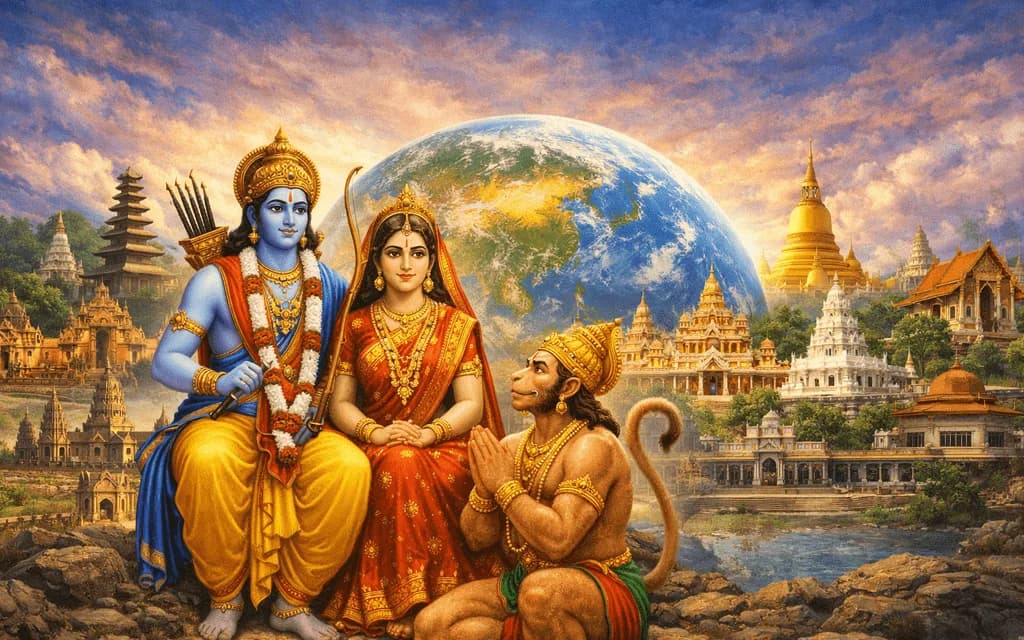
Focus Keyword: Sri Rama temples around the worldSecondary Keywords: famous Ram temples, Lord Rama temples India, Ram Mandir worldwide, Hindu temples dedicated…
Focus Keyword: Sri Rama temples around the world
Secondary Keywords: famous Ram temples, Lord Rama temples India, Ram Mandir worldwide, Hindu temples dedicated to Lord Rama
Sri Rama Temples Around the World: A Complete Pilgrim's Guide
Jai Shri Ram! Lord Sri Ramachandra — the seventh avatar of Lord Vishnu, the ideal king, the devoted husband, and the embodiment of dharma — is one of the most universally revered deities in all of Hinduism. His divine story, told in the immortal Valmiki Ramayana and the Tulsidas Ramcharitmanas, has transcended the borders of India and taken root in the hearts of millions across every continent.
Wherever the Indian diaspora has settled — from the sugarcane fields of Trinidad and Tobago to the temples of Bali, from the streets of London to the shores of Fiji — devotees have built sacred spaces to worship Maryada Purushottam Shri Rama. Sri Rama's temples abound in every nook and corner of not only India but also in the whole of Aryavart of yore, which included Indonesia, Thailand, Cambodia, and beyond.
This comprehensive guide from HinduTone takes you on a complete global pilgrimage — covering the most important and celebrated Sri Rama temples across India and the world. Whether you are a devout pilgrim, a spiritual traveller, or simply a seeker of Hindu heritage, this guide is your sacred companion.
Why Sri Rama Temples Matter Across the World
Lord Rama's journey — from Ayodhya through the forests of exile, to the shores of Lanka and back — is not merely a historical narrative. It is a living spiritual map that devotees around the world follow in their hearts every day. Temples dedicated to Lord Rama serve as:
- Centres of Dharma — spaces where the values of truth, righteousness, and devotion are actively practiced and passed on to future generations
- Cultural Anchors — especially in diaspora communities, Ram temples preserve language, tradition, music, and ritual far from the Indian subcontinent
- Pilgrimage Destinations — drawing millions of devotees annually for darshan, especially during Sri Rama Navami, Diwali, and Vivaha Panchami
- Community Hubs — organizing satsangs, Ramayana recitations, classical music festivals, and charitable activities
Part 1: Sri Rama Temples in India – The Sacred Heartland
India is home to thousands of temples dedicated to Lord Rama, spread from the Himalayas to Kanyakumari, and from Gujarat to Manipur. Here are the most important ones every devotee must know.
1. Ram Mandir, Ayodhya – Uttar Pradesh Most Sacred
Location: Ayodhya, Uttar Pradesh
Deity: Ram Lalla (Lord Rama as a child / Balak Ram)
Significance: Birthplace of Lord Rama — the holiest Rama shrine on Earth
There is no more sacred place for a devotee of Lord Rama than Ayodhya, the city on the banks of the River Saryu where the Supreme Being incarnated as the prince of Kaushalya. The Ram Mandir in Ayodhya, also known as Ram Janmabhoomi Temple, is the most famous Ram temple in India, built at the place believed to have been the birthplace of Lord Rama. The principal deity of the Shri Ram Mandir in Ayodhya is Ram Lalla, the infant form of Sri Rama.
The newly consecrated Ram Mandir, inaugurated in January 2024, is a marvel of Nagara-style Hindu temple architecture built entirely with pink sandstone from Rajasthan's Bansi Paharpur quarry. The Ayodhya temple complex, apart from the temple to Sri Ram, also has temples to the Sun God Surya, Ganesha, Shiva, Durga, Vishnu, and Brahma.
Every year on Sri Rama Navami, the extraordinary Surya Tilak ceremony takes place — an engineered ray of sunlight falls precisely on the forehead of the Ram Lalla idol at noon, symbolizing divine cosmic recognition of the Lord's birth.
Best time to visit: Sri Rama Navami (March–April), Diwali (October–November)
Nearest Airport: Maharishi Valmiki International Airport, Ayodhya
2. Sri Sita Ramachandraswamy Temple, Bhadrachalam – Telangana
Location: Bhadrachalam, Bhadradri Kothagudem District, Telangana
Deity: Lord Sri Rama with Goddess Sita and Lakshmana
Significance: One of the most revered Vaishnava pilgrimage sites in South India
Bhadrachalam Temple, located on the banks of the Godavari River, is one of the most famous temples of Lord Rama. The composer of the popular South Indian Carnatic music, Kancherla Gopanna, is known to have constructed the temple. It is believed to be 400 years old and is a sacred place that attracts lakhs of devotees from around the world.
This magnificent temple is world-famous for its annual Rama Navami Kalyanam — the grand celestial wedding re-enactment of Lord Rama and Goddess Sita, attended by hundreds of thousands of devotees every year. The state government of Telangana provides silk garments (Pattavasthrams) as offerings from the Chief Minister to the divine couple — a tradition unbroken for centuries.
Best time to visit: Sri Rama Navami, Vaikunta Ekadasi
Distance from Hyderabad: ~300 km
3. Ramanathaswamy Temple, Rameswaram – Tamil Nadu
Location: Rameswaram Island, Tamil Nadu
Deity: Lord Shiva (as Ramanathaswamy), installed by Lord Rama himself
Significance: One of the four Char Dhams; one of the 12 Jyotirlingas
It is said that the Shiva-linga in the Ramanathaswami temple was installed by Sri Rama on his return from Lanka after killing Ravana. Rama wanted to install a Shiva-linga at Rameswaram to absolve himself of any sin from the war, as Ravana was a Brahmin. This temple's corridor — stretching over 1.2 km — is the longest temple corridor in the world. Taking a holy dip in the 22 theerthams (sacred wells) within the temple complex is considered a supreme act of spiritual purification.
Best time to visit: Sri Rama Navami, Maha Shivaratri, Aadi Amavasai
Nearest Airport: Madurai International Airport (163 km)
4. Ram Raja Temple, Orchha – Madhya Pradesh
Location: Orchha, Madhya Pradesh
Deity: Lord Rama (worshipped as a King — Ram Raja)
Significance: The only temple in India where Lord Rama is worshipped as a sovereign king and receives a daily Guard of Honour
If Lord Rama is worshipped as Ram Lalla at Ayodhya, he is worshipped as Ram Raja in Orchha. The deity is worshipped as a King, and all ceremonies including the offerings are befitting royalty. A Guard of Honour is accorded to Raja Ram every day. Lord Rama can be seen with a sword and shield in the sanctum, accompanied by Lakshman and Sita.
This extraordinary temple sits on the banks of the Betwa River and draws thousands of pilgrims throughout the year. The story behind the temple involves Queen Ganesh Kunwari, who brought the idol of Rama from Ayodhya and installed it in her palace — which then became the temple.
Best time to visit: Ram Navami, Vivaha Panchami
Nearest Airport: Gwalior Airport (120 km)
5. Kodanda Rama Temple, Vontimitta – Andhra Pradesh
Location: Vontimitta, YSR Kadapa District, Andhra Pradesh
Deity: Kodanda Rama (Lord Rama with his bow — Kodanda)
Significance: One of the most ancient and architecturally magnificent Rama temples in South India
The Kodandarama Temple in Vontimitta, Andhra Pradesh, is a prominent Rama temple that attracts thousands of pilgrims each year. Built during the Vijayanagara Empire period, this temple is renowned for its stunning Dravidian-style gopuram (tower) and its exquisite sculptural art. Lord Rama is depicted here in his powerful warrior form, bow in hand — hence the name Kodanda (the great bow of Rama).
Best time to visit: Sri Rama Navami, Brahmotsavam
Nearest City: Kadapa (60 km)
6. Raghunath Temple, Jammu – Jammu & Kashmir
Location: Jammu, Jammu & Kashmir
Deity: Lord Raghunath (Rama) with shrines of the entire Hindu pantheon
Significance: The largest temple complex in North India, built by Maharaja Gulab Singh
Maharaja Gulab Singh, the first Dogra king of Jammu and Kashmir, commissioned the construction of this temple in 1835. While Lord Rama is worshipped as the chief deity, shrines are built in honour of other Gods and Goddesses. In total, there are seven different temples within the premises, decorated with beautiful paintings and carvings. The inner walls of the Raghunath Temple are covered with gold foil, making it one of the most spectacular temples in northern India.
Best time to visit: Ram Navami, Dussehra
Nearest Airport: Jammu Airport (7 km)
7. Kalaram Temple, Nashik – Maharashtra
Location: Nashik (Panchavati region), Maharashtra
Deity: Kalaram (Black Rama — a rare form of Lord Rama)
Significance: The place where Lord Rama lived during a portion of his 14-year forest exile
The Kalaram Temple in Nashik is one of India's oldest Hindu temples devoted to Lord Rama. The temple was constructed in 1788 and has a black-coloured Lord Rama statue, which is the reason behind its name. It is believed that the temple was constructed by Sardar Rangarao Audhikar, who had a dream about the statue of Lord Rama and found it in the same position as seen in his dream.
The Panchavati region of Nashik is historically significant as the place where Rama, Sita, and Lakshmana stayed during their forest exile, and where the fateful episode of Surpanakha's encounter and Sita's abduction took place. The temple also has a historical connection to Dr. B.R. Ambedkar's famous Kalaram Temple Entry Satyagraha of 1930.
Best time to visit: Ram Navami, Kumbh Mela
Nearest Airport: Nashik Airport (8 km)
8. Triprayar Sri Rama Temple – Kerala
Location: Triprayar, Thrissur District, Kerala
Deity: Lord Rama (Triprayarappan / Triprayar Thevar)
Significance: One of the four most revered Vishnu temples in Kerala (Kerala's Char Dham equivalent)
The Triprayar Sri Rama Temple is located in Kerala's Thrissur district. It is believed that Lord Krishna, who is also thought to be an avatar of Lord Vishnu, worshipped the idol preserved at Triprayar. This captivating temple contains unique sculptures and wooden carvings. The temple follows the Tantric Kerala style of worship and is one of the most spiritually powerful Rama temples in the country. The Ekadasi Festival here is celebrated with remarkable grandeur.
Best time to visit: Ekadasi, Thrissur Pooram season
Nearest City: Thrissur (20 km)
9. Sri Rama Temple, Kumbakonam – Tamil Nadu
Location: Kumbakonam, Thanjavur District, Tamil Nadu
Deity: Lord Rama seated with Goddess Sita
Significance: An ancient Dravidian-style temple in the "temple city" of Tamil Nadu
The temple of Lord Rama in Kumbakonam was constructed 400 years back during the time of Achutha Nayaka. The temple has a 3-tiered gopuram and Kalasams on the top. The main temple portrays the image of Rama sitting with Sita, with images of Lakshmana, Bharatha, and Shatruguna standing at his feet and Hanuman seen praying. Kumbakonam, with its incredible density of ancient temples, is one of India's most rewarding pilgrimage destinations for devotees of Lord Vishnu and Lord Rama.
Best time to visit: Ram Navami, Mahamaham festival
Nearest Airport: Tiruchirapalli Airport (80 km)
10. Hazara Rama Temple, Hampi – Karnataka
Location: Hampi, Vijayanagara District, Karnataka
Deity: Lord Rama with Sita, Lakshmana, and Hanuman
Significance: A UNESCO World Heritage site — the royal chapel of the Vijayanagara emperors
The Hazara Rama Temple near Hampi reflects a mix of Vijayanagara and Hoysala styles of architecture. Lord Rama is worshipped here with Mata Sita, his brother Lakshmana, and his most ardent devotee, Lord Hanuman. UNESCO declared this beautiful shrine as a World Heritage site. The outer walls of this 15th-century temple are adorned with extraordinary bas-relief carvings depicting the complete story of the Ramayana — a visual epic carved in stone.
Best time to visit: Hampi Utsav (November), Ram Navami
Nearest Airport: Hubli Airport (143 km)
11. Janaki Mandir (Sita Temple), Janakpur – Nepal
Location: Janakpur, Dhanusha District, Nepal
Deity: Goddess Sita (Janaki) — birthplace of Mata Sita
Significance: The sacred birthplace of Mata Sita and site of the divine wedding of Rama and Sita
The Janaki Mandir in Janakpur, Nepal, is popularly known as "Nau Lakha Mandir." Located in what was once the famous Mithila Kingdom, it is 123 km to the south-east of Kathmandu and is dedicated to the Hindu deity Sita. This stunning white marble temple was built in 1911 in a fusion of Rajput and Mughal architectural styles and is one of the most beautiful temple complexes in all of South Asia. The Vivaha Panchami festival here — celebrating the wedding of Rama and Sita — draws hundreds of thousands of devotees every year.
Best time to visit: Vivaha Panchami (November–December), Ram Navami
Nearest Airport: Janakpur Airport (2 km)
12. Vontimitta Kodanda Rama Temple – Sri Lanka Connection
A very notable sacred site associated with Lord Rama's journey is Sita Eliya near Nuwara Eliya in Sri Lanka, traditionally identified as the Ashoka Vatika where Sita was held captive by Ravana. The Sita Amman Temple here, built where Sita is believed to have stayed, is one of the most emotionally moving shrines in all of Ramayana-connected geography.
Part 2: Sri Rama Temples Outside India – A Global Legacy
The devotion to Lord Rama has followed the Indian diaspora to every corner of the globe. From the Caribbean to the Pacific, from North America to Europe, Ram temples stand as living monuments to Hindu faith and cultural identity.
13. Sri Sita Ramachandraswamy Temple, Bali – Indonesia
Location: Bali, Indonesia
Significance: Bali remains the most vibrant living Hindu culture outside India, and the Ramayana is deeply embedded in Balinese art, dance, and ritual
Sri Rama's temples abound in the whole of Aryavart of yore, which included Indonesia, Thailand, Cambodia, and beyond. Several of the events mentioned in the Valmiki Ramayana have been authenticated by recent archaeological findings.
The famous Kecak Dance performed nightly at Pura Uluwatu in Bali dramatically re-enacts scenes from the Ramayana — the battle of Lanka, the rescue of Sita, and the defeat of Ravana — drawing thousands of visitors every evening. The Ramayana is not merely mythology in Bali; it is a living, breathing cultural practice embedded in every aspect of Balinese Hindu life.
Must-visit: Pura Besakih (Mother Temple), Pura Uluwatu, Tirta Empul
Best time to visit: Nyepi (Balinese New Year), Galungan
14. Prambanan Temple Complex – Indonesia (Java)
Location: Central Java, near Yogyakarta, Indonesia
Dedicated to: The Hindu Trimurti — Brahma, Vishnu, Shiva — with extensive Ramayana carvings
Built: 850 CE
The Prambanan Temple, located in central Java, is the largest Hindu temple in Indonesia. Built in 850 CE, it consisted of eight main shrines (gopuras) that are 47 metres high, with 250 smaller gopuras surrounding them. Nearly all walls of the temple have hand-carved art, telling the tales of Lord Vishnu's Dasavataram, Ramayana, adventures, and other Hindu legends.
The entire story of the Ramayana is depicted in extraordinary detail across the Prambanan bas-relief panels — from Lord Rama's birth in Ayodhya to the final return to his kingdom. This UNESCO World Heritage site is one of the most remarkable temples in all of Southeast Asia and a must-visit for every devotee who can travel to Indonesia.
Best time to visit: The annual Sendratari Ramayana Ballet is performed here against the backdrop of the illuminated temple on full moon nights from May to October.
15. Angkor Wat, Siem Reap – Cambodia
Location: Siem Reap Province, Cambodia
Built: Early 12th century CE (by King Suryavarman II)
Dedicated to: Lord Vishnu (with extensive Ramayana bas-reliefs)
One of the most remarkable features of Angkor Wat is its detailed carvings, which depict scenes from Hindu epics like the Ramayana and Mahabharata. The temple's central tower is designed to represent Mount Meru, the mythical home of the gods, symbolizing the centre of the universe in Hindu cosmology. Today, Angkor Wat stands as a UNESCO World Heritage site and attracts millions of visitors each year.
Covering over 400 acres, Angkor Wat is the largest religious monument ever built. The epic battles of the Ramayana — including the Battle of Lanka — are depicted across its magnificent galleries in carvings of breathtaking scale and detail. Even today, Cambodia's national flag bears the image of this sublime Vaishnava temple.
Best time to visit: Sunrise during the dry season (November to March)
16. Munneswaram Temple, Chilaw – Sri Lanka
Location: Chilaw, Northwestern Province, Sri Lanka
Deity: Lord Shiva (with strong Rama connection)
Significance: The temple where Lord Rama is believed to have prayed after defeating Ravana
According to legend, Lord Rama prayed at Munneswaram Temple after his victory over Ravana, seeking Lord Shiva's blessings to cleanse himself of any sins from the war. The temple attracts both Hindu and Buddhist devotees. This ancient temple, dating back over a thousand years, is deeply embedded in the Ramayana pilgrimage circuit of Sri Lanka, which also includes sites like Sita Eliya, Divurumpola, and Kelaniya Raja Maha Vihara.
Best time to visit: Navaratri, annual festival (August–September)
17. Sri Ram Temple, Paramaribo – Suriname
Location: Paramaribo, Suriname (South America)
Significance: One of the most important centres of Rama worship in the Caribbean/South American Hindu diaspora
Suriname has one of the largest Hindu populations outside South Asia, descended from indentured labourers brought from the Indian subcontinent in the 19th century. Ram temples in Suriname are vibrant centres of community life, where the Ramayana — especially the Ramayan mandali tradition of group reading and singing — has been kept alive across generations far from India.
18. Dattatreya Temple & Hanuman Statue, Carapichaima – Trinidad and Tobago
Location: Carapichaima, Trinidad and Tobago
Significance: The Caribbean's most important Hindu site dedicated to the tradition of Lord Rama
Trinidad and Tobago is often referred to as "Ramayan country," with traditions such as Bhagwat Katha and Ramayan recitations preserved for generations since the arrival of Indian indentured labourers in the 19th century. The proposed Ram Mandir would join the many existing temples across Trinidad and Tobago and hold special significance for its connection to the sacred site in Ayodhya.
Trinidad has one of the most robust living Ramayana traditions outside of India. The annual Ram Leela performances here last nine nights and are attended by tens of thousands of Trinidadians of all backgrounds. The Hanuman Mandir at Carapichaima houses a 85-foot statue of Lord Hanuman — a testament to the depth of Vaishnava devotion in this Caribbean nation.
Best time to visit: Ram Navami, Divali, Phagwah (Holi)
19. Arya Samaj Mandir, Durban – South Africa
Location: Durban, KwaZulu-Natal, South Africa
Significance: A leading centre for Rama devotion and Hindu culture in the African continent
South Africa's Indian community — concentrated in KwaZulu-Natal — traces its roots to indentured labourers who arrived in the 1860s, bringing their Rama devotion with them. The Arya Samaj Mandir in Durban uses Ram Navami to highlight the ethical and moral principles taught by Lord Rama, with celebrations usually coupled with discourses on the Ramayana, aimed at educating the youth about Rama's virtues and leadership qualities.
20. Sri Ram Temple, Pennsylvania – USA
Location: Pennsylvania, United States
Significance: One of the most active Sri Rama temples serving the Indian-American community
Located in Pennsylvania, the Sri Ram Temple serves the Indian-American community, offering a cultural and religious platform for celebrations such as Ram Navami. The temple holds special readings of the Ramayana, followed by Indian classical music performances and community feasts.
The United States is home to hundreds of Rama temples and shrines — from the grand ISKCON temples in Los Angeles, Chicago, and New York to community temples in New Jersey, Texas, Virginia, California, and Georgia. Many of these temples host elaborate nine-day Ram Navami celebrations that draw thousands of devotees from across the country.
21. Shri Ram Dham, Ontario – Canada
Location: Ontario, Canada
Significance: One of the principal centres of Ram worship for the Indo-Canadian community
In the multicultural landscape of Ontario, Shri Ram Dham serves as a focal point for the Hindu community during Ram Navami. The temple organises special pujas, satsangs, and a procession of deities, providing a taste of traditional Indian culture in a foreign land. Canada's large and growing Indian diaspora has established Rama temples in Ontario, British Columbia, Alberta, and Quebec, making the worship of Lord Rama a vibrant, living tradition across the country.
22. Sri Venkateswara Temple (ISKCON), London – United Kingdom [image: 🇬🇧]
Location: Bhaktivedanta Manor, Watford, United Kingdom
Significance: The largest and most celebrated Vaishnava temple in the United Kingdom
One of the largest and most famous temples outside India, this temple celebrates Ram Navami with a blend of traditional rituals and modern community outreach. The festivities typically include a ceremonial reading of the Ramayana, bhajans, and cultural performances by the local Indian community, drawing attendees from various backgrounds.
Bhaktivedanta Manor in Watford — gifted to the Hare Krishna movement by George Harrison — hosts some of the most spectacular Hindu festival celebrations in all of Europe. Ram Navami celebrations here draw over 20,000 devotees from across the United Kingdom.
23. Ram Mandir, Sydney – Australia [image: 🇦🇺]
Location: Sydney, New South Wales, Australia
Significance: A key centre for Rama worship in Australia's rapidly growing Hindu community
Reflecting Australia's growing South Asian community, the Ram Mandir in Sydney hosts vibrant Ram Navami celebrations that include Vedic chanting, bhajan sessions, and dramatic reenactments of episodes from the Ramayana. It draws participants from diverse ethnic backgrounds.
Australia is home to a rapidly growing Hindu population, with thriving temple communities in Sydney, Melbourne, Brisbane, and Perth. Ram temples across Australia celebrate Sri Rama Navami with week-long programs of puja, Ramayana discourses, classical dance, and community meals.
24. Hanuman Temple (Rama Shrine), Paris – France [image: 🇫🇷]
Location: Paris, France
Significance: A principal centre for Hindu worship and cultural preservation for the South Asian diaspora in France
The Hindu temple in Paris celebrates Ram Navami with special poojas and cultural programs that include dance, music, and recitations from the Ramayana. These activities not only cater to the spiritual needs but also help in preserving Indian culture abroad.
25. Sri Rama Temple, Fiji [image: 🇫🇯]
Location: Nadi, Fiji
Significance: An important centre of Rama devotion for Fiji's large Indo-Fijian Hindu community
The Sri Rama Temple located in Nadi, Fiji, is an important religious and cultural centre for the Hindu community. It is dedicated to Lord Rama and serves as a centre for religious and cultural activities. Fiji's Indo-Fijian community — descendants of indentured labourers who arrived in the late 19th century — has maintained an incredibly rich Ramayana tradition, including the Ram Leela performances and Bhajan mandalis that preserve the music and culture of North India from nearly 150 years ago.
Part 3: Notable ISKCON Ram Temples Around the World
The International Society for Krishna Consciousness (ISKCON) — the global Vaishnava movement — has established temples on every continent where Lord Rama is honoured alongside Lord Krishna. Key ISKCON Ram temple celebrations occur at:
Part 4: India's Most Notable Regional Rama Temples
Beyond the temples already listed, here are other important Sri Rama temples spread across India:
Ramayana Pilgrimage Circuit: Walk in the Footsteps of Lord Rama
For the devout pilgrim, there exists a sacred Ramayana Pilgrimage Circuit tracing the actual journey of Lord Rama across the Indian subcontinent. The key sites include:
1. Ayodhya (UP) — Birth of Lord Rama
2. Shringverpur (UP) — Where Rama crossed the Ganga during his exile
3. Chitrakoot (UP/MP) — Rama's forest dwelling during exile
4. Panchavati / Nashik (MH) — Forest hermitage site; Sita's abduction occurred nearby
5. Hampi / Kishkindha (KA) — Kingdom of Sugriva; where Rama met Hanuman
6. Rameshwaram (TN) — Where Rama built the bridge to Lanka; one of the four Char Dhams
7. Dhanushkodi (TN) — The southernmost point where Lord Rama is said to have destroyed a small bridge with his bow at the request of Vibhishana.
8. Sri Lanka — Lanka, the kingdom of Ravana; Sita's place of captivity
There are hundreds of ancient monuments along the route that Sri Rama took from Ayodhya to Lanka that bear testimony to his presence even to this day. A photograph by the US Space Agency shows the remains of the "Setu" (bridge) that Lord Rama built between India and Sri Lanka.
Planning Your Rama Temple Pilgrimage: Tips for Devotees
Whether you are visiting the divine Ram Mandir at Ayodhya or a humble Ram temple in your own city, here are some important guidelines:
Before You Visit
- Check the temple's darshan timings — most major temples have morning and evening darshan slots
- For major festivals like Ram Navami, book accommodation in advance — crowds can be enormous
- Dress modestly: traditional attire (dhoti, saree, or salwar kameez) is appropriate at most temples
- Some temples require you to leave shoes and mobile phones outside
During Darshan
- Arrive early for the Madhyahna Darshan (midday darshan) on Ram Navami — this is the most auspicious time
- Bring offerings of flowers, tulsi leaves, fruits, and coconut for the puja
- Chanting "Sri Ram, Jai Ram, Jai Jai Ram" as you wait in the darshan queue transforms the wait into prayer
Spiritual Preparation
- Read or listen to the Ramayana before your pilgrimage — understanding the Lord's story deepens the experience
- Observe a fast on the day of your temple visit if possible
- Approach the temple with humility, gratitude, and an open heart — the Lord sees the bhava (emotion) of the devotee, not the grandeur of their offering
Frequently Asked Questions (FAQs)
Q1: Which is the most famous Sri Rama temple in the world?
A: The Ram Mandir in Ayodhya is the most famous and sacred Sri Rama temple in the world, built at the believed birthplace of Lord Rama on the banks of the River Saryu.
Q2: Which is the largest Sri Rama temple outside India?
A: The Rama Temple in Trinidad and Tobago is one of the largest Hindu temples outside of India. ISKCON's Bhaktivedanta Manor in the UK is also among the most prominent Rama-related temple complexes outside India.
Q3: Are there Sri Rama temples in Southeast Asia?
A: Yes. The Ramayana tradition is deeply embedded across Southeast Asia. The Prambanan Temple in Central Java has intricately carved walls with stories about Lord Hanuman, Lord Vishnu, Ramayana, and other Hindu deities. Bali, Cambodia (Angkor Wat), Thailand, and Myanmar all have strong Ramayana heritage.
Q4: Which temple celebrates the most spectacular Ram Navami in South India?
A: The Sri Sita Ramachandraswamy Temple in Bhadrachalam, Telangana, is famous for its Rama Navami Kalyanam — a grand celestial wedding ceremony of Rama and Sita that draws hundreds of thousands of devotees every year.
Q5: Is there a complete Ramayana pilgrimage route I can follow?
A: Yes! The Ramayana Circuit — covering Ayodhya, Shringverpur, Chitrakoot, Panchavati, Kishkindha (Hampi), Rameshwaram, and Sri Lanka — traces the actual journey of Lord Rama and is considered one of the most spiritually rewarding pilgrimages in Hinduism.
Q6: Which country outside India has the strongest Ramayana tradition?
A: Trinidad and Tobago is often referred to as "Ramayan country," where traditions such as Bhagwat Katha and Ramayan recitations have been preserved for generations since the arrival of Indian indentured labourers in the 19th century. Indonesia (Bali and Java) and Suriname also maintain extraordinarily strong living Ramayana traditions.
Conclusion: The Eternal Presence of Lord Rama
From the sacred banks of the Saryu in Ayodhya to the tropical shores of Fiji, from the ancient stone galleries of Angkor Wat to the vibrant Ram Mandirs of Pennsylvania and Ontario — Lord Sri Rama's presence is felt in every corner of the world where his name is chanted with devotion. His temples are not merely buildings of stone; they are living centres of dharma, culture, and community. They are beacons of hope for millions of devotees who, no matter how far they may be from India, find in these sacred spaces the presence of their beloved Lord.
At HinduTone, we celebrate this magnificent global legacy of Sri Rama's worship and invite you to explore, visit, and deepen your connection with these sacred shrines.
Jai Shri Ram! Jai Siya Ram!
Bookmark this article and share it with every devotee of Lord Rama in your life.
Follow HinduTone for more temple guides, festival articles, puja vidhi, and Hindu heritage content.
Tags: Sri Rama temples around the world, famous Ram temples India, Ram Mandir Ayodhya, Bhadrachalam temple, Rameswaram, Rama temples USA, Rama temples UK, Hindu temples Southeast Asia, Ramayana pilgrimage circuit, global Hindu temples, Lord Rama shrines worldwide
Categories: Temple Guides | Hindu Temples | Pilgrimage | Ramayana Heritage | Global Hinduism
Author: HinduTone Editorial Team
Published: March 2026
Last Updated: March 24, 2026
You might also like
Janmashtami 2026 in India: Date, Rituals & Top Temples to Visit
Ayodhya Ram Mandir: Divine Mysteries & Soul-Stirring Miracles of Lord Rama's Birthplace
Koneswaram: Divine Mysteries & Soul-Stirring Miracles of Lord Shiva in Sri Lanka