Tirumala Balaji and Kubera Loan Myth: The Hidden Symbolism
The story of Lord Venkateswara's (Tirumala Balaji) loan from Kubera is one of Hindu mythology's most profound tales, explaining why millions of devotees offer…
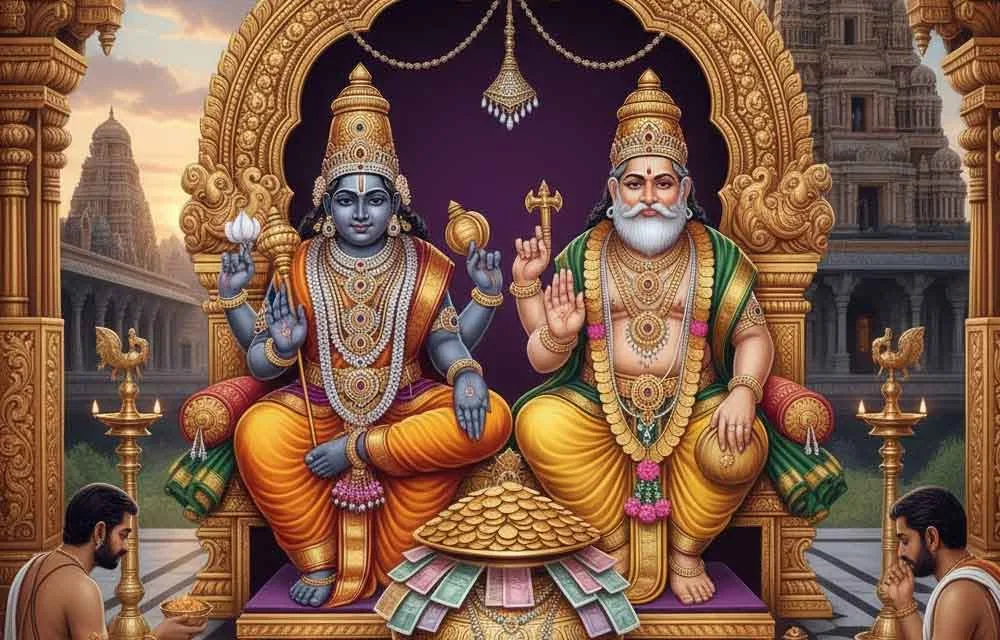
The story of Lord Venkateswara's (Tirumala Balaji) loan from Kubera is one of Hindu mythology's most profound tales, explaining why millions of devotees offer…
The story of Lord Venkateswara's (Tirumala Balaji) loan from Kubera is one of Hindu mythology's most profound tales, explaining why millions of devotees offer donations at the Tirupati temple. This ancient legend carries deep spiritual symbolism that transcends its narrative surface.
The Complete Devotional Story
The Divine Marriage Crisis
In the Kali Yuga, Lord Vishnu descended to Earth and manifested as Lord Venkateswara on the sacred Tirumala hills. During this time, he fell in love with Padmavati, the daughter of King Akasha Raja. The king, though blessed by the divine proposal, needed to arrange a wedding befitting a god.
However, Lord Venkateswara, having taken human form, had no material wealth to conduct the marriage ceremonies with proper grandeur. The wedding required extensive arrangements, including elaborate rituals, ornaments, and celebrations that would honor both the divine groom and the royal bride.
Kubera's Divine Loan
Faced with this situation, Lord Venkateswara approached Kubera, the celestial treasurer and god of wealth. Kubera, honored by the Lord's request, immediately agreed to lend an enormous sum of money for the wedding expenses.
The loan was granted with the understanding that it would be repaid with interest. However, this wasn't an ordinary financial transaction—it was a divine arrangement with cosmic significance.
The Eternal Debt
According to the legend, Lord Venkateswara's debt to Kubera continues to this day and will last until the end of Kali Yuga—believed to span approximately 432,000 years, of which only about 5,000 have passed.
The Lord declared that devotees who visit his temple and offer donations are actually helping him repay this divine debt. Each offering, whether large or small, contributes to settling the cosmic loan.
The Hidden Spiritual Symbolism
1. The Divine Accessibility
Lord Venkateswara taking a loan represents the supreme deity making himself accessible and relatable to common people. By assuming financial obligations, he demonstrates that even the divine can experience worldly concerns, bridging the gap between the transcendent and the mundane.
2. Seva as Spiritual Currency
The donations symbolize seva (selfless service). When devotees contribute to "repaying" the Lord's debt, they're not actually helping an omnipotent being who needs nothing. Instead, they're engaging in an act of devotion that purifies their own hearts and burns their karmic debts.
3. The Cycle of Giving and Receiving
Kubera lending to Vishnu, and devotees repaying on his behalf, illustrates the cosmic principle of reciprocity. The universe operates on exchange—giving and receiving, action and consequence. This myth teaches that:
- Even the wealthy (Kubera) serve the divine
- Even the divine (Venkateswara) accepts help
- Even ordinary devotees participate in cosmic transactions
4. Detachment from Material Wealth
By voluntarily donating money to help the Lord "repay" his debt, devotees practice vairagya (detachment). They learn that wealth is meant to circulate, not to be hoarded, and that the highest use of money is in service of the divine.
5. Equality Before God
The myth democratizes devotion. Whether rich or poor, every devotee can contribute according to their capacity. The Lord doesn't discriminate based on the amount but values the bhava (sentiment) behind the offering. A poor person's single rupee carries equal spiritual weight to a wealthy person's millions.
6. Kali Yuga's Material Nature
The debt lasting through Kali Yuga symbolizes this age's materialistic character. In Kali Yuga, even spiritual practices often require material expression. The Lord accommodates this by establishing a system where material offerings become pathways to spiritual merit.
7. The Inexhaustible Divine Grace
The fact that the debt is never fully repaid represents the infinite nature of divine grace. No matter how much devotees give, the Lord continues to give infinitely more in return—blessings, protection, liberation. The debt serves as an eternal excuse for devotees to maintain their connection with the divine.
The Deeper Philosophy
The Paradox of Divine Poverty
Why would the Lord of the Universe need a loan? This apparent contradiction contains profound wisdom:
- In manifestation, even infinity assumes limitations: When the infinite becomes finite (avatar), it accepts the rules of materiality
- True wealth is spiritual, not material: The Lord's "poverty" in material terms contrasts with his infinite spiritual wealth
- Dependence creates relationship: By making himself dependent on Kubera and devotees, the Lord creates opportunities for loving service
The Hundi as Sacred Exchange
The donation hundi (collection box) at Tirupati becomes more than a collection point—it transforms into:
- A karma kshaya yantra (instrument for dissolving karma)
- A bhakti pratishtha (establishment of devotion)
- A tyaga bhoomi (ground of sacrifice)
Each coin dropped represents not just money but:
- Surrender of ego
- Acknowledgment of divine grace
- Participation in cosmic order
- Hope for spiritual advancement
Modern Relevance
In contemporary times, this myth teaches several lessons:
Financial Wisdom: Debt isn't inherently negative—even the divine uses it as a tool for greater purposes.
Community Responsibility: Just as devotees collectively help the Lord, communities must support each other's welfare.
Sacred Economics: Money becomes sanctified when used for divine purposes, transforming economic transactions into spiritual practices.
Purpose Over Possession: The myth shifts focus from accumulating wealth to using it meaningfully.
Conclusion: The Eternal Bond
The Kubera loan myth ultimately establishes an eternal bond between the devotee and deity. Through this beautiful story, Lord Venkateswara ensures that devotees always have a reason to visit, to serve, and to feel needed by the divine.
The "debt" is actually the Lord's boundless compassion—creating an opportunity for every soul to earn spiritual merit through material sacrifice. In helping him "repay" his loan, devotees discover they're actually receiving far more than they give: his grace, his blessings, and ultimately, his liberating love.
The symbolism reminds us that in the spiritual economy, the giver is always the receiver, and the Lord who seems to take is actually giving everything.
For more devotional stories and spiritual insights, visit hindutone.com and explore the profound wisdom embedded in Hindu mythology.
Related Topics: Tirupati temple significance, Why Lord Balaji is richest god, Kubera and Vishnu relationship, Spiritual meaning of temple donations, Kali Yuga dharma practices
Frequently Asked Questions
Why did Lord Venkateswara borrow money from Kubera?
As commonly told, Venkateswara fell in love with Padmavati, daughter of King Akasha Raja, but had no material wealth for a grand wedding. He approached Kubera, the celestial treasurer, who agreed to lend a large sum.
How long will the Kubera loan last?
In the legend, the debt continues until the end of Kali Yuga, believed to span about 432,000 years, of which only about 5,000 have passed.
Are devotees' donations at Tirupati really repaying the Lord's debt?
In the legend, the Lord declared that devotees who visit and donate help him repay the debt. Symbolically, the offering is seva, an act of devotion that purifies the giver's heart rather than help for a Lord who needs nothing.
What does the hundi at Tirumala symbolise?
The donation hundi is seen as more than a collection box: a karma kshaya yantra, a bhakti pratishtha and a tyaga bhoomi. Each coin represents surrender of ego, acknowledgment of divine grace and hope for spiritual advancement.
Does the size of the offering matter to Lord Balaji?
No. The myth stresses equality before God: the Lord values the bhava (sentiment) behind an offering, so a poor person's single rupee carries equal spiritual weight to a wealthy person's millions.
Why is the debt never fully repaid in the Kubera loan myth?
The never-ending debt symbolises the infinite nature of divine grace. It also gives devotees a lasting reason to stay connected with the Lord through visits, service and giving.
You might also like
Tirumala Tirupati TTD — Complete Guide for NRIs (Darshan, Seva, Accommodation)
Anant Ambani Donates 25 Electric Buses to Tirumala TTD | ₹27.5 Crore Mahā Kānuka

Vishnu's Ten Avatars and the One Question Every NRI Child Eventually Asks