
Worldwide Hindu New Year 2026: Regional Names, State-Wise Traditions and Global Dates
Worldwide Hindu New Year 2026: Regional Names, State-Wise Traditions and Global Dates The Hindu New Year is not a single uniform date or name, but a beautiful…
Worldwide Hindu New Year 2026: Regional Names, State-Wise Traditions and Global Dates The Hindu New Year is not a single uniform date or name, but a beautiful…
Worldwide Hindu New Year 2026: Regional Names, State-Wise Traditions and Global Dates
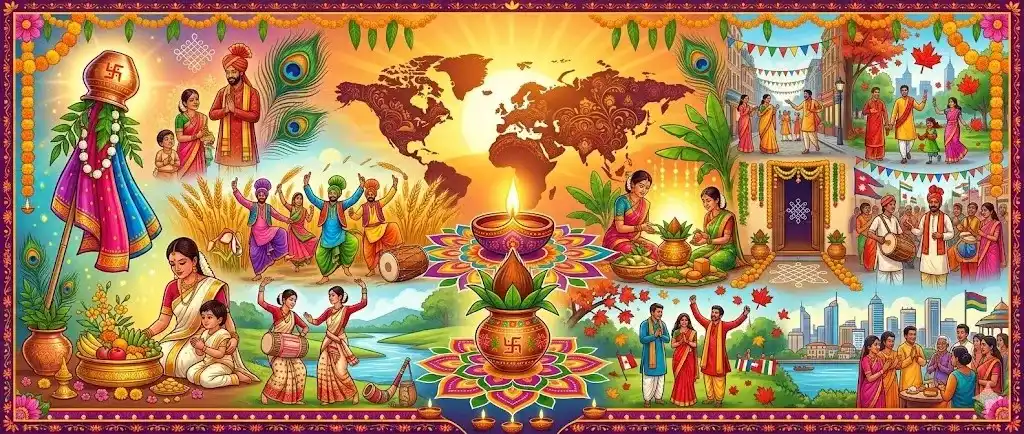
The Hindu New Year is not a single uniform date or name, but a beautiful tapestry of regional traditions across India and the global Hindu diaspora. Based on different regional calendars—lunar, solar and lunisolar—Hindu New Year 2026 will be celebrated on different days and under different names, yet the underlying spirit remains the same: welcoming a fresh beginning with devotion, gratitude and hope. This guide offers an overview of Hindu New Year 2026 celebrations across India (state-wise and regional names) and a general picture of how the festival is observed worldwide. Exact dates and times depend on specific calendars and local panchang calculations, so always refer to your regional almanac or temple schedule for precise details.
Key Hindu New Year Names and Traditions in India
Across India, Hindu New Year is known by various names, often aligned with the beginning of either the Chaitra Shukla Pratipada (lunar month starting) or regional solar months.
Ugadi / Yugadi – Andhra Pradesh, Telangana, Karnataka
- States: Andhra Pradesh, Telangana, Karnataka.
- Name: Ugadi (or Yugadi).
- Calendar Basis: Beginning of the Chaitra month (lunar), marking the start of the new year according to the Deccan region.
Ugadi 2026 marks the start of a new era in the regional Panchanga. Families clean and decorate their homes, draw rangoli designs, hang mango leaf toranas, and prepare special dishes like Ugadi pachadi or bevu-bella that symbolize the mixed flavors of life. Temples host special pujas and panchanga sravanam (reading of the almanac).
Gudi Padwa – Maharashtra and Goa
- States: Maharashtra, parts of Goa and Konkan region.
- Name: Gudi Padwa.
- Calendar Basis: Chaitra Shukla Pratipada, beginning of the Maharashtrian New Year.
On Gudi Padwa 2026, families erect a gudi—a decorated bamboo staff with a silk cloth, garlands and an inverted copper pot—outside their homes, symbolizing victory, auspiciousness and prosperity. Traditional foods, home decorations and temple visits add to the festive mood.
Chaitra Navratri / Hindu New Year – North India
- Regions: Uttar Pradesh, Delhi, Bihar, Rajasthan and parts of North India.
- Name: Often simply observed as the beginning of the new year and the start of Chaitra Navratri.
- Calendar Basis: Chaitra Shukla Pratipada (lunar).
In North India, Hindu New Year 2026 coincides with the first day of Chaitra Navratri, a nine-day festival dedicated to the Divine Mother. Devotees begin fasts, visit temples, and perform special pujas, seeing this as a powerful time for spiritual renewal and aligning the new year with devotion.
Vishu – Kerala
- State: Kerala.
- Name: Vishu.
- Calendar Basis: Solar new year, typically around mid-April when the Sun enters Mesha (Aries).
Vishu 2026 marks the Malayalam New Year in Kerala. A special Vishu kani (auspicious arrangement) is prepared with items such as rice, fruits, vegetables, flowers, a mirror, coins, holy text and a lamp, so that the first sight upon waking is filled with abundance and blessings. Fireworks, special meals and family gatherings are common.
Puthandu – Tamil Nadu
- State: Tamil Nadu.
- Name: Puthandu or Tamil New Year.
- Calendar Basis: Tamil solar calendar, usually mid-April.
Puthandu 2026 marks the beginning of a new year in the Tamil calendar. Devotees visit temples, perform rituals at home, and prepare traditional dishes. The day is seen as auspicious for starting new ventures and renewing commitments. Special kolams (rangoli) and ceremonial greetings add to the joy.
Poila Boishakh – West Bengal
- State: West Bengal.
- Name: Poila Boishakh (Bengali New Year).
- Calendar Basis: Bengali solar calendar, generally around mid-April.
Poila Boishakh 2026 is celebrated with processions, cultural programs, new clothes and special meals. Shopkeepers often open new account books and perform Lakshmi-Ganesh puja for prosperous beginnings.
Other Regional New Year Observances
- Rongali Bihu / Bohag Bihu – Assam: Assamese New Year, celebrated with dance, music and rural festivities.
- Navreh – Kashmiri Pandits: Kashmiri Hindu New Year, observed with special rituals and offerings.
- Cheti Chand – Sindhi Community: Celebrated as the New Year and the birth anniversary of Jhulelal.
Each of these reflects the unique cultural flavors of Hindu New Year 2026, yet all share the core theme of renewal and divine blessings.
Hindu New Year 2026: General Date Range
In 2026, most Hindu New Year observances will fall between late March and mid-April 2026, depending on whether the lunar Chaitra month or solar Mesha Sankranti is followed. For example:
- Ugadi / Gudi Padwa / Chaitra Navratri: Late March or early April 2026 (Chaitra Shukla Pratipada).
- Vishu, Puthandu, Poila Boishakh, Bohag Bihu: Around mid-April 2026 (solar new year).
Important: For exact dates, refer to regional panchangs such as Drik Panchang, local temple calendars or community organizations, as they will provide city-specific timings and observances for Hindu New Year 2026.
Worldwide Hindu New Year 2026: Country-Wise Overview
As Hindu communities have settled across the globe, Hindu New Year 2026 will be observed worldwide, often blending traditional practices with local cultural contexts. Here is a general overview of how celebrations may occur in different regions. Date alignment is based on either the Indian lunar or solar calendar, adjusted to local time zones.
United States and Canada
In North America, Hindu New Year 2026 will be observed primarily through temple programs and community gatherings. Major cities like New York, New Jersey, Toronto, Vancouver, Chicago, Houston, Dallas, Atlanta, San Francisco Bay Area and Los Angeles have temples representing different regional traditions. Typical pattern:
- Ugadi, Gudi Padwa and Chaitra Navratri New Year services around late March or early April 2026, following Indian lunar dates.
- Vishu, Puthandu and Poila Boishakh celebrations around mid-April 2026, aligned with solar calendar transitions.
- Events often scheduled on weekends closest to the actual dates to accommodate work and school commitments.
Programs may include abhishekam, special pujas, panchanga sravanam, satsangs, cultural performances and community meals.
United Kingdom and Europe
In the UK—London, Leicester, Birmingham, Manchester—and across Europe (Germany, France, Netherlands, Switzerland, Italy and others), Hindu New Year 2026 will be marked by temples and cultural associations. Many follow the Indian dates for Ugadi, Gudi Padwa and other New Year observances. General practice:
- Evening or morning temple services on the actual lunar/solar New Year dates.
- Weekend cultural programs, bhajans and community meals for wider participation.
Regional communities often retain their distinct customs—Kannadiga, Telugu, Marathi, Tamil, Bengali, Assamese, etc.—while sharing temple spaces.
Australia and New Zealand
In Australia (Sydney, Melbourne, Brisbane, Perth, Adelaide) and New Zealand (Auckland, Wellington), Hindu New Year 2026 will be observed mainly through temples representing South and North Indian traditions. Ugadi, Gudi Padwa and Chaitra Navratri New Year are likely to fall in late March/early April 2026, while Vishu, Puthandu and Poila Boishakh will be around mid-April 2026. Events often take the form of special pujas, devotional singing, cultural programs and prasadam distribution.
Middle East (Gulf Countries)
In Gulf countries like the UAE, Qatar, Bahrain, Oman and Saudi Arabia (where permitted), Hindu New Year 2026 observances will primarily be held in temples, community halls or private gatherings. Because of local regulations, celebrations are generally focused on puja, kirtan and community meals rather than loud public processions. Regional groups—Telugu, Kannada, Marathi, Tamil, Malayalam and others—often organize their own Ugadi, Gudi Padwa, Vishu and Puthandu events on or near the actual dates, with timings adjusted to local working schedules.
South and Southeast Asia
In countries like Nepal, Singapore, Malaysia, Sri Lanka and Indonesia, Hindu New Year 2026 will align closely with regional customs and temple calendars:
- Nepal: Follows its own Bikram Sambat calendar (Nepali New Year), with temple visits and cultural events.
- Singapore and Malaysia: Temples serving South Indian communities will observe Puthandu and Vishu; North Indian temples will follow Chaitra New Year and Navratri.
- Sri Lanka: Tamil New Year (Puthandu) is a key festival for Tamil Hindus.
Africa, Latin America and Caribbean
In regions such as Mauritius, South Africa, Trinidad & Tobago, Guyana and Suriname, Hindu New Year 2026 will be celebrated in connection with local Indian-origin communities and their respective traditions (e.g., Tamil New Year, North Indian Chaitra New Year). Temples and cultural associations will publish their calendars with specific dates and times for pujas and events.
How to Find Exact Hindu New Year 2026 Date and Time for Your Location
Because Hindu New Year is observed differently across regions—Ugadi, Gudi Padwa, Chaitra Navratri start, Vishu, Puthandu, Poila Boishakh, Bohag Bihu and others—the exact date and muhurta will depend on:
- Your region’s traditional calendar (lunar or solar).
- Your local time zone and sunrise/sunset times.
- The temple or community organization you follow.
To get precise information for Hindu New Year 2026 in your state or country, you should:
- Consult your local temple’s 2026 calendar or website.
- Check regional panchangs in print or online that are specific to your country.
- Follow updates from trusted Hindu organizations and priests in your area.
Spiritual Essence of Hindu New Year
Beyond dates and times, the spiritual meaning of Hindu New Year 2026 is universal:
- Fresh Start: An opportunity to let go of past negativity and begin anew with positive intention.
- Gratitude: Offering thanks to the Divine, ancestors and nature for the blessings of the previous year.
- Dharma: Renewing commitment to righteous living, self-discipline and compassion.
- Devotion: Strengthening one’s relationship with Ishta Devata (chosen deity) through puja, mantra and satsang.
Many families use Hindu New Year 2026 to set spiritual resolutions—such as daily japa, regular temple visits, reading sacred texts or performing more acts of seva (service).
Conclusion: A Global Tapestry of New Beginnings
From Ugadi and Gudi Padwa in the Deccan, Chaitra Navratri in North India, Vishu and Puthandu in the South, Poila Boishakh in the East, to celebrations in the USA, Canada, UK, Europe, Australia, the Middle East, Africa and the Americas, Hindu New Year 2026 will be welcomed with devotion and joy across the globe. Even though names and dates vary, the essence of the worldwide Hindu New Year 2026 celebrations is one: honoring the Divine, embracing renewal and stepping into the future with faith, humility and hope. Wherever you are, may your new year be filled with spiritual growth, inner peace and auspicious beginnings.
Frequently Asked Questions
What is Worldwide Hindu New Year?
Worldwide Hindu New Year 2026: Regional Names, State-Wise Traditions and Global Dates The Hindu New Year is not a single uniform date or name, but a beautiful tapestry of regional traditions across India and the global Hindu diaspora. Based on different regional calendars—lunar, solar and lunisolar—Hindu New Year 2026 will be celebrated on different days and
What are the key points about Worldwide Hindu New Year?
This guide offers an overview of Hindu New Year 2026 celebrations across India (state-wise and regional names) and a general picture of how the festival is observed worldwide. Exact dates and times depend on specific calendars and local panchang calculations, so always refer to your regional almanac or temple schedule for precise details.
Why does Worldwide Hindu New Year matter in Hinduism?
It reflects core values of Sanatana Dharma and offers practical and spiritual guidance that remains relevant across generations.
How can devotees apply Worldwide Hindu New Year in daily life?
By reflecting on its teaching, incorporating the related practices or observances into daily routine, and approaching it with sincere devotion and understanding.
You might also like
Purushottam Maas 2026: Lord Vishnu's Sacred Gift of Spiritual Multiplication & Divine Grace
Shani Jayanti 2026: Date, Significance, Rituals & Powerful Mantras
Hindu Priest Jobs New Zealand 2026 — Auckland, Wellington, Christchurch Vacancies & NZ Religious Worker Visa Guide