
Dussehra Essay for Students 2026: 100, 200 and 500 Words, 10 Lines and a Speech
A Dussehra essay for students in simple English: a 100-word essay, a 200-word essay and a 500-word essay, 10 lines on Dussehra for young children, and a short speech for the school assembly, with correct 2026 dates (Navratri 11 to 19 October, Dussehra on Tuesday 20 October 2026).
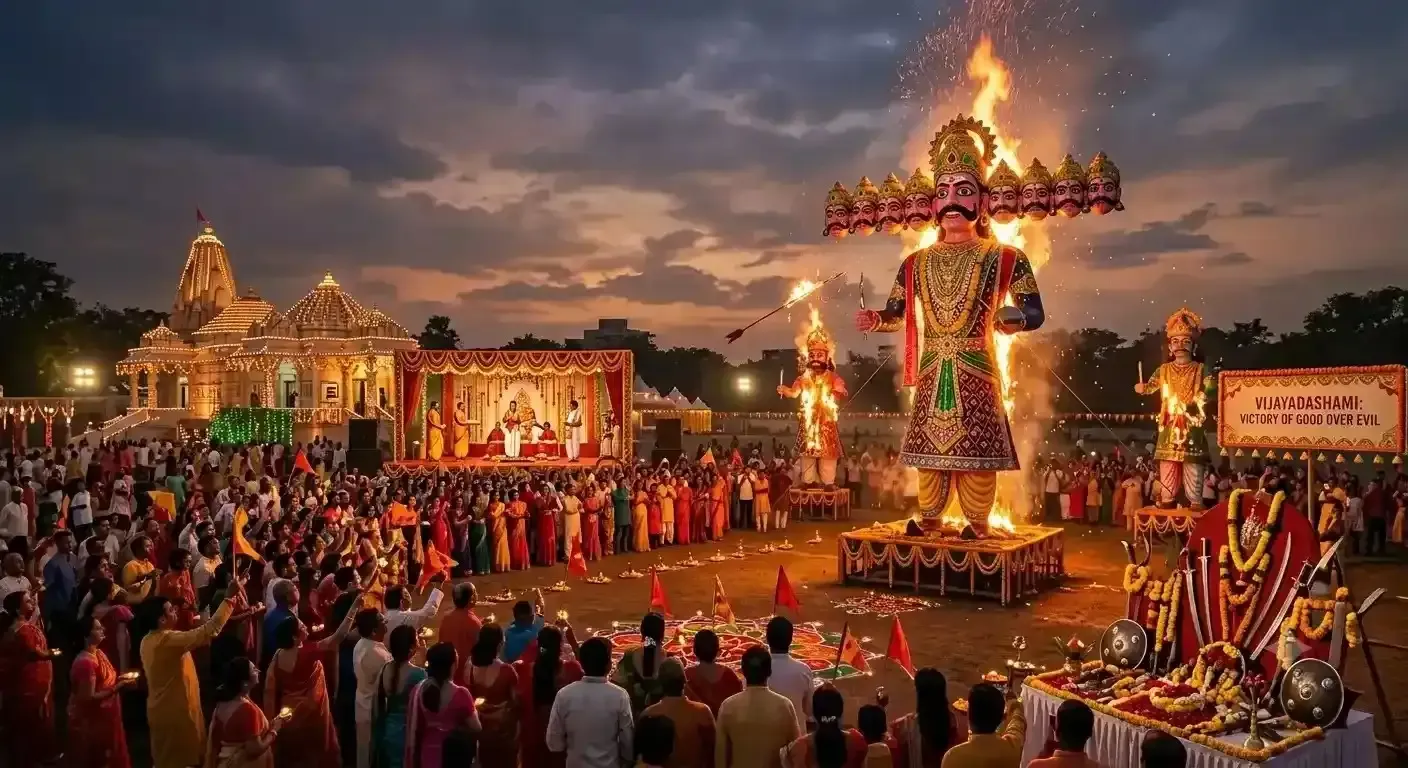
A Dussehra essay for students in simple English: a 100-word essay, a 200-word essay and a 500-word essay, 10 lines on Dussehra for young children, and a short speech for the school assembly, with correct 2026 dates (Navratri 11 to 19 October, Dussehra on Tuesday 20 October 2026).
Quick answer: This Dussehra essay page gives students of classes 1 to 12 ready models in simple English: 10 lines on Dussehra, a 100-word essay, a 200-word essay, a 500-word essay and a short speech for the school assembly. Key facts for 2026: Dussehra (Vijayadashami) falls on Tuesday 20 October 2026, after the nine nights of Navratri from 11 to 19 October. It celebrates Lord Rama's victory over Ravana and Goddess Durga's victory over Mahishasura.
This guide has been restored at its original hindutone.com address. Parents and teachers can also use it to explain the festival to children in India and abroad.
Key facts to include in any Dussehra essay
| Fact | Details |
|---|---|
| Other name | Vijayadashami, 'the tenth day of victory' |
| Date in 2026 | Tuesday 20 October 2026 (India, per Drik Panchang) |
| Comes after | Navratri, nine nights of Goddess worship, 11 to 19 October 2026 |
| Main stories | Rama defeats Ravana; Durga defeats Mahishasura |
| Main customs | Ramlila plays, Ravan Dahan, Shami puja, Ayudha puja, visiting elders |
| Famous celebrations | Mysuru Dasara, Kullu Dussehra, Durga Puja in Bengal, Bathukamma and Jammi in Telangana |
| Message | Good always wins over evil |
10 lines on Dussehra (for classes 1 to 3)
- Dussehra is a major Hindu festival celebrated all over India.
- It is also called Vijayadashami.
- In 2026, Dussehra is on Tuesday 20 October.
- It comes after the nine nights of Navratri.
- On this day, Lord Rama defeated the demon king Ravana.
- Goddess Durga also defeated the demon Mahishasura.
- People watch the Ramlila, a play about the life of Rama.
- In the evening, big effigies of Ravana are burnt.
- People wear new clothes, eat sweets and meet their elders.
- Dussehra teaches us that good always wins over evil.
Dussehra essay in 100 words
Dussehra is one of the most important festivals of India. It is also called Vijayadashami. In 2026, it falls on Tuesday 20 October, after the nine nights of Navratri. On this day, Lord Rama defeated the ten-headed demon king Ravana and brought Sita back home. Goddess Durga also won her battle against the demon Mahishasura on this day. People watch the Ramlila and burn huge effigies of Ravana, Meghnad and Kumbhakarna in the evening. Families wear new clothes, share sweets and take blessings from elders. Dussehra teaches us that truth and goodness always win over evil.
Dussehra essay in 200 words
Dussehra, also known as Vijayadashami, is a joyful Hindu festival celebrated across India and by Indian families around the world. The word Vijayadashami means 'the tenth day of victory'. In 2026, Dussehra will be celebrated on Tuesday 20 October, right after the nine nights of Navratri from 11 to 19 October.
There are two main stories behind this festival. According to the Ramayana, Lord Rama fought a great battle against Ravana, the king of Lanka, who had kidnapped Sita. With the help of his brother Lakshmana, Hanuman and the army of vanaras, Rama defeated Ravana. According to the Devi tradition, Goddess Durga fought the demon Mahishasura for nine days and defeated him on the tenth day.
In North India, people enjoy the Ramlila, a play on the life of Rama, for many days. On Dussehra evening, huge effigies of Ravana are burnt with fireworks. In other parts of India, people worship the Goddess, books and tools, and exchange Shami leaves.
Dussehra reminds us that evil may look strong, but goodness and truth win in the end. It inspires us to remove bad habits like anger and pride from our own lives.
Dussehra essay in 500 words
Introduction: India is a land of festivals, and Dussehra is one of the brightest among them. It is also called Vijayadashami, which means 'the tenth day of victory'. The festival falls on the tenth lunar day of the bright half of the month of Ashvin. In 2026, Dussehra will be celebrated on Tuesday 20 October, after the nine nights of Navratri from 11 to 19 October. People of all ages look forward to this festival of joy, courage and victory.
The story of Rama and Ravana: The most popular story of Dussehra comes from the Ramayana. Lord Rama, the prince of Ayodhya, went to the forest for fourteen years with his wife Sita and his brother Lakshmana. Ravana, the powerful king of Lanka, kidnapped Sita. Rama, with the help of Hanuman, Sugriva and the vanara army, built a bridge across the sea to Lanka. After a long war, Rama defeated Ravana and rescued Sita. Ravana was very learned, but his pride and wrong actions led to his downfall.
The story of Durga and Mahishasura: Another story comes from the Devi tradition. The demon Mahishasura had become so powerful that even the gods could not defeat him. The gods combined their powers to create Goddess Durga. She fought Mahishasura for nine days and defeated him on the tenth day. This is why the nine nights of Navratri are followed by Vijayadashami.
How Dussehra is celebrated: In North India, Ramlila plays are performed in towns and villages during Navratri. On Dussehra evening, tall effigies of Ravana, his brother Kumbhakarna and his son Meghnad are filled with firecrackers and burnt. This is called Ravan Dahan. Crowds cheer as the effigies burn, which shows the end of evil. Many families also worship weapons, tools, vehicles and books on this day, a custom known as Ayudha Puja. In South India, young children often begin their education on Vijayadashami with a ceremony called Vidyarambham.
Regional celebrations: Dussehra is celebrated in many different ways across India. In Karnataka, the Mysuru Dasara is famous for its grand procession and the beautifully lit Mysuru Palace. In Himachal Pradesh, the Kullu Dussehra begins on Vijayadashami and continues for several days, with local deities brought to the town in colourful processions. In West Bengal, the festival is celebrated as Durga Puja, and the idols of the Goddess are immersed in rivers. In Telangana, women celebrate Bathukamma with flower arrangements and songs, and on Dussehra people exchange Jammi (Shami) leaves as a sign of good luck and friendship. In Gujarat, people dance Garba during Navratri.
The message of Dussehra: Dussehra teaches us that evil may seem powerful for a while, but truth and goodness always win in the end. The ten heads of Ravana are often compared to bad qualities like anger, greed, pride, jealousy and selfishness. Burning Ravana's effigy reminds us to remove these qualities from our own hearts. The festival also teaches us to respect women, to stand by our family, and to be brave in difficult times.
Conclusion: Dussehra is not only a festival of fireworks and sweets but also a festival of values. It brings families and communities together and fills everyone with hope. As we celebrate Dussehra on 20 October 2026, let us promise to choose the right path, help others and become better human beings.
Short Dussehra speech for the school assembly
Good morning to our respected Principal, teachers and my dear friends. Today I am going to speak about Dussehra, a festival that teaches us the victory of good over evil.
This year, Dussehra falls on Tuesday 20 October 2026. It comes after nine nights of Navratri, when people worship the nine forms of Goddess Durga. Dussehra is also called Vijayadashami, which means 'the tenth day of victory'.
On this day, Lord Rama defeated Ravana and brought Sita home. On the same day, Goddess Durga defeated the demon Mahishasura. These stories show us that no matter how strong evil looks, truth and courage will win.
Across India, people celebrate Dussehra in many ways. Some watch the Ramlila and the burning of Ravana. Some visit the Mysuru Dasara or the Kullu Dussehra. In Bengal people celebrate Durga Puja, and in Telangana people share Jammi leaves with their friends and elders.
Friends, each of us has a small Ravana inside us, such as anger, laziness or telling lies. This Dussehra, let us try to defeat one bad habit and become a better student and a better person. Thank you, and Happy Dussehra to everyone!
Tips for writing a good Dussehra essay
- Use the correct date: Write Tuesday 20 October 2026 for Dussehra and 11 to 19 October 2026 for Navratri.
- Mention both stories: Include Rama and Ravana, and Durga and Mahishasura.
- Add your own experience: Describe how your family, school or town celebrates. Teachers love personal details.
- Write in short paragraphs: Use an introduction, a body and a conclusion.
- End with the message: Finish with what Dussehra teaches us about truth, courage and kindness.
Frequently asked questions
When is Dussehra in 2026?
Dussehra, also called Vijayadashami, is on Tuesday 20 October 2026 in India, per Drik Panchang. It comes right after the nine nights of Navratri, which run from Sunday 11 October to Monday 19 October 2026.
Why is Dussehra celebrated?
Dussehra celebrates the victory of good over evil. Lord Rama defeated the demon king Ravana on this day, and Goddess Durga defeated the demon Mahishasura after nine days of battle. Both stories teach that truth and courage win in the end.
Which essay length should I choose?
Students in classes 1 to 3 can use the 10 lines or the 100-word essay. Classes 4 to 7 can use the 200-word essay. Classes 8 to 12 can use the 500-word essay as a base and add their own experiences and examples.
Can I copy these essays for my school work?
You can use them as a model, but teachers value your own words. Read the essay, understand the points, and then write it again in your own style. Add how your family or town celebrates Dussehra to make it personal.
What does the word Dussehra mean?
Dussehra comes from the Sanskrit words 'dasha' (ten) and 'hara' (removal or defeat), and is often explained as the defeat of the ten-headed Ravana. Vijayadashami means 'the tenth day of victory', because it falls on the tenth lunar day (Dashami) of the bright half of the month of Ashvin.
Editor's note
Editor's note (6 October 2026): This guide has been restored at its original address after the earlier version was lost. All essays and the speech are original and written in simple English for students. Dates are India dates from Drik Panchang: Navratri from Sunday 11 to Monday 19 October 2026 and Dussehra (Vijayadashami) on Tuesday 20 October 2026. Regional customs are described in general terms and vary from place to place.
Related guides
- Dussehra / Vijayadashami 2026 (pillar guide)
- Explaining Navratri and Dussehra to Children: A Parent's Guide
- Rama vs Ravana and Durga vs Mahishasura: both Dussehra legends
- Ravana Dahan: why we burn Ravana
- Ramlila: a vibrant retelling of the Ramayana
- Mysore Dasara 2026
- Kullu Dussehra 2026
- Saraswati Puja and Vidyarambham on Vijayadashami
- Dussehra 2026 wishes, messages and quotes
You might also like
Dussehra 2026 Wishes, Messages and Quotes: 45 Original Vijayadashami Greetings
Dussehra 2026 in Victoria, BC: Date, Vijay Muhurat, Temples and Navratri Celebrations
Dussehra 2026 in Surrey: Date, Vijay Muhurat, Temples and Navratri Celebrations