
Vidyarambham 2026: Date (21 October), Saraswati Puja, Ezhuthiniruthu and Writing 'Hari Sri' in Rice
Drik Panchang lists Dussehra on Tuesday 20 October 2026 and Vidyarambham Day on Wednesday 21 October. The reason is the Dashami tithi: it covers the afternoon of the 20th but prevails at sunrise on the 21st, when many Kerala and South Indian families seat children to write their first letters. Here is the tithi explained, the Ezhuthiniruthu ritual, Kerala, Karnataka and Tamil Nadu customs, and a simple home guide.
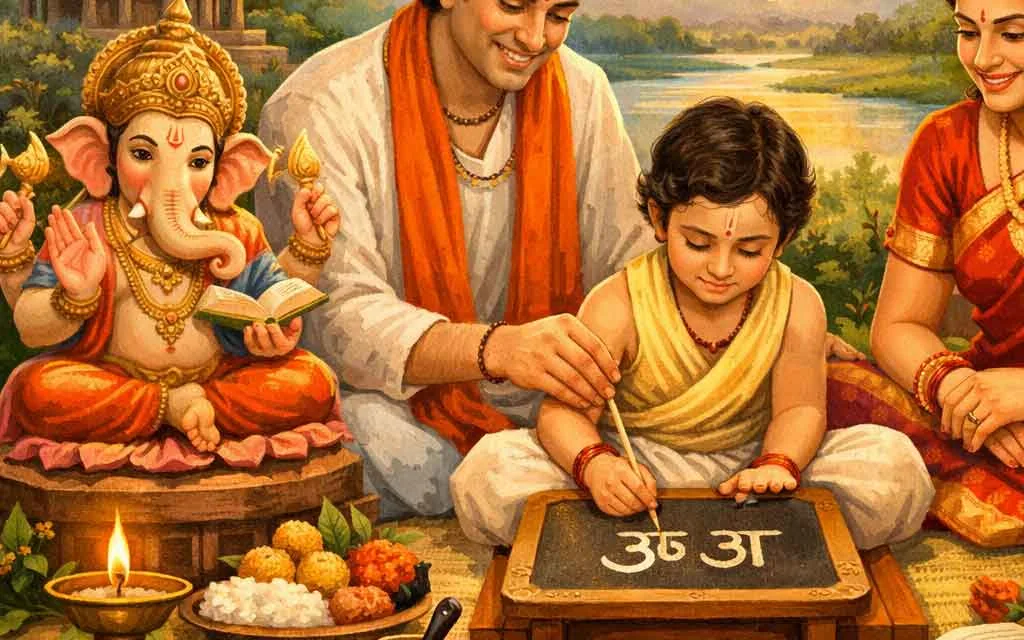
Drik Panchang lists Dussehra on Tuesday 20 October 2026 and Vidyarambham Day on Wednesday 21 October. The reason is the Dashami tithi: it covers the afternoon of the 20th but prevails at sunrise on the 21st, when many Kerala and South Indian families seat children to write their first letters.
Quick answer: Drik Panchang (Hyderabad) lists Vidyarambham Day on Wednesday 21 October 2026, the morning after Dussehra. Vijayadashami / Dussehra and South Saraswati Puja are on Tuesday 20 October 2026. The reason for the split is the Dashami tithi: it begins at 12:50 PM IST on 20 October and lasts until 2:11 PM IST on 21 October, so it covers the afternoon of the 20th (Dussehra) and the sunrise of the 21st (Vidyarambham). Follow the date and time your temple or family priest announces.
Last updated: 10 October 2026. This guide has been rewritten with the 2026 tithi details from Drik Panchang, regional customs and a simple home guide.
Vidyarambham, literally "the beginning of learning", is the day a small child writes the first letters, seated on the lap of an elder in front of Goddess Saraswati. In Kerala it is called Ezhuthiniruthu; in Karnataka and the Telugu states it is Aksharabhyasa or Aksharabhyasam; in Tamil Nadu it is Vidyarambam. Few family moments are as tender: a tiny finger, a plate of rice, and the first syllables of a lifetime of learning. For the wider festival, see our Dussehra / Vijayadashami 2026 guide.
Vidyarambham 2026 date and the tithi explained
| Day (IST, Hyderabad) | Tithi and nakshatra | Observances listed by Drik |
|---|---|---|
| Monday 19 October | Ashtami until 10:51 AM, then Navami; Shravana from 3:38 PM | Durga Ashtami, Maha Navami, Saraswati Visarjan |
| Tuesday 20 October | Navami until 12:50 PM, then Dashami; Shravana until 6:02 PM | Vijayadashami / Dussehra, Ayudha Puja, South Saraswati Puja |
| Wednesday 21 October | Dashami at sunrise (6:11 AM) until 2:11 PM | Vidyarambham Day, Madhvacharya Jayanti, Bengal Vijayadashami |
Source: Drik Panchang day panchang for Hyderabad. Tithi changes happen at the same moment across India, though sunrise differs from city to city.
Why two different days?
Hindu festivals are tied to tithis (lunar days), and a tithi rarely lines up neatly with a calendar day. Different observances look at the tithi at different times of day:
- Dussehra looks at the afternoon. Vijayadashami is kept on the day Dashami covers the Aparahna (afternoon) period, when the Vijay Muhurat falls. On Tuesday 20 October, Dashami begins at 12:50 PM and runs through the afternoon, so Dussehra is on the 20th.
- Vidyarambham looks at the morning. It is a morning rite, done after bathing and puja. Many Kerala and South Indian traditions prefer Dashami to be the tithi at sunrise. On the morning of the 20th it is still Navami; on Wednesday 21 October Dashami prevails at sunrise and lasts until 2:11 PM IST, so Drik lists Vidyarambham Day on the 21st.
- Some families and temples, following their own calendar or custom, held or will hold Vidyarambham on the 20th. Neither is wrong; follow your temple, family priest or community.
Practical tip: on the 21st, plan the ceremony for the morning, comfortably before Dashami ends at 2:11 PM IST. Temples usually start early and announce their own sessions.
Saraswati Visarjan and Shravana nakshatra
In many South Indian traditions the books placed before the Goddess are linked with nakshatras: Saraswati is invoked under Moola and given farewell under Shravana. In 2026 Shravana begins at 3:38 PM on Monday 19 October and lasts until 6:02 PM on Tuesday 20 October. Customs differ, so the exact moment of taking up the books is best confirmed with your priest.
Pooja Veppu, Pooja Eduppu and Ayudha Puja
In Kerala, books, musical instruments and tools of work are placed before Saraswati in a ceremony called Pooja Veppu, usually on Durgashtami evening. For the days that follow, many families do not read or write; the tools of learning rest with the Goddess. On Vijayadashami morning comes Pooja Eduppu: the books are taken back after worship, and the first thing anyone does is to read or write a few letters. Children who are beginning school are seated for Vidyarambham at the same time.
In Tamil Nadu and Karnataka, Saraswati Puja and Ayudha Puja are kept together on Maha Navami, with books, instruments, vehicles and tools honoured. See our Ayudha Puja 2026 guide and the Kerala Navaratri and Vijayadashami 2026 guide.
Ezhuthiniruthu: the Vidyarambham ritual
The ceremony is simple and usually takes only a few minutes. The details below are common customs; your family's way may differ.
- The child is bathed and dressed in new or clean clothes, and the family prays to Ganesha, the remover of obstacles, and to Saraswati, the Goddess of learning.
- An elder, teacher, priest or respected person (the acharya) sits facing east or north, with the child on the lap.
- A plate or tray of raw rice, or other grain, is placed in front of them.
- Holding the child's index finger, the acharya helps the child write 'Hari Sri Ganapataye Namah' in the rice, the traditional opening, followed by the first letters of the alphabet of the family's language.
- In many families, the acharya also gently writes the same words on the child's tongue with a gold ring, as a prayer that speech and learning be blessed.
- The child is then often given a slate, notebook or pencil to make the first marks, and sweets are shared.
- The family offers gurudakshina to the acharya: traditionally betel leaves, areca nut, a coin or some money, and sometimes new cloth.
'Hari Sri' invokes the Lord and auspiciousness at the very start of learning, and 'Ganapataye Namah' is a salutation to Ganesha. The words are written, not just spoken, because the day is about the first act of writing.
Keep it gentle. If the child is shy, sleepy or upset, let the elder do most of the writing and try again with a smile. The blessing lies in the family's love and prayer, not in perfect letters.
Vidyarambham in Kerala, Karnataka and Tamil Nadu
Kerala: Ezhuthiniruthu
Kerala keeps Vidyarambham with special warmth. Many temples, cultural centres and even newspaper offices across the state host sessions on Vijayadashami morning, where writers, teachers and scholars initiate children. Families often choose a guru they admire, so the first letters are written under a respected hand.
Thunchan Parambu, Tirur: the birthplace memorial of Thunchath Ezhuthachan, revered as the father of modern Malayalam, at Tirur in Malappuram district. It is well known for its large Vidyarambham gatherings, where children write their first letters, some of them in sand. Check local announcements for arrangements.
Karnataka: Aksharabhyasa
In Karnataka, Aksharabhyasa is commonly done on Vijayadashami and on other auspicious days, at home or at Devi and Saraswati shrines. Navaratri in the state also brings Mysore Dasara and celebrations in every district.
Tamil Nadu: Vidyarambam
In Tamil Nadu, Saraswati Puja and Ayudha Puja close the Navarathri Golu season, and Vidyarambam on Vijayadashami morning is popular at temples and schools, with many schools also choosing the day to admit young children. Telugu families call the ceremony Aksharabhyasam; our Aksharabhyasam / Vidyarambham NRI guide covers the Telugu tradition and other auspicious days in the year.
Temples known for Vidyarambham
Kollur Sri Mookambika Temple (Karnataka). The shrine at Kollur in Udupi district stands on the bank of the Souparnika river at the foot of Kodachadri hill in the Western Ghats. According to the account given by the Udupi district administration, Mookambika is presented as the union of Shiva and Shakti, regarded as Parvati, Saraswati and Mahalakshmi together, and temple tradition associates the shrine with Adi Shankaracharya. Families from across South India bring children here for Vidyarambham. Read our Kollur Sri Mookambika Temple guide.
Panachikkad Saraswathi Temple, the 'Dakshina Mookambika' (Kerala). In Panachikkad village, Kottayam district, this temple is dedicated to Saraswati. Kerala Tourism notes that poojas here continue throughout the year, and that the temple holds an important Saraswathi Pooja and the Vidyarambham ceremony. See our Panachikkad Dakshina Mookambika temple page.
Expect large crowds at well-known shrines. Go early, carry water and snacks for the child, and check the temple's official website or notice board for current arrangements. A local temple, or your own home, is just as blessed.
A simple Vidyarambham at home
- Choose the morning of Wednesday 21 October (or the day your family follows), while Dashami is current.
- Clean the puja space and place a picture of Saraswati and Ganesha. Light a lamp and offer flowers.
- Place the child's books, a slate or notebook and a pencil before the Goddess, with a plate of raw rice.
- Begin with a short prayer to Ganesha, then chant the Saraswati mantra below.
- Let the most respected elder at home guide the child's finger to write 'Hari Sri Ganapataye Namah' and the first letters in the rice.
- Offer a sweet, give the child the slate or notebook, and touch the elders' feet for blessings.
- Cook the rice later or give it to someone in need, as many families do, rather than throwing it away.
No materials? A lamp, a flower and a few letters traced with love on any clean surface make a complete Vidyarambham.
Saraswati prayers for the day
A short Saraswati mantra (Om Aim Sarasvatyai Namah):
ॐ ऐं सरस्वत्यै नमः॥
oṃ aiṃ sarasvatyai namaḥ||
Meaning: Om, salutations to Goddess Saraswati. Aim is the seed syllable traditionally associated with her.
The opening verse of the Saraswati Stuti (Ya Kundendu), widely sung before study:
या कुन्देन्दु-तुषारहार-धवला या शुभ्र-वस्त्रावृता
या वीणावरदण्डमण्डितकरा या श्वेतपद्मासना ।
या ब्रह्माच्युत-शंकर-प्रभृतिभिर्देवैः सदा पूजिता
सा मां पातु सरस्वती भगवती निःशेषजाड्यापहा ॥ १॥
yā kundendu-tuṣārahāra-dhavalā yā śubhra-vastrāvṛtā
yā vīṇāvaradaṇḍamaṇḍitakarā yā śvetapadmāsanā |
yā brahmācyuta-śaṃkara-prabhṛtibhirdevaiḥ sadā pūjitā
sā māṃ pātu sarasvatī bhagavatī niḥśeṣajāḍyāpahā || 1||
Meaning: May Goddess Saraswati, fair as the jasmine, the moon and a garland of snow, clad in white, her hands adorned with the vina, seated on a white lotus, ever worshipped by Brahma, Vishnu, Shiva and the gods, protect me and remove all dullness.
Chant with devotion; these are prayers for a clear and willing mind, not promises of exam results.
Beyond children: starting anything new
Vijayadashami is not only for toddlers. People of all ages choose the day to begin music, dance, a language, a craft or a new course, and many teachers accept new students on this day. Artists often perform a short piece before their teacher. The idea is simple and beautiful: every beginning is offered to the Goddess of learning first.
Hindus abroad: choosing the day
- Ask your temple which day and time it holds Vidyarambham; many diaspora temples hold sessions on the nearest convenient morning, including the weekend.
- Whether Dashami prevails at your local sunrise depends on your time zone. In some places the tithi at sunrise on 21 October may already be Ekadashi, so temples may choose the 20th.
- Never convert Indian times to your local clock. Follow your temple's own panchang.
- Grandparents in India can join by video call to bless the child, and some families repeat the first letters in both the home language and English.
For more on Navaratri abroad, see the Navratri 2026 NRI guide.
Tips for parents
- Keep the ceremony short and joyful; small children have short attention spans.
- Teach the child to bow to books and never to step over them, a lovely habit that starts on this day.
- Take photos, but let the moment be about the child and the elder, not the camera.
- Do not worry if the date or temple you wanted is not possible; devotion counts more than the venue.
Frequently asked questions
When is Vidyarambham in 2026?
Drik Panchang (Hyderabad) lists Vidyarambham Day on Wednesday 21 October 2026. Dashami tithi runs from 12:50 PM IST on Tuesday 20 October to 2:11 PM IST on Wednesday 21 October, so Dashami prevails at sunrise on the 21st, which many South Indian traditions prefer for this morning rite. Some temples and families may hold it on the 20th; follow the date your temple announces.
Why is Dussehra on 20 October but Vidyarambham on 21 October?
Dussehra (Vijayadashami) is fixed by Dashami in the afternoon, when the Vijay Muhurat falls, and Dashami covers the afternoon of Tuesday 20 October. Vidyarambham is done in the morning, and many families want Dashami at sunrise. That happens on Wednesday 21 October, when Dashami is current at sunrise and lasts until 2:11 PM IST.
What is Ezhuthiniruthu?
Ezhuthiniruthu is the Malayalam name for the ceremony of seating a child to write for the first time. An elder, teacher or priest holds the child's finger and helps the child trace letters in rice or grains on a plate, beginning with 'Hari Sri Ganapataye Namah'.
At what age is Vidyarambham done?
It is usually done for children of about two to five years, before or as they start formal schooling. There is no fixed rule, and adults also choose Vijayadashami to begin music, dance, a language or any new study.
Can Vidyarambham be done at home?
Yes. Many families do it at home in front of a picture of Saraswati and Ganesha with a lamp, a plate of rice and a respected elder to guide the child. A temple ceremony is a cherished option, not a requirement.
What should Hindus abroad do?
Ask your local temple which day it holds Vidyarambham. Whether Dashami prevails at your local sunrise depends on your time zone, so the day can differ from India. Do not convert Indian times; follow your temple's own panchang.
Editor's note (10 October 2026)
This guide was updated in place on 10 October 2026 with Drik Panchang's tithi data for Hyderabad and a fuller account of regional customs. Temple facts are taken from our source-checked temple pages. Dates and session timings at temples can vary; please confirm with your temple or family priest.
Also read: Vidyarambham 2026: date and ritual
You might also like

Saraswati Puja 2026 Vidhi: Complete Step-by-Step Rituals, Samagri List & Significance for Vasant Panchami on January 23

Powerful Saraswati Mantras & Prayers for Vasant Panchami 2026

Vasant Panchami 2026: Saraswati Puja & Yellow Outfit Ideas
