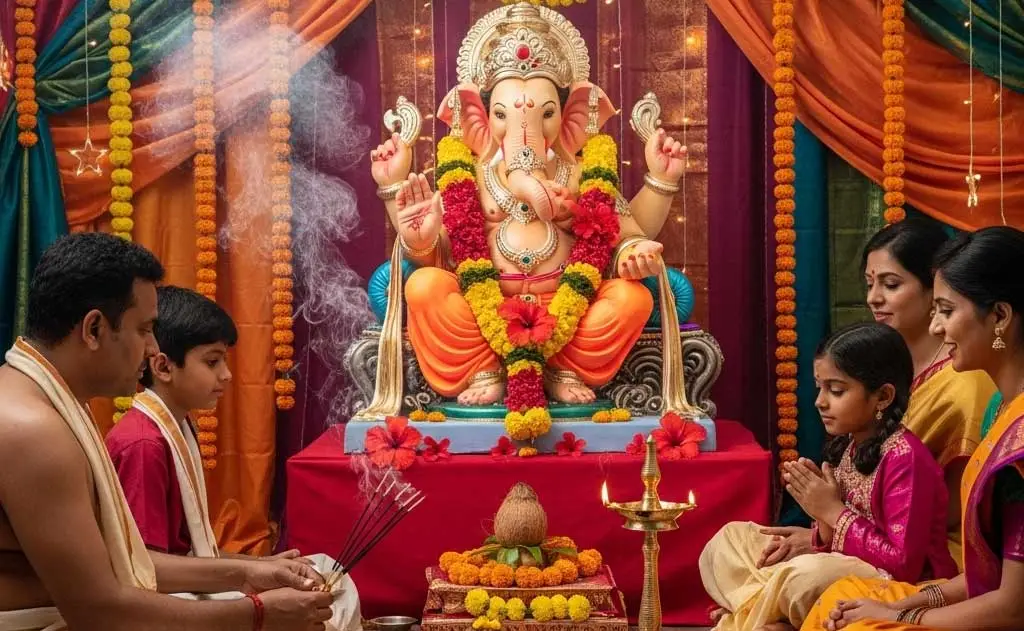
How to Make Eco-Friendly Ganesha Idol at Home: Complete Step-by-Step Guide (2026)
"Worship Ganesha with love — and leave the Earth as pure as His blessings." This complete guide shows you exactly how to make an eco-friendly Ganesha idol at…
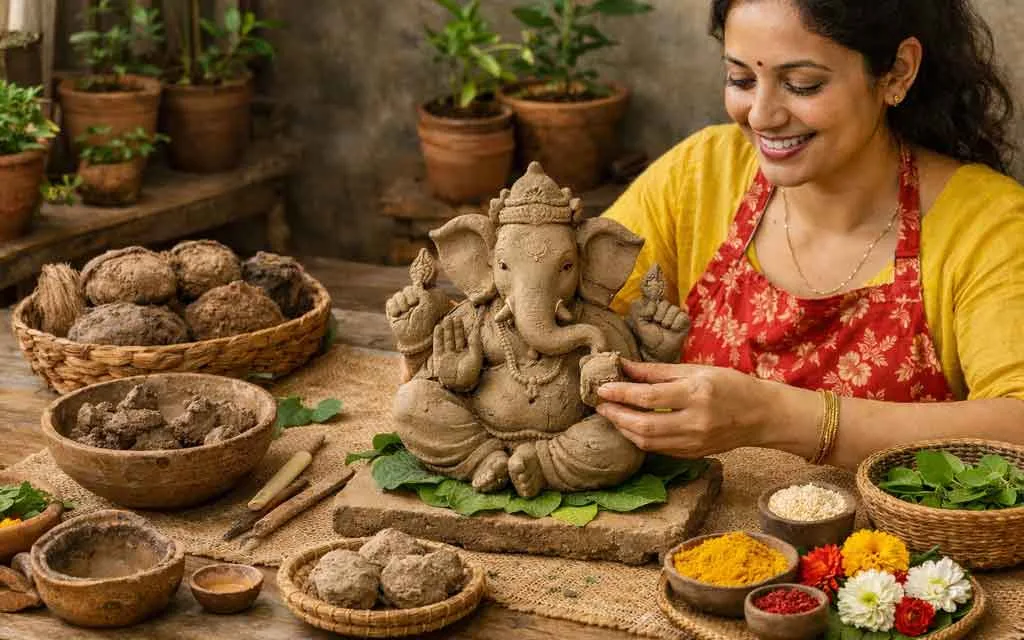
"Worship Ganesha with love — and leave the Earth as pure as His blessings.
"Worship Ganesha with love — and leave the Earth as pure as His blessings."
This complete guide shows you exactly how to make an eco-friendly Ganesha idol at home using natural clay, turmeric dough, and organic pigments — safe for water, soil, and your family. Perfect for Vinayaka Chavithi 2026 (September 14).
Why Make an Eco-Friendly Ganesha Idol?
Every year during Ganesh Chaturthi (Vinayaka Chavithi), millions of Ganesha idols are immersed in rivers, lakes, and the sea. The majority of commercially sold idols are made from Plaster of Paris (PoP) — a material that does not dissolve in water. Instead, it sinks to the riverbed and slowly leaches toxic chemicals, heavy metals, and synthetic paint pigments into the water, harming fish, aquatic plants, and the entire ecosystem.
But the original tradition of Ganesh Chaturthi used natural clay idols — shadu mati (river clay) that dissolves completely within hours of Visarjan, returning its minerals to the earth. Making your own eco-friendly Ganesha idol at home is not just an environmental choice — it is the authentic, traditional choice, exactly as generations of Hindu families practised before mass-produced PoP idols became common.
This guide walks you through the entire process: choosing materials, kneading the clay, shaping each part, applying natural colors, drying properly, and performing eco-friendly home Visarjan.
What Materials Do I Need to Make an Eco-Friendly Ganesha Idol?
Base Material — Choose One
Recommended for beginners: Shadu mati (natural river clay) is the easiest to shape, most forgiving of errors, and gives the most authentic texture and appearance.
Full Materials List
- Shadu mati / turmeric + rice flour (base clay)
- Rice flour — binder for clay dough
- Wheat flour — improves surface smoothness
- Natural gum (gum arabic or tamarind) — for joining parts
- Bamboo skewers or thin sticks — internal armature support
- Wooden tools or toothpicks — for carving fine details
- Soft cloth strips — to support limbs while drying
- Fine sandpaper — for smoothing the dried surface before painting
- Soft natural-bristle paintbrushes — for applying colors
- White chalk powder (khadi mitti) — for the base coat before painting
Natural Color Pigments
Color adhesion tip: Add a few drops of gum arabic to each pigment mixture for better adhesion and slower fading during puja days.
Complete Step-by-Step Guide: How to Make an Eco-Friendly Ganesha Idol at Home
Step 1: Prepare the Clay Dough
Mix natural clay (shadu mati) with rice flour in a 4:1 ratio by volume. Add water gradually and knead for 10–15 minutes until the dough is smooth, pliable, and non-sticky — the texture should feel like firm bread dough.
The rice flour strengthens the clay body and significantly reduces cracking during the drying phase. Keep the prepared dough covered with a damp cloth at all times when not actively shaping, to prevent the surface from drying out.
Turmeric dough alternative: Combine 2 cups turmeric powder + 1 cup rice flour + warm water. Knead well. This produces a naturally golden-yellow idol that needs minimal painting afterward.
Step 2: Build the Body — Torso and Belly
Ganesha's large, round belly is His most recognisable feature, symbolising the universe contained within the Self.
Roll a large rounded conical or egg-shaped mass for the torso. Ganesha's belly should push forward prominently. Insert one or two bamboo skewers vertically through the centre of the body — these act as an internal armature, preventing the head from toppling once attached.
The body should represent approximately 60–70% of the idol's total height. For a standard 8–10 inch home idol, the body should stand 5–6 inches tall.
Step 3: Shape the Head
Roll a round ball slightly smaller than the body for the elephant head. Ganesha's head is broad at the forehead and tapers gently toward the neck. Lightly flatten the face area.
Mark eye positions in the upper third of the face, set wide apart with a slight upward tilt. Hollow two shallow eye sockets with a wooden tool. Mark a small vertical line at the centre of the forehead for the third eye, and add small raised bumps on either side for the tusk bases.
Attach the head to the top of the body using fresh clay slurry (clay mixed with water to a thick paste) as adhesive. Press firmly and smooth the join with a wet fingertip.
Step 4: Form and Attach the Trunk
Roll a tapered cone — thicker at the face attachment point and narrowing toward the tip. The trunk should be long enough to curl gracefully.
The direction of the trunk's curl is spiritually significant:
- Trunk curling to Ganesha's left (curves right when you face the idol) — Vamamukhi. This is the most auspicious form for home worship, symbolising grace, peace, and moksha. Recommended for all home devotees.
- Trunk curling to Ganesha's right — Dakshinamukhi. Considered powerful but requiring strict puja discipline. Not recommended for casual home worship.
Attach the trunk base between the eye line and the mouth area. Curve the tip gently to the left, angled slightly upward, resting it near where the lower left hand will hold the modak.
Step 5: Sculpt the Ears
Ganesha's elephant ears are large and fan-shaped, extending outward from the head. They represent His quality of attentive listening to devotees' prayers.
Roll two wide, flat oval pieces. Thin the outer edges by pressing and rotating gently. Score both the inner face of each ear and the attachment points on the head with crosshatch marks before joining — this roughening dramatically improves the clay-to-clay bond.
Press the ears firmly to either side of the head, angling them slightly forward and outward. Support with small propped clay pieces underneath each ear until dry.
Step 6: Shape the Crown (Mukut)
For a beginner: roll a short cylinder, flatten the base, score both surfaces, and attach to the top of the head. Press small dots around the crown's lower edge to represent gemstone settings.
For an intermediate crown: make a wider domed piece with a flare at the base, and press small petal shapes around its circumference for a lotus-crown (padma mukut) style, which is traditional in South Indian Ganesha imagery.
Step 7: Attach the Four Arms
Ganesha is classically depicted with four arms, each holding a sacred attribute:
Roll four tapered cylinders for the arms, making the upper arms slightly thicker. Attach at natural shoulder angles with clay slurry. Support all four arms with small cloth strips or propped clay pieces until fully dry — unsupported arms will droop or crack at the shoulder join. Add flat oval shapes for hands and thin cylinders for fingers.
Step 8: Carve Details with a Wooden Tool
Once the assembled idol reaches a leather-hard state (firm to touch but still slightly moist inside), use a wooden toothpick or bamboo carving tool for fine details:
- Eyes: Oval outlines with a raised inner iris circle. Add crow's-feet lines at the corners.
- Sacred thread (jandhyam): A thin diagonal line from the left shoulder across the chest to the right hip.
- Navel (nabhi): A small circular indent in the centre of the belly.
- Broken right tusk (ekadanta): A short cylinder on the right side of the trunk base, with its tip slightly chipped — Ganesha's iconic single-tusk symbol.
- Toe and finger lines: Light parallel lines across digits.
- Belt (katisootra): A horizontal band around the waist.
- Lotus petal marks: Curved petal impressions pressed around the base platform.
Best carving window: The leather-hard stage, roughly 8–12 hours after assembly for a small idol. Too wet and the clay collapses under the tool; too dry and it crumbles rather than carving cleanly.
Step 9: Create the Lotus Base (Padma Peetha)
Flatten a wide round disc of clay — broader than the idol's widest point for stability. Press curved petal shapes around the outer edge with a wooden tool or your thumb, overlapping slightly like real lotus petals.
Score the top of the base and the bottom of the idol's feet, apply clay slurry, and press firmly together. The padma peetha (lotus seat) is not merely decorative — it distributes the idol's weight and prevents the feet from breaking off during the drying phase.
Step 10: Dry the Idol Properly
Rushing the drying phase is the most common beginner mistake. Uneven or rapid drying causes cracking that weakens the idol and ruins paintwork.
Day 1–2: Shade drying Place the assembled idol in a cool, shaded, well-ventilated spot — indoors near an open window is ideal. Place on a cloth or foam pad, never on a hard floor. Keep out of direct wind. Check at 12 hours: hairline cracks can be repaired immediately with fresh clay slurry while the inside is still moist.
Day 3–5: Gradual sun exposure Once the outer surface is leather-hard, move the idol to gentle morning sunlight for 2–3 hours per day. Rotate so all sides dry evenly.
Ready test: The idol is fully dry when it sounds slightly hollow when tapped, has no cold spots indicating interior moisture, and feels uniformly light compared to when freshly assembled. A standard 8-inch idol typically needs 5–7 days total.
Step 11: Apply the White Base Coat
Lightly sand the fully dried surface with fine sandpaper and wipe away all dust. Mix white chalk powder (khadi mitti) with water and a few drops of gum arabic to a smooth, creamy consistency. Apply evenly over the entire idol with a soft brush.
This base coat creates a bright, uniform surface that makes all natural colors vivid, fills tiny surface pores in the clay, and improves pigment adhesion. Allow the base coat to dry for at least 4–6 hours before applying any colors.
Step 12: Paint with Natural Colors
Apply natural colors in this traditional order:
- Body and face: Turmeric yellow or golden orange (turmeric + sindoor mixed). Apply 2–3 thin coats, drying between each.
- Dhoti / lower garment: Red (kumkum) or orange (sindoor).
- Crown: Gold (turmeric + saffron mixture).
- Sacred thread (jandhyam): White (chalk powder).
- Eyes: White irises with black pupils (charcoal powder). Red inner corner detail with kumkum.
- Tusks: Cream white (chalk powder + pinch of turmeric).
- Trunk: Same golden tone as body, with slightly darker shading at the curves using diluted charcoal.
- Lotus base: Alternating petals in white and pale pink (diluted kumkum).
- Jewellery details: Gold (turmeric + saffron) for the crown, necklace, wristbands, and ankle ornaments.
Natural sealant: Once all paint is completely dry, apply one thin coat of rice starch water — the starchy water left after cooking rice — with a soft brush. This acts as a gentle natural varnish that adds a light sheen while still allowing the idol to dissolve completely during Visarjan.
Eco-Friendly Decoration Ideas for the Puja Area
Complete the eco-friendly vision with a naturally decorated altar:
- Banana leaves as the backdrop and shelf covering
- Fresh marigold (zendu) and rose garlands — no plastic flowers
- Mango leaf (thoranam) strings at the entrance
- Clay diyas (earthen lamps) instead of metal electric lights
- Bamboo or jute fabric for the puja table cloth
- Terracotta bowls for incense and camphor
- Handmade paper flags in saffron and green instead of plastic banners
- Fresh fruit, coconut, and home-made kudumu as naivedyam
Home Visarjan: The Eco-Friendly Method
Home Visarjan in a bucket is equally valid, fully traditional, and dramatically better for local water bodies than immersing in a lake or river already burdened with chemical PoP idols.
Step-by-Step Home Visarjan
- Perform the Uttarpuja — the farewell prayer. Offer flowers, light a deepam, recite Ganesha's names. The eldest family member places turmeric rice (akshat) on the idol and does a final namaskar.
- Fill a large clay pot or bucket with clean water.
- Chant "Ganpati Bappa Morya, Pudhchya Varshi Lavkar Ya" — the promise to welcome Bappa again next year.
- Gently immerse the idol in the water. Natural clay idols begin dissolving almost immediately.
- Let the idol dissolve completely — 30 minutes to several hours depending on clay type and idol size.
- The resulting clay-mineral water is sacred and nutritious for plants. Pour it at the base of a tree, in your garden, or into a pot of soil. It enriches the earth exactly as riverbed clay does.
Never pour Visarjan water down a drain. Return it to the earth — which is precisely what river Visarjan is meant to do symbolically.
What to Strictly Avoid
Materials That Harm Rivers, Lakes, and Soil
Troubleshooting Common Problems
Cracks appearing during drying: If cracks appear in the first 12 hours (while the clay inside is still moist), fill immediately with fresh clay slurry and smooth with a wet fingertip. Cracks appear because the outer surface is drying faster than the interior. Slow down drying by covering lightly with a damp cloth.
Arms or limbs falling off: The joint surfaces were not scored before attachment. For repair: roughen both surfaces with a toothpick crosshatch, apply thick clay slurry, reattach, and support with cloth strips until dry.
Colors looking dull after drying: Natural pigments are visibly lighter when dry than when wet. Apply 2–3 thin coats instead of one thick coat, and always apply over the white chalk base coat — skipping it dramatically reduces color vibrancy.
Idol not dissolving during Visarjan: Synthetic varnish was applied somewhere on the idol. For next year: never use any synthetic sealant. Use only the rice starch water finish described above.
Turmeric dough crumbling: Insufficient binder was used. Add more rice flour and a teaspoon of gum arabic before kneading again.
Frequently Asked Questions
Q: How long does it take to make an eco-friendly Ganesha idol at home? A: Active crafting time is 3–4 hours for a standard 8-inch idol. Total time from start to puja-ready is 6–8 days, with most of that being passive drying. Start at least 10 days before Vinayaka Chavithi to be comfortable.
Q: Can I make a Ganesha idol with only kitchen materials? A: Yes. The turmeric dough method uses only turmeric powder, rice flour, and water — entirely pantry-sourced. It produces a naturally golden idol that dissolves completely within minutes of Visarjan and is one of the most auspicious materials as turmeric is sacred to Lord Ganesha.
Q: Is it religiously permissible to make your own Ganesha idol at home? A: Absolutely. Hindu tradition strongly encourages making your own idol (swayam-nirmita murti) — the act of creation itself becomes a form of devotion (bhakti). The prana pratishtha (invocation of Ganesha's presence) at the start of puja is what sanctifies the idol, not its commercial origin.
Q: What size Ganesha idol is best for home puja? A: For home worship, idols between 6 and 12 inches are most practical. Smaller idols (4–6 inches) are best for first-time makers. Large community idols above 2 feet require significantly more structural support and drying time.
Q: Can children help make the idol? A: Yes — this is one of the most beautiful family activities for Vinayaka Chavithi. Children can help knead the clay, add small decorative details, and paint with natural colors. All the materials listed — shadu mati, turmeric, chalk powder, vegetable pigments — are completely non-toxic and child-safe.
Q: Where can I buy shadu mati (natural river clay) in India? A: Shadu mati is available at pottery supply shops, craft stores, and art supply shops across India. In Hyderabad, find it at Laad Bazaar, Abids, and craft stores in Secunderabad. In Mumbai, it is available at Crawford Market and Dadar craft suppliers. It is also available through online craft supply platforms.
Q: What is the difference between a natural clay idol and a PoP idol for Visarjan? A: A natural clay idol dissolves completely in water within hours, returning minerals to the water and causing zero harm. A Plaster of Paris idol does not dissolve — it sinks and remains on the riverbed for decades, releasing sulfates and toxic paint chemicals that deplete oxygen and kill aquatic life.
Q: What if my idol gets damaged before puja? A: Re-wet the damaged area and repair with fresh clay slurry. Natural clay is forgiving and self-repairing as long as it has not been fully dried. Even after drying, small repairs can be made with clay slurry, allowed to dry again, and repainted.
Summary Checklist: Eco-Friendly Ganesha Idol at Home
Ganpati Bappa Morya! May your handcrafted idol carry the most powerful blessing of all — love made with your own hands.
Published by HinduTone Editorial | www.hindutone.com | April 2026 Last Updated: April 9, 2026
You might also like
Gita Jayanti 2026 Prasad Recipes — Tulsi-Honoring Sweets, Krishna's Favourites & December 10 Bhog Plate
Maha Shivratri 2026 Vrat Recipes — Sabudana Khichdi, Singhada Halwa, Phalahara Foods Complete Fasting Guide
Hindu Festival Calendar 2026 — Complete Guide for NRIs (Dates, Tithis, Puja)