How to Find Your Ancestor's Shraddha Tithi
Shraddha is offered on the lunar tithi of a loved one's passing, not the English calendar date. Here is a calm, practical way to find that tithi — and what tradition offers when records are incomplete.
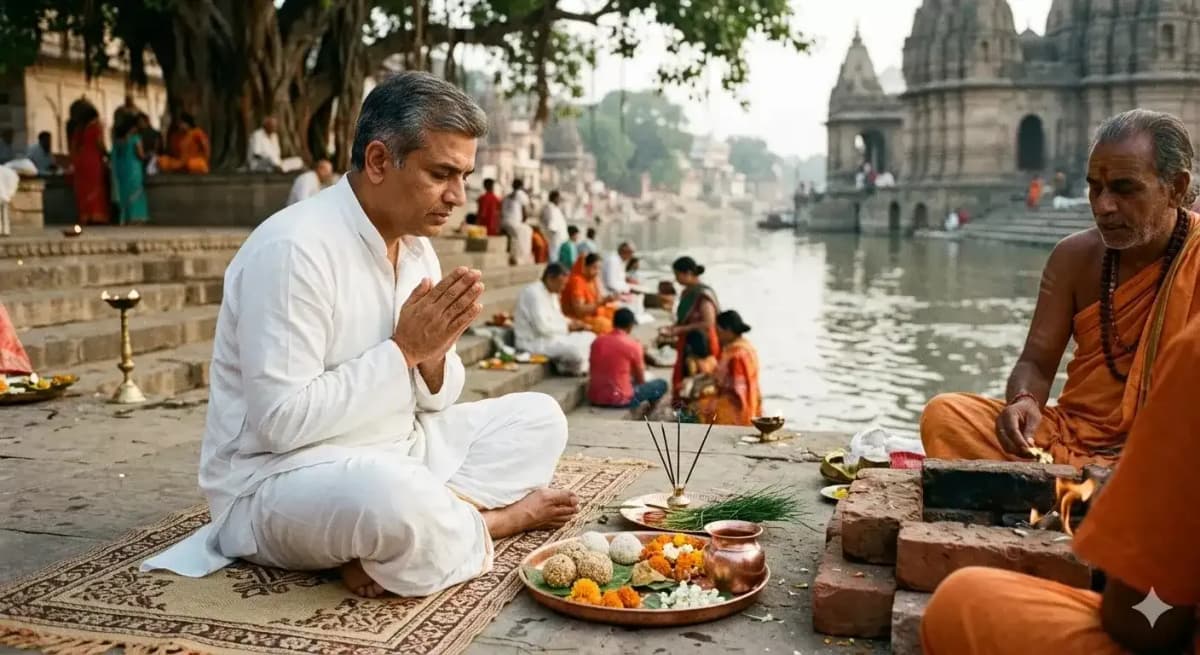
Shraddha is offered on the lunar tithi of a loved one's passing, not the English calendar date. Here is a calm, practical way to find that tithi — and what tradition offers when records are incomplete.
Quick answer: Shraddha is performed on the lunar tithi (moon-day) on which a person passed, not the Gregorian date. Note the paksha (Shukla or Krishna), the lunar month, and the tithi of passing, then find the matching tithi during Pitru Paksha using a panchang. If the tithi is unknown, Sarva Pitru Amavasya (10 Oct 2026) covers all ancestors.
When we lose someone we love, the world often records the date in English — a hospital form, a certificate, a calendar note. Yet the Hindu tradition of shraddha and tarpan follows the moon, not the sun. The rite is offered on the tithi, the lunar day on which the person departed, which is why the same anniversary can fall on a different English date each year. This guide is meant to be gentle and practical: to help you locate that tithi calmly, even if your family records are incomplete.
There is no need for anxiety here. Tradition is wide and forgiving. If you know the tithi, this article shows how to find it in the 2026 calendar; if you do not, it shows the honoured ways families have always managed — and reassures you that a place is kept for every ancestor, named or unnamed, during Pitru Paksha.
- Pitru Paksha 2026: 26/27 September – 10 October 2026
- Sarva Pitru Amavasya: Saturday, 10 October 2026 (covers all ancestors)
- What decides the day: the lunar tithi of passing, not the English date
- If tithi is unknown: observe Sarva Pitru Amavasya
- Confirm timing: check a local panchang; muhurat/kutup times vary by place
Why the tithi, not the English date
The Hindu calendar is lunisolar. A lunar month is divided into two pakshas (fortnights) — Shukla Paksha (waxing moon) and Krishna Paksha (waning moon) — and each paksha has fifteen tithis. Because a tithi is defined by the angle between the sun and moon, it drifts against the Gregorian calendar by roughly eleven days a year. So a passing that occurred on, say, 3 October in one year corresponds not to '3 October' forever, but to a particular tithi in a particular paksha and lunar month. Shraddha honours that lunar anniversary.
During Pitru Paksha — the fortnight the tradition sets aside for the departed — each day corresponds to a tithi. The shraddha for an ancestor is generally offered on the Pitru Paksha day that carries the same tithi on which they passed. This is why the first step is simply to identify the tithi of passing.
How tithis map to Pitru Paksha days
Pitru Paksha falls in the Krishna Paksha of the lunar month (Bhadrapada into Ashwina). Each tithi of that fortnight is traditionally associated with those who passed on that tithi. The table below is a general guide; the exact clock timing of any day should be confirmed against your local panchang.
| Tithi of passing | Shraddha generally observed on |
|---|---|
| Pratipada (1st) | Pratipada shraddha day of Pitru Paksha |
| Panchami / Navami / others | The same-named tithi day within Pitru Paksha |
| Any tithi, but you passed away as a married woman | Avidhava Navami (Navami) is traditionally observed for her |
| Chaturdashi (unnatural/accidental passing) | Chaturdashi is traditionally observed |
| Amavasya, OR tithi unknown, OR no separate day was possible | Sarva Pitru Amavasya (10 Oct 2026) — covers all |
Step by step: finding the tithi from an English date
If you know the Gregorian date of passing but not the tithi, you can recover it. The most reliable route is a panchang — a printed almanac or a trusted panchang tool — that lets you look up any past date and read off the lunar details for that day.
- Write down the exact Gregorian date of passing (day, month, year), and if you can, the time of day and the town.
- Note the time, because a tithi changes during the day; the tithi prevailing at the recorded time of passing is the one that counts.
- Open a panchang for that historical date and locality and read three things: the paksha (Shukla or Krishna), the lunar month, and the tithi.
- Write these down together — for example, 'Krishna Paksha, Ashwina, Dashami'. This trio is your ancestor's shraddha identity.
- For Pitru Paksha 2026, find the day within 26/27 Sep–10 Oct that carries that tithi and observe shraddha then.
- If any detail is uncertain, or the tithi spans a day-boundary, ask a local priest or elder to confirm; when in doubt, Sarva Pitru Amavasya is always valid.
Some families keep this record already — a slip of paper, a note in a religious diary, or a memory held by an elder. It is worth asking older relatives; often someone remembers 'it was the Navami' or 'it was around Amavasya', and that memory is enough to begin.
When you only know the English date — and nothing more
This is common, especially for families who migrated, or where a passing happened long ago or far away. You are not doing anything wrong. If you have only the English date, use the panchang-lookup above to derive the tithi. If even the date is uncertain — only a month, or only a year — you still have honoured options, described next.
When the tithi is unknown
Tradition anticipated exactly this. Records are lost, ancestors are unknown by name, families are scattered. For this reason the fortnight closes with Sarva Pitru Amavasya — the 'all-ancestors' new-moon day, Saturday 10 October 2026 — on which tarpan and shraddha are offered collectively to every departed soul of the lineage, known and unknown, whose tithi cannot be fixed. Observing this day is a complete and dignified way to remember them.
- If you know no tithi at all, observe Sarva Pitru Amavasya (10 Oct 2026).
- If you know only the lunar month or paksha, an elder or priest can still guide you to a suitable day; otherwise Amavasya covers it.
- If you cannot travel to Gaya, Kashi or Prayagraj, home tarpan is fully accepted; the tradition never required a pilgrimage.
- Feeding others — offering food to those in need, or to a Brahmin, cow, crow or guest — is a widely honoured way to remember when a formal rite is not possible.
- Daan (giving) done with a quiet remembrance of one's ancestors is considered a fitting observance.
Who may perform it
Traditionally a son offers shraddha, but the practice today is broader than that. Many priests and families now welcome daughters, wives, brothers, grandchildren and other relatives to perform the rite, and a great many households observe it with a local priest's guidance rather than a fixed rule. This guide does not lay down who must or must not perform it — that is a decision for you, your family and, if you wish, a priest you trust. What matters most is the remembrance offered with sincerity.
A gentle note on timing and belief
The clock times sometimes mentioned for shraddha — such as the aparahna period, or kutup and rauhina windows — vary by place and date, so confirm them against a local panchang or with a priest rather than any single printed time. And a word of reassurance: the beliefs surrounding Pitru Paksha are offered here as beliefs, held with love and reverence. Remembering our ancestors is an act of gratitude and continuity; it is best approached with calm and affection, not fear.
Related reading
- Pitru Paksha 2026 — complete guide
- Pitru Paksha 2026 tithi calendar (day-by-day)
- Sarva Pitru Amavasya 2026
- Pitru Paksha 2026 start date
- Can a daughter perform shraddha?
- Pitru Paksha 2026 — NRI guide
- Bhadrapada Masam 2026 (month pillar)
Frequently Asked Questions
Is shraddha performed on the English date or the tithi?
On the tithi — the lunar day of passing — not the Gregorian date. Because the Hindu calendar is lunisolar, the tithi drifts against the English calendar by about eleven days a year, so the same anniversary falls on a different English date each year.
How do I convert a death date into a tithi?
Look up that exact past date in a panchang (almanac or trusted panchang tool) for the town where the passing occurred. Read off the paksha, the lunar month, and the tithi prevailing at the recorded time. That trio is the shraddha tithi.
Why does the tithi matter more than the date?
A tithi is defined by the moon's position, which is what the tradition of shraddha follows. The English date is simply how modern records happen to be kept; the lunar anniversary is the one the rite honours.
I only know the English date, not the tithi. What should I do?
Use a panchang to derive the tithi from that date, as described above. If that is not possible, you can observe Sarva Pitru Amavasya (10 October 2026), which is kept for all ancestors regardless of tithi.
I am an NRI and don't have my ancestor's tithi at all. Is that a problem?
It is very common and not a problem. Observe Sarva Pitru Amavasya, which covers all departed of the lineage, including those whose tithi is unknown. Home tarpan is fully accepted; travel to a holy place is an option, never a requirement.
Two panchangs give slightly different tithis for the same day. Which do I follow?
Tithis can straddle a day-boundary, so almanacs sometimes differ by the reckoning used. Follow the panchang your family or local priest customarily uses, and when uncertain, Sarva Pitru Amavasya is always a valid observance.
There is no son in the family. Can someone else perform the shraddha?
Yes. While a son traditionally offers it, many priests and families today welcome daughters, wives, brothers, grandchildren and other relatives to perform the rite. This is a decision for your family, ideally with a priest you trust.
What if I cannot travel or arrange a formal rite this year?
Home tarpan, daan (giving), and feeding others in remembrance are all honoured ways to remember your ancestors when a formal rite or pilgrimage is not possible. Sincerity and remembrance are what the tradition values most.
You might also like
Navratri 2026: 9 Days, Colors, Goddess Names, Puja & Significance
Navratri 2026 USA: Dates, Garba, Dandiya, Durga Puja & NRI Celebration Guide

Indian Temple Flowers: Sacred Blooms & What Each Deity Loves