
Dussehra 2026 in Thailand, City by City: Date, Vijay Muhurat and Hindu Temples
Vijayadashami falls on Tuesday 20 October 2026 across Thailand. Local Vijay Muhurat, Aparahna and Dashami times for Bangkok, Chiang Mai, Phuket and Pattaya, why the puja should start after 2:20 PM, Hindu temples from Silom to Rawai, and how to mark the day at home.
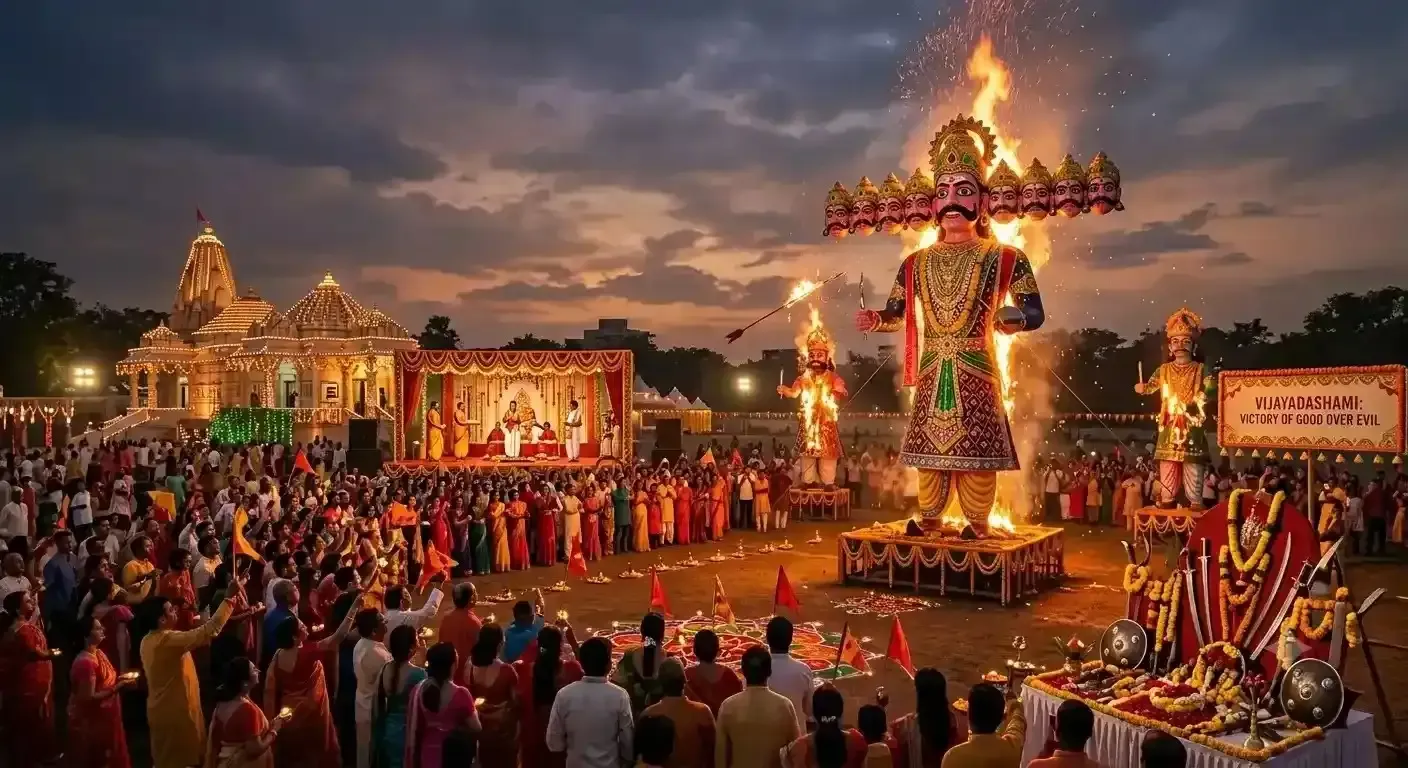
Vijayadashami falls on Tuesday 20 October 2026 across Thailand. Local Vijay Muhurat, Aparahna and Dashami times for Bangkok, Chiang Mai, Phuket and Pattaya, why the puja should start after 2:20 PM, Hindu temples from Silom to Rawai, and how to mark the day at home.
Quick answer: Dussehra (Vijayadashami) 2026 in Thailand is on Tuesday 20 October 2026 in every city. The Vijay Muhurat, calculated by the Drik Panchang method, is 2:00 PM – 2:47 PM in Bangkok, 2:05 PM – 2:51 PM in Chiang Mai, 2:10 PM – 2:58 PM in Phuket and 1:59 PM – 2:46 PM in Pattaya (Thai time, ICT, UTC+7). Dashami begins at 2:20 PM Thai time, so do the Shami, Aparajita and Vijay puja after 2:20 PM, within the Aparahna. Navratri runs from Sunday 11 to Monday 19 October 2026.
Editor's note (5 October 2026): The local times on this page were calculated for each city from the Drik Panchang tithi (Dashami from 12:50 PM IST on 20 October to 2:11 PM IST on 21 October 2026), using Indochina Time, which Thailand keeps all year with no daylight saving. The Vijay Muhurat is the 11th of the 15 daytime muhurtas, calculated by the Drik Panchang method. We do not list 2026 event schedules, because temples and associations announce their own programmes; please check with them directly.
Thailand has a long, quiet relationship with Hinduism. Brahmin priests have served the Thai royal court for centuries, the Ramakien — Thailand's national version of the Ramayana — is painted on the gallery walls of Bangkok's Grand Palace, and Thai Buddhists widely worship Ganesha, Brahma, Shiva and Lakshmi at shrines across the country. Alongside this, an Indian community of tens of thousands has grown since the late nineteenth century: Tamil traders who founded the Silom temple, North Indian and Punjabi merchant families in Bangkok's Phahurat and Sampheng districts, Sindhi and Gujarati businesses, and today a large number of Indian professionals, hoteliers, jewellers and students. Nepali Hindus also form an active community, particularly in Bangkok and Phuket. The result is a Navratri season that mixes Tamil, Bengali, Gujarati and North Indian traditions with a uniquely Thai public devotion to the Goddess.
Dussehra 2026 in Thailand: dates and Vijay Muhurat by city
The whole of Thailand is on Indochina Time (UTC+0700) all year. The Dashami tithi begins and ends at the same moment everywhere, so only the sun-based windows differ from city to city. Phuket, in the south-west, has the latest Vijay Muhurat and sunset; Pattaya and Bangkok the earliest.
| Region | City | Dussehra date | Vijay Muhurat (Drik Panchang method) | Dashami begins → ends |
|---|---|---|---|---|
| Bangkok | Bangkok | Tue 20 Oct | 2:00 PM – 2:47 PM | Tue 20 Oct, 2:20 PM → Wed 21 Oct, 3:41 PM |
| Chiang Mai | Chiang Mai | Tue 20 Oct | 2:05 PM – 2:51 PM | Tue 20 Oct, 2:20 PM → Wed 21 Oct, 3:41 PM |
| Phuket | Phuket | Tue 20 Oct | 2:10 PM – 2:58 PM | Tue 20 Oct, 2:20 PM → Wed 21 Oct, 3:41 PM |
| Chonburi | Pattaya | Tue 20 Oct | 1:59 PM – 2:46 PM | Tue 20 Oct, 2:20 PM → Wed 21 Oct, 3:41 PM |
The Aparahna (afternoon period) is the traditional window for Aparajita and Shami puja, and sunset marks the time for any evening Ravan Dahan or aarti:
| City | Aparahna, 20 Oct | Sunset, 20 Oct |
|---|---|---|
| Bangkok | 1:13 PM – 3:34 PM | 5:56 PM |
| Chiang Mai | 1:18 PM – 3:38 PM | 5:58 PM |
| Phuket | 1:22 PM – 3:45 PM | 6:08 PM |
| Pattaya | 1:12 PM – 3:33 PM | 5:55 PM |
Why the puja should start after 2:20 PM
In Thailand this year the Vijay Muhurat begins slightly before the Dashami tithi does. Dashami begins at 2:20 PM Thai time on 20 October, so do the Shami, Aparajita and Vijay puja after that, within the Aparahna. In practice that gives a comfortable window: in Bangkok from 2:20 PM until the Aparahna ends at 3:34 PM, with the overlap with the Vijay Muhurat from 2:20 PM – 2:47 PM. Chiang Mai has until 3:38 PM, Phuket until 3:45 PM and Pattaya until 3:33 PM. Dashami covers well over an hour of the Aparahna in every city, so there is no doubt about the date: it is Tuesday 20 October.
Key Navratri and Dussehra dates 2026
| Observance | Date (2026) |
|---|---|
| Navratri begins (Ghatasthapana) | Sunday 11 October |
| Durga Ashtami and Maha Navami | Monday 19 October |
| Dussehra / Vijayadashami in Thailand | Tuesday 20 October |
| Dashami tithi, Thai time | Tue 20 Oct, 2:20 PM → Wed 21 Oct, 3:41 PM |
| Bijoya Dashami / Sindoor Khela (India, Bengal tradition) | Wednesday 21 October |
Ashtami and Navami share Monday 19 October in India's calendar this year, so families who do Kanya pujan on either day will hold it then.
Hindu temples in Thailand for Navratri & Dussehra
These temples and associations have been confirmed to exist in or near each city. We list name and area only; check their own websites or social pages for opening hours and festival plans. Temples and community groups usually announce Navratri garba, Durga Puja, Ramlila and Ravan Dahan programmes a few weeks ahead — check their websites/social pages.
Bangkok
Bangkok's Vijay Muhurat is 2:00 PM – 2:47 PM, with the Aparahna from 1:13 PM – 3:34 PM and sunset at 5:56 PM; begin the puja after Dashami starts at 2:20 PM. The capital is home to most of Thailand's Indian community and its best-known temples, and Navratri here is a citywide event that draws Thai devotees in large numbers.
- Sri Maha Mariamman Temple (Wat Khaek) — Silom, Bang Rak. Founded by Tamil traders in the late nineteenth century, it is Thailand's most important Tamil Hindu temple, dedicated to the Goddess Mariamman. Its Navaratri festival, ending in a large street procession of the Goddess, is one of Bangkok's best-known religious events.
- Dev Mandir (Hindu Samaj) — near the Giant Swing, Phra Nakhon (old city). Established in 1925 by the Hindu Samaj, a Vaishnava temple of Vishnu, Narayana and Lakshmi that serves North Indian families and many Thai worshippers.
- Vishnu Mandir — Unakan Road, beside Wat Suthat, Phra Nakhon. Built in 1982 by the Indian-Thai community to mark the bicentenary of Rattanakosin.
- Devasathan — near Wat Suthat and the Giant Swing, Phra Nakhon. The royal Brahmin temple and official centre of Hinduism in Thailand, where court Brahmins conduct state ceremonies.
- ISKCON Bangkok — Thonburi, with a second centre near Assumption University. Hare Krishna temples holding daily programmes and festival kirtans.
- Bharati (Bengali Association of Thailand) — Bangkok. Founded in 1986, it has organised the city's Bengali Durga Puja for decades.
At Navratri, the Silom temple typically holds nightly pujas to the Goddess, with crowds spilling onto the street, and the closing procession carries decorated images through Silom with music and offerings set out along the road; the authorities usually close roads around the temple for it. Dev Mandir and the Hindu Samaj typically hold Durga puja, aarti and bhajans, and Gujarati and wider Indian groups hold garba and dandiya nights in hotel ballrooms and halls.
Chiang Mai
Chiang Mai's Vijay Muhurat is 2:05 PM – 2:51 PM (Aparahna 1:18 PM – 3:38 PM, sunset 5:58 PM); begin the puja after 2:20 PM. The northern capital has a small but long-established Indian community, most of it Sikh, with Hindu families settled since the 1930s, plus a steady stream of Indian visitors and students.
- Dev Mandir Chiang Mai — Rattanakosin Road, near the city centre. A temple with several Hindu shrines under one roof that observes the main festivals of the Hindu calendar.
- Ganesha Hindu Temple — Charoen Prathet Road, Chang Khlan area. A small temple dedicated to Ganesha, used by local Hindu families and visitors.
Celebrations in Chiang Mai are typically modest: temple puja and aarti during the nine nights, family gatherings, and joint events with the wider Indian community. Many families do the Dussehra puja at home in the afternoon.
Phuket
Phuket's Vijay Muhurat is 2:10 PM – 2:58 PM (Aparahna 1:22 PM – 3:45 PM, sunset 6:08 PM); begin the puja after 2:20 PM. The island has an Indian community working in tourism, hospitality and jewellery, a sizeable Nepali community, and many Indian tourists in October.
- Wat Khaek Phuket — Phuket Town. Established about 80 years ago by Indian immigrants, with shrines to Ganesha, Murugan and Lakshmi.
- Shree Bhagawat Dham Sanatan Mandir (Shiva temple) — near Patong. A Shiva temple serving the island's Nepali, Indian and other Hindu communities.
- Lord Shrimant Ganpati Bappa Devalai — Rawai. A Ganesha temple opened in late 2024, modelled on the Dagdusheth Halwai Ganpati temple in Pune.
Nepali families on the island often observe Dashain with tika and jamara, while Indian families gather at the temples for puja and aarti; larger garba evenings may be held at hotels.
Chonburi: Pattaya
Pattaya's Vijay Muhurat is 1:59 PM – 2:46 PM (Aparahna 1:12 PM – 3:33 PM, sunset 5:55 PM); begin the puja after 2:20 PM. Pattaya has Indian residents in hospitality, retail and trade and a large number of Indian visitors, and it is within easy reach of Bangkok's temples.
- ISKCON Pattaya Temple — Na Kluea, north Pattaya. A Krishna temple with Radha, Krishna and Balaram, as well as Shiva and Parvati.
The Sanctuary of Truth in Na Kluea, a huge carved wooden building themed on Hindu and Buddhist beliefs, is a visitor attraction rather than a temple. Many Pattaya families do the Dussehra puja at home or travel to Bangkok for the larger Navratri events.
How Thailand celebrates Navratri and Dussehra
The most distinctive feature of Navratri in Thailand is how widely Thai Buddhists take part. The Goddess is worshipped as Phra Mae Uma Devi, and Thai devotees join Indian families with marigolds, fruit and incense, especially in Silom. Spirit-medium processions and roadside offering stalls are a Thai addition you will not see in India.
Within the Indian community, Gujarati and wider Indian groups hold garba and dandiya nights, usually on the weekends either side of the nine nights, with a central Mataji image and aarti at the start. Bharati's Durga Puja brings dhak drumming, pushpanjali, bhog and cultural evenings, ending with Bijoya greetings and Sindoor Khela. Tamil families set up Golu (Bommai Kolu) displays and visit each other's homes, while temples hold Saraswati Puja and Ayudha Puja near the end of the nine nights and Vidyarambham on Vijayadashami. Telugu families may celebrate Bathukamma, and Nepali families observe Dashain with tika and jamara.
Large open-air Ravan Dahan as seen in North India is uncommon in Thailand. Open fires, effigy burning and fireworks are regulated by local authorities, so where groups mark it at all, it is usually a small symbolic effigy, a Ramlila play for children or a story session. In Thailand the Rama story is also everywhere in the form of the Ramakien — a good way to share it with children is to visit the Grand Palace murals or a khon masked-dance performance.
Dussehra puja at home
If you cannot reach a temple on a Tuesday afternoon, a short puja at home is entirely traditional. Start after Dashami begins at 2:20 PM and finish within your city's Aparahna, ideally overlapping the Vijay Muhurat:
- Aparajita puja: draw an eight-petalled lotus with kumkum or rice flour, place a lamp, and worship Devi Aparajita, the goddess of victory, with flowers, akshat and a simple prayer for success over obstacles.
- Shami puja: if you have Shami leaves (or a substitute such as apta/bauhinia leaves, which grow widely in Thailand), offer them to the Devi and exchange them with family as "gold" — a Maharashtrian and Karnataka custom.
- Ayudha Puja / Shastra puja: clean and decorate tools, books, laptops, scooters and the car, apply kumkum and offer flowers, thanking them for their service.
- Vidyarambham: Vijayadashami is the traditional day for small children to begin learning — writing "Om" or the first letters of the alphabet in rice.
- Seemollanghan and new beginnings: a short walk beyond your street, starting a course or signing a new venture are traditional symbols of victory on this day.
A simple order: bathe, light a lamp, pray to Ganesha, do the Aparajita and Shami puja, then Ayudha puja, offer naivedya (sweets, fruit), do aarti and share prasad. For full step-by-step vidhi and the stories behind the festival, see our Dussehra / Vijayadashami 2026 pillar guide.
Practical tips for Dussehra in Thailand
- Working day: Tuesday 20 October is a normal working and school day in Thailand. The puja window falls in mid-afternoon, so consider a short break or working from home, or do the puja at any point between 2:20 PM and the end of your city's Aparahna.
- Crowds and road closures: Silom gets very crowded during the Navratri season, and roads around the Sri Maha Mariamman Temple are often closed for the procession. Use the BTS (Surasak or Chong Nonsi) or MRT (Silom) rather than driving, and follow local news for closures.
- Fire and fireworks: rules on open fires, effigy burning and fireworks are set by local authorities. Do not burn effigies or set off fireworks without permission.
- Weather: October is the tail of the rainy season, so afternoon storms are common in Bangkok and Phuket. Carry an umbrella, and remember temples ask for modest dress and shoes off.
- Puja items: Phahurat (Little India) in Bangkok and the shops around the Silom temple sell marigolds, kumkum, lamps and Indian sweets; marigolds are easy to find across Thailand.
- Muhurat: use your own city's times from the table above; never convert India's times into Thai time.
Frequently asked questions
When is Dussehra 2026 in Thailand?
Tuesday 20 October 2026 in every Thai city. The Dashami tithi begins at 2:20 PM Thai time (ICT) on 20 October and ends at 3:41 PM on Wednesday 21 October. It overlaps the afternoon Aparahna of the 20th by more than an hour, so the 20th is the day.
What is the Vijay Muhurat in Bangkok?
Calculated by the Drik Panchang method, Bangkok's Vijay Muhurat is 2:00 PM – 2:47 PM on Tuesday 20 October 2026. Because Dashami only begins at 2:20 PM, do the Shami, Aparajita and Vijay puja after 2:20 PM, within the Aparahna, which runs until 3:34 PM in Bangkok.
What about Chiang Mai, Phuket and Pattaya?
Chiang Mai's Vijay Muhurat is 2:05 PM – 2:51 PM, Phuket's 2:10 PM – 2:58 PM and Pattaya's 1:59 PM – 2:46 PM, all calculated by the Drik Panchang method. In every city, Dashami begins at 2:20 PM, so start the puja after 2:20 PM and finish within your city's Aparahna.
Can I convert India's Dussehra muhurat into Thai time?
No. The Vijay Muhurat depends on local sunrise and sunset, so it has to be calculated for your own city. Use the Thai times on this page or your temple's calendar, not India's times shifted by the time difference.
When is Bijoya Dashami and Sindoor Khela for Bengali families in Thailand?
In India, Bengal-tradition Bijoya Dashami and Sindoor Khela fall on Wednesday 21 October 2026 (Drik Panchang, Kolkata). The Durga Puja in Bangkok run by Bharati, the Bengali association of Thailand, follows its own committee's schedule, so check their announcements.
Is Dussehra a public holiday in Thailand?
No. Tuesday 20 and Wednesday 21 October 2026 are normal working and school days in Thailand. Many families do the afternoon puja at home or at a temple during a break, and join community celebrations in the evening or at the weekend.
Related guides
- Dussehra / Vijayadashami 2026: complete guide
- Navratri 2026: complete guide for NRI families
- Dussehra 2026 Malaysia, state by state
- Dussehra 2026 Singapore, area by area
- Dussehra 2026 in Indonesia, city by city
- Dussehra 2026 in Sri Lanka, city by city
- Dussehra 2026 in Hong Kong, city by city
- Dashain 2026 in Nepal
- October 2026 Hindu festival calendar
You might also like
Dussehra 2026 in Victoria, BC: Date, Vijay Muhurat, Temples and Navratri Celebrations
Dussehra 2026 in Surrey: Date, Vijay Muhurat, Temples and Navratri Celebrations
Dussehra 2026 in Vancouver: Date, Vijay Muhurat, Temples and Navratri Celebrations