Raas Purnima 2026 in Assam: Date, Majuli Raas Mahotsav, Story and Celebrations
Assam's Raas Purnima (Rash Purnima) 2026 falls on Tuesday 24 November, the Kartika full moon. The story of Krishna's Raas Leela, Majuli's Raas Mahotsav and satra traditions, celebrations in Barpeta and Nalbari, and how to celebrate at home or abroad.
Assam's Raas Purnima (Rash Purnima) 2026 falls on Tuesday 24 November, the Kartika full moon. The story of Krishna's Raas Leela, Majuli's Raas Mahotsav and satra traditions, celebrations in Barpeta and Nalbari, and how to celebrate at home or abroad.
Quick answer: Raas Purnima (Rash Purnima) 2026 in Assam is on Tuesday 24 November, the Kartika full moon. Satras on Majuli and communities in Barpeta, Nalbari and across Assam stage Raas Leela dance-dramas of Krishna's life. Confirm each venue's dates before travelling.
Last updated: 19 October 2026
Raas Purnima is one of the most beautiful Krishna celebrations in Assam. Known locally as Rash Purnima or Raas Mahotsav, it celebrates the divine love of Lord Krishna through devotional performances, traditional dance-dramas, music and storytelling based on Krishna's life and his Raas Leela with the Gopis.
Assam's Raas Mahotsav is especially famous on Majuli, widely described as the world's largest river island, and in cultural centres such as Barpeta and Nalbari. The satras, the Vaishnava monasteries of Assam, play a central role in preserving the devotional art, music and theatre of the festival.
Raas Purnima 2026 in Assam falls on Tuesday 24 November 2026, the full moon of Kartika (Kartika Purnima). Individual satras and committees may hold performances over several nights around the full moon, so confirm local schedules before travelling. This guide covers the date, the story of the Raas Leela, the celebrations on Majuli and elsewhere in Assam, the role of the satras, and ways to celebrate at home or abroad.
Raas Purnima 2026 date and key details
| Detail | Information |
|---|---|
| Festival | Raas Purnima / Rash Purnima / Raas Mahotsav |
| Date in Assam | Tuesday 24 November 2026 |
| Lunar occasion | Kartika Purnima |
| Main deity | Lord Krishna |
| Main centres | Majuli, Barpeta, Nalbari and towns across Assam |
| Main activities | Raas Leela performances, devotional singing (naam-kirtan), prayer and cultural programmes |
The date follows the general Indian calendar for Kartika Purnima, which HinduTone's November 2026 festivals state-wise also lists for Assam. Individual Raas Mahotsav programmes follow their own institutional calendars, so confirm exact dates with the satra or organiser.
Not the same as Sharad Purnima "Raas Purnima"
In Braj, Gujarat and many Krishna temples, the name Raas Purnima is also used for Sharad Purnima, the full moon of Ashvin, which fell on 25 October 2026 this year, because the Bhagavata tells of Krishna's Maha Raas on an autumn full-moon night. Assam's Raas Mahotsav is held a month later, on the Kartika full moon. See Sharad Purnima 2026 for the October festival.
What is Raas Purnima in Assam?
Raas Purnima celebrates the divine Raas Leela of Lord Krishna. In Hindu devotional tradition, the Raas Leela is Krishna's enchanting circle-dance with the Gopis of Vrindavan, a symbol of the soul's loving devotion to the Divine.
In Assam the festival combines Vaishnava worship, traditional theatre, dance, music and community participation. Performers enact episodes from Krishna's life while devotees gather to watch, sing devotional songs and offer prayers. The Raas Mahotsav is not simply a stage show: it is a living religious heritage, preserved over generations by satras, artists, musicians and local communities.
The Assamese Vaishnava tradition (Ekasarana Dharma) was founded by the saint-scholar Srimanta Sankardeva in the 15th and 16th centuries and carried forward by his disciple Madhavdeva. Sankardeva created the Ankiya Naat one-act plays and their performance, known as Bhaona, to teach devotion to Krishna through music, dance and drama. Raas performances in Assam grow out of this heritage.
Why is Raas Purnima important?
1. A celebration of Krishna's divine love
The central theme of the Raas Leela is the loving relationship between Krishna and his devotees. Many Vaishnava traditions see the Gopis' devotion as a symbol of complete surrender to God.
2. Preserving Assamese culture
Raas performances keep alive Assamese music, dance, costumes, masks, storytelling and theatre. Communities often prepare for weeks before the festival.
3. The importance of the satras
Assam's satras are centres of Vaishnava practice and cultural learning. Many have preserved devotional performance traditions and passed them from one generation to the next.
4. Community participation
The Raas Mahotsav brings together devotees, performers, volunteers, families and visitors to celebrate faith and regional identity.
5. Spiritual reflection
For devotees, watching Krishna's Raas Leela is a time to reflect on humility, devotion, compassion and spiritual love.
The story of Krishna's Raas Leela
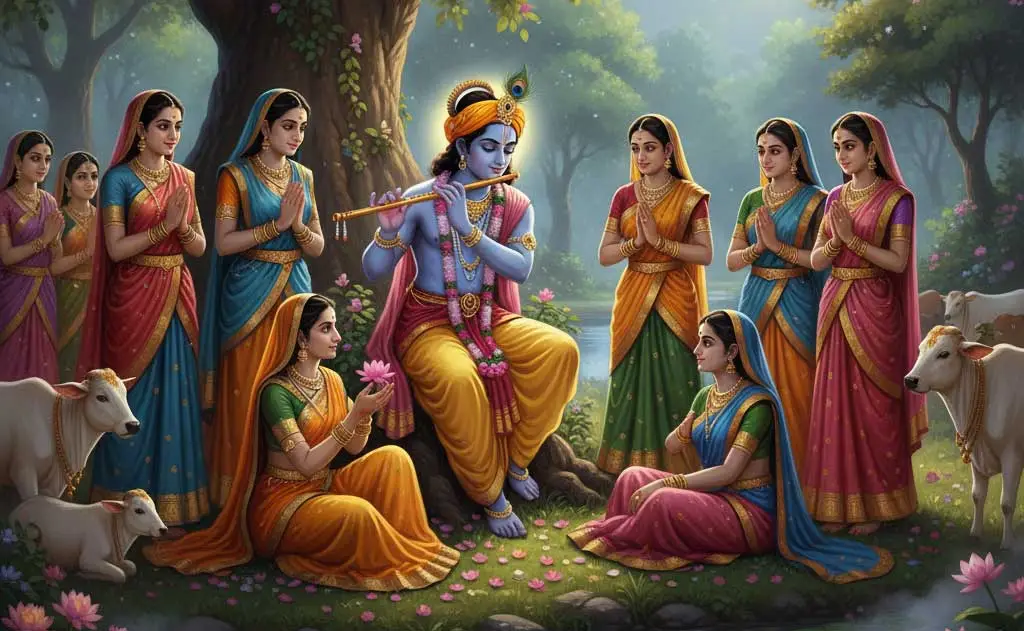
Krishna spent his childhood in the Braj region, where his play and divine presence won the love of the people of Vrindavan. The Gopis, the cowherd women of Vrindavan, became deeply devoted to him. One moonlit night, the sound of Krishna's flute drew them to the banks of the Yamuna, and Krishna danced with them in the Raas Leela, an episode described in the tenth book of the Bhagavata Purana and especially loved by Krishna devotees.
Different devotional traditions understand the story in different ways. Many Vaishnava teachers explain the Raas Leela as a spiritual allegory of the soul's longing for union with God rather than an earthly dance. In Assam, episodes from Krishna's life are adapted into devotional performances in which music, costumes, movement and dialogue bring the story to life for audiences of every age. The performance is both an art and a form of devotional storytelling.
Raas Mahotsav on Majuli
Majuli, in the Brahmaputra, is one of Assam's best-known centres of Vaishnava heritage. Its satras have played a major role in preserving the teachings and cultural traditions of the Assamese Vaishnava movement. During the Raas Mahotsav, satras and village communities stage elaborate performances of Krishna's childhood, his life among the people of Braj and the Raas Leela.
What visitors may experience
Depending on the venue and programme, visitors may see:
- Traditional dance-dramas based on Krishna's life
- Devotional songs with khol drums and cymbals
- Colourful costumes and carefully prepared stage settings
- Traditional masks; Majuli's Samaguri Satra is well known for mask-making
- Community prayer and religious observances
- Local food, crafts and cultural activities around the venues
Not every satra or village follows the same programme. Performance formats, timings and visitor arrangements vary, so check with the organiser before travelling.
Why Majuli matters
Majuli's satras are treasure-houses of Assamese Vaishnava tradition, preserving religious teachings alongside performing arts, crafts and community life. The Raas Mahotsav lets visitors learn about this heritage from the communities who keep it alive. Approach religious spaces respectfully and follow local instructions on photography, footwear, seating and participation.
Raas Mahotsav in Barpeta, Nalbari and other parts of Assam
Barpeta
Barpeta, home to the historic Barpeta Satra, is closely associated with Assamese Vaishnava traditions and has contributed greatly to the region's devotional music and theatre. Check local announcements for the 2026 Raas programme.
Nalbari
Nalbari and nearby areas have a long tradition of Raas celebrations, with Krishna Leela performances, devotional music and community gatherings.
Other Assamese communities
Raas performances are organised in many localities across Assam, some by satras and others by community organisations and cultural committees.
Travel note: confirm the 2026 dates, venues and performance schedules with the organisers. Do not assume every venue holds its main performance on 24 November.
How to celebrate Raas Purnima at home
Step 1: Prepare a clean prayer space
Place an image or idol of Lord Krishna in a clean spot, with flowers, a small lamp and your customary offerings.
Step 2: Offer prayers to Lord Krishna
Offer flowers, fruits or sweets as naivedya, following your household tradition, and sing a Krishna bhajan or a familiar prayer.
Step 3: Read about the Raas Leela
Read a passage from a trusted edition of the Bhagavata Purana or a devotional text your family uses, and explain its spiritual meaning to children.
Step 4: Listen to devotional music
Play Krishna bhajans or recordings of Assamese devotional music such as Borgeet, the devotional songs of Sankardeva and Madhavdeva. You might also watch a recording of a traditional Raas performance.
Step 5: Share the festival with children
Talk about devotion, respect, kindness and cultural heritage. Children can draw Krishna, learn a devotional song or join a simple family prayer.
Step 6: Share food and goodwill
Offer prasadam to family members and, where possible, share food with neighbours or people in need.
Raas Purnima 2026 for Assamese families abroad
Assamese and Hindu communities in the USA, UK, Canada, Australia, New Zealand and elsewhere can celebrate through home worship and community programmes:
- Confirm the date in your local panchang; the Kartika full moon can fall on a different calendar day abroad. See Karthika Pournami 2026 for times by country.
- Check whether an Assamese association, Hindu temple or cultural group is holding a Krishna programme.
- Arrange a small home puja with an image of Lord Krishna.
- Watch or share recordings of traditional Assamese Raas performances.
- Teach children about Majuli, the satras and the history of Assamese Vaishnava culture.
- Send devotional greetings to friends and relatives in Assam.
- Support authentic organisations that preserve Assamese arts and traditions.
Raas Purnima 2026 wishes
Traditional greeting: Happy Raas Purnima 2026! May Lord Krishna fill your heart with devotion, your home with happiness and your life with peace and spiritual wisdom.
Devotional message: On this sacred Raas Purnima, may the divine love of Shri Krishna inspire compassion, humility and unwavering faith in your heart. Radhe Krishna!
Short WhatsApp Status: 🌕🙏 Happy Raas Purnima 2026! May Shri Krishna's divine grace bring peace, love and happiness to every home.
Assamese cultural greeting: Warm wishes on Raas Mahotsav 2026 to everyone celebrating in Assam, Majuli and around the world. May this beautiful tradition of Krishna bhakti inspire future generations.
For families abroad: Happy Raas Purnima! Wherever we live, may devotion to Lord Krishna and our cultural traditions keep us connected to our roots.
Instagram caption: 🌸✨ Celebrating the divine love of Shri Krishna and the timeless beauty of the Raas Leela. Wishing everyone a blessed Raas Purnima 2026! 🙏
Conclusion
Raas Purnima celebrates devotion to Lord Krishna and the rich cultural heritage of Assam. Through the Raas Leela, traditional music, theatre and community worship, the festival keeps an important spiritual and artistic tradition alive. As Raas Purnima 2026 approaches, check the local programme before travelling, learn about the traditions of the venue you visit, and celebrate with respect for the communities who preserve this heritage.
HinduTone wishes everyone a blessed Raas Purnima 2026. May Lord Krishna's grace bring peace, devotion and happiness to every family.
Frequently asked questions
When is Raas Purnima 2026 in Assam?
Tuesday 24 November 2026, the Kartika full moon (Kartika Purnima). Satras and committees may stage performances over several nights around the full moon, so confirm local schedules.
Where is Raas Mahotsav celebrated in Assam?
Majuli is the best-known centre. Raas celebrations are also held in Barpeta, Nalbari and many other towns and villages across Assam.
Is Raas Purnima the same as Sharad Purnima?
Not in Assam. In Braj and Gujarat the name Raas Purnima is often used for Sharad Purnima (25 October 2026), while Assam's Raas Mahotsav is held on the Kartika full moon, 24 November 2026.
What is the significance of the Raas Leela?
The Raas Leela is Krishna's divine dance with the Gopis, described in the Bhagavata Purana. In Vaishnava tradition it symbolises the soul's loving devotion to God.
Can visitors attend the Raas Mahotsav?
Visitors are usually welcome at public performances, but access, seating and photography rules depend on the venue. Check the organiser's latest announcement before travelling.
Does Raas Purnima require fasting?
There is no single fasting rule for Raas Purnima. Customs vary by family and tradition; follow your own practice and do not keep a fast that could harm your health.
Editor's note (19 October 2026)
Owner-supplied article. The date follows the Kartika Purnima date in Drik Panchang and HinduTone's November 2026 calendar. We added the distinction from Sharad Purnima's "Raas Purnima", brief background on Sankardeva's tradition, and links to related guides. We have not listed 2026 venue schedules, which are announced locally by satras and committees.
Related guides
You might also like
Kartik Purnima 2026: Date, Purnima Time, Snan, Deep Daan, Puja Vidhi and Significance

Sharad Purnima 2026 in the USA, UK and Canada: Kojagari Night (24 or 25 October?) and Moonrise Time by City
Dussehra 2026 Date, Puja Muhurat, Significance and Celebrations Around the World