
The Syamantaka Story: Spiritual Meaning and Deeper Teaching
How the Syamantaka jewel led to a false accusation against Lord Krishna, why the story is read on Vinayaka Chavithi to ward off Mithya Dosha, and what it teaches about possession, reputation and truth.
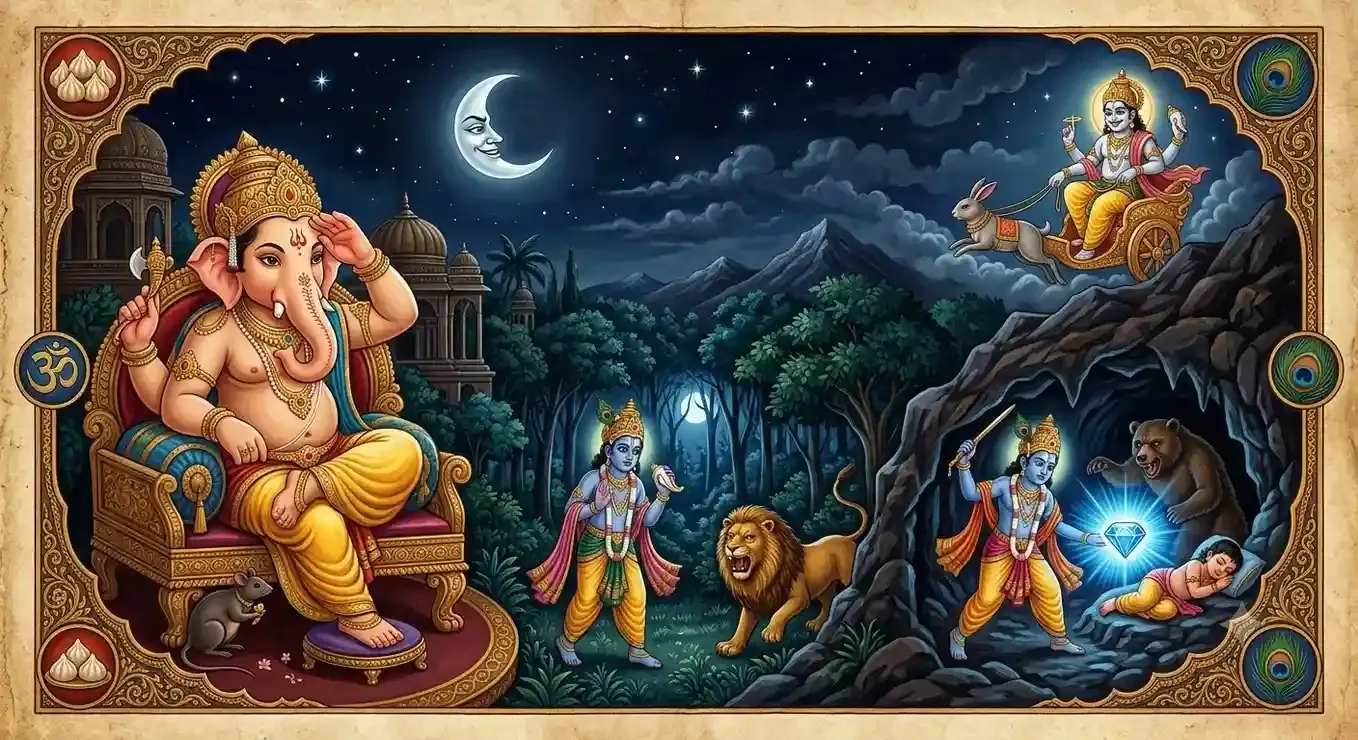
How the Syamantaka jewel led to a false accusation against Lord Krishna, why the story is read on Vinayaka Chavithi to ward off Mithya Dosha, and what it teaches about possession, reputation and truth.
Quick answer: The Syamantaka story tells how Lord Krishna was falsely accused of stealing a wondrous jewel, the Syamantaka mani, and how he cleared his name by finding it in the cave of Jambavan. It is read on Vinayaka Chavithi because tradition says anyone who sees the moon that night suffers Mithya Dosha (false blame), as Krishna did. Beneath the story lie lessons on greed, suspicion, patience and the way truth restores reputation.
For many families, especially Telugu, Kannada and Tamil households, the Vinayaka Chavithi pooja is not complete without the katha: the story of Ganesha's birth, the curse on the moon, and finally Krishna and the Syamantaka jewel. Children hear it every year, usually sitting with akshata in their hands. This guide retells the story and then looks at what it teaches.
The story in brief
The account below follows the Bhagavata Purana (10.56 to 10.57) and the Vishnu Purana (4.13). Details such as the number of days of battle differ between texts.
Satrajit and the gift of the Sun
Satrajit, a Yadava nobleman of Dwaraka, was a devotee of Surya, the Sun god. Pleased with him, Surya gave him the Syamantaka jewel, so radiant that when Satrajit entered Dwaraka the people thought the Sun himself had come. The jewel was said to produce gold every day and to protect the land where it was honoured from famine and calamity.
A request refused
Krishna suggested that such a treasure would serve the whole kingdom best in the hands of King Ugrasena. Satrajit, attached to the jewel, refused. Krishna let the matter rest.
Prasena, the lion and Jambavan
Satrajit's brother Prasena wore the jewel on a hunting trip into the forest. A lion killed Prasena and carried off the gem. The lion was in turn killed by Jambavan, the great bear-king who had served Lord Rama in the Ramayana. Jambavan took the jewel to his cave and gave it to his child as a plaything.
The accusation
When Prasena did not return, whispers spread in Dwaraka: Krishna had wanted the jewel, so surely Krishna had killed Prasena and taken it. Satrajit believed the rumour. Krishna, the beloved protector of the city, found himself under suspicion.
The search and the battle
Krishna did not argue. He gathered citizens and went into the forest to find the truth. They found Prasena's body, then the dead lion, then the bear's tracks leading to a cave. Krishna entered alone. Inside he heard a nurse singing the child to sleep with the very words that became the Syamantaka shloka. Jambavan, not recognising him, attacked, and they fought for many days (21 in one account, 28 in another). At last Jambavan, exhausted, realised that only his own lord Rama could be so strong. He bowed, offered the jewel, and gave his daughter Jambavati in marriage to Krishna.
Truth revealed
Krishna returned to Dwaraka and, before the assembly, handed the jewel back to Satrajit and explained everything. Ashamed of his suspicion, Satrajit offered Krishna both the jewel and his daughter Satyabhama. Krishna married Satyabhama but declined the jewel, letting Satrajit keep it.
The sequel
Greed did not end there. Shatadhanva, encouraged by others who resented Satrajit, killed him in his sleep and took the jewel, then left it with Akrura and fled. Krishna and Balarama pursued him, and Krishna killed Shatadhanva, but the jewel was not on him. Balarama even suspected Krishna of hiding it. Eventually Akrura revealed that he had the jewel, and Krishna asked him to keep it publicly in Dwaraka, finally clearing his name before everyone, including his own brother.
Why the story is linked to Vinayaka Chavithi
The Vinayaka vrata katha connects three episodes. First, Ganesha's birth and his elephant head. Second, the moon, Chandra, laughing at Ganesha's pot belly and elephant face as he rode his mouse, and Ganesha cursing the moon so that anyone who saw it would face disgrace. When the gods pleaded, the curse was limited to Bhadrapada Shukla Chaturthi, the day of Ganesha's worship. Third, Krishna, who in the katha unknowingly saw the moon's reflection in a vessel of milk on that day and soon after faced the Syamantaka accusation.
From this comes the practice: on Vinayaka Chavithi night, avoid looking at the moon. If you see it by accident, hear or read the Syamantaka story and recite the shloka with akshata in hand, then place the akshata on your head as Ganesha's blessing.
The Syamantaka shloka:
सिंहः प्रसेनमवधीत् सिंहो जाम्बवता हतः।
सुकुमारक मारोदीस्तव ह्येष स्यमन्तकः॥
Simhah Prasenam avadhit, simho Jambavata hatah; sukumaraka ma rodis, tava hy esha Syamantakah.
Meaning: The lion killed Prasena; the lion was killed by Jambavan. Do not cry, tender child, this Syamantaka is yours. These are the lullaby words Krishna overheard in the cave. Reciting them is a way of stating the true sequence of events, which is exactly what removes a false accusation.
For the full rules on the moon, read our guide to Ganesh Chaturthi moon and Chandra darshan.
The deeper teaching
1. Possession breeds suspicion
Every misfortune in the story flows from attachment to one object. Satrajit will not share it, Prasena flaunts it, Shatadhanva kills for it, Akrura hides it, and even Balarama doubts his brother because of it. The jewel that was meant to bring prosperity to a whole land becomes a source of fear and death once it is held as private property. The teaching is not that wealth is evil, but that wealth clutched for oneself poisons relationships.
2. False blame can fall on anyone
If Krishna himself could be accused, no one is immune. The story is a humbling reminder that reputation is fragile. It also cautions us as listeners: how quickly a city believed a rumour about the person who had protected it. The curse of Mithya Dosha is as much about the harm we do by spreading gossip as about the harm of being its target.
3. Answer accusation with action, not anger
Krishna does not shout, threaten or sulk. He walks into the forest with witnesses, follows the evidence step by step, and returns with the facts. Even when suspected a second time, he lets the truth surface on its own. For anyone facing an unfair allegation at work, in a community or in the family, this is a model of composure: gather the facts, keep witnesses, and trust truth to speak.
4. Humility of the strong
Jambavan, a hero of the Ramayana, fights with all his might, yet the moment he recognises the divine, he surrenders without bitterness. Surrender here is not defeat but recognition. The story suggests that our struggles often end when we finally see who we are dealing with.
5. The moon and the mind
In Indian thought the moon is linked with the mind (manas). Chandra laughs at Ganesha's appearance, judging by outer form, and is cursed. The connection hints that the restless, judging mind is what leads us into false perceptions of others and of ourselves. Avoiding the moon on Chaturthi can be read symbolically as turning away from superficial judgment for at least one night, and turning toward Ganesha, the lord of wisdom.
Lessons for NRI families
- Read the story aloud on Vinayaka Chavithi, even if your pooja is short. It is part of the vrata and children love the adventure in it.
- Use it to talk about rumours and online gossip. A forwarded message can damage someone's name as quickly as the whispers in Dwaraka.
- Talk about sharing. Satrajit's refusal to share is where it all began.
- Keep the shloka written on a card near your altar so anyone who accidentally sees the moon can recite it.
Ganesh Chaturthi 2027 falls on Saturday, 4 September 2027. The story is equally relevant on any Chaturthi, and many families read it whenever they feel unjustly blamed.
Frequently asked questions
Where is the Syamantaka story found?
The main accounts are in the Bhagavata Purana (Tenth Canto, chapters 56 and 57) and the Vishnu Purana (Book Four, chapter 13). It also appears in the Harivamsa and other texts, with differences in detail.
Why is the Syamantaka story read on Vinayaka Chavithi?
Tradition holds that seeing the moon on Bhadrapada Shukla Chaturthi brings Mithya Dosha, the blemish of being falsely accused, because Ganesha cursed the moon on that day. Krishna himself suffered such an accusation over the Syamantaka jewel. Hearing or reading his story, and the associated shloka, is believed to remove the blemish.
What is the Syamantaka mantra?
The shloka commonly recited is "Simhah Prasenam avadhit, simho Jambavata hatah, sukumaraka ma rodis tava hy esha Syamantakah": the lion killed Prasena, the lion was killed by Jambavan; do not cry, dear child, this Syamantaka is yours.
Did Krishna really see the moon?
The link between Krishna's false accusation and seeing the Chaturthi moon comes from the festival tradition, particularly the Vinayaka vrata katha read in Telugu and other South Indian homes. In that telling Krishna saw the moon's reflection in a vessel of milk. The Puranic chapters themselves focus on the jewel and the accusation.
What is the main lesson of the Syamantaka story?
Attachment to possessions breeds suspicion and violence, while truth eventually clears an innocent name. Krishna does not argue his innocence; he patiently goes out, finds the facts and returns the jewel, showing that integrity is proven by action.
Editor's note (5 October 2026)
This page restores a lost hindutone.com article, rewritten from the Bhagavata Purana and Vishnu Purana accounts as commonly retold. The detail that Krishna saw the moon in a vessel of milk belongs to the Vinayaka vrata katha tradition rather than the Puranic chapters themselves. Episode details, such as the length of the fight with Jambavan, vary between texts and are presented as such.
Related guides
You might also like
Who Started Public Ganesh Chaturthi? Lokmanya Tilak and the Story of 1893
Ganesh Chaturthi 2026 in Mumbai: Lalbaugcha Raja, Siddhivinayak, Famous Mandals, Visarjan and Planning for 2027
Hyderabad Ganesh Nimajjanam: Khairatabad, Balapur and the Hussain Sagar Shobha Yatra, a Complete Guide