The Eternal Devotion: The Complete Spiritual Story of Lord Hanuman
Jai Shri Ram! Jai Hanuman! 🐒🙏 In the vast tapestry of Hindu mythology, woven from the threads of the ancient Vedas, Puranas, and the epic Ramayana, Lord…
Jai Shri Ram! Jai Hanuman! 🐒🙏 In the vast tapestry of Hindu mythology, woven from the threads of the ancient Vedas, Puranas, and the epic Ramayana, Lord…
Jai Shri Ram! Jai Hanuman! 🐒🙏
In the vast tapestry of Hindu mythology, woven from the threads of the ancient Vedas, Puranas, and the epic Ramayana, Lord Hanuman stands as an eternal beacon of unwavering devotion (bhakti), unyielding strength (shakti), and selfless service (seva). Known as the monkey god (vanara), the son of the wind (Pavanputra), and the devoted messenger of Lord Rama, Hanuman's life is not merely a tale of heroic feats but a profound spiritual journey that teaches us the essence of surrender, humility, and divine grace. His story transcends time, inspiring millions to invoke his name—especially on sacred Tuesdays (Mangalvar), when devotees across India and the world flood platforms like X with chants of "Jai Hanuman" for protection, courage, and inner peace.
This complete spiritual narrative draws from Valmiki's Ramayana, Tulsidas's Ramcharitmanas, the Shiva Purana, and folk traditions, blending mythology with timeless lessons. It is structured as a spiritual odyssey: from cosmic origins to eternal legacy. May reciting this story infuse your heart with Hanuman's boundless energy, removing obstacles and awakening the divine warrior within. As we reflect on the digital surge of devotion on this November 18, 2025—where accounts like @BhagavadGita (320K+ followers) and @VibhorVarshney (338K+ followers) sparked over 1,100 engagements with early morning invocations—let us immerse in the full glory of Bajrangbali.
🌟 1. The Divine Conception: Seeds of Shakti and Bhakti
Before the stars aligned for his birth, Hanuman's arrival was foretold in the celestial realms. In the Ramayana and Shiva Purana, it is said that Lord Vishnu, foreseeing the tyranny of the demon king Ravana, decided to incarnate as Lord Rama to restore dharma (cosmic order). To aid this mission, Shiva himself sought to manifest as Hanuman, the ultimate devotee. Parvati, Shiva's consort, yearned to participate in Rama's earthly leela (divine play). Shiva, in a moment of cosmic contemplation, assumed the form of a handsome vanara (monkey) and embraced Parvati, who appeared as Anjana, a celestial apsara cursed to live as a vanari (female monkey) on Earth until freed by Shiva's touch.
Meanwhile, Vayu, the wind god, blessed Anjana with his essence, making Hanuman his spiritual son (Pavanputra). Born in the lush forests near Anjanadri Hill (modern-day Hampi, Karnataka), baby Hanuman was no ordinary child. His cries echoed like thunder, shaking the mountains, for he was imbued with the panch pranas (five vital winds) of creation itself. From infancy, he symbolized the union of shakti (power) and bhakti (devotion)—a reminder that true strength flows from surrender to the Divine.
Spiritual Lesson: Hanuman's birth teaches that every soul is a spark of the Divine, born to serve a higher purpose. In today's chaotic world, invoke him to align your prana (life force) with dharma, turning personal trials into cosmic triumphs.
🧒 2. Childhood Leelas: The Playful Power and the Curse of Forgetting
Hanuman's childhood was a whirlwind of miraculous leelas that showcased his innate divinity. Mistaking the rising sun for a ripe mango, the infant leaped across the sky to grasp it, devouring it in one playful bite! Alarmed, Indra, king of the gods, hurled his vajra (thunderbolt), striking Hanuman's jaw (hanu), causing it to swell—thus earning him the name "Hanuman." As he fell, his father Vayu caught him, halting the winds in fury, suffocating the world. The gods, appeased, revived him: Brahma granted immortality (chiranjeevi status), Shiva bestowed invulnerability to weapons, and Indra offered a diamond-hard body.
But Hanuman's boundless energy led to mischief. He uprooted trees for sport, outwitted sages in debates, and once disrupted a yajna by scattering offerings. Exasperated yet loving, the sages cursed him to forget his powers until reminded by a true devotee. This "curse" was a divine veil, teaching humility: power without purpose is chaos.
Under the tutelage of Surya (the sun god), Hanuman became a prodigy, learning the Vedas while circling the chariot in reverse—earning Surya's guru dakshina as a pledge to aid his son Sugriva. Later, he humbled the demoness Surasa by expanding and shrinking his form, proving mastery over maya (illusion).
Spiritual Lesson: Like Hanuman's forgotten powers, our divine potential lies dormant until awakened by satsang (holy company). Tuesdays, ruled by Mars (Mangal), amplify this—recite his name to shatter illusions and reclaim your inner strength.
⚔️ 3. The Ramayana Saga: Bhakti in Action – Devotion as the Ultimate Weapon
Hanuman's true glory unfolds in the Kishkindha Kanda and Sundara Kanda of the Ramayana, where he emerges as Rama's eternal bhakta. Exiled Rama, wandering with Lakshmana and Sita, befriended Sugriva, the exiled vanara king. Jambavan, the wise bear, reminded Hanuman of his powers, igniting his seva bhava (spirit of service).
Key Feats in the Epic:
- The Leap of Faith: To find Sita, abducted by Ravana, Hanuman led the vanara army to the ocean's edge. With a colossal leap (udana), he crossed the 100-yojana sea to Lanka, shrinking to evade Surasa's jaws, growing to crush Simhika's shadow, and assuming a sage's form to enter the golden city. There, in Ashoka Vatika, he found Sita in despair, consoling her with Rama's ring—a token of hope. When Ravana's guards captured him, Hanuman let his tail be set ablaze, then torched Lanka, symbolizing how devotion burns ego.
- The Sanjeevani Miracle: Returning, Hanuman reported to Rama, then fetched the life-restoring herb from Dronagiri Mountain. Unable to identify it, he lifted the entire Himalayas—teaching that true devotion moves mountains, not just herbs.
- The War of Dharma: In the Lanka Yudh, Hanuman crushed armies, revived fallen warriors with mountain springs, and even offered his chest as a pillow to the wounded Lakshmana. When Rama asked, "Who am I to you?" Hanuman replied in three profound stages: "As body, your servant; as soul, your spark; in truth, we are one." This encapsulates the spiritual evolution—from dasya bhakti (servitude) to advaita (non-duality).
His feats—immense size (vishvarupa), shape-shifting (kamarupa), and breath control (pranayama)—make him the patron of yoga, embodying mind over matter.
Spiritual Lesson: Hanuman's Ram bhakti reveals that devotion is not passive worship but active karma yoga. In post-Diwali fervor, as seen in today's X wave of "Jai Hanuman" posts blending ancient chants with modern shares, it unites us against inner Ravanas—fear, doubt, and division.
🛡️ 4. Post-Ramayana Glories: The Immortal Guardian
After Rama's victory and coronation, Hanuman refused to return to the heavens, choosing eternal vigilance at Rama's feet. Legends abound: He scribed the Ramayana on his chest with his nail (hence Ram Bhakta Hanuman as the unseen 25th yuddha kanda author). In the Hanuman Purana, he aids Bhima (his brother via Vayu) in the Mahabharata, humbling him with a single toe-lift. To evade Saturn's (Shani) gaze, Hanuman trapped him under mountains for seven-and-a-half minutes—equivalent to Sade Sati's torment—earning devotees protection by placing Hanuman images on Shani shrines.
Folk tales portray him as Sankat Mochan (remover of troubles): freeing the sun from Rahu's eclipse, blessing childless couples, and guarding the four Vedas as Veer Hanuman.
Spiritual Lesson: As a chiranjeevi, Hanuman reminds us of immortality beyond the physical—eternal through bhakti. Tuesdays honor him as Mars tempers his fiery valor into disciplined grace.
🕉️ 5. Symbols, Worship, and the Hanuman Chalisa: Invoking the Divine Monkey
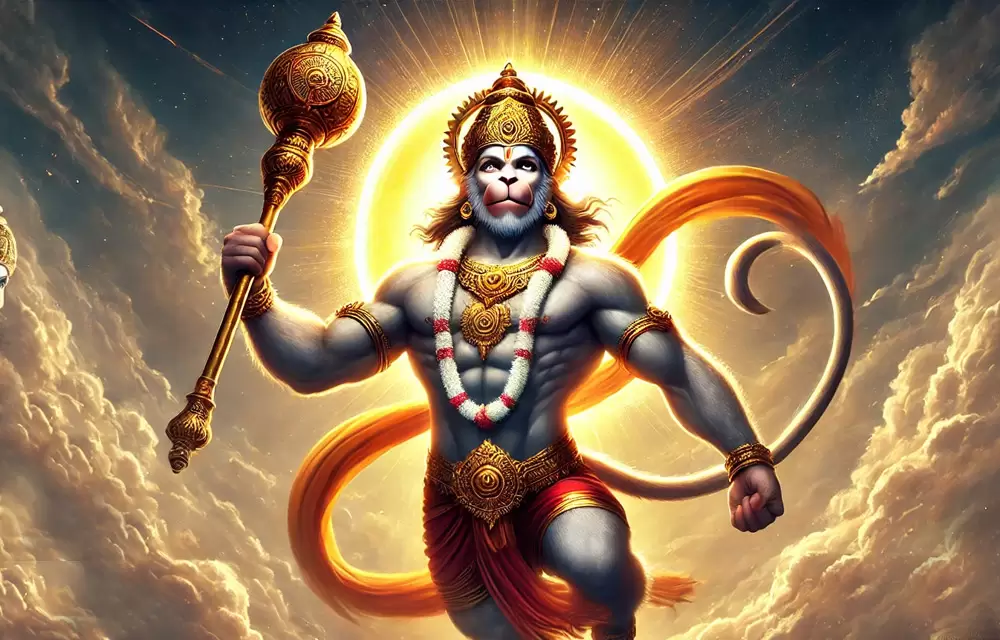
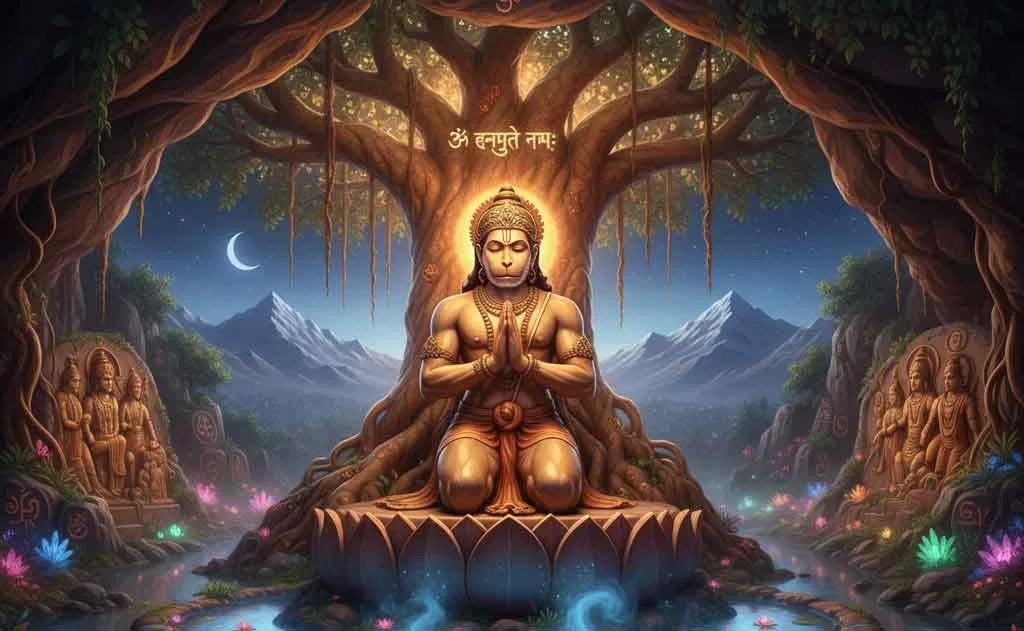
Hanuman's iconography—a red-faced vanara with a mace (gada), carrying Rama's mountain—symbolizes controlled rage (krodha as tejas), devotion (tilak on forehead), and service (Rama-Sita in heart). Worship involves Tuesdays' fasts (vrat), oil anointings, and japa of "Om Han Hanumate Namah."
Central to his upasana is the Hanuman Chalisa, composed by Tulsidas in the 16th century during his imprisonment—miraculously freeing him as walls crumbled at its chant. Here's the full text with English translation (verse-by-verse for spiritual depth):
Doha (Opening Couplets)
Shri Guru Charan Saroj Raj, Nij Manu Mukur Sudhari Baranau Raghubar Bimal Yash, Jo Dayak Phal Chari Having polished the mirror of my heart with the dust of my Guru's lotus feet, I recite the divine fame of the clean, bright and incomparable Lord Rama, which bestows the four fruits of life: dharma (righteousness), artha (wealth), kama (desire), and moksha (liberation).
Budhiheen Tanu Janike, Sumirow Pavan Kumar Bal Budhi Vidya Dehu Mohi, Harhu Kelesa Bikaar Knowing that this mind of mine has less intelligence, I remember the 'Son of Wind'. O Hanuman! Bestow upon me strength, wisdom, and all kinds of knowledge, removing my griefs and shortcomings.
Chaupai (40 Verses – Excerpted for Brevity; Full Recitation Recommended)
- Jai Hanuman Gyan Gun SagarJai Kapis Tihun Lok UjaagarVictory to thee, O Hanuman! Ocean of wisdom and virtue, victory to the Lord of the Monkeys, whose fame has crossed the three worlds.
Verses 2-10: Praises his birth, golden form, wisdom, and celibacy (brahmachari). Mahabir Bikram Bajrangi, Kumati Nivaar Sumati Ke Sangi. Carrier of the Lord's Ring, you are the guardian of Rama's divine abode... Destroyer of evil thoughts and companion of good ones.
Verses 11-20: His valor in Lanka, tail-fire, and mountain-lift. Raghupati Kinhi Bahut Badaai, Tum Mama Priya Bharat-hi Sam Bhai. Lord Rama extolled you greatly, always stating: "You are as dear to me as my brother Bharat."
Verses 21-30: His devotion, removal of fears, and blessings. Sankat Te Hanuman Chhuwaaye, Man Kar Himsa Hut Na Bhay. You deliver one from the travails of existence; with the false chatter of the world, you dispel one's delusion.
Verses 31-40: Promises of protection, success, and ultimate bliss. Jo Sat Baar Paath Kar Koyee, Chhutahi Bani Maha Sukh Hoyee. Whoever recites this a hundred times is released from bondage and enjoys the highest bliss at last.
Closing Doha
Jo Yah Padhai Hanuman Chalisa Hoye Siddhi Saakhi Gaurisa Those who read this Hanuman Chalisa regularly are sure to be benedicted. Lord Rama, Lakshmana, Sita, and all the gods reside in their hearts forever.
Pavan Tanay Sankat Harana, Mangala Murati Roop Ram Lakhan Sita Sahit, Hriday Basahu Soor Bhup O Shri Hanuman, the Son of Wind, the remover of distress, the embodiment of auspiciousness... Dwell in my heart along with Shri Ram, Laxman, and Sita.
Spiritual Essence of Chalisa: Each verse is a mantra for transformation—invoking Hanuman's 108 names (e.g., Anjaneya, Bajrangbali) to conquer the 108 worldly afflictions.
🌍 Eternal Legacy: Hanuman in Modern Devotion
Hanuman's story lives on in temples like the grand Meenakshi in Madurai or the hilltop Anjaneya in Karnataka, where monkeys roam as his kin. In 2025's digital age, as Indian X users surge with post-Diwali fervor—sharing invocations that blend Vedic chants with viral memes—Hanuman bridges ancient rituals and contemporary unity. Influencers like Vibhor Varshney amplify this, turning personal sadhana into communal sangha.
Closing Invocation
O Hanuman! As you leaped oceans for Rama, guide us across modern storms. Grant buddhi (wisdom), bal (strength), and bhakti (devotion). May your mace shatter our fears, and your ring unite us in Rama's light.
Jai Bajrangbali! Jai Shri Ram! Ram Raksha Stotra: "Jai Hanuman, gyan gun sagar..."
For daily mantras and temple darshans, visit kindred sites like hindutone.com. Share your Hanuman experiences below—let's build a virtual kirtan!
Frequently Asked Questions
Who is The Eternal Devotion?
🐒🙏 In the vast tapestry of Hindu mythology, woven from the threads of the ancient Vedas, Puranas, and the epic Ramayana , Lord Hanuman stands as an eternal beacon of unwavering devotion ( bhakti ), unyielding strength ( shakti ), and selfless service ( seva ). Known as the monkey god ( vanara ), the son of the wind ( Pavanputra ), and the devoted messenger
How is The Eternal Devotion worshipped?
Through daily puja, mantra chanting, aarti and offerings of flowers, lamps and prasad — on dedicated days and festivals associated with the deity.
What are the benefits of worshipping The Eternal Devotion?
Devotees seek blessings for protection, prosperity, health, wisdom and inner peace, and a deeper connection with the divine.
Which day is dedicated to The Eternal Devotion?
Each deity has an associated day and festivals; worshipping on that day, with fasting and mantra, is considered especially auspicious (see the guide above).
You might also like
Hidden Science Behind the Hanuman Chalisa: Neuroscience, Sound, Quantum & the Earth-Sun Verse
Rama Avatar — The Seventh Incarnation of Vishnu: Ramayana, Ayodhya, the Ideal Man & Eternal Dharma Lessons for 2026
Hanuman Worship on Saturday: Powerful Rituals & Remedies for Shani Dosha