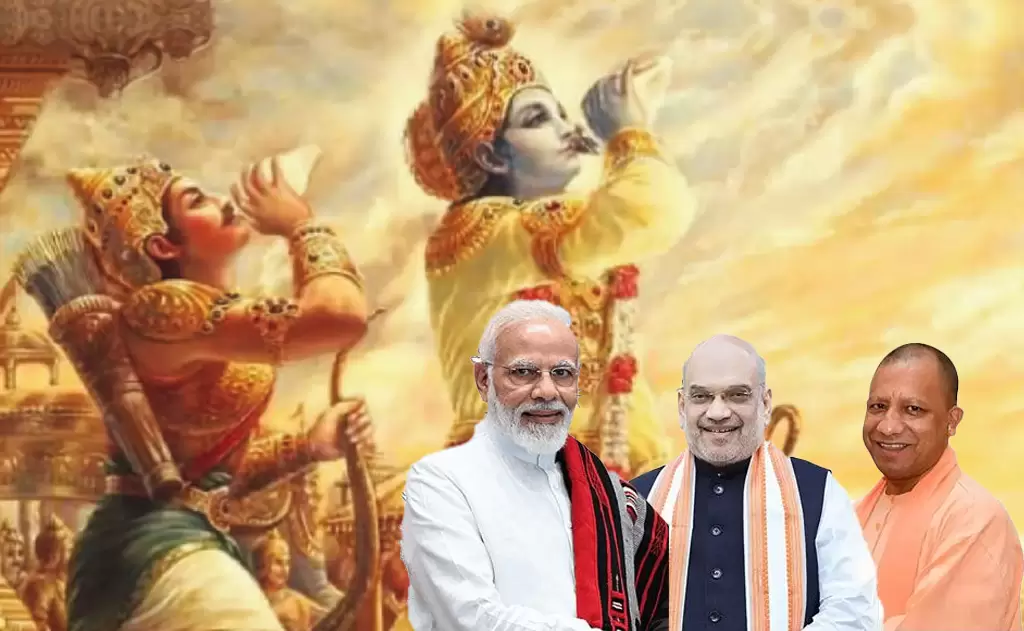
How PM Modi, Amit Shah, and Yogi Adityanath are Reviving and Promoting Sanatana Dharma in Modern India
In the heart of a rapidly evolving nation, India's leadership under Prime Minister Narendra Modi, Union Home Minister Amit Shah, and Uttar Pradesh Chief…
In the heart of a rapidly evolving nation, India's leadership under Prime Minister Narendra Modi, Union Home Minister Amit Shah, and Uttar Pradesh Chief…
In the heart of a rapidly evolving nation, India's leadership under Prime Minister Narendra Modi, Union Home Minister Amit Shah, and Uttar Pradesh Chief Minister Yogi Adityanath is steadfastly working to preserve and promote the timeless values of Sanatana Dharma. Through their actions, policies, and vision, they are rekindling a sense of spiritual pride while aligning India's ancient heritage with modern aspirations.
- Reviving Ancient Temples and Pilgrimage Sites
One of the cornerstones of their efforts has been the grand revival of historical and sacred sites.
The Kashi Vishwanath Corridor in Varanasi, led by PM Modi, has transformed the experience of devotees, ensuring the preservation of the temple's spiritual and historical essence. Amit Shah's advocacy for the Ram Mandir in Ayodhya showcases a commitment to rectifying historical wrongs and restoring India's cultural pride. Yogi Adityanath, with initiatives like the Prayagraj Kumbh Mela 2019, has ensured global recognition for India's spiritual grandeur, making ancient practices accessible to modern pilgrims.
- Celebration of Festivals and Traditions
Their leadership has also mainstreamed the celebration of festivals like Diwali in Ayodhya and Kumbh Mela, drawing attention to India's rich spiritual traditions. By blending grand celebrations with efficient management, they have highlighted how these festivals are not just cultural but economic and global phenomena.
- Sanatana Dharma in Education
Under the New Education Policy (NEP), ancient Indian knowledge systems, Vedic mathematics, and Sanskrit have found a place in the curriculum, ensuring that future generations connect with their roots. This aligns with the vision of making Sanatana Dharma a living tradition, deeply intertwined with modern education.
- Preservation of Cow and Agriculture-Based Traditions
Yogi Adityanath has emphasized cow protection and traditional farming, which resonate deeply with Sanatana Dharma’s principles of living in harmony with nature. Policies encouraging organic farming and rural upliftment echo the Dharmic ideals of self-sufficiency and sustainability.
- Spiritual Diplomacy on the Global Stage
PM Modi has positioned India as the spiritual hub of the world, taking yoga, Ayurveda, and the message of Vasudhaiva Kutumbakam to the global stage. International Yoga Day is a prime example of how ancient Dharmic practices have been given modern global appeal.
- Combating Anti-Sanatana Narratives
The trio's leadership is also countering narratives aimed at misrepresenting Sanatana Dharma. By fostering unity, promoting interfaith dialogue, and ensuring Dharmic values are integrated into governance, they are empowering the Sanatana ethos to thrive in a diverse, modern society.
Conclusion
PM Modi, Amit Shah, and Yogi Adityanath are not just leaders but torchbearers of Sanatana Dharma in the 21st century. Their dedication to preserving India’s spiritual heritage while steering the nation towards progress reflects the timeless wisdom of Sanatana Dharma — a way of life that remains relevant, adaptable, and eternal.
Keywords: Sanatana Dharma, Narendra Modi, Amit Shah, Yogi Adityanath, cultural revival, Hindu heritage, Kashi Vishwanath Corridor, Ram Mandir, Prayagraj Kumbh Mela, Indian traditions, spiritual diplomacy, Indian heritage preservation.
What Does Sanatana Dharma Actually Mean, and Why Does Its Revival Matter Now?
The term Sanatana Dharma derives from two Sanskrit roots: 'sanatana,' meaning eternal or timeless, and 'dharma,' meaning the cosmic order, moral law, and one's sacred duty. Unlike a religion founded at a fixed historical moment, Sanatana Dharma is described in the Rigveda as Ritam — the universal truth that governs both the cosmos and human conduct. The Bhagavad Gita (Chapter 4, verse 7) records the divine assurance: 'Yada yada hi dharmasya glanir bhavati Bharata... sambhavami yuge yuge' — whenever dharma declines, a restoration follows across the ages.
In the context of modern India, revival is not merely a political gesture but a civilisational reclamation. Centuries of colonial rule systematically devalued Sanskrit scholarship, disrupted temple economies, and stigmatised indigenous practices. Contemporary policy efforts seek to reverse that cultural amnesia by reconnecting citizens with texts such as the Manusmriti, Arthashastra, and Dharmashastra — not as archaic codes but as living frameworks for ethics, governance, and ecology.
The urgency is also demographic and global. With millions of the Indian diaspora seeking their roots, and with international interest in yoga, Ayurveda, and Vedanta at an all-time high, a strong domestic revival creates a foundation from which Sanatana Dharma can speak to the world on its own terms rather than through the filter of orientalist interpretation.
How Are Sacred River Corridors and Tirtha Kshetras Being Restored Across India?
The Kashi Vishwanath Dham Corridor, inaugurated in December 2021, is one of the most visible examples of tirtha revival. The project cleared encroachments around the Jyotirlinga of Lord Vishwanath in Varanasi and opened a direct processional route from the Dashashwamedh Ghat on the Ganga to the temple sanctum. Ancient temples submerged within the corridor — including a Mandir to Adi Vishweshvara — were excavated and restored, honouring the principle stated in the Skanda Purana that Kashi (Varanasi) is the field of liberation, the 'Mukti Kshetra,' where Shiva himself whispers the Taraka mantra into the ears of the dying.
Beyond Varanasi, the Char Dham road connectivity project links Yamunotri, Gangotri, Kedarnath, and Badrinath in Uttarakhand with all-weather roads, reducing the peril of the traditional yatra. The Kedarnath reconstruction, following the devastating floods of 2013, included the restoration of the sabha-mandapa and the paving of the approach path with granite, while deliberately preserving the temple's original Nagara-style shikhara architecture. Ayodhya's Ram Mandir, consecrated in January 2024 with the Prana Pratishtha ceremony following Vedic Agama rituals, represents the restoration of one of the 108 Divya Desams celebrated in Tamil Vaishnava tradition and a site sanctified in the Valmiki Ramayana as Rama's birthplace.
State governments have also begun mapping and restoring lesser-known Shakti Peethas and ancient Shaiva shrines that had fallen into neglect. The Uttar Pradesh government's initiative to clean and illuminate the ghats of Prayagraj — the Triveni Sangam where the Ganga, Yamuna, and the invisible Saraswati meet — reflects the Puranic injunction in the Prayaga Mahatmya that bathing at Triveni during Kumbh yields liberation equivalent to a thousand Ashvamedha yajnas.
What Role Does Sanskrit Play in the Intellectual Restoration of Sanatana Dharma?
Sanskrit is described in the Ashtadhyayi of Panini — composed around the 4th century BCE — as a language whose grammar was revealed, not invented. The National Education Policy 2020 explicitly encourages Sanskrit as a three-language option from the school level, and several Indian Institutes of Technology have begun integrating courses on Indian Knowledge Systems (IKS) that draw from the Vedanga disciplines: Shiksha (phonetics), Kalpa (ritual procedure), Vyakarana (grammar), Nirukta (etymology), Chandas (metre), and Jyotisha (astronomy and calendrics).
The revival of Sanskrit is also institutional. The Rashtriya Sanskrit Sansthan, now elevated to the status of a central university as Shri Lal Bahadur Shastri National Sanskrit University in New Delhi, and institutions like the Sampurnanand Sanskrit Vishwavidyalaya in Varanasi, are receiving renewed governmental support for publishing critical editions of unpublished manuscripts. India's National Mission for Manuscripts has catalogued over five million manuscripts across the country, many dealing with Ayurveda, Dharmashastra, and Agama temple-building sciences.
When Sanskrit thrives, the living commentarial tradition — through which each generation of acharyas interprets the Upanishads, the Brahmasutras, and the Bhagavad Gita — remains unbroken. This is precisely the tradition through which Adi Shankaracharya unified four mathas (Sringeri, Dwaraka, Puri, and Jyotirmath) in the 8th century CE to protect Sanatana Dharma during a period of fragmentation.
How Does Kumbh Mela Function as a Living Institution of Sanatana Dharma?
The Kumbh Mela is not merely a festival; it is perhaps the world's largest living institution of dharmic transmission. Rooted in the Puranic narrative of the Samudra Manthan — the churning of the cosmic ocean — the Mela rotates among four tirtha sites: Prayagraj (Allahabad), Haridwar on the Ganga, Nashik on the Godavari, and Ujjain on the Shipra. The timing of each Mela is determined by Jyotisha calculations based on the positions of Jupiter (Brihaspati), the Sun, and the Moon, connecting celestial rhythms with earthly pilgrimage.
At Prayagraj Kumbh 2019, an estimated 240 million pilgrims gathered over 49 days, making it the largest human gathering ever recorded. The Uttar Pradesh government deployed AI-based crowd management, integrated CCTV surveillance, and real-time data analytics to ensure safety — a synthesis of ancient sacred geography with modern governance that became a model studied internationally. The Shahi Snan (royal bath) processions of the Akharas — the ancient monastic orders of Shaiva, Vaishnava, and Udasin traditions — preserved ritual precedence established over centuries by acharyas tracing their lineage to Adi Shankaracharya and Ramananda.
For sincere seekers, Kumbh is also a living gurukula. Hundreds of spiritual discourses, yajnas, and initiations happen simultaneously across the temporary city of tents. The Maha Kumbh scheduled for Prayagraj in 2025 is expected to further elevate the global profile of this institution, with dedicated infrastructure investment in ghats, roads, and sanitation ensuring the sacred character of the event is not compromised by logistical strain.
What Is the Connection Between Sanatana Dharma and India's Foreign Policy Identity?
India's civilisational identity has increasingly shaped its diplomatic language. Prime Minister Modi's addresses at the United Nations have invoked the Vedic phrase 'Vasudhaiva Kutumbakam' — 'the world is one family,' drawn from the Maha Upanishad — as a philosophical foundation for India's approach to multilateralism. This is not rhetorical decoration; it reflects the dharmic concept of loka-sangraha, the welfare of all beings, articulated by Krishna in the Bhagavad Gita (Chapter 3, verse 20) as the duty of those in positions of power.
India's presidency of the G20 in 2023 placed the Nataraja — Shiva as the cosmic dancer of creation, preservation, and dissolution — at the centre of the summit venue in Bharat Mandapam, New Delhi. The symbolism was deliberate: Nataraja represents the Panchakriya, the five cosmic acts of Srishti (creation), Sthiti (preservation), Samhara (dissolution), Tirobhava (concealment), and Anugraha (grace), encapsulating a philosophy of cyclical renewal rather than linear progress, offering an alternative civilisational perspective to a world facing ecological and social crisis.
Bilateral cultural diplomacy has also been anchored in Sanatana Dharma. The gifting of replicas of the Sengol — the sacred sceptre placed in the new Parliament building — and coordinated efforts to repatriate stolen temple idols from institutions in the United States, the United Kingdom, and Australia reflect an assertion that India's sacred heritage belongs within its living temple traditions, not in foreign museum displays. These repatriations honour the Agama shastra principle that a consecrated murti carries divine presence and must be housed in a properly ritually maintained space.
How Do Ayurveda and Yogic Science Fit Into the Broader Framework of Sanatana Dharma Revival?
Ayurveda and Yoga are not peripheral health practices within Sanatana Dharma — they are Upangas, supplementary limbs, of the Atharvaveda, and are considered among the fourteen Vidyasthanas (seats of knowledge) alongside the four Vedas, the six Vedangas, Mimamsa, Nyaya, Puranas, and Dharmashastra. The establishment of a dedicated Ministry of AYUSH (Ayurveda, Yoga and Naturopathy, Unani, Siddha, and Homeopathy) in 2014 gave institutional weight to this understanding, moving these sciences from the margins of the healthcare system toward mainstream recognition.
The declaration of June 21 as International Day of Yoga by the United Nations in 2015 — following India's proposal — was a landmark moment. Patanjali's Yoga Sutras, composed around the 2nd century BCE, codify the eight-limbed path (Ashtanga Yoga) from Yama and Niyama (ethical restraints and observances) through Asana, Pranayama, Pratyahara, Dharana, Dhyana, and Samadhi. When millions across 190 countries practise Surya Namaskar on the summer solstice, they participate — knowingly or not — in a solar devotional sequence rooted in Vedic Surya upasana.
Domestically, the National AYUSH Mission has expanded Ayurvedic hospitals, standardised classical formulations based on texts such as the Charaka Samhita and Sushruta Samhita, and promoted the cultivation of medicinal plants described in the Dravyaguna Vijnana tradition. This ensures that Ayurveda evolves not as a folkloric curiosity but as a rigorous classical science with documented epistemological foundations — true to the Sanatana Dharma principle that shraddha (faith) and viveka (discrimination) must work together.
Frequently Asked Questions
What is How PM Modi, Amit Shah, and Yogi Adityanath are?
In the heart of a rapidly evolving nation, India's leadership under Prime Minister Narendra Modi, Union Home Minister Amit Shah, and Uttar Pradesh Chief Minister Yogi Adityanath is steadfastly working to preserve and promote the timeless values of Sanatana Dharma. Through their actions, policies, and vision, they are rekindling a sense of spiritual pride whi
What are the key points about How PM Modi, Amit Shah, and Yogi Adityanath are?
Reviving Ancient Temples and Pilgrimage Sites One of the cornerstones of their efforts has been the grand revival of historical and sacred sites. The Kashi Vishwanath Corridor in Varanasi, led by PM Modi, has transformed the experience of devotees, ensuring the preservation of the temple's spiritual and historical essence.
Why does How PM Modi, Amit Shah, and Yogi Adityanath are matter in Hinduism?
It reflects core values of Sanatana Dharma and offers practical and spiritual guidance that remains relevant across generations.
How can devotees apply How PM Modi, Amit Shah, and Yogi Adityanath are in daily life?
By reflecting on its teaching, incorporating the related practices or observances into daily routine, and approaching it with sincere devotion and understanding.
You might also like
Hindu Temples & Festivals in UAE — Complete NRI Guide to Sanatana Dharma in the Emirates (2026)
Hindu Temples & Festivals in Europe — Complete NRI Guide to Sanatana Dharma Across the Continent (2026)
Hindu Temples & Festivals in Australia — Complete NRI Guide to Sanatana Dharma Down Under (2026)