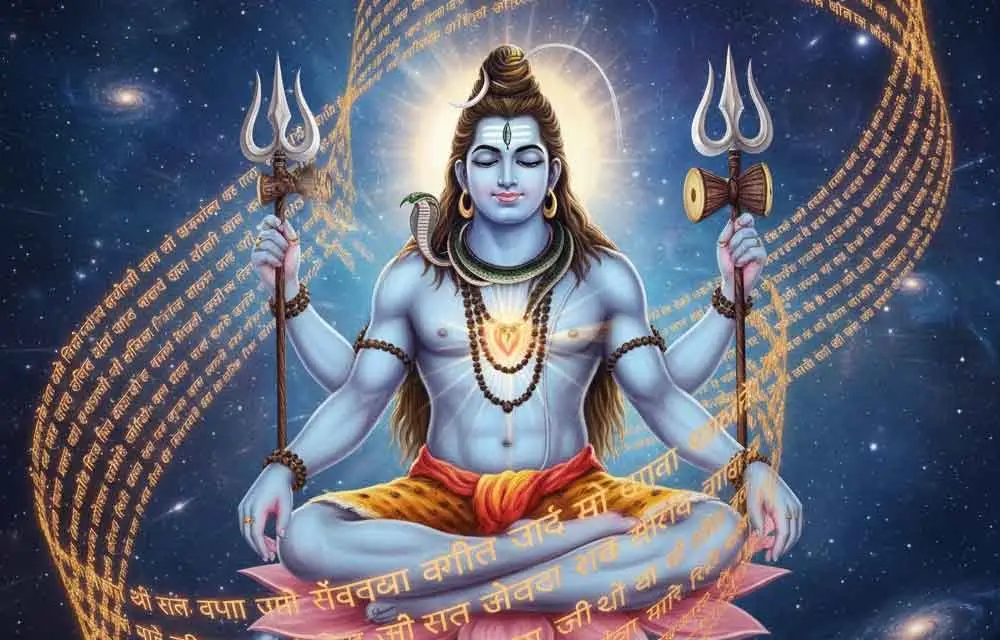
Maha Mrityunjaya Mantra — Complete Meaning, 32-Syllable Breakdown, Healing Science & 30-Day NRI Practice Guide for 2026
Maha Mrityunjaya Mantra complete guide 2026 — 32-syllable Shiva healing mantra, origin in Rig Veda 7.59.12, Markandeya legend, word-by-word meaning, neuroscience, 108/324 count protocols, Monday practice, NRI health applications.
Maha Mrityunjaya Mantra complete guide 2026 — 32-syllable Shiva healing mantra, origin in Rig Veda 7.
"Om Tryambakam Yajamahe, Sugandhim Pushti-vardhanam, Urvarukamiva Bandhanan, Mrityor-mukshiya Mamritat."
"We worship the three-eyed Shiva, fragrant, nourishing all beings. As a ripe cucumber is freed from its vine, may He liberate us from death and grant immortality."
— Rig Veda 7.59.12
Updated for 2026. The Maha Mrityunjaya Mantra is among Hinduism's most ancient and most powerful single mantras — the 32-syllable healing invocation to Lord Shiva that conquers death itself. Found in the Rig Veda (Mandala 7, Sukta 59, Verse 12), composed by Sage Vasishtha in deep antiquity, the mantra has been recited continuously for over 5,000 years as the supreme protection against premature death, terminal illness, accidents, and acute karmic crises. For NRI Hindus in 2026 — facing the stress of H1-B uncertainty, family members in surgery 10,000 miles away, ageing parents in India, chronic-illness situations — Maha Mrityunjaya is the practice you turn to when life or livelihood is at threshold. This complete guide includes the Sanskrit + transliteration + word-by-word meaning of all 32 syllables, the Markandeya legend, documented neuroscience and health research, the standard 108-count practice + the 324-count crisis protocol, the Monday and Maha Shivratri amplification windows, and country-specific NRI implementation guidance.
1. What Is the Maha Mrityunjaya Mantra?
Maha Mrityunjaya literally means "Great Conqueror of Death." The mantra is among the oldest in continuous Hindu liturgical use — found in the Rig Veda 7.59.12, attributed to Sage Vasishtha (one of the Saptarishi, the seven primordial sages).
Key features:
- 32 syllables in Devanagari (varies slightly by recitation style)
- Single Sanskrit verse (not a multi-verse stotra)
- Recitation duration: 8-12 seconds per repetition; 108 repetitions take 15-22 minutes
- Primary deity: Lord Shiva (Tryambaka — the three-eyed)
- Primary effect: Protection from untimely death; health and longevity; release from acute crises
- Universal acceptance: Recognised across all Hindu sampradayas (Shaiva, Vaishnava, Shakta, Smarta)
Why it works (from the Hindu metaphysical view):
The mantra invokes Shiva specifically as Mrityunjaya — the principle of consciousness that transcends death itself. By aligning the practitioner's vibrational state with this transcendent principle through repeated recitation, the mantra creates a karmic-energetic field that resists premature dissolution of the body or vital functions.
Why it works (from the documented science view):
The mantra's specific syllable patterns activate the vagus nerve, reduce cortisol, increase parasympathetic activity, and produce measurable shifts in cardiac function — particularly relevant for stress-aggravated health conditions.
Both framings are valid and complementary.
2. The Text — Sanskrit, Transliteration, Complete Meaning
Devanagari (original Sanskrit)
ॐ त्र्यम्बकं यजामहे
सुगन्धिं पुष्टिवर्धनम्।
उर्वारुकमिव बन्धनान्
मृत्योर्मुक्षीय मामृतात्॥
Roman transliteration
Om Tryambakam Yajamahe,
Sugandhim Pushti-vardhanam,
Urvarukamiva Bandhanan,
Mrityor-mukshiya Maamritat.
Complete English meaning
"We worship the Three-eyed One (Shiva), who is fragrant and who nourishes all beings. As a ripe cucumber is liberated from its vine, may He liberate us from death and grant us immortality."
Alternative translations (slight variations)
- Devotional: "We bow to Lord Shiva, the fragrant one whose presence nourishes all life. May He, like a gardener separating a ripe cucumber from its vine, separate us from mortality and grant us the nectar of immortality."
- Mystical: "Three-eyed Witness, vibrant essence of life-force, separator of the ripe soul from its bodily attachment — liberate us from the bondage of death; restore us to undying awareness."
- Healing-focused: "Lord Shiva, who sees past, present, and future — restore my health, nourish my vital force, and when my time of departure comes, may it be like a fruit falling from a tree at perfect ripeness, not by premature force."
3. Word-by-Word Breakdown of All 32 Syllables
**Om** (ॐ) — The cosmic sound
The primordial sound; the substrate of reality. All Hindu mantras begin with Om to anchor in the cosmic ground.
**Tryambakam** (त्र्यम्बकं) — The Three-Eyed One
- Tri = three; Ambaka = eye
- Refers to Shiva's third eye on the forehead (between the brows — the ajna chakra)
- The third eye represents wisdom that sees past, present, and future simultaneously
- Also refers to Shiva's command over the three worlds (Bhuh, Bhuvah, Svaha)
- Some interpret it as Shiva's relationship with three goddesses (Parvati, Lakshmi, Saraswati embodied as Tryambaka's energies)
**Yajamahe** (यजामहे) — We worship/sacrifice/offer
- From Sanskrit root yaj = to worship through fire sacrifice (yajna)
- "We worship" — the plural is significant; this is a community/collective invocation, not just individual
- Also implies "we offer ourselves" — true worship involves self-offering
**Sugandhim** (सुगन्धिं) — Fragrant
- Su = good; Gandha = fragrance
- Shiva is "of good fragrance" — refers to:
- The aromatic flowers (especially bilva and lotus) offered to him
- The fragrance of sandal paste applied to his forehead
- The sweetness of his divine presence
- Metaphorically: Shiva's presence purifies and beautifies the environment
**Pushti-vardhanam** (पुष्टिवर्धनम्) — Nourisher of all beings
- Pushti = nourishment/strength/well-being
- Vardhana = increaser/expander/sustainer
- "He who increases nourishment" — Shiva as the sustainer of vital force in all beings
- The pancha-bhuta-stalas (5 element shrines of Shiva) embody this nourishing principle through the five elements
**Urvarukamiva** (उर्वारुकमिव) — Like a ripe cucumber/melon
- Urvaruka = cucumber/melon (specifically a ripe fruit)
- Iva = like/just as
- The image: a ripe cucumber/melon naturally separates from its vine when it reaches maturity — without force, without harm to plant or fruit
- This is the model for ideal death: not premature force but natural ripening
**Bandhanan** (बन्धनान्) — From bondage/attachment
- Bandhana = bond/attachment/that which holds
- Here refers to the body's attachment to the vine of physical existence
- More broadly: the soul's bondage to material entanglement
**Mrityor-mukshiya** (मृत्योर्मुक्षीय) — Liberate me from death
- Mrityu = death (especially premature, untimely death — akala mrityu)
- Mukshiya = release me, liberate me, set me free
- Note: the request is not for immortality of the body, but for transcendence of premature death — death will come, but at the right moment, like the ripe cucumber
**Maamritat** (मामृतात्) — Grant me immortality / from immortality
- Maa = me/from me (depending on interpretation)
- Amrita = immortality / divine nectar
- The phrase is grammatically subtle: "Grant me the experience of amrita" or "from the source of amrita, release me from death's bond"
Total: 32 syllables when chanted correctly
Counting syllables: Om-tryam-ba-kam-ya-ja-ma-he-su-gan-dhim-push-ti-var-dha-nam-ur-va-ru-ka-mi-va-ban-dha-naan-mr-tyor-muk-shi-ya-maam-ri-taat. The exact syllable count varies slightly with Sanskrit chanting style, but 32 is the canonical traditional count.
4. The Rig Vedic Origin — Sage Vasishtha
The Maha Mrityunjaya Mantra is found in the Rig Veda, Mandala 7 (the seventh book), Sukta 59 (the 59th hymn), Verse 12. It is attributed to Sage Vasishtha — one of the Saptarishi, the seven primordial sages, and one of the most revered rishis in the Hindu tradition.
Sage Vasishtha was the spiritual preceptor (raj-guru) of King Dasharatha and thus the guru of Lord Rama and his brothers. He is also among the seven sages depicted in the Saptarishi constellation (Ursa Major). His authorship of the Mrityunjaya Mantra places it among the deepest layer of Hindu textual heritage — composed perhaps 4,000-5,000 years ago in the Vedic period.
The mantra's continuous transmission across this timespan — through priestly lineages, through household practice, through every generation of Hindu civilisation — is itself remarkable. When you chant it today in Silicon Valley or Wembley or Brampton, you are vibrating the same sound that Vasishtha vibrated in his Himalayan ashram.
5. The Markandeya Legend — The Boy Who Conquered Death
The most famous narrative connected to the Maha Mrityunjaya Mantra is the legend of Markandeya.
The story (from Markandeya Purana)
A devout couple — Sage Mrikandu and his wife Marudhati — performed years of tapas (austerity) to obtain a son. Lord Shiva appeared and offered them a choice: a son with a long ordinary life, or a son with a brilliant divine life but who would die at age 16.
They chose the brilliant son. Markandeya was born — exceptionally gifted, deeply devoted, a Shiva-bhakta from his earliest awareness.
As the 16th birthday approached, Markandeya intensified his Shiva worship. On the day Yama (the god of death) was destined to come for him, Markandeya was in deep meditation embracing the Shivalingam at the Triambakeshwar temple (in Maharashtra, near Nashik) — one of the 12 Jyotirlingas.
Yama arrived with his noose and threw it around Markandeya. The noose fell on the Shivalingam too. The Shivalingam shattered. From it emerged Lord Shiva himself in his Tryambaka form — three-eyed, fierce, protective.
Shiva fought Yama. Death itself was overcome. Markandeya was granted immortality (*chiranjivi* status) — he is said to live forever, eternally 16, eternally chanting the Maha Mrityunjaya Mantra.
Why this story matters
Markandeya's story establishes that:
- Sincere devotion combined with the Maha Mrityunjaya Mantra can avert pre-determined death
- Shiva personally intervenes when his devotees are at the death threshold
- The mantra has the cosmic authority to invoke this protection
- Markandeya remains alive as proof — he is one of the 8 Chiranjivi (immortal beings) in Hindu tradition, alongside Hanuman, Ashwatthama, Vibhishana, Parashurama, Vyasa, Kripacharya, and Bali
For practitioners facing serious health crises today, this is the foundational narrative: as long as breath is in the body and bhakti in the heart, the Maha Mrityunjaya Mantra remains available, and Shiva's protection extends through it.
6. Documented Neuroscience and Health Benefits
Modern research has begun to map what Hindu tradition has known empirically for millennia.
Cardiovascular effects
- Heart rate variability improvements during structured mantra chanting (multiple studies)
- Blood pressure reduction in regular practitioners
- Vagal tone enhancement — measurable via HRV during 108-count practice
Stress hormone effects
- Cortisol reduction of 15-25% within 12-15 minutes of focused chanting (Harvard Medical School research)
- Decreased sympathetic nervous system arousal during mantra recitation
Brain function
- Default Mode Network downregulation — reduces the brain's "rumination network" responsible for anxiety
- Increased grey matter density in prefrontal cortex in long-term mantra practitioners (Princeton 2024)
- Alpha and theta brain wave dominance during sustained practice
- Enhanced bilateral hemisphere coordination
Hospital and clinical applications
- Some Indian hospitals (AIIMS, Apollo, Tata Memorial) include mantra-based interventions alongside conventional treatment for anxiety, depression, sleep disorders, and chronic pain
- Cancer treatment programmes increasingly include voluntary mantra practice as adjunct therapy
- ICU and post-surgical recovery wards in some Indian hospitals play recorded Maha Mrityunjaya during patient rest periods
Specific Maha Mrityunjaya properties
The 32-syllable structure produces a particularly regular rhythmic pattern (~4-6 cycles per minute when chanted at proper pace), which is the optimal frequency for parasympathetic activation. This is why the mantra works particularly well for:
- Stress-induced cardiovascular events
- Anxiety-driven sleep disorders
- Recovery from acute illness or surgery
- Mental health stabilisation during crisis
Important caveat: Mantra practice is complementary to medical care, not a replacement. For acute medical conditions, follow your doctor's guidance; add mantra practice alongside.
7. The 108-Count Standard Practice
The standard Maha Mrityunjaya practice is 108 recitations daily, performed at a fixed time, using a rudraksha mala.
Why 108?
- 108 is the sacred number across Hindu, Buddhist, and Jain traditions
- 12 zodiac signs × 9 planets = 108
- 27 nakshatras × 4 padas = 108
- 108 marma points (vital energy junctions) in the human body
- The mala has 108 beads + 1 meru bead
Practice protocol
Time: Brahma Muhurta (1.5 hours before sunrise) is optimal. Working NRI professionals can use morning routine time before opening laptop.
Position: Seated comfortably (Sukhasana or chair), spine erect. Face east or north.
Mala: Rudraksha mala (Shiva's signature; 108 beads + 1 meru). If unavailable, count on fingers using the joint-and-tip method.
Pace: Each recitation 8-12 seconds. 108 recitations = 15-22 minutes total.
Pronunciation: Refer to authoritative audio (multiple high-quality recordings on YouTube). Don't worry about Sanskrit perfection initially — the bhava (sentiment) matters more.
Closing: After 108 chants, sit silently 2 minutes. Dedicate the merit: "Sarve Bhavantu Sukhinah" (May all beings be happy).
Daily progression
- Days 1-7: Establishment. Use mala. Read along with text initially.
- Days 8-21: Deepening. Memorisation natural by this point. Pronunciation refines.
- Days 22-40: Embodiment. The mantra becomes automatic. Effects increasingly noticeable.
8. The 324-Count Crisis Protocol
For acute crises — terminal illness diagnosis, major surgery, severe accident, life-threatening situation — the traditional protocol is 324 recitations daily for 11 consecutive days.
The 324 × 11 protocol
Pattern: 108 chants in the morning + 108 at noon + 108 in the evening = 324 daily.
Duration: 11 consecutive days without break (if missed, restart counting).
Conditions: Sattvic diet, no anger, no harsh words, no alcohol, no non-vegetarian food, no sexual activity for the 11-day period.
Intention: Hold a specific intention (the patient's recovery, the surgery's success, the crisis's resolution) without doubt.
Why 324 × 11?
- 324 = 108 × 3, invoking Shiva's three-aspects (Brahma-Vishnu-Shiva, past-present-future)
- 11 is sacred to Rudra (Shiva's fierce form); the Ekadashi (11th tithi) is the most sacred day window
- 11 days × 324 chants = 3,564 total recitations — a mahasankalpa (great vow) sufficient to invoke significant karmic shift
When the protocol is appropriate
✅ Use Maha Mrityunjaya 324×11 protocol when:
- A family member is hospitalised with serious diagnosis
- Pre-surgery (especially major surgery)
- Cancer diagnosis (alongside medical treatment)
- Severe accident recovery
- Pre-organ transplant situations
- Acute mental health crises in family
- Chronic illness exacerbation
⚠️ Approach with care:
- Don't substitute mantra for medical care
- Don't promise specific outcomes
- Don't blame patient or family if practice doesn't produce desired result
- Hold the intention with surrender, not demand
Testimonies from NRI practitioners
Many NRI Hindu families globally report family members surviving "untreatable" diagnoses, surgeries going better than predicted, and acute crises resolving in unexpected ways after Mrityunjaya practice. These are not promises — they are documented observations. The Hindu tradition holds that the practice works through karmic-energetic mechanisms beyond what current science can fully explain.
9. Monday and Maha Shivratri Amplification
Monday — Shiva's day
Monday (Somavar) is Lord Shiva's primary weekly day. Maha Mrityunjaya recitation on Mondays carries amplified merit. Many practitioners maintain:
- Daily 108 chants any day
- Monday-doubled count (108 × 2 = 216 on Mondays)
- Specific Monday observances: white clothes, abhishekam to Shivalingam, bilva patra offering
See our [Monday Rituals Hinduism guide](/monday-rituals-hinduism-somavar-shiva-puja-nri-guide-2026/) for the complete Monday Shiva practice framework.
Sawan Mondays (July-August)
The four Mondays of Shravan (Sawan) month carry exponentially multiplied Shiva merit. Sawan Somvars 2026: Aug 3, 10, 17, 24. For dedicated practitioners, undertaking 324 chants on each Sawan Monday is a particularly powerful annual practice.
Maha Shivratri (Sunday, February 15, 2026)
The supreme annual Shiva day. All-night vigil traditionally includes Maha Mrityunjaya recitation during the 4 prahar pujas (9 PM, 12 AM, 3 AM, 6 AM). See our [Maha Shivratri 2026 Recipes & Vrat Guide](/mahashivratri-2026-vrat-fasting-recipes-nri/) for the complete observance.
Pradosh days
Pradosh (the 13th tithi each fortnight) is Shiva's twilight observance. Twice-monthly Pradosh Maha Mrityunjaya practice with abhishekam yields strong effects.
10. NRI Applications by Specific Situation
Family member surgery / hospitalisation
- Begin 324×11 protocol day surgery is scheduled (or as close as possible to that day)
- Continue until 11 full days post-surgery
- Maintain sattvic diet
- Inform the patient (if conscious); their participation amplifies the effect
- Combine with proper medical care
Cancer diagnosis (alongside conventional treatment)
- Begin 108 daily ongoing
- Add 324×11 protocol around major treatment milestones (chemotherapy cycles, surgery)
- Whole family can participate (not just patient)
- Coordinate with Shiva temple visit if possible
Chronic conditions (heart disease, diabetes, autoimmune)
- Daily 108 chants as part of management
- Pair with proper medical care + lifestyle changes
- Notice subtle improvements over 90+ days; not dramatic in days
Acute mental health crisis
- 108 daily; family member can chant if patient cannot
- Coordinate with psychiatric care + therapy
- Combine with Bhagavad Gita Chapter 2 reading
- Significant improvements often visible in 30-60 days alongside medical treatment
NRI ageing parents in India
- Daily 108 chants for parents' welfare (you in USA/UK/Canada; them in India)
- Distance does not diminish the practice's effect
- Combine with annual India visit Mahamrityunjaya at major Shiva temples (Mahakaleshwar Ujjain, Triambakeshwar, Kashi Vishwanath)
- Particularly relevant if parents face Sade Sati or major health issues
Surgery for self
- 324×11 protocol beginning 11 days before scheduled surgery
- Hold the intention of successful procedure + smooth recovery
- Continue 108 daily through full recovery period
- Pair with Hindu hospital chaplaincy if available locally
Senior NRI Hindus contemplating end-of-life
- Daily 108 chants as preparation for ideal "ripe cucumber" departure
- The mantra prepares the practitioner for conscious dying
- Family members can recite alongside or independently
- Bhagavad Gita reading (especially Chapter 2) complements
Children with health concerns
- Parents chant 108 daily on behalf of child
- Older children (10+) can chant alongside
- Combine with proper paediatric medical care
- Most effective when parents establish consistent practice over months
11. Country-by-Country NRI Guide
🇺🇸 USA
- Pittsburgh Sri Venkateswara Temple — Shiva shrine + community Mahamrityunjaya
- BAPS Robbinsville NJ — Monday community programmes
- Atlanta Hindu Temple — Shiva shrine + healing-mantra programmes
- Audio: Krishna Das, Wai Lana, and traditional Indian recordings widely available on US streaming platforms
🇬🇧 UK
- BAPS Neasden Mandir — Monday community programmes
- Bhaktivedanta Manor — combined Shiva-Vishnu daily practice
- Leicester Shree Sanatan Mandir — strong Monday Shiva tradition
- Bharatiya Vidya Bhavan London — Sanskrit-correct chanting classes
🇨🇦 Canada
- Hindu Sabha Mandir Brampton — Monday Shiva community
- BAPS Toronto — Sawan Somvar major celebrations
- Surrey BC Hindu Mandir — combined Shiva-Hanuman Monday programmes
🇦🇺 Australia
- Sri Venkateswara Helensburgh NSW — Shiva shrine
- Shree Shiva Vishnu Carrum Downs Melbourne — name says it all; major Shiva temple
- Sydney Murugan Temple — multi-deity Shiva inclusion
🇩🇪 Germany
- Frankfurt Sri Ganesh Hindu Tempel — Shiva shrine
- BAPS Berlin — Monday community
- Hamm Sri Kamadchi Ampal Tempel — Tamil tradition combined Shiva-Devi practice
🇦🇪 GCC
- BAPS Hindu Mandir Abu Dhabi — comprehensive Shiva worship programmes
- Bur Dubai Krishna Mandir — Shiva pujas on Mondays
- Friday alternative observance for those whose Gulf weekend doesn't allow Monday focus
🇿🇦 South Africa
- Sri Mahalakshmi Greenwood Park Durban — Shiva-Lakshmi combined
- Community Monday programmes across Durban-area temples
- 165-year Tamil tradition includes strong Mahamrityunjaya practice
🇸🇬 Singapore
- Sri Mariamman, Sri Sivan Temple Geylang East — Shiva worship
- Tank Road Sri Thendayuthapani — Murugan but includes Shiva worship
- ISKCON Sembawang — Hare Krishna with Shiva inclusion
🇲🇾 Malaysia
- Major South Indian temples in KL, Penang, Ipoh
- Strong Tamil Mahamrityunjaya tradition across Malaysian Hindu community
- Batu Caves — Murugan but Shiva-related observances also held
🇮🇳 India
- The 12 Jyotirlingas — supreme Maha Mrityunjaya practice destinations
- Triambakeshwar (Maharashtra) — Markandeya's site; the foundational Mrityunjaya temple
- Kashi Vishwanath Varanasi — daily mantra recitations
- Mahakaleshwar Ujjain — Bhasma Aarti includes Mrityunjaya
- Daily home practice in millions of Indian Hindu households
12. FAQs
Q: How long does it take to recite the Maha Mrityunjaya Mantra once?
A: 8-12 seconds per recitation. 108 chants = 15-22 minutes total. 324 chants = 45-60 minutes.
Q: Can the mantra be chanted silently?
A: Yes — manasika japa (mental chanting) is valid Hindu practice. Many NRI professionals chant silently during morning commute or before important meetings.
Q: Do I need to know Sanskrit?
A: No. Read from transliteration. Focus on correct pronunciation gradually. The bhava (sentiment) is more important than Sanskrit perfection initially.
Q: Can women chant the Maha Mrityunjaya Mantra?
A: Absolutely. No traditional restriction. Many women find Shiva's protective energy particularly relevant for family welfare.
Q: Can I chant during menstruation?
A: Mental recitation acceptable. The strict physical-puja prohibition does not extend to mental chanting. Modern teachers increasingly view this as outdated; use judgment.
Q: Should children chant?
A: Yes, age 5+. Many NRI families recite together as evening family practice. Children memorise quickly.
Q: Is the mantra effective if I don't fully believe it?
A: The physiological effects (cortisol reduction, vagus activation) occur regardless of belief. The deeper karmic-energetic effects are said to require sincerity (*shraddha*). Begin with sincere experimentation; belief deepens with experience.
Q: How long before I see results?
A: Physiological effects (calmer baseline, better sleep, improved focus) within 21-30 days of sustained 108-daily practice. Crisis-specific effects (illness resolution, surgery success) vary by situation.
Q: Can the mantra prevent natural death?
A: No. The mantra protects from premature/untimely death (akala mrityu). It does not extend life beyond karmically allotted span. The "ripe cucumber" image is the ideal: death at the right moment, like a fruit falling at perfect ripeness.
Q: How does Maha Mrityunjaya relate to Hanuman Chalisa and Vishnu Sahasranama?
A: Complementary. Maha Mrityunjaya = Shiva healing/death-protection. Hanuman Chalisa = Tuesday/Saturday courage and Mars-Saturn pacification. Vishnu Sahasranama = Sunday family welfare and preservation. Together they form the comprehensive weekly dharmic protection framework.
Q: Should I visit Triambakeshwar (Markandeya's temple)?
A: For dedicated Mrityunjaya practitioners, yes — it's the foundational site. Located in Nashik, Maharashtra. One of the 12 Jyotirlingas. Combine with Mahakaleshwar Ujjain and Kashi Vishwanath for a complete Shiva yatra.
Q: What if the practice doesn't seem to "work"?
A: Several possibilities: (1) Karmic patterns may require more time than expected; (2) Hold the intention without demanding specific outcome; (3) Continue alongside proper medical/practical action. The Hindu framework holds that the practice always produces results — but not always the results we explicitly expect.
Final Words — The Mantra of Last Resort and Daily Foundation
The Maha Mrityunjaya Mantra is unique among Hindu mantras in serving two simultaneous functions: it is both the everyday daily practice that builds long-term spiritual immunity, and the acute-crisis intervention that families turn to when life or livelihood is on the line.
For NRI Hindus in 2026 — facing the stresses of modern professional life, the distance from ageing parents, the uncertainty of immigration systems, the rise of chronic-illness conditions globally — Maha Mrityunjaya is the one Hindu mantra that arguably no household should be without.
Begin tomorrow morning. Print the verse. Sit for fifteen minutes. Chant 108 times slowly, paying attention to pronunciation. Continue daily without break for 30 days. By the end of the first month, the practice will have begun to shift your nervous system, your sleep, your reactivity to stress, your underlying sense of stability.
When the family crisis comes — and in a long life, it eventually does — you will already have the practice in your body and your relationship with Shiva established. The 324×11 protocol will not feel foreign. The mantra will rise naturally.
This is the gift of the Vedic tradition: ancient practices, modern relevance, immediate accessibility, lifetime depth.
Om Tryambakam Yajamahe. Sugandhim Pushti-vardhanam. Urvarukamiva Bandhanan. Mrityor-mukshiya Maamritat.
We worship the Three-Eyed One, fragrant and nourishing all beings. As a ripe cucumber from its vine — may He release us from premature death and grant us the nectar of immortality.
Jai Shiv Shankara! Har Har Mahadev! Mrityunjaya Anugraha!
HinduTone Editorial Team · Categories: Pooja Slokas & Mantras, Hinduism, Spirituality · Tags: Maha Mrityunjaya Mantra, 32 Syllable Mantra, Rig Veda 7.59.12, Sage Vasishtha, Markandeya Legend, Monday Shiva, Triambakeshwar, NRI Healing Practice, Mantra for Health, Surgery Mantra
Frequently Asked Questions
What is the Maha Mrityunjaya Mantra?
A 32-syllable mantra to Lord Shiva from the Rig Veda (7.59.12), composed by Sage Vasishtha. Known as the great death-conquering mantra, it invokes the three-eyed Shiva for healing, protection and freedom from the fear of death.
How many times should it be chanted?
It is commonly chanted 108 times on a rudraksha mala; more intensive practice uses 324 repetitions (three malas). Even a sincere 11 or 21 daily is beneficial — consistency matters more than the count.
What is the best time and day to chant it?
Monday — Shiva's day — and the dawn and pradosh hours are considered especially auspicious. Many chant daily at sunrise after a bath, facing east, before a Shivalingam or Shiva image.
Who can chant the Maha Mrityunjaya Mantra?
Anyone may chant it with faith and a clean mind, regardless of age or background. It is widely recited for the health and protection of loved ones; learners should hear the correct pronunciation first.
You might also like
Maha Mrityunjaya Mantra: Lyrics, Meaning, Benefits, and How to Chant — Complete Guide
Maha Shivratri 2026: Complete Puja Guide with Mantras, Four Prahara Vigil & Fast Rules
Maha Mrityunjaya Mantra for Hindus