Anagha
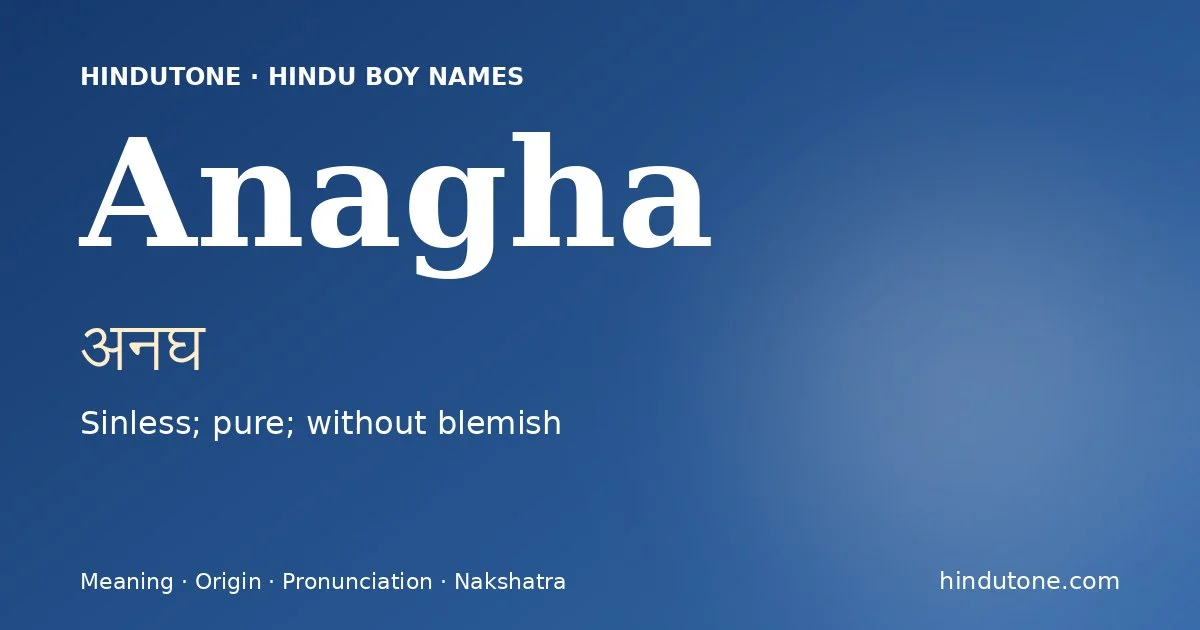
Anagha (अनघ) is a Sanskrit-origin Hindu boy-name meaning “Sinless; pure; without blemish”. Find pronunciation, origin, deity association, popularity and similar Hindu baby names.
Anagha (अनघ) is a Sanskrit-origin Hindu boy-name meaning “Sinless; pure; without blemish”. Find pronunciation, origin, deity association, popularity and similar Hindu baby names.
Anagha (अनघ, IAST: Anagha) is an Sanskrit-origin Hindu boy-name meaning “Sinless; pure; without blemish”. From the negative prefix an- and agha (sin, stain, evil), Anagha declares Viṣṇu to be the one utterly untouched by any impurity, whose very nature is absolute moral and spiritual purity.
Meaning, etymology & significance
Agha in Sanskrit denotes sin, transgression, or the accumulated spiritual weight of wrong action; the negating prefix an- transforms the word into a declaration of pristine holiness. As Anagha, Viṣṇu is not merely forgiven or purified but constitutionally incapable of contact with sin — He is its antithesis and ultimate destroyer. The name is also used as an address in the Mahābhārata, where great sages and divine beings address heroes and gods as Anagha to honour their purity.
Anagha is used as a given name for both boys and girls across India, celebrated for its short, clear sound and its powerful spiritual meaning; it also appears in the Viṣṇu Sahasranāma and other great hymns. Pronounced ah-NAH-ghah.
Scriptural source
Anagha appears in the Vishnu Sahasranama, among the sacred names of Vishnu.
Astrology — nakshatra, rashi & numerology
By the standard Vedic correspondence between a name’s first syllable and the lunar mansion, Anagha aligns with the Krittika nakshatra, under the Mesha rashi (Moon sign). Its Chaldean name-number is 7.
Anagha — Name Facts
- Meaning
- Sinless; pure; without blemish
- Gender
- Hindu boy name
- Nakshatra
- Krittika
- Rashi
- Mesha (Aries)
- Numerology
- 7
Frequently asked questions
What does the name Anagha mean?
Anagha is a Sanskrit-origin Hindu boy name meaning “Sinless; pure; without blemish”.
Is Anagha a boy or girl name?
Anagha is traditionally a Hindu boy name.
Which nakshatra and rashi suit the name Anagha?
By the first-syllable rule of Vedic naming, Anagha aligns with the Krittika nakshatra, under the Mesha (Aries) rashi.
What is the numerology number of Anagha?
The Chaldean name number of Anagha is 7.
Explore more: Krittika nakshatra names · Mesha rashi names · Hindu boy names with A · All Hindu names A–Z