Narendra Modi Biography: Life, Journey & Vision
Narendra Modi biography — his life journey from Vadnagar tea-stall to PM, RSS years, Gujarat reforms, Hindu cultural revival, key achievements & vision.
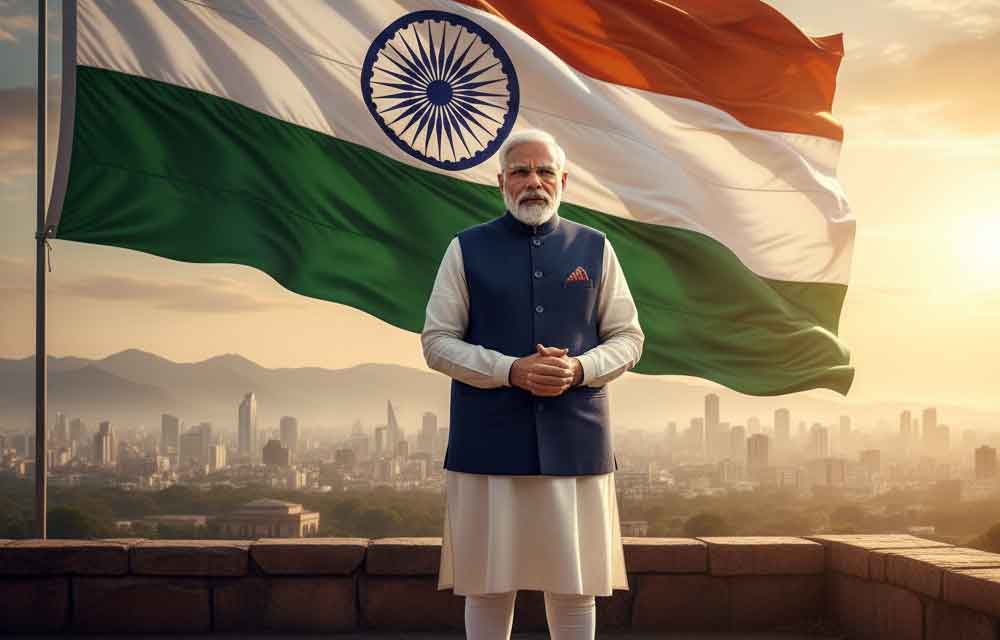
Narendra Modi biography — his life journey from Vadnagar tea-stall to PM, RSS years, Gujarat reforms, Hindu cultural revival, key achievements & vision.
Narendra Modi biography is the story of how a boy who once helped his father sell tea on a railway platform in a tiny Gujarat town rose to become the most influential Prime Minister of India in a generation. From Vadnagar to 7 Race Course Road, from a teenage Rashtriya Swayamsevak Sangh (RSS) volunteer to a four-time Chief Minister of Gujarat and a three-term Prime Minister, his life is a study in discipline, dharma and decisive action. Whether you admire his economic reforms, his work on the Ayodhya Ram Mandir, the launch of International Yoga Day, or the cultural renaissance that has accompanied his tenure, you cannot understand modern India without understanding him. This in-depth profile traces every major chapter — early life, RSS pracharak years, Gujarat Chief Minister tenure, three Lok Sabha victories, signature welfare schemes, foreign-policy doctrine, personal spiritual practices, and the enduring legacy he is building for Sanatan Dharma and modern India.
Early Life and Family Background
Narendra Damodardas Modi was born on 17 September 1950 in Vadnagar, a small town in the Mehsana district of Gujarat. His father, Damodardas Mulchand Modi, ran a modest tea stall at the Vadnagar railway station; his mother, Heeraben Modi, was a homemaker who lived to over a hundred years. Narendra was the third of six children in a Ghanchi family — a traditional oil-pressing community classified as Other Backward Classes.
A childhood of austerity
The Modi household lived in a small one-room home with mud walls. Narendra and his brother Prahlad helped at the tea stall before and after school. Schoolmates and teachers later recalled his voracious reading habit, a strong interest in public speaking, and an early connection to the river Sharmishtha and the local Hatkeshwar Mahadev temple.
The young swayamsevak
At eight, Modi began attending RSS shakhas in Vadnagar where Lakshmanrao Inamdar (whom Modi called his political guru) introduced him to the philosophy of seva, sangathan and dharma. By his late teens he had left home for the Himalayas, spending nearly two years travelling between Rishikesh, Belur Math, the Ramakrishna Mission ashrams in Almora and Kolkata, and the Advaita Ashrama at Mayavati — an immersive exposure to the teachings of Swami Vivekananda that shaped him for life.
The RSS Years: Foundation of a Public Life
Modi returned to Gujarat in 1971 and became a full-time RSS pracharak under Inamdar. The decade that followed was one of relentless travel by motorcycle and bus across rural Gujarat, organising shakhas, training cadre, and during the 1975–77 Emergency, working underground to print and distribute opposition literature in disguise.
In 1985 the RSS deputed Modi to the BJP, where he served as the party's Gujarat unit organising secretary. He played a key behind-the-scenes role in two events that defined Indian politics — L. K. Advani's Somnath-to-Ayodhya Rath Yatra (1990) and Murli Manohar Joshi's Ekta Yatra to Srinagar (1991–92).
Education on the move
Through his pracharak years Modi completed an MA in Political Science from Gujarat University as an external student. He has since spoken often of his disciplined pre-dawn routine — yoga, pranayama, and the reading of the Bhagavad Gita and Vivekananda's collected works — that he says he developed in this period.
Chief Minister of Gujarat (2001–2014)
On 7 October 2001, following the Bhuj earthquake recovery and a leadership change, Modi was sworn in as Chief Minister of Gujarat. He went on to win four consecutive Assembly elections (2002, 2007, 2012 and an interim 2002 by-poll from Maninagar), making him one of the longest-serving CMs of any Indian state.
The "Gujarat Model"
24-hour electricity to every village through the Jyotigram Yojana — a first in India for an entire state.
Vibrant Gujarat Global Summit (launched 2003) — biennial investment summit that has attracted lakhs of crores in MoUs.
Sardar Sarovar Dam completion and the Narmada canal network reaching 18,000 villages.
Solar parks — the Charanka Solar Park became Asia's largest at the time of inauguration.
Statue of Unity to Sardar Vallabhbhai Patel — the world's tallest statue at 182 m, dedicated in 2018.
Controversies and clearance
The 2002 Gujarat riots remain the most contested chapter of his CM tenure. After multiple investigations spanning over a decade, the Special Investigation Team appointed by the Supreme Court in 2012 found no prosecutable evidence against Modi. The Supreme Court of India upheld the SIT's clean chit in June 2022, closing the legal chapter.
Prime Minister of India (2014, 2019, 2024)
In May 2014 the BJP won an absolute Lok Sabha majority — the first single-party majority since 1984 — and Modi was sworn in as the 14th Prime Minister of India on 26 May 2014. He repeated the feat in 2019 with an even larger mandate (303 seats) and returned for a third term in 2024 leading the NDA coalition. His core PM agenda has rested on six pillars:
Sabka Saath, Sabka Vikas, Sabka Vishwas, Sabka Prayas — inclusive growth.
Aatmanirbhar Bharat — self-reliant manufacturing, defence and pharmaceuticals.
Welfare delivery via Direct Benefit Transfer and the JAM trinity (Jan Dhan, Aadhaar, Mobile).
Cultural and civilisational revival — Ayodhya, Kashi Vishwanath corridor, Mahakal Lok, Char Dham road.
Foreign policy upgrade — G20 presidency, Quad, IMEC, neighbourhood-first.
Climate leadership — International Solar Alliance, LiFE Mission, Mission Green Hydrogen.
Signature Achievements
Welfare schemes that touched a billion lives
Pradhan Mantri Jan Dhan Yojana — 50+ crore zero-balance bank accounts.
AdvertisementUjjwala Yojana — 10+ crore free LPG connections to BPL households.
Swachh Bharat Abhiyan — India declared Open Defecation Free in 2019.
Ayushman Bharat — world's largest health-insurance scheme, ₹5 lakh free cover for 50+ crore people.
PM-Kisan Samman Nidhi — ₹6,000/year to 11+ crore farmers.
PM Awas Yojana — 4+ crore pucca houses for the poor.
Cultural and civilisational milestones
Ayodhya Sri Ram Janmabhoomi Mandir — consecrated by PM Modi on 22 January 2024 after a 500-year struggle.
Kashi Vishwanath Dham Corridor — inaugurated December 2021, restoring Varanasi's sacred geography.
Mahakal Lok, Ujjain — inaugurated October 2022.
Article 370 abrogation (August 2019) — full integration of Jammu & Kashmir.
CAA, Triple Talaq, Waqf reform — legislative reforms long pending.
International Day of Yoga — UN-recognised on 11 December 2014 after Modi's call at the UNGA; first observed 21 June 2015 with 192 nations.
Foreign Policy Doctrine
Modi has been the most-travelled Prime Minister in Indian history, visiting over 70 countries. Key doctrinal shifts include the "neighbourhood first" policy, the "Act East" upgrade of "Look East", the embrace of the Indo-Pacific Quad with the US, Japan and Australia, and the conceptualisation of IMEC (India–Middle East–Europe Economic Corridor) as a counter to the Belt-and-Road. India's G20 Presidency in 2023 produced the New Delhi Declaration and the inclusion of the African Union as a permanent member.
Personal Life and Daily Practice
Vegetarian — follows a strict satvik vegetarian diet, has often spoken about taking only one meal a day during Navratri and Chaturmas.
Yoga — a documented 4 a.m. start, with pranayama (Anulom-Vilom, Kapalbhati) and asanas before work.
Reads voraciously — biographies, the Bhagavad Gita and Swami Vivekananda's Complete Works.
Celibate sannyasi-householder — while technically married in his teens to Jashodaben in an arrangement his family had made, he chose the path of a pracharak and the marriage was never lived out.
Sleeps 4–5 hours — a habit he says was set in his pracharak years.
Famous Quotes by Narendra Modi
"Yoga is an invaluable gift of India's ancient tradition. It embodies unity of mind and body, thought and action." — Address to the UN General Assembly, 27 September 2014.
"India's growth is incomplete without the growth of every Indian." — Independence Day Address from the Red Fort, 15 August 2019.
"Sabka Saath, Sabka Vikas, Sabka Vishwas, Sabka Prayas." — Governance mantra, articulated repeatedly from 2014 onward.
"Five hundred years of waiting are over. Today, on this auspicious day, every Indian is filled with pride." — Pran Pratishtha address, Ayodhya, 22 January 2024.
Interesting Facts and Lesser-Known Stories
At 17, he travelled alone to the Himalayas with a small bag and almost no money, spending months at the Belur Math ashram.
His Twitter/X handle is one of the most-followed of any world leader, crossing 100 million.
He keeps no personal house — his entire savings have been donated to the Kanya Kelavani campaign for girl-child education.
He has a Master's in Political Science but never sat in a regular college classroom — both his BA and MA were external degrees.
He is a published author of poetry in Gujarati (Aankh Aa Dhanya Chhe) and a children's book (Exam Warriors).
His favourite Bhagavad Gita verse, often cited, is from chapter 18 — "yatra yogeshvarah krishno…" — on victory through the union of action and dharma.
Legacy and Impact on Hinduism, India and the World
Whatever side of the political spectrum a reader sits on, Modi's impact on three dimensions of contemporary India is undeniable. First, the cultural confidence that ordinary Hindus now express about their festivals, their temples and their identity is dramatically different from the apologetic posture of the previous generation. Second, the digital welfare-state he built (Aadhaar-DBT-UPI stack) has been studied and emulated from Africa to Latin America. Third, India's global voice — through the G20 presidency, the African Union's induction, the International Solar Alliance, the Voice of the Global South Summit, and the IMEC corridor — has decisively moved from "third world" to "leading power".
For Sanatan Dharma specifically, his tenure has overseen the consecration of the Ayodhya Ram Mandir, the Kashi Vishwanath corridor, the Mahakal Lok, the rejuvenation of Char Dham roads, the renaming of historical places to their original Sanskrit names (Allahabad → Prayagraj, etc.), the institutionalisation of the International Day of Yoga, and a generational shift in how a Hindu majority-but-secular nation thinks of its civilisational continuity.
Conclusion: The Tea-Seller Who Changed a Civilisation
The full Narendra Modi life and teachings arc — from a child carrying a wooden trunk of tea to chai-loving railway commuters in Vadnagar, to a Prime Minister addressing the United Nations on Yoga and dharma — is a uniquely Hindu story of karma yoga. It demonstrates that with discipline, sankalpa and seva, an ordinary person rooted in Sanatana values can reshape an entire civilisation. Whether or not history records him as transformative, the next generation of Indian leaders, entrepreneurs, and devotees will all measure themselves against the bar he has set.
Share this article with your family and friends if you found it inspiring — and explore our companion biographies on Swami Vivekananda and Chanakya to see the deeper civilisational lineage Modi often draws from.
Frequently Asked Questions
When and where was Narendra Modi born?
Narendra Damodardas Modi was born on 17 September 1950 in Vadnagar, Mehsana district, Gujarat.
What is Narendra Modi's educational qualification?
He holds an MA in Political Science from Gujarat University, completed as an external student. He also holds a BA in Political Science from Delhi University by correspondence.
When did Narendra Modi become Prime Minister of India?
He was sworn in as the 14th Prime Minister of India on 26 May 2014 after the BJP's historic Lok Sabha majority. He was re-elected in 2019 and 2024.
What was Modi's connection to Swami Vivekananda?
At 17, Modi spent nearly two years travelling between the Ramakrishna Mission ashrams in the Himalayas — Belur Math, Almora and Mayavati. He cites Vivekananda's teachings as the deepest influence of his life.
Is Narendra Modi married?
Yes, an arranged marriage in his teens to Jashodaben Modi was solemnised but never lived out, as he had already chosen the path of a full-time RSS pracharak. He has lived as a renunciant ever since.
What is the role Modi played in the Ayodhya Ram Mandir?
As Prime Minister he attended the bhumi pujan in August 2020 and consecrated the temple in the historic Pran Pratishtha ceremony on 22 January 2024 — the formal end of a 500-year struggle.
Has Narendra Modi written any books?
Yes — among others, Exam Warriors (a guide for students), the Gujarati poetry collection Aankh Aa Dhanya Chhe, and several compilations of his speeches.
What is Narendra Modi's daily routine?
A documented 4 a.m. start with yoga and pranayama, only 4–5 hours of sleep, a strict vegetarian diet, and reading sessions late at night.
Explore HinduTone — May 2026 hub
Continue your reading across HinduTone's May 2026 publishing cluster — every post in this hub is interlinked for a complete devotional and informational journey.
🪔 Festivals & Vrats: Hindu Festivals in May 2026 — Complete Vrats & Puja Guide · Ganga Dussehra 2026 — Story, Muhurat & Home Vidhi · Adhik Maas 2026 — Purushottam Maas Dates & Rules.
🌟 Vedic Horoscopes: May 2026 Monthly Horoscope — All 12 Rashis · Weekly Horoscope May 11–17, 2026 · Weekly Horoscope May 18–24, 2026.
👤 Famous Hindus — Biographies: Swami Vivekananda Biography · Sadhguru Biography — Jaggi Vasudev · Mata Amritanandamayi (Amma) Biography.
🕉️ Powerful Mantras: Gayatri Mantra — Meaning, Benefits & Chanting · Om Namah Shivaya — Meaning & Power · Mahamrityunjaya Mantra — Healing Mantra · Hare Krishna Maha Mantra.