
30-Day Powerful Hindu Mantra Schedule for Career Success, Salary Hike, and Job Security
In today’s competitive professional world, aligning spiritual energies can help you attract opportunities, overcome obstacles, secure projects, achieve salary…
In today’s competitive professional world, aligning spiritual energies can help you attract opportunities, overcome obstacles, secure projects, achieve salary…
In today’s competitive professional world, aligning spiritual energies can help you attract opportunities, overcome obstacles, secure projects, achieve salary hikes, and protect your career from layoffs. This 30-day mantra schedule combines powerful Hindu mantras with daily routines to maximize career growth and stability.
How to Use This Schedule
- Time: Early morning (Brahma Muhurta) is ideal. Evening chanting is optional.
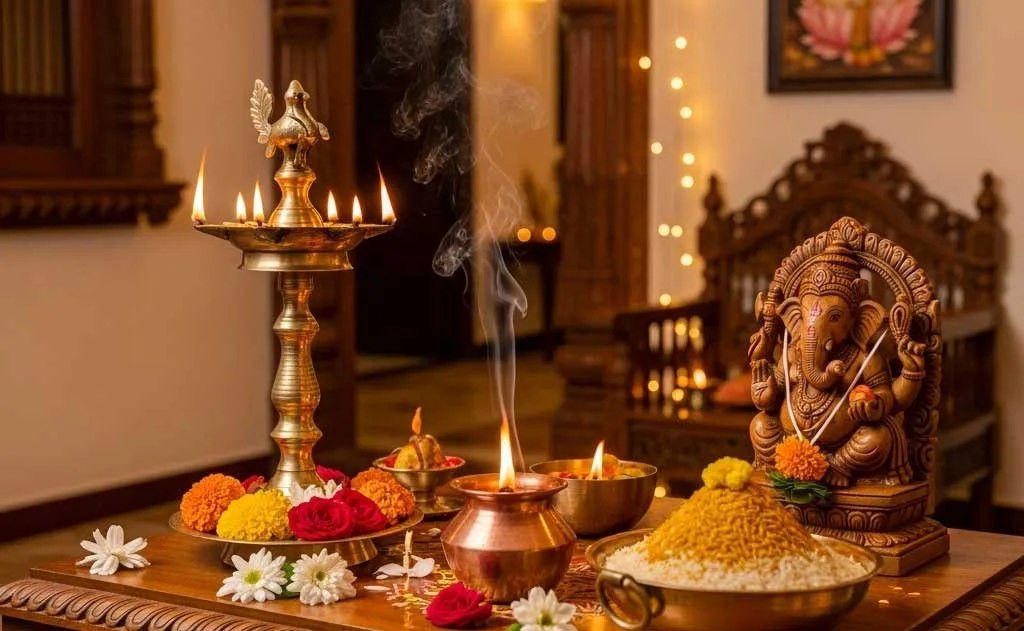
- Method: Sit in a clean, quiet place. Light a lamp or incense if possible.
- Focus: Visualize your goal—project acquisition, salary hike, promotion, or job security.
- Repetition: Chant each mantra 108 times for maximum effect. You can use a mala (prayer beads) to keep count.
- Consistency: Repeat daily without breaks for the full 30 days.
Daily Mantra Schedule
Day 1-5: Removing Obstacles & Starting Fresh
- Morning:
Ganesh Mantra – Om Gam Ganapataye Namaha
Purpose: Remove obstacles and ensure smooth progress. - Evening:
Maha Mrityunjaya Mantra – Om Tryambakam Yajamahe…
Purpose: Protection, courage, and stability.
Day 6-10: Attracting Projects & Opportunities
- Morning:
Saraswati Mantra – Om Aim Saraswatyai Namaha
Purpose: Enhance communication, creativity, and intelligence. - Evening:
Hanuman Mantra – Om Hanumate Namaha
Purpose: Courage and determination to take new projects.
Day 11-15: Financial Growth & Salary Hike
- Morning:
Mahalakshmi Mantra – Om Shreem Hreem Shreem Kamale Kamalalaye Praseedha Praseedha
Purpose: Attract abundance and financial growth. - Evening:
Kubera Gayatri Mantra – Om Yakshaya Kuberaya Vaishravanaya…
Purpose: Prosperity and wealth enhancement.
Day 16-20: Confidence & Career Recognition
- Morning:
Gayatri Mantra – Om Bhur Bhuvaḥ Swaḥ…
Purpose: Enhances clarity, focus, and decision-making. - Evening:
Lakshmi Ganesh Mantra Combo – Om Shreem Gam Saubhagya Lakshmi Ganapataye Namaha
Purpose: Remove obstacles and attract opportunities.
Day 21-25: Job Security & Protection
- Morning:
Durga Mantra – Om Dum Durgayei Namaha
Purpose: Strength, courage, and removal of adversities. - Evening:
Shree Ganesh Raksha Mantra – Om Gan Ganapataye Namaha
Purpose: Protection from sudden career obstacles or layoffs.
Day 26-30: Consolidating Career Success
- Morning:
Combination: Ganesh + Saraswati + Lakshmi Mantras
Purpose: Attract success, projects, and financial growth.
Example Chanting:
36 repetitions each, totaling 108 chants. - Evening:
Maha Mrityunjaya Mantra
Purpose: Maintain stability, confidence, and divine protection.
Additional Tips for Maximum Effect
- Visualization: See yourself achieving the goal while chanting.
- Cleanliness & Positivity: Keep the area tidy; avoid negative thoughts.
- Journaling: Note any positive changes in your work or opportunities.
- Faith & Patience: Spiritual practices work gradually; trust the process.
Conclusion
Following this 30-day mantra schedule with sincerity can bring positive transformation in your career, finances, and job stability. It not only enhances confidence and focus but also aligns your energies for long-term professional growth.
Why Brahma Muhurta Is the Most Potent Time for Career Mantras
Brahma Muhurta, literally 'the hour of Brahma,' falls approximately 96 minutes before sunrise — typically between 4:00 a.m. and 5:30 a.m. depending on the season and location. Ancient texts including the Ashtanga Hridayam and the Vishnu Purana specifically recommend this window for spiritual practice, noting that the mind is free from the day's sensory accumulation and the atmosphere carries heightened sattva (purity). For career-focused chanting, this sattvic quality helps intentions penetrate deeper into the subconscious mind.
The Taittiriya Aranyaka, part of the Krishna Yajurveda, describes the pre-dawn period as the juncture (sandhi) when divine energies are most accessible to sincere practitioners. Chanting Gayatri, Mahalakshmi, or Kubera mantras during this window is considered exponentially more effective than the same repetition performed mid-day. Even a single 108-count round at Brahma Muhurta is said in traditional commentaries to carry the cumulative merit of multiple rounds performed at ordinary times.
The Scriptural Roots of Each Deity's Connection to Career and Livelihood
Lord Ganesha's role as Vighnaharta (remover of obstacles) is firmly rooted in the Mudgala Purana and the Ganesha Purana, both of which narrate how no auspicious undertaking — business, education, or professional venture — should begin without his invocation. The bija mantra 'Gam,' embedded in 'Om Gam Ganapataye Namaha,' is described in tantric texts as the seed sound encoding Ganesha's power to clear karmic blocks that manifest as career stagnation.
Goddess Saraswati's link to professional excellence goes beyond simple 'creativity.' The Rigveda (VI.61) praises her as 'Sarasvati who illuminates all intellects,' and the Devi Bhagavata Purana states she governs buddhi (discernment), pratibha (spontaneous insight), and vak siddhi (power of speech) — all critical competencies in modern workplaces involving presentations, negotiations, and client communication.
Kubera, the divine treasurer of the gods, is not a minor figure: the Mahabharata (Sabha Parva) describes his city Alakapuri as the wealthiest realm in all creation, and the Atharvaveda contains hymns seeking his grace for material prosperity. His Gayatri mantra activates what classical texts call artha shakti — the specific energetic current governing acquisition of resources — making it especially suited to salary-hike and financial-growth intentions.
How to Set Up a Proper Mantra Space at Home Without Elaborate Resources
The Padma Purana and various Grihyasutras (domestic ritual manuals) agree that the sacred space matters more than its size or cost. A clean wooden plank or a simple mat facing east or north is sufficient. Place an image or small idol of the deity whose mantra you are chanting that day — this gives the mind a focal anchor, a practice called murti dhyana that sharpens visualization and reduces mental wandering during japa.
A single ghee lamp (deepa) is strongly preferred over electric lights because Agni (fire) is considered a living witness and purifier in Vedic tradition. If ghee is unavailable, sesame oil or coconut oil lamps are traditional alternatives mentioned in the Grihyasutras. Adding a small stick of frankincense (loban) or sandalwood incense helps transition the nervous system into a parasympathetic state conducive to deep chanting. Keep the space reserved exclusively for this 30-day practice — daily use charges the space with accumulated sankalpa (intention) energy.
Before beginning each session, perform a simple achamana (sipping of water three times while chanting 'Om Keshavaya Namaha,' 'Om Narayanaya Namaha,' 'Om Madhavaya Namaha') to purify the body and mind. This micro-ritual, prescribed in the Dharmasindhु and similar smriti texts, signals to the subconscious that you are shifting from mundane to sacred time.
The Role of Sankalpa: Setting a Specific Career Intention Before Each Session
Sankalpa — a sacred resolve or intention — is not a vague wish but a precisely worded declaration made before the japa begins. Traditional sankalpa formulas begin with time, place, and the practitioner's lineage, but for a personal 30-day sadhana the essential element is a clear, present-tense statement of your career goal: 'I am performing this japa for promotion to [specific role] / a salary increase of [specific amount] / job security in my current position.' The Taittiriya Upanishad (3.10.5) states, 'Satyam eva jayate' — truth (precise intention) alone prevails.
Neuroscience broadly supports what Vedic rishis observed intuitively: a focused intention stated before rhythmic repetition primes the reticular activating system to notice aligned opportunities in the environment. In spiritual terms, the mantra's sound frequency and the sankalpa together form a kavacha (protective and directive shield) around your professional life. Write your sankalpa on paper and place it beneath the deity's image for the full 30 days to reinforce it visually each morning.
Key Temples in India Where These Career Mantras Carry Amplified Shakti
Pilgrimage to a presiding deity's principal temple is not mandatory for this schedule, but even a one-time visit during or after the 30 days significantly amplifies the sadhana's results according to the Skanda Purana's Tirtha Mahatmya sections. For Ganesha mantra practitioners, Shri Siddhivinayak Temple in Prabhadevi, Mumbai, and Shri Ashtavinayaka Ganesha temples across Maharashtra are considered the most potent; the presiding deity here is specifically Siddhi Vinayaka, the Ganesha who grants worldly accomplishments.
Devotees focusing on the Mahalakshmi mantra for financial growth revere Shri Mahalakshmi Temple in Kolhapur (Maharashtra) and Padmanabhaswamy Temple in Thiruvananthapuram (Kerala) as pre-eminent seats of Lakshmi's artha-bestowing grace. For Kubera's Gayatri, Shri Kubera temple in Srimushnam (Tamil Nadu) and the Kubera shrine within the Tirumala Venkateswara Temple complex in Tirupati are traditionally associated with business blessings. A visit to any of these temples with your written sankalpa in hand is considered a powerful concluding ritual for the 30-day practice.
What to Do After Day 30: Sustaining Career Momentum Through Ongoing Practice
The completion of a 30-day mantra sadhana is called purascharana in tantric tradition — a foundational cycle that 'charges' the mantra within the practitioner's energy body. On Day 31, perform a small homa (fire offering) if accessible, or simply offer sesame seeds mixed with ghee into an oil lamp while chanting the mantra 11 times as a concluding ahuti (oblation). This closes the formal cycle with gratitude (kritajnata), which classical texts identify as the quality that keeps the channel of divine grace open.
After the 30-day cycle, maintain the mantra's potency by continuing a reduced daily practice: 27 repetitions (one quarter of a mala) every morning of your primary deity's mantra — chosen based on which phase of the schedule yielded the strongest results for you. The Narada Bhakti Sutras remind practitioners that continuity of devotional effort, even in small measure, surpasses intensity without consistency. Over months, this minimal-maintenance practice builds an invisible but durable karmic infrastructure around your professional life.
Finally, acknowledge visible results — an email, a new project, a salary conversation — as prasad (grace received) rather than coincidence. Recording these in a dedicated journal builds what yogic psychology calls dridha vishwasa (firm faith), which in turn deepens the efficacy of all future mantra practice. Many practitioners repeat the full 30-day cycle at the start of a new financial year, before a job interview, or at the onset of a new career phase.
Frequently Asked Questions
What is the 30?
In today’s competitive professional world, aligning spiritual energies can help you attract opportunities, overcome obstacles, secure projects, achieve salary hikes, and protect your career from layoffs. This 30-day mantra schedule combines powerful Hindu mantras with daily routines to maximize career growth and stability.
How many times should the 30 be chanted?
It is traditionally chanted 108 times using a rudraksha or tulsi mala. Even 11 or 21 sincere repetitions daily are considered beneficial — steady, focused practice matters more than the count.
What is the best time to chant the 30?
Dawn (Brahma Muhurta) after a bath is considered ideal, though it may be chanted any time with a calm, focused mind. Many devotees keep a fixed daily time to build consistency.
Who can chant the 30?
Anyone may chant it with faith and a pure mind, regardless of age, gender or background. Beginners benefit from first hearing the correct pronunciation and understanding its meaning.
What are the benefits of chanting the 30?
It is believed to calm the mind, dissolve negativity, and draw divine grace, protection and clarity to the devotee.
You might also like
Powerful Mantras for Students & Parents Before Joining School
Powerful Hindu Mantras for Purushottam Maas 2026: Vishnu Bhakti, Chanting Guide & Global Devotion
Shani Jayanti 2026: Date, Significance, Rituals & Powerful Mantras